
← Back to Class 9 Social Science Notes
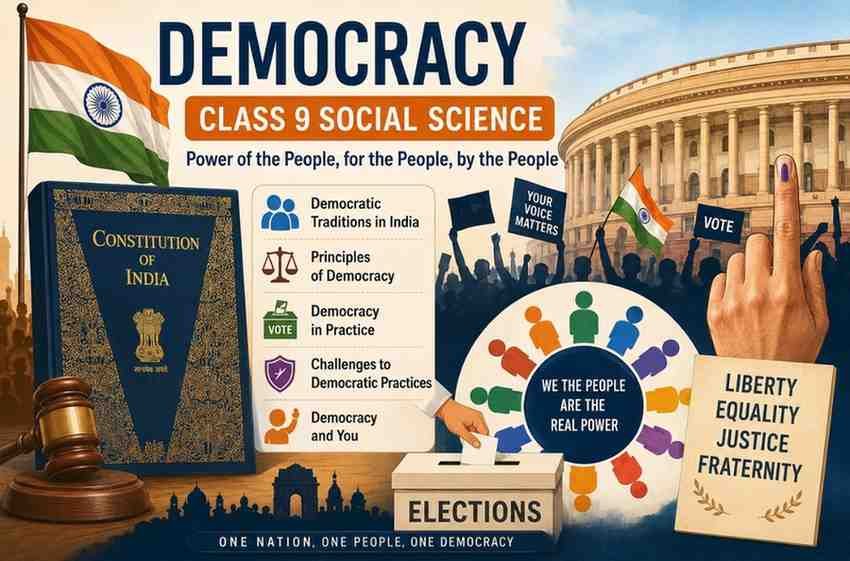
Democracy Class 9 Notes provide simple and easy-to-understand explanations of all the important topics from the latest CBSE Class 9 Social Science syllabus. These notes cover the meaning and principles of democracy, democratic traditions in India, the Constitution, Fundamental Rights, democracy in practice, challenges to democracy, and the role of responsible citizens.
Democracy class 9 notes
India is the largest democracy in the world; the population of India is more than 140 crore, and there are more than 96.8 crore voters in 2024. In democracy, people choose their government by voting for their representative. The Constitution of India guides and protects democracy. The Constitution of India was adopted on 26 November 1949 and came into force on 26 January 1950. The constitution guarantees fundamental rights and ensures equality for all citizens.

Tracing Democratic Traditions from Early Times
Democracy has been a part of India from ancient times. In the Vedic period, Sabha, Samiti and Vidhata help the people to make important decisions together. That time kings do not rule alone; they take advice from assemblies and ministers. The Bauddha Samghas made decisions through discussion and voting.
During British rule, people had little participation, but the freedom struggle strengthened democratic values. In 1946, the Constituent Assembly was formed and drafted the Constitution in 2 years, 11 months, and 18 days. The Constitution protects liberty, equality, justice, and fraternity. Under Article 368, Parliament can amend the Constitution to keep it flexible and updated.

Principles of Democracy
A successful democracy is based on important principles that ensure freedom, equality, justice, and people’s participation. In India, these principles are protected by the Constitution of India.
Popular Sovereignty: The people are the real source of power in a democracy. Citizens 18 years and above can vote in free and fair elections through the universal adult franchise.
- Rule of Law: Everyone is equal before the law, and no one is above the law. Laws protect the rights of all citizens.
- Fundamental Rights: The Constitution gives six fundamental rights to protect the freedom, equality, and dignity of every citizen.
- Separation of Powers: The government has three organs. Legislature – helps to make laws; Executive – helps to implement laws; and Judiciary – helps to interpret laws. This prevents the misuse of power.
- Accountability and Transparency: The government is answerable to the people. Citizens can get government information through the Right to Information (RTI) Act, 2005.
- Multi-Party System: Many political parties contest elections, giving people different choices. The party (or coalition) with the majority of seats forms the government.
- Safeguarding the Rights of Vulnerable Groups: The government protects the rights of weaker and disadvantaged sections of society and works for equal opportunities.
Democracy in Practice: India’s Living Democracy
India is the world’s largest democracy with nearby 100 crore voters. People from different languages, religions and cultures take part in elections.
India has a three-tier government: union, state, and local.
The Constitution protects tribal rights through Autonomous District Councils (ADCs) and the PESA Act, 1996.
Civil society organisations, cooperatives, trade unions, and public interest litigation (PIL) help strengthen democracy and connect people with the government.
Challenges to Democratic Practices in India
Democracy needs care, awareness, and active participation. The Constitution gives rights, but citizens must use them responsibly. Actions like damaging public property, spreading fake news, or ignoring public issues weaken democracy.
India faces challenges such as illiteracy, poverty, inequality, regionalism, gender discrimination, and social discrimination. The spread of misinformation, especially on social media, is a major problem, as it can mislead people and create conflict.
Weakness in the implementation of laws and policies reduces trust in institutions. These challenges show that democracy is not just about elections but also about responsible behaviour and civic duty in everyday life.
Democracy and You
Democracy works best when citizens are well‑informed and responsible. Young citizens should read newspapers, watch news, and use the internet carefully to stay aware of events. Programmes like NSS and NCC teach civic duty, teamwork, and service to the nation.
Democracy is not only about elections but also about everyday participation and responsibility. India’s democracy is strong because of its scale, diversity, and resilience. It functions through elections, constitutional values, and civic practices. Challenges exist, but active and informed citizens keep democracy vibrant.
Disclaimer: The content that is present on our website is based on the NCERT Class 9 Social Science textbook and is provided for educational purposes only. All the content and images have been taken from Social Science Class 9 NCERT Textbook and CBSE Support material. Images and content shown above are the property of individual organizations and are used here for reference purposes only. To make it easy to understand, some of the content and images are generated by AI and cross-checked by the teachers.