
← Back to Class 9 Social Science Notes
Building Blocks in Economics: The Problem of Choice Class 9 Notes provide simple and easy-to-understand explanations of all the important concepts from the latest CBSE Class 9 Social Science syllabus. These notes cover the problem of choice, limited resources, opportunity cost, Production Possibility Curve (PPC), key economic questions, economic systems, and factors of production in exam-ready language for quick revision.
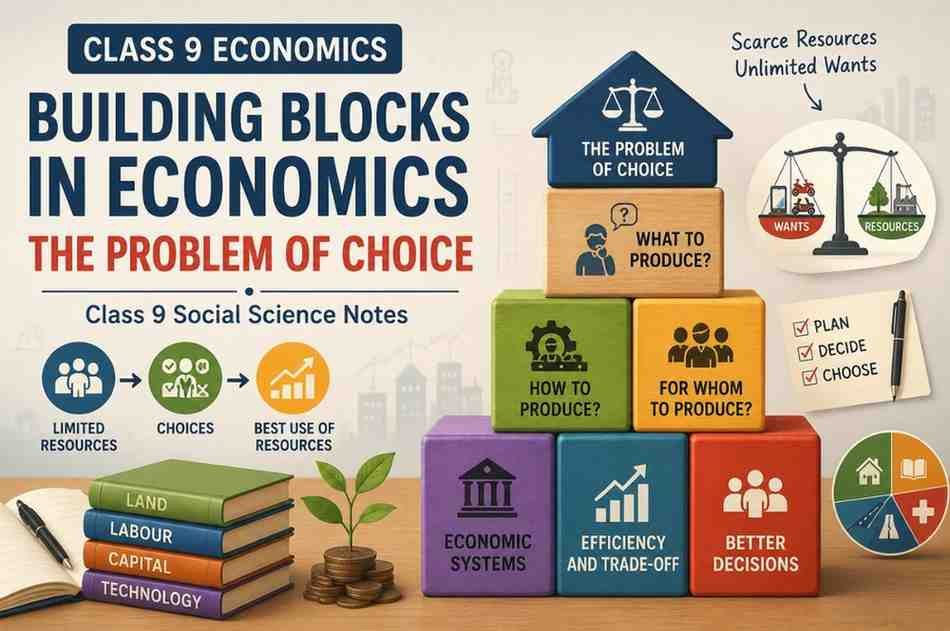
Building Blocks in Economics the Problem of Choice Class 9 Notes
Economics is a study of how people make choices when resources are limited. In everyday life, people, businesses and government make economic decisions. For example,
- Buy snacks or save money for shoes.
- Decide who gets a new library book first.
- A farmer chooses which crop to grow.
- A business decides how to produce goods.
- The government decides whether to spend more on roads or hospitals.
Choices and Limited Resources
People need resources like land, labour, capital and technology to make goods and services. But these resources are limited; we must make choices about how to use resources. For example, money can be used to buy fruit or shoes. Steel can be used to make cars or bridges.
Imagine a farmer has land and can grow barley or wheat. If the farmer grows more barley, they must grow less wheat. This trade‑off is shown by the production possibility curve (PPC). The PPC shows the maximum output possible when resources are used efficiently without waste.
What does economics deal with?
The word ‘economics’ comes from the Greek word ‘oikonomia’, which means ‘household management’. Economics studies explain how individuals, businesses and governments make choices to use resources in the best way. It explains
- How people work and earn
- How prices are decided in markets
- How resources and wealth are shared
- How government policies, trade, education, and technology affect jobs and investments.
Good economic decisions are based on data and analysis, not guesswork. For example:
- Families divide money between essentials (food, medicines, and school supplies), non‑essentials (entertainment and jewellery), and savings.
- Governments use tax money for roads, hospitals, and welfare programmes.
- Enterprises study market trends and innovations to serve customers and earn profits.
Economists look at alternatives, opportunity costs, and outcomes to guide better decisions. They use information from economic surveys, financial reports, and data analysis to understand risks and opportunities.
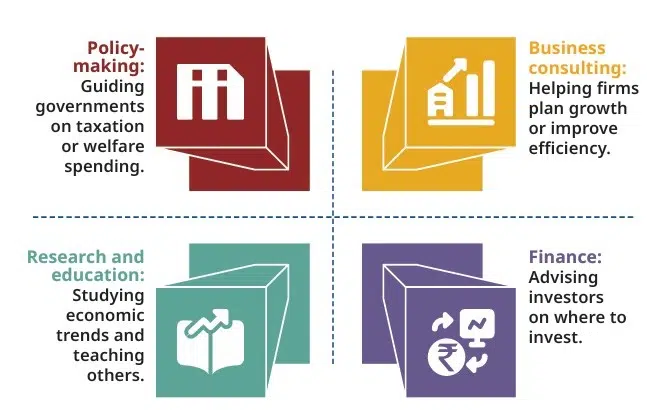
Key Questions in Economics
Any mismatch between unlimited wants and limited resources gives rise to three key questions that the discipline of economics seeks to address.
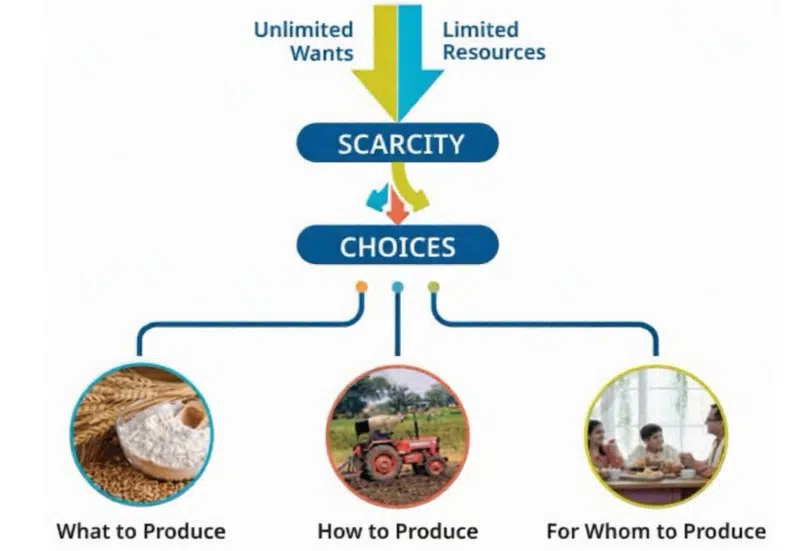
What to Produce and for Whom?
Economics asks two big questions. What to produce and for whom to produce.
What to produce?
This means that what goods and services should be made and in what quantity. Example: Should farmers grow sugarcane or millets? Choosing one means giving up the other. The value of the option given up is called the opportunity cost.
For whom to produce?
This means deciding who will use the goods. People have different needs, different income levels and lifestyles, so the producers make goods for different groups. Before making goods, producers study demand, tastes, and purchasing power.
How to Produce?
After deciding what to produce, the next question came: “How to produce it?” The producers choose the best method, resources and technology to make goods. They use the factors of production—land, labour, capital, and technology. Production can be:
- Labour‑intensive: more workers, fewer machines (example: farming, handicrafts).
- Capital‑intensive: more machines, fewer workers (example: steel, automobile industry).
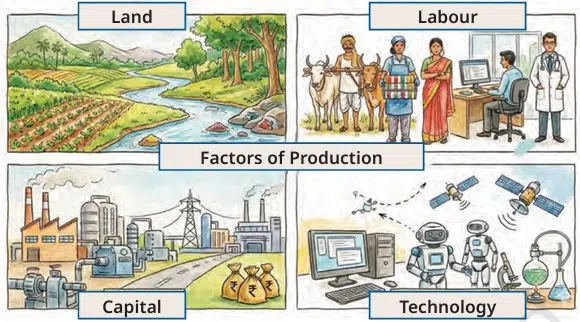
The choice depends on the cost of machines, availability of workers, technology, type of product, and government rules. Producers choose the method that reduces cost, increases production, and uses resources efficiently.
Economic Systems and How Choices are Made
An economic system means the way a country decides what to produce, how to produce, and for whom to produce. It shows how resources are used and who controls decisions.
There are three main types of economic systems:
1. Planned Economy
The government makes all the major decisions. It decides what, how, and for whom to produce. Most resources and industries are owned by the government. There is less competition and fewer private businesses. Example: Former Soviet Union, North Korea, Cuba.
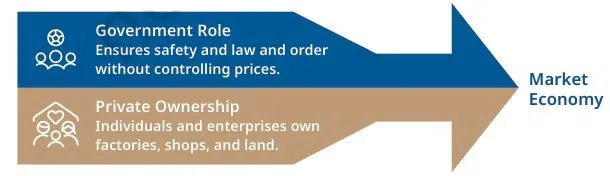
2. Market Economy
The decision is made based on demand and supply. The resources owned by individuals and private companies. There is more competition, better quality, and innovation. Examples: United States, Japan, Hong Kong.
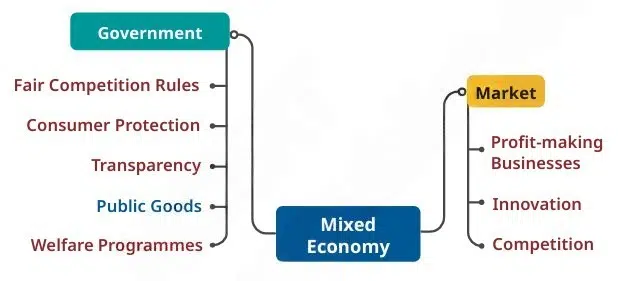
3. Mixed Economy
Both the government and private businesses share economic decisions. It combines the features of planned and market economies. The government regulates important sectors while private businesses also operate freely. Examples: India, China, Germany, Sweden.
Disclaimer: The content that is present on our website is based on the NCERT Class 9 Social Science textbook and is provided for educational purposes only. All the content and images have been taken from Social Science Class 9 NCERT Textbook and CBSE Support material. Images and content shown above are the property of individual organizations and are used here for reference purposes only. To make it easy to understand, some of the content and images are generated by AI and cross-checked by the teachers.
best notes and easy notes
30/9/26
thank you for this notes
Very good notes
very useful as term exams are coming
So easy to understand 🙂🙂🙂
Thank u so much it is very helpful for us. 🥰🎀
Bruh this is much easy to read and understand
this is very useful and these are made topic by topic to make it easier to understand
I like it very much