
← Back to Class 9 Social Science MCQs
State and Society Up to 1000 CE Class 9 with these carefully prepared MCQs based on the latest CBSE Class 9 Social Science syllabus. These multiple-choice questions cover important topics such as the Mahajanapadas, Mauryan Empire, Gupta Empire, Harshavardhana, administration, society, economy, religion, trade, art, culture, and major historical developments up to 1000 CE.
Conceptual Recall MCQs
Q1. Which is the earliest literary source of early Indian history?
a) Mahābhārata
b) Ṛigveda
c) Rāmāyaṇa
d) Manusmṛiti
Answer: b) Ṛigveda
Q2. What does the term “jana” in the Rigvedic period refer to?
a) Territory-based kingdom
b) Kin-based social group
c) Village settlement
d) Empire
Answer: b) Kin-based social group
Q3. Which Veda is considered the earliest and contains 1,028 hymns?
a) Yajurveda
b) Sāmaveda
c) Atharvaveda
d) Ṛigveda
Answer: d) Ṛigveda
Q4. What does the term “society” mainly refer to in early India?
a) A political system based on laws
b) A system of social relationships, customs, and practices
c) A military organization
d) A trade network
Answer: b) A system of social relationships, customs, and practices
Q5. Which five clans are collectively referred to as “pañchajana” in the Rigveda?
a) Bharata, Magadha, Kosala, Anga, Avanti
b) Yadu, Turvaśha, Puru, Anu, and Druhyu.
c) Chera, Chola, Pandya, Matsya, Kuru
d) Maurya, Gupta, Satavahana, Kushana, Chola
Answer: b) Yadu, Turvaśha, Puru, Anu, and Druhyu.
Q6. What was the primary role of the rājā in the early Vedic period?
a) Tax collector
b) Clan chief leading warfare and protection
c) Religious priest
d) Trader of grains
Answer: b) Clan chief leading warfare and protection
Q7. According to the Yajurveda, what was one of the king’s duties?
a) To collect taxes only
b) To judge the strong and weak impartially
c) To expand trade routes
d) To perform music rituals
Answer: b) To judge the strong and weak impartially
Q8. Which text is considered one of the earliest systematic treatises on statecraft?
a) Mahābhārata
b) Arthaśhāstra
c) Sangam literature
d) Upaniṣads
Answer: b) Arthaśhāstra
Q9. In the Satavāhana empire, what were the administrative divisions called?
a) Bhuktis
b) Āhāras
c) Mandalams
d) Valanāḍus
Answer: b) Āhāras
Q10. Who was the village headman in early Indian administration?
a) Pradeśhika
b) Grāmika
c) Amātya
d) Kumārāmātya
Answer: b) Grāmika
Q11. Which principle in Vedic thought emphasizes sameness and equality?
a) Dharma
b) Samatva
c) Ṛita
d) Artha
Answer: b) Samatva
Q12. What does the word “dharma” literally mean according to its Sanskrit root “dhri”?
a) Wealth
b) That which upholds beings
c) Ritual sacrifice
d) Political authority
Answer: b) That which upholds beings
Q13. In Vedic society, what was the smallest and most basic social unit?
a) Jana
b) Grāma
c) Kula (family)
d) Viśha
Answer: c) Kula (family)
Q14. Which of the following is not one of the four puruṣhārthas?
a) Dharma
b) Artha
c) Kāma
d) Yajña
Answer: d) Yajña
Q15. Which deities were praised as supreme in different hymns of the Vedas?
a) Only Viṣhṇu and Śhiva
b) Different deities associated with nature, like the sun, rain, fire, and dawn
c) Only Śhakti
d) Only Indra
Answer: b) Different deities associated with nature, like the sun, rain, fire, and dawn
Q16. Who were the twelve saint-poets of Tamil Bhakti literature who composed hymns in praise of Lord Vishnu?
a) Nāyanmārs
b) Āḻvārs
c) Sangam poets
d) Buddhist monks
Answer: b) Āḻvārs
Q17. What was the basic land tax during the Mauryan period?
a) One-fourth of the produce
b) One-sixth of the produce
c) One-tenth of the produce
d) Fixed cash payment
Answer: b) One-sixth of the produce
Q18. Which inscription records the construction of a dam on Sudarshana Lake by Puṣhyagupta, governor under Chandragupta Maurya?
a) Allahabad Pillar inscription
b) Junagadh inscription
c) Hathigumpha inscription
d) Uttaramerur inscription
Answer: b) Junagadh inscription
Q19. What were guilds (śreṇīs) in early India?
a) Military groups
b) Associations of traders, artisans, and merchants
c) Royal councils
d) Village assemblies
Answer: b) Associations of traders, artisans, and merchants
Q20. How many types of guilds are referred to in Jātaka literature?
a) Ten
b) Twelve
c) Eighteen
d) Twenty
Answer: c) Eighteen
Application-Based MCQs
Q21. If archaeologists find Painted Grey Ware (PGW), which period of Indian history are they studying?
a) Neolithic
b) Chalcolithic
c) Iron Age
d) Bronze Age
Answer: c) Iron Age
Q22. Why does our understanding of early Indian society become more detailed after 2000 BCE?
a) Because of cave paintings
b) Because of literary sources like the Ṛigveda
c) Because of foreign travelers’ accounts
d) Because of inscriptions only
Answer: b) Because of literary sources like the Rigveda
Q23. If historians want to study the earliest kin-based polities in India, which source should they consult?
a) Buddhist texts
b) Rigveda
c) Gupta inscriptions
d) Ashokan edicts
Answer: b) Rigveda
Q24. Why are Vedic texts regarded as foundational to Indian culture?
a) They were written in Sanskrit only.
b) They provide continuity of cultural practices and insights into society, polity, and religion.
c) They were the first texts to mention trade routes.
d) They describe only kings and wars.
Answer: b) They provide continuity of cultural practices and insights into society, polity, and religion.
Q25. If archaeologists find Northern Black Polished Ware (NBPW) in the middle Ganga region, what does it indicate?
a) Early Neolithic farming
b) Advanced material culture with iron tools and paddy cultivation
c) Bronze Age settlements
d) Sangam literature period
Answer: b) Advanced material culture with iron tools and paddy cultivation
Q26. Why did Magadha emerge as the most powerful mahājanapada?
a) It had strong rulers, fertile plains, and a strategic location.
b) It was closest to the sea.
c) It had the largest temples.
d) It was supported by Roman trade.
Answer: a) It had strong rulers, fertile plains, and a strategic location.
Q27. If a king failed to protect his subjects from robbery and disorder, which duty was he neglecting?
a) Ethical conduct
b) Justice and protection
c) Ritual yajñas
d) Trade expansion
Answer: b) Justice and protection
Q28. Why does the Arthaśāstra state that “one wheel does not move the carriage”?
a) To highlight the importance of warfare
b) To show that governance requires cooperation and administrative machinery
c) To explain the role of religion in politics
d) To describe the duties of farmers
Answer: b) To show that governance requires cooperation and administrative machinery
Q29. If a copper plate inscription mentions a district office with a chief banker, caravan trader, artisan, and revenue officer, which empire’s administration is being described?
a) Mauryan
b) Gupta
c) Pallava
d) Chola
Answer: b) Gupta
Q30. Why did the Pallavas grant tax-free land to villages called Brahmadeya?
a) To encourage trade
b) To support Brahmins and temples
c) To expand military control
d) To reward artisans
Answer: b) To support Brahmins and temples
Q31. If a ruler followed Aśhoka’s edicts, which of the following actions would he most likely promote?
a) Expanding military conquests
b) Non-violence and compassion
c) Strict hereditary occupations
d) Trade with foreign lands only
Answer: b) Non-violence and compassion
Q32. The Uttaramerur inscription required candidates for village assemblies to have “honest earnings” and be “pure of mind.” What does this reflect?
a) Importance of wealth in politics
b) Ethical principles guiding governance
c) Military strength of rulers
d) Ritual yajñas in villages
Answer: b) Ethical principles guiding governance
Q33. If a person is in the Gṛhastha āśrama, what stage of life are they in?
a) Studentship
b) Householder stage
c) Forest life
d) Renunciation
Answer: b) Householder stage
Q34. Why is artha (material well-being) considered desirable only when guided by dharma?
a) Because wealth must align with social welfare
b) Because wealth was forbidden in Vedic society
c) Because only kings could pursue wealth
d) Because wealth was considered sinful
Answer: a) Because wealth must align with social welfare.
Q35. If a student in early India studied grammar, logic, philosophy, and astronomy and also practiced yoga and meditation, where were they most likely educated?
a) Palace schools
b) Gurukula
c) Sangam assemblies
d) Buddhist monasteries only
Answer: b) Gurukula
Q36. Why was Bhakti considered accessible to all people?
a) It required elaborate rituals.
b) It offered a direct connection with gods without ritual restrictions, open to all classes and genders.
c) It was limited to kings and priests.
d) It was only for Brahmins.
Answer: b) It offered a direct connection with gods without ritual restrictions, open to all classes and genders.
Q37. If a ruler wanted to encourage cotton cultivation in the Deccan, which natural resource would he rely on?
a) Red soil
b) Black soil
c) Sandy soil
d) Alluvial soil
Answer: b) Black soil
Q38. Why were irrigation structures like dams and canals considered so important that their construction was recorded in inscriptions?
a) They were symbols of royal power.
b) They supported agriculture and ensured revenue for the state.
c) They were used for religious rituals.
d) They were built only for military defense.
Answer: b) They supported agriculture and ensured revenue for the state.
Q39. If a donation was deposited with a guild and interest was used to maintain Buddhist monasteries, which inscription records this practice?
a) Hathigumpha inscription
b) Nashik cave inscription
c) Allahabad pillar inscription
d) Junagadh inscription
Answer: b) Nashik cave inscription
Q40. Why did guilds regulate the quality of goods and fix prices?
a) To increase royal revenue
b) To protect artisans and consumers
c) To expand military power
d) To control foreign trade only
Answer: b) To protect artisans and consumers
Assertion–Reason MCQs
Q41. Assertion (A): The concept of chakravarti samrāṭ symbolized the idea of a pan-Indian monarch.
Reason (R): It was expressed through rituals like the aśvamedha yajña.
a) Both A and R are true, and R is the correct explanation of A.
b) Both A and R are true, but R is not the correct explanation of A.
c) A is true, but R is false.
d) A is false, but R is true.
Answer: a) Both A and R are true, and R is the correct explanation of A.
Q42. Assertion (A): The Rigveda was composed in the Sapta-Sindhu region.
Reason (R): This region included the Indus River, its five tributaries, and the Sarasvatī.
a) Both A and R are true, and R is the correct explanation of A.
b) Both A and R are true, but R is not the correct explanation of A.
c) A is true, but R is false.
d) A is false, but R is true.
Answer: a) Both A and R are true, and R is the correct explanation of A.
Q43. Assertion (A): The assemblies sabha, samiti, and vidhata played important roles in Vedic polity.
Reason (R): They allowed participation of people in discussions on justice, warfare, and political affairs.
a) Both A and R are true, and R is the correct explanation of A.
b) Both A and R are true, but R is not the correct explanation of A.
c) A is true, but R is false.
d) A is false, but R is true.
Answer: a) Both A and R are true, and R is the correct explanation of A.
Q44. Assertion (A): Kingship in early India was not always hereditary.
Reason (R): There are references to kings being elected or expelled.
a) Both A and R are true, and R is the correct explanation of A.
b) Both A and R are true, but R is not the correct explanation of A.
c) A is true, but R is false.
d) A is false, but R is true.
Answer: a) Both A and R are true, and R is the correct explanation of A.
Q45. Assertion (A): Village assemblies in the Chola empire were independent and self-reliant.
Reason (R): They managed revenue collection, irrigation, land management, and justice without depending on the central government.
a) Both A and R are true, and R is the correct explanation of A.
b) Both A and R are true, but R is not the correct explanation of A.
c) A is true, but R is false.
d) A is false, but R is true.
Answer: a) Both A and R are true, and R is the correct explanation of A.
Q46. Assertion (A): In early Vedic society, occupations were flexible and not strictly hereditary.
Reason (R): The Rigveda mentions families where members had different occupations.
a) Both A and R are true, and R is the correct explanation of A.
b) Both A and R are true, but R is not the correct explanation of A.
c) A is true, but R is false.
d) A is false, but R is true.
Answer: a) Both A and R are true, and R is the correct explanation of A.
Q47. Assertion (A): Women in the Vedic period held a high and respectful position.
Reason (R): They participated in scholarly learning, rituals, and even social gatherings like the sabha.
a) Both A and R are true, and R is the correct explanation of A.
b) Both A and R are true, but R is not the correct explanation of A.
c) A is true, but R is false.
d) A is false, but R is true.
Answer: a) Both A and R are true, and R is the correct explanation of A.
Q48. Assertion (A): The Bhakti tradition gained prominence in the Tamil region around the 6th century CE.
Reason (R): The Āḻvārs and Nāyanmārs composed devotional hymns in praise of Viṣhṇu and Śhiva.
a) Both A and R are true, and R is the correct explanation of A.
b) Both A and R are true, but R is not the correct explanation of A.
c) A is true, but R is false.
d) A is false, but R is true.
Answer: a) Both A and R are true, and R is the correct explanation of A.
Q49. Assertion (A): The Cholas built irrigation systems like canals, lakes, and tanks.
Reason (R): Irrigation was essential for agriculture and settlement growth.
a) Both A and R are true, and R is the correct explanation of A.
b) Both A and R are true, but R is not the correct explanation of A.
c) A is true, but R is false.
d) A is false, but R is true.
Answer: a) Both A and R are true, and R is the correct explanation of A.
Q50. Assertion (A): Guilds in early India functioned as financial institutions.
Reason (R): They accepted deposits, paid interest, and supported religious establishments.
a) Both A and R are true, and R is the correct explanation of A.
b) Both A and R are true, but R is not the correct explanation of A.
c) A is true, but R is false.
d) A is false, but R is true.
Answer: a) Both A and R are true, and R is the correct explanation of A.
Case Study MCQ
Q51. Case Study: During the Rigvedic period, society was organized into kin-based groups such as jana and kula. Over time, these evolved into larger territory-based political units called janapadas and mahājanapadas. Later, empires like the Mauryas and Guptas in the north and the Cholas in the south emerged. Rituals such as the aśvamedha yajña reinforced the idea of kingship, while the principle of dharma guided socio-ethical life.
What was the earliest form of polity in the Rigvedic period?
a) Janapadas
b) Empires
c) Kin-based groups (jana, kula)
d) Mahājanapadas
Answer: c) Kin-based groups (jana, kula).
Which principle provided socio-ethical guidance in early India?
a) Artha
b) Dharma
c) Moksha
d) Karma
Answer: b) Dharma
Q52. Case Study: The Rigveda, composed in the Sapta-Sindhu region, contains hymns praising deities and reflecting on universal thoughts like creation and death. It was transmitted orally for centuries before being written down. Historians use Vedic texts to understand the social structures, political systems, and religious practices of early India.
What was the earliest form of transmission of the Rigveda?
a) Written manuscripts
b) Oral tradition
c) Stone inscriptions
d) Copper plates
Answer: b) Oral tradition
What kind of insights do Vedic texts provide?
a) Only military campaigns
b) Social, political, and religious practices
c) Trade with Mesopotamia
d) Only agricultural methods
Answer: b) Social, political, and religious practices
Q53. Case Study: Between 1000 BCE and 600 BCE, Vedic society transitioned from kinship-based clans (janas) to territorial units called janapadas. Later, sixteen mahājanapadas emerged, among which Magadha became dominant. In southern India, the Cheras, Cholas, and Pandyas flourished in fertile rice-growing regions, as described in Sangam literature.
What does the term “janapada” literally mean?
a) Land of kings
b) Place where people set their feet
c) Territory of priests
d) Fortified city
Answer: b) Place where people set their feet
Which literary source provides information about the Chera, Chola, and Pandya kingdoms?
a) Rigveda
b) Sangam literature
c) Arthashastra
d) Upaniṣads
Answer: b) Sangam literature
Q54. Case Study: The Junagadh Rock Inscription in Gujarat records the achievements of three rulers: Aśhoka (3rd century BCE), Rudradaman I (c. 150 CE), and Skandagupta (5th century BCE). It mentions moral governance, military achievements, and public works like repairing the Sudarshana Lake.
Which Mauryan emperor’s edicts spread the message of Dhamma?
a) Chandragupta Maurya
b) Ashoka
c) Skandagupta
d) Rudradaman I
Answer: b) Aśhoka
What public work is repeatedly mentioned in the Junagadh inscription?
a) Building temples
b) Repairing the Sudarshana Lake
c) Expanding trade routes
d) Constructing forts
Answer: b) Repairing the Sudarshana Lake
Q55. Case Study: The Uttaramerur inscription of Parantaka I (10th century CE) describes the Kudavolai system of elections in Chola villages. Names of eligible candidates were written on palm leaves and placed in a pot. A child drew the leaves in full public view, ensuring fairness. The elected members were then divided into committees (variyams) to manage irrigation, justice, and taxes.
What was the Kudavolai system used for?
a) Land distribution
b) Village elections
c) Tax collection
d) Temple rituals
Answer: b) Village elections
Why was a child asked to draw the palm leaves?
a) To ensure fairness and impartiality
b) To train children in governance
c) To honor village traditions
d) To avoid adult participation
Answer: a) To ensure fairness and impartiality
Q56. Case Study: Several hymns of the Rigveda are attributed to women sages such as Apālā. Viśhvavārā, Ghoṣhā, and Lopāmudrā. Sangam literature also mentions women poetesses like Avvaiyar and Vennikuyattiyar. Inscriptions from the Chola period record royal women like Sembiyan Mahādevī supporting temple building.
Which Rigvedic woman sage composed hymns?
a) Avvaiyar
b) Lopāmudrā
c) Vennikuyattiyar
d) Sembiyan Mahādevī
Answer: b) Lopāmudrā
What role did Sembiyan Mahādevī play in Chola society?
a) She was a poetess.
b) She supported temple building and religious institutions.
c) She ruled as a regent.
d) She was a trader.
Answer: b) She supported temple building and religious institutions.
Q57. Case Study: In early India, education was imparted in gurukulas where students lived with their teachers. They studied subjects like Vedas, mathematics, medicine, and astronomy while also learning arts, crafts, yoga, and meditation. The teacher–student relationship was sacred, with the guru guiding students from ignorance to knowledge.
What was the role of the guru in the gurukula system?
a) To provide food only
b) To guide students from ignorance to knowledge
c) To train students only in warfare
d) To collect taxes
Answer: b) To guide students from ignorance to knowledge
Why was education in early India considered holistic?
a) It focused only on religious texts.
b) It combined moral values, practical skills, arts, and spiritual practices.
c) It was limited to kings’ children.
d) It was only about mathematics.
Answer: b) It combined moral values, practical skills, arts, and spiritual practices.
Q58. Case Study: The Arthaśhāstra identifies trade as a major economic activity. Magadha traded textiles, gems, coral, pearls, metals, and minerals. Salt production was strictly regulated by the state. Trade routes like Dakṣiṇāpatha and Uttarāpatha connected inland regions with coastal ports such as Muziris and Kāveripaṭṭinam, facilitating both inland and maritime trade.
Which two major land routes connected different regions of India?
a) Silk Route and Grand Trunk Road
b) Dakṣiṇāpatha and Uttarāpatha
c) Indus Route and Ganga Route
d) Coastal Route and Desert Route
Answer: b) Dakṣiṇāpatha and Uttarāpatha
Which commodity’s production was strictly regulated by the state?
a) Cotton
b) Salt
c) Pepper
d) Sugarcane
Answer: b) Salt
Q59. Case Study: An inscription on the southern gateway of the Great Stupa at Sanchi mentions the guild of ivory workers from Vidiśhā. They carved stone sculptures on the gateways and railings, showing their role in artistic production and religious patronage.
Which guild is mentioned in the Sanchi inscription?
a) Silk weavers
b) Ivory workers
c) Metal smiths
d) Salt makers
Answer: b) Ivory workers
What does this inscription reveal about guilds?
a) They only produced goods for trade.
b) They also contributed to art and religious patronage.
c) They were limited to banking activities.
d) They were controlled only by kings.
Answer: b) They also contributed to art and religious patronage.
Diagram-Based MCQ
Q60. Observe Figure, shows the timeline of early India. Which ware is associated with the Iron Age?
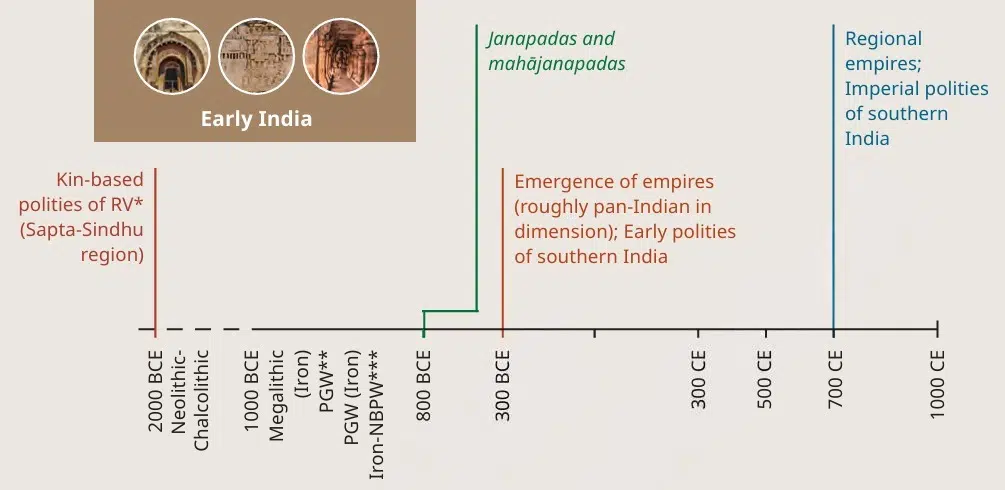
a) Painted Grey Ware (PGW) and Northern Black Polished Ware (NBPW)
b) Chalcolithic Ware
c) Bronze Ware
d) Neolithic Ware
Answer: a) Painted Grey Ware (PGW) and Northern Black Polished Ware (NBPW)
Q61. Observe Figure, shows a Rigveda manuscript. Why is the Rigveda considered unique among early sources?
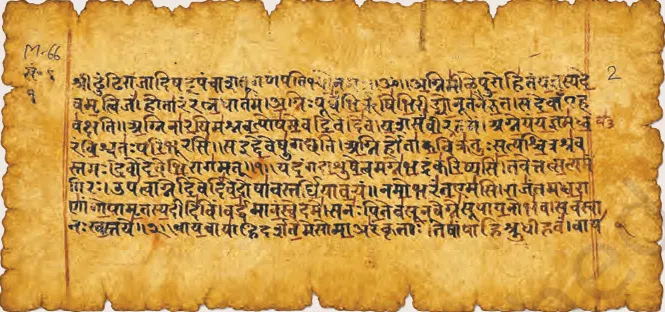
a) It is the earliest corpus of Indian literature.
b) It was written in Greek.
c) It describes only kings.
d) It is a law code.
Answer: a) It is the earliest corpus of Indian literature.
Q62. Observe Figure, showing the spatial distribution of mahājanapadas. Which mahājanapada is located in present-day Bihar and became the most powerful?
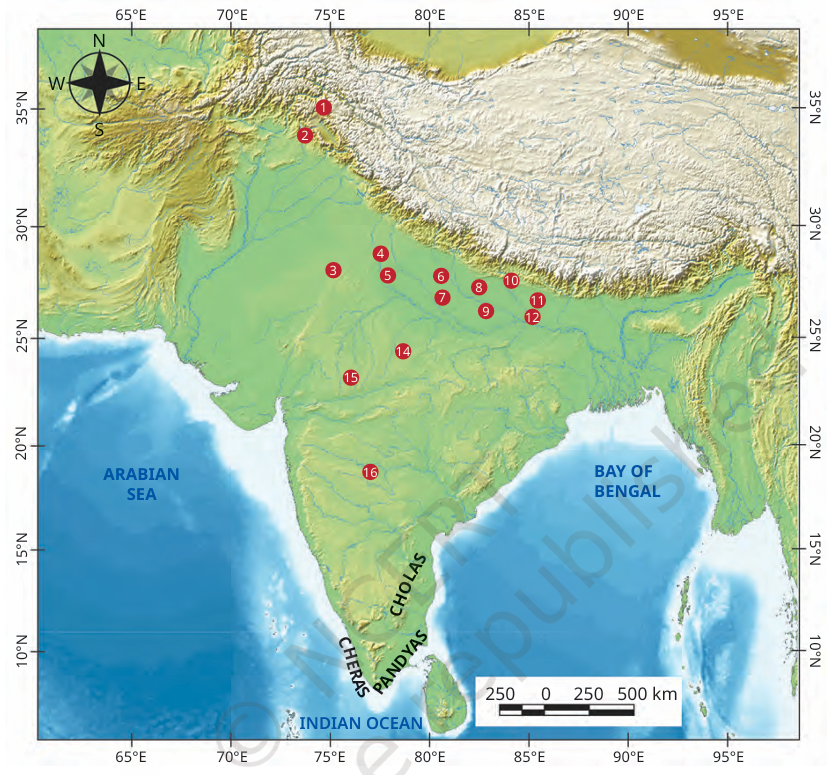
a) Kosala
b) Magadha
c) Avanti
d) Vatsa
Answer: b) Magadha
Q63. Observe Figure, showing the Junagadh Rock Inscription. Why is this site unique?
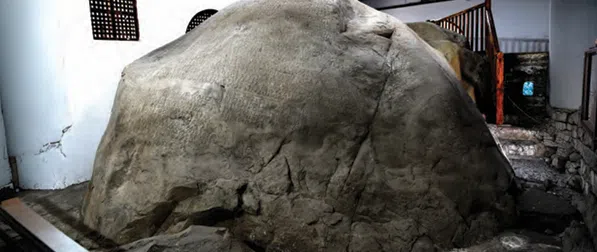
a) It records only one king’s achievements
b) It preserves inscriptions of three rulers from different dynasties over 700 years.
c) It is the earliest inscription in India.
d) It describes only religious rituals.
Answer: b) It preserves inscriptions of three rulers from different dynasties over 700 years.
Q64. Observe Fig. 5.6 showing kingdoms between the 3rd and 10th centuries CE. Which city became the center of the tripartite struggle among the Gurjara–Pratihāras, Pālas, and Rāṣhṭrakūṭas?
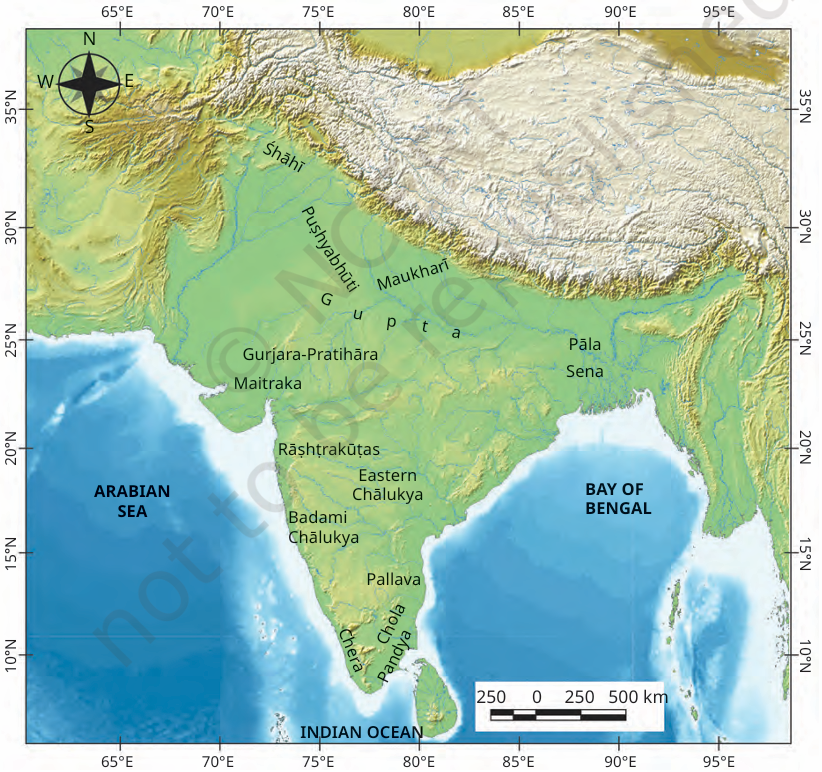
a) Ujjain
b) Kannauj
c) Madurai
d) Thanjavur
Answer: b) Kannauj
Q65. In the varṇa system, which group was mainly associated with warfare and justice?
a) Brāhmaṇas
b) Kshatriyas
c) Vaishyas
d) Śhūdras
Answer: b) Kṣhatriyas
Q66. Observe Figure, showing the four āśramas. Which stage represents renunciation from worldly life?
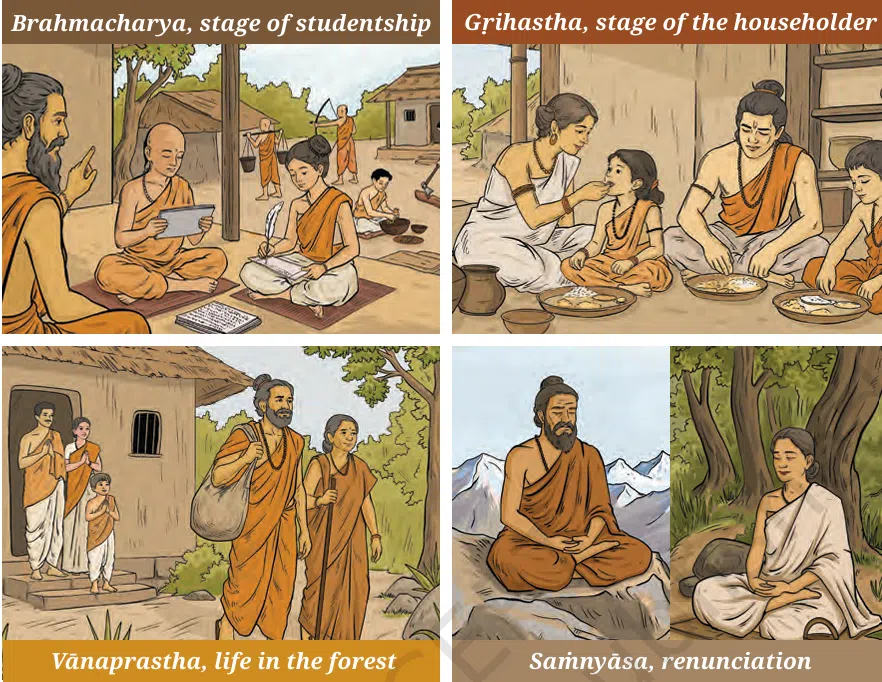
a) Brahmacharya
b) Gṛihastha
c) Vānaprastha
d) Saṁnyāsa
Answer: d) Saṁnyāsa
Q67. Observe Figure, showing centers of learning. Which famous university was located in Bihar and attracted students from across Asia?
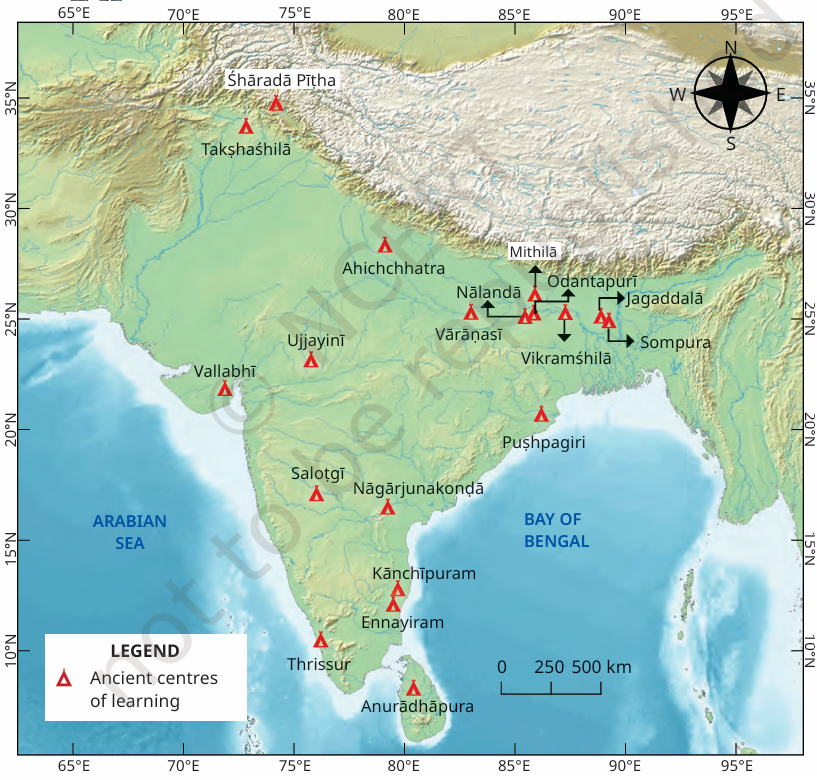
a) Takṣhaśhilā
b) Nālandā
c) Vikramśhilā
d) Vallabhī
Answer: b) Nālandā
Q68. Observe Figure, showing major trade routes. Which port on the western coast was famous for overseas trade with Rome?
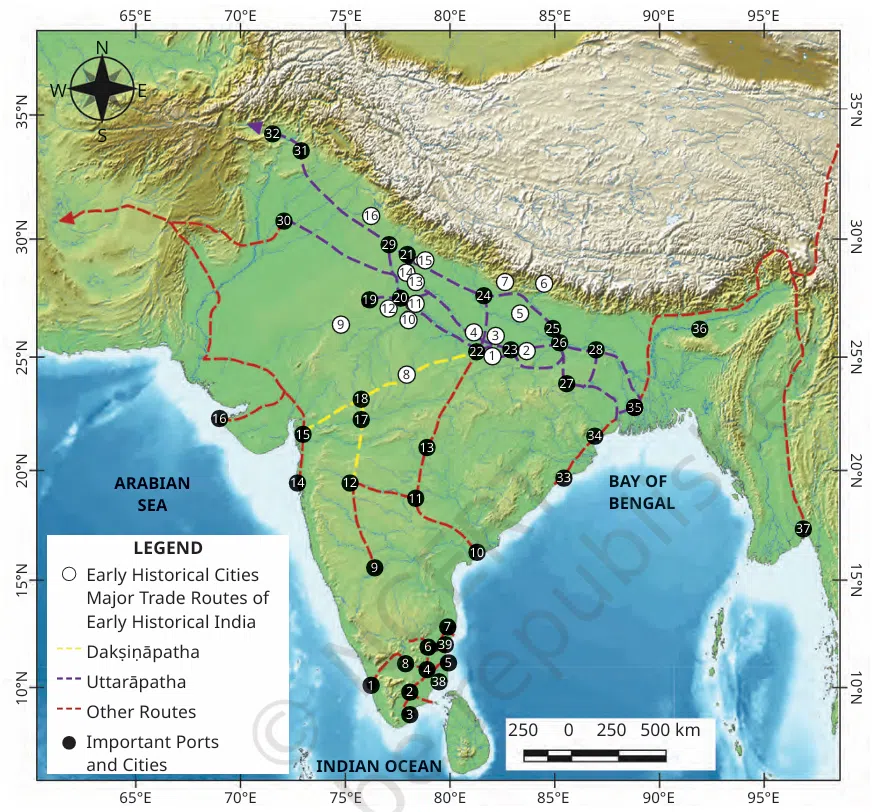
a) Kāñchīpuram
b) Muziris
c) Takṣhaśhilā
d) Mathurā
Answer: b) Muziris
Q69. Observe Figure showing the Nashik cave inscription. What economic role of guilds does it highlight?
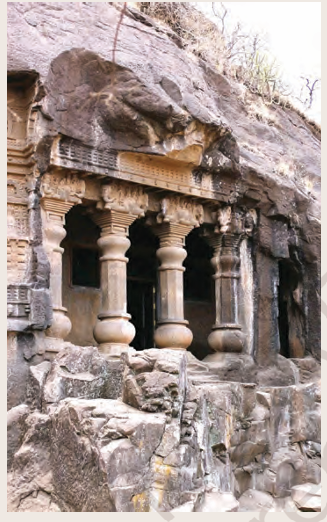
a) Guilds acted as military units.
b) Guilds functioned as banking and credit institutions.
c) Guilds were only religious groups.
d) Guilds were village councils.
Answer: b) Guilds functioned as banking and credit institutions.
Disclaimer: The content that is present on our website is based on the NCERT Class 9 Social Science textbook and is provided for educational purposes only. All the content and images have been taken from Social Science Class 9 NCERT Textbook and CBSE Support material. Images and content shown above are the property of individual organizations and are used here for reference purposes only. To make it easy to understand, some of the content and images are generated by AI and cross-checked by the teachers.
These really helped me revise and understand my weak and strong spots… very helpful
Wow
Nice
Super
Awesome
Good
🙏