
← Back to Class 9 Social Science MCQs
Early Humans and Beginning of Civilisation Class 9 MCQs to strengthen your understanding of one of the most important history chapters in the latest CBSE Class 9 Social Science syllabus. These multiple-choice questions cover key topics such as early human life, the Stone Age, hunting and gathering, the discovery of fire, the invention of tools, the beginning of farming, domestication of animals, permanent settlements, and the rise of early civilizations.
Early Humans and Beginning of Civilisation Class 9 MCQ
Conceptual Recall MCQs
Q1. The Harappan script is also called:
a) Brahmi script
b) Sindhu lipi
c) Hieroglyphic script
d) Cuneiform script
Answer: b) Sindhu lipi
Q2. Which script was formalized by Emperor Ashoka in the 3rd century BCE?
a) Harappan script
b) Brahmi script
c) Hieroglyphic script
d) Cuneiform script
Answer: b) Brahmi script
Q3. Who were the earliest ancestors of modern humans?
a) Homo sapiens
b) Australopithecines
c) Homo erectus
d) Neanderthals
Answer: b) Australopithecines
Q4. Homo erectus is known as:
a) Upright or bipedal ancestor
b) First farmer
c) Cave painter
d) Modern human
Answer: a) Upright or bipedal ancestor
Q5. Homo habilis is also called the
a) Handy man
b) Upright man
c) Modern man
d) Cave man
Answer: a) Handy man
Q6. Which period is known as the Old Stone Age?
a) Mesolithic
b) Neolithic
c) Palaeolithic
d) Chalcolithic
Answer: c) Palaeolithic
Q7. Which site in Madhya Pradesh is famous for Mesolithic cave paintings?
a) Bhimbetka
b) Attirampakkam
c) Isampur
d) Mehrgarh
Answer: a) Bhimbetka
Q8. The hallmark of the Neolithic Revolution was:
a) Cave paintings
b) Domestication of plants and animals
c) Use of microlithic tools
d) Discovery of fire
Answer: b) Domestication of plants and animals
Q9. Which site is considered the oldest Neolithic site in the Indian subcontinent?
a) Kalibangan
b) Mehrgarh
c) Dholavira
d) Lothal
Answer: b) Mehrgarh
Q10. The Early Harappans at Kalibangan practiced:
a) Cave painting
b) Double crop cultivation
c) Iron smelting
d) Writing in Brahmi script
Answer: b) Double crop cultivation
Q11. Which civilization is known as the “land in between” because it was located between the Euphrates and Tigris rivers?
a) Egyptian
b) Mesopotamian
c) Harappan
d) Chinese
Answer: b) Mesopotamian
Q12. What was the name of the temple structure built by the Sumerians?
a) Pyramid
b) Ziggurat
c) Stupa
d) Pagoda
Answer: b) Ziggurat
Q13. What was the writing material used by Egyptians made from the papyrus plant?
a) Clay tablets
b) Papyrus sheets
c) Stone slabs
d) Bronze plates
Answer: b) Papyrus sheets
Q14. Who finally deciphered the Egyptian script using the Rosetta Stone?
a) Pierre Bouchard
b) Jean-François Champollion
c) Herodotus
d) Cleopatra
Answer: b) Jean-François Champollion
Q15. The Chinese civilization flourished mainly along which two rivers?
a) Nile and Euphrates
b) Huang He and Yangtze
c) Sarasvatī and Indus
d) Tigris and Ganga
Answer: b) Huang He and Yangtze
Q16. Which dynasty is credited with unifying China and giving the country its name?
a) Shang dynasty
b) Zhou dynasty
c) Qin dynasty
d) Han dynasty
Answer: c) Qin dynasty
Application-Based MCQs
Q17. If archaeologists find a seal with Harappan pictographs, what challenge will they face?
a) The script is already translated.
b) The script is undeciphered.
c) The seal is broken.
d) The seal is too old to study.
Answer: b) The script is undeciphered.
Q18. Suppose you want to study the social life of Harappans. Which source will be most useful?
a) Written documents
b) Artefacts like tools and pottery
c) Modern books
d) Coins from the Gupta period
Answer: b) Artefacts like tools and pottery
Q19. If archaeologists find hand axes and cleavers in Asia, what does it suggest?
a) Tools were invented in Asia.
b) Homo erectus migrated out of Africa.
c) Homo sapiens lived only in Asia.
d) Tools were made by Neanderthals.
Answer: b) Homo erectus migrated out of Africa.
Q20. Why did early humans develop tools and techniques during the Quaternary Period?
a) To decorate caves
b) To adapt to a changing climate and environment
c) To write stories
d) To fight wars
Answer: b) To adapt to changing climate and environment
Q21. If archaeologists find microlithic tools and bone points, which stage of human history are they studying?
a) Palaeolithic
b) Mesolithic
c) Neolithic
d) Bronze Age
Answer: b) Mesolithic
Q22. Why are stone tools called “extra-corporal limbs”?
a) They were used for decoration.
b) They worked as extensions of the human body.
c) They were made of bones.
d) They were used only for hunting.
Answer: b) They worked as extensions of the human body.
Q23. If archaeologists find earthenware pottery and polished stone tools, which stage of human history are they studying?
a) Mesolithic
b) Neolithic
c) Chalcolithic
d) Bronze Age
Answer: b) Neolithic
Q24. Why did Mesolithic people depend on fishing as their main subsistence?
a) Climate became warmer, expanding rivers and lakes.
b) They had no hunting skills.
c) They lived only near the seas.
d) They disliked farming.
Answer: a) Climate became warmer, expanding rivers and lakes.
Q25. If archaeologists find sun-dried brick houses and granaries along with wheat and barley remains, which site are they most likely studying?
a) Bhimbetka
b) Mehrgarh
c) Kalibangan
d) Harappa
Answer: b) Mehrgarh
Q26. How would long-distance trade have been affected if Harappans had not followed a standard system of weights?
a) Trade would have been more efficient.
b) Trade would have been confusing and unreliable.
c) Trade would have expanded faster.
d) Trade would have used coins instead.
Answer: b) Trade would have been confusing and unreliable.
Q27. If archaeologists find wedge-shaped marks on clay tablets, which civilization are they studying?
a) Harappan
b) Egyptian
c) Mesopotamian
d) Chinese
Answer: c) Mesopotamian
Q28. Suppose a historian wants to study the world’s first dynastic empire. Which Mesopotamian civilization should they focus on?
a) Sumerian
b) Akkadian
c) Assyrian
d) Babylonian
Answer: b) Akkadian
Q29. If archaeologists find mastabas stacked one above the other, what structure are they studying?
a) Step pyramid
b) Ziggurat
c) Stupa
d) Pagoda
Answer: a) Step pyramid
Q30. Why did Egyptians develop a calendar based on Sirius (Dog Star)?
a) To celebrate festivals
b) To count days between Nile floods
c) To track Pharaoh’s reign
d) To measure trade routes
Answer: b) To count days between Nile floods
Q31. If archaeologists find oracle bones with cracks used for fortune-telling, which civilization are they studying?
a) Mesopotamian
b) Egyptian
c) Harappan
d) Chinese
Answer: d) Chinese
Q32. Why was jade considered a prestige object in ancient China?
a) It was locally available.
b) It was imported and used in rituals.
c) It was used only for farming.
d) It was cheaper than bronze.
Answer: b) It was imported and used in rituals.
Assertion–Reason MCQs
Q33. Assertion (A): The Harappan script has not been deciphered yet.
Reason (R): There are no bilingual inscriptions to compare it with.
a) Both A and R are true, and R is the correct explanation of A.
b) Both A and R are true, but R is not the correct explanation of A.
c) A is true, but R is false.
d) A is false, but R is true.
Answer: a) Both A and R are true, and R is the correct explanation of A.
Q34. Assertion (A): Homo sapiens evolved in Africa around 300,000 years ago.
Reason (R): Africa is considered the birthplace of modern humans.
a) Both A and R are true, and R is the correct explanation of A.
b) Both A and R are true, but R is not the correct explanation of A.
c) A is true, but R is false.
d) A is false, but R is true.
Answer: a) Both A and R are true, and R is the correct explanation of A.
Q35. Assertion (A): Homo erectus was the first ancestor to migrate out of Africa.
Reason (R): They invented handaxes and cleavers, which helped them survive in new regions.
a) Both A and R are true, and R is the correct explanation of A.
b) Both A and R are true, but R is not the correct explanation of A.
c) A is true, but R is false.
d) A is false, but R is true.
Answer: a) Both A and R are true, and R is the correct explanation of A.
Q36. Assertion (A): The Neolithic period is called a revolution.
Reason (R): Humans shifted from food gathering to food production, leading to permanent settlements.
a) Both A and R are true, and R is the correct explanation of A.
b) Both A and R are true, but R is not the correct explanation of A.
c) A is true, but R is false.
d) A is false, but R is true.
Answer: a) Both A and R are true, and R is the correct explanation of A.
Q37. Assertion (A): Mehrgarh people are also called Chalcolithic people.
Reason (R): They were the first to make copper objects around 4000 BCE.
a) Both A and R are true, and R is the correct explanation of A.
b) Both A and R are true, but R is not the correct explanation of A.
c) A is true, but R is false.
d) A is false, but R is true.
Answer: a) Both A and R are true, and R is the correct explanation of A.
Q38. Assertion (A): The Harappan script has not been deciphered.
Reason (R): Unlike cuneiform, there are no bilingual inscriptions to help decode it.
a) Both A and R are true, and R is the correct explanation of A.
b) Both A and R are true, but R is not the correct explanation of A.
c) A is true, but R is false.
d) A is false, but R is true.
Answer: a) Both A and R are true, and R is the correct explanation of A.
Q39. Assertion (A): Egyptians believed in preserving the body through mummification.
Reason (R): They believed each person had a ka (spiritual double) that lived on after death if the body was preserved.
a) Both A and R are true, and R is the correct explanation of A.
b) Both A and R are true, but R is not the correct explanation of A.
c) A is true, but R is false.
d) A is false, but R is true.
Answer: a) Both A and R are true, and R is the correct explanation of A.
Q40. Assertion (A): The Zhou rulers were considered appointees of heaven.
Reason (R): They could be dismissed if their people did not prosper.
a) Both A and R are true, and R is the correct explanation of A.
b) Both A and R are true, but R is not the correct explanation of A.
c) A is true, but R is false.
d) A is false, but R is true.
Answer: a) Both A and R are true, and R is the correct explanation of A.
Case Study MCQ
Q41. Case Study: Archaeologists discovered a Harappan seal with pictographs. They compared it with Mesopotamian cuneiform and Egyptian hieroglyphs. Unlike these, the Harappan script remains undeciphered. This makes it difficult to know Harappan rulers’ names or details of wars.
Which two ancient scripts have been deciphered?
a) Harappan and Brahmi
b) Cuneiform and Hieroglyphic
c) Brahmi and Sindhu lipi
d) None of the above
Answer: b) Cuneiform and Hieroglyphic
Why is the Harappan script difficult to understand?
a) It is too long.
b) It is undeciphered.
c) It is written in Brahmi.
d) It is destroyed.
Answer: b) It is undeciphered.
Q42. Case Study: Archaeologists discovered bones and stone tools in Olduvai Gorge (Africa). These included hand axes and cleavers. Similar tools were later found in Europe and Asia. This evidence shows that Homo erectus, an upright ancestor, migrated out of Africa about 2 million years ago.
Which ancestor first moved out of Africa?
a) Homo sapiens
b) Homo erectus
c) Australopithecines
d) Neanderthals
Answer: b) Homo erectus
What does the finding of similar tools in Asia and Europe prove?
a) Tools were invented in Europe.
b) Homo erectus dispersed from Africa.
c) Homo sapiens lived in Asia first.
d) Neanderthals made the tools.
Answer: b) Homo erectus dispersed from Africa.
Q43. Case Study: At Attirampakkam (Tamil Nadu) and Isampur (Karnataka), archaeologists found large cutting tools like handaxes and cleavers, along with animal fossils. These tools were used to chop meat, scrape skins, and extract marrow. Such evidence shows how early humans adapted to their environment.
Which ancestor is linked with handaxes and cleavers?
a) Homo habilis
b) Homo erectus
c) Homo sapiens
d) Neanderthals
Answer: b) Homo erectus
What does the discovery of tools at Attirampakkam and Isampur prove?
a) Early humans decorated caves.
b) Early humans used tools for survival tasks.
c) Early humans wrote inscriptions.
d) Early humans farmed crops.
Answer: b) Early humans used tools for survival tasks.
Q44. Case Study: At Bhimbetka, archaeologists discovered hundreds of painted rock shelters showing hunting scenes, animals, and human figures. These paintings belong to Mesolithic times, when people used microlithic tools and depended on fishing and small game hunting.
What does Bhimbetka cave art reveal about Mesolithic people?
a) They were farmers.
b) They were hunters and gatherers.
c) They were metalworkers.
d) They were traders.
Answer: b) They were hunters and gatherers.
Which type of tools were mainly used during this period?
a) Handaxes and cleavers
b) Microlithic tools
c) Bronze tools
d) Iron tools
Answer: b) Microlithic tools
Q45. Case Study: At Mehrgarh (7000 BCE), people cultivated wheat and barley, raised sheep, goats, and zebu cattle, and built sun-dried brick houses. By 4000 BCE, they made copper objects and ornaments from lapis lazuli and carnelian. These developments laid the foundation for the Sindhu–Sarasvatī civilization.
Which animal was especially raised at Mehrgarh?
a) Horse
b) Zebu humped bull
C) Camel
d) Elephant
Answer: b) Zebu humped bull
Which civilization grew out of these early developments?
a) Mesopotamian civilization
b) Sindhu–Sarasvatī civilization
c) Egyptian civilization
d) Chinese civilization
Answer: b) Sindhu–Sarasvatī civilization
Q46. Case Study: King Hammurabi of Babylonia (1792 BCE) expanded his city-state into a large empire. His most significant contribution was the Code of Hammurabi, a set of rules and regulations for civil and social conduct. This code became a model for future legal systems.
Which Babylonian king is associated with the Code of Hammurabi?
a) Sargon
b) Hammurabi
c) Gilgamesh
d) Assur
Answer: b) Hammurabi
Why is the Code of Hammurabi important?
a) It was the first written script.
b) It served as a foundation for future legal systems.
c) It described farming methods.
d) It was a religious text.
Answer: b) It served as a foundation for future legal systems.
Q47. Case Study: Around 3000 BCE, Egyptian farmers diverted water from the Nile by digging ditches and storing it in reservoirs. This collective effort led to the rise of local government. Later, pharaohs became rulers, and pyramids were built to preserve their bodies after death.
What natural feature was central to Egyptian civilization?
a) Sahara Desert
b) River Nile
c) Mediterranean Sea
d) Red Sea
Answer: b) River Nile
What was the main reason pyramids were built?
a) To store food
b) To preserve pharaohs’ bodies for the afterlife
c) To serve as temples
d) To protect against floods
Answer: b) To preserve Pharaohs’ bodies for the afterlife
Q48. Case Study: The Great Wall of China was built from 680 BCE onwards by the Zhou and later dynasties to protect against nomadic raids. It was expanded and repaired for nearly 2000 years, becoming one of the most famous defensive structures in history.
What was the main reason for building the Great Wall?
a) To store food
b) To protect against nomadic raids
c) To preserve rulers’ bodies
d) To mark trade routes
Answer: b) To protect against nomadic raids
Which dynasty began building the earliest walls?
a) Shang dynasty
b) Zhou dynasty
c) Qin dynasty
d) Han dynasty
Answer: b) Zhou dynasty
Diagram-Based MCQ
Q49. Observe the Harappan seal shown in Fig. 4.1. Why can historians not fully explain the meaning of the symbols?

a) The seal is broken.
b) The script is undeciphered.
c) The seal is too small.
d) The seal is written in Brahmi.
Answer: b) The script is undeciphered.
Q50. Observe Fig. 4.4 shows Homo erectus dispersal. Which statement is correct?
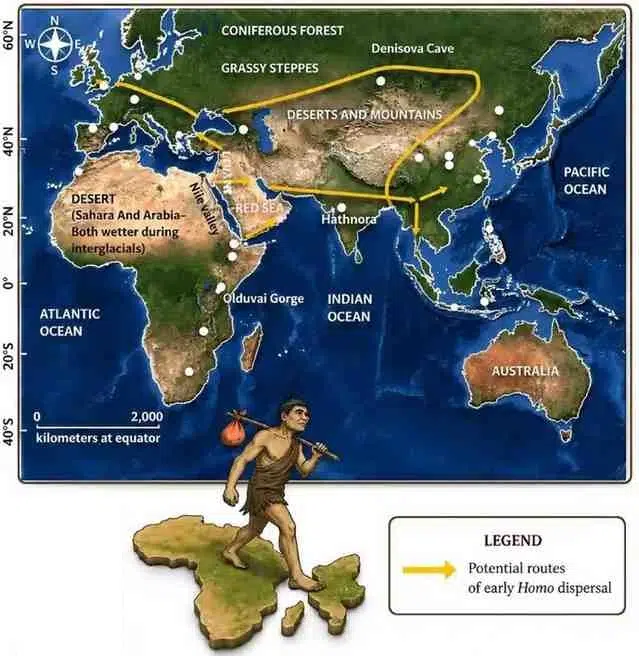
a) Homo erectus remained only in Africa.
b) Homo erectus spread to Asia and Europe.
c) Homo sapiens moved out first.
d) Australopithecines migrated to Australia.
Answer: b) Homo erectus spread to Asia and Europe.
Q51. Observe Fig. 4.6 showing skulls of early humans. What gradual change can be noticed?
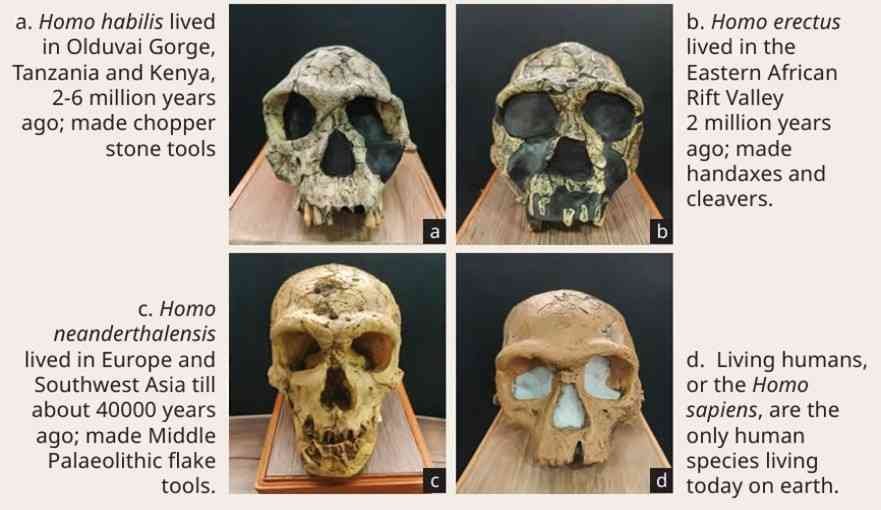
a) Skulls became smaller.
b) Faces gradually straightened.
c) Teeth disappeared.
d) Skulls turned into fossils
Answer: b) Faces gradually straightened
Q52. Observe Fig. 4.13 showing Neolithic stone tools. What was their main purpose?

a) Hunting large animals
b) Producing and processing food
c) Engraving cave walls
d) Fishing in rivers
Answer: b) Producing and processing food
Q53. Observe Fig. 4.19 showing ploughed fields at Kalibangan. What does the pattern of horizontal and vertical furrows indicate?

a) Use of iron plows
b) Double crop cultivation (Rabi and Kharif)
c) Decorative farming methods
d) Cultivation of only rice
Answer: b) Double crop cultivation (Rabi and Kharif)
Q54. Observe Fig. 4.25 showing wedge-shaped marks on clay tablets. What does this script represent?

a) Hieroglyphics
b) Brahmi script
c) Cuneiform
d) Sindhu lipi
Answer: c) Cuneiform
Q55. Observe Fig. 4.32 shows Egyptian social hierarchy. Which group was at the top?

a) Nobles and priests
b) Pharaoh
c) Artisans and merchants
d) Serfs and slaves
Answer: b) Pharaoh
Q56. Observe Fig. 4.36 shows oracle carvings. What were these bones mainly used for?

a) Writing laws
b) Fortune-telling and recording beliefs
c) Farming instructions
d) Trade records
Answer: b) Fortune-telling and recording beliefs
Disclaimer: The content that is present on our website is based on the NCERT Class 9 Social Science textbook and is provided for educational purposes only. All the content and images have been taken from Social Science Class 9 NCERT Textbook and CBSE Support material. Images and content shown above are the property of individual organizations and are used here for reference purposes only. To make it easy to understand, some of the content and images are generated by AI and cross-checked by the teachers.
very nice
Really helpfull for easy recap and understanding of the lesson.
Thankyou