
← Back to Class 9 Social Science MCQs
Atmosphere and Climate Class 9 MCQs, designed according to the latest CBSE Class 9 syllabus. This collection includes important multiple-choice questions covering the atmosphere, weather and climate, atmospheric layers, air pressure, winds, humidity, rainfall, monsoons, seasons, climate change, greenhouse gases, and related concepts. These chapter-wise MCQs with answers help students strengthen their understanding, improve conceptual clarity, and practice for school exams, periodic tests, and annual examinations.
Atmosphere and Climate Class 9 MCQ
Conceptual Recall MCQs
Q1. Which gas is present in the largest proportion in the Earth’s atmosphere?
a) Oxygen
b) Nitrogen
c) Carbon dioxide
d) Argon
Answer: b) Nitrogen (78%)
Q2. The layer of the atmosphere where most weather phenomena occur is:
a) Stratosphere
b) Troposphere
c) Mesosphere
d) Thermosphere
Answer: b) Troposphere
Q3. “Weather” refers to:
a) Long-term average conditions of a place
b) Hour-to-hour and day-to-day conditions of the atmosphere
c) Climate of a region
d) Seasonal changes only
Answer: b) Hour-to-hour and day-to-day conditions of the atmosphere
Q4. Climate is defined as
a) Sudden changes in temperature
b) Average weather conditions over a long period (30 years or more)
c) Daily rainfall and humidity
d) Wind speed only
Answer: b) Average weather conditions over a long period (30 years or more)
Q5. How many distinct seasons are recognized by the Indian Meteorological Department (IMD)?
a) Two
b) Four
c) Six
d) Eight
Answer: b) Four
Q6. Which months are the coldest in India?
a) April–May
b) December–January
c) June–July
d) September–October
Answer: b) December–January
Q7. The word “monsoon” is derived from which language?
a) Sanskrit
b) Arabic
c) Persian
d) Hindi
Answer: b) Arabic (from the word “mausim,” meaning season)
Q8. Which monsoon accounts for most of the rainfall in India?
a) Northeast monsoon
b) Southwest monsoon
c) Winter winds
d) Local winds
Answer: b) Southwest monsoon
Q9. Climate change refers to:
a) Short-term changes in weather
b) Long-term changes in weather patterns
c) Seasonal winds only
d) Local rainfall variations
Answer: b) Long-term changes in weather patterns
Q10. Which of the following is a greenhouse gas?
a) Oxygen
b) Nitrogen
c) Carbon dioxide
d) Argon
Answer: c) Carbon dioxide
Q11. Which rivers mainly contributed to the floods in Punjab in 2025?
a) Ganga, Yamuna, Brahmaputra
b) Satluj, Beas, Ravi, Ghaggar
c) Narmada, Tapti, Godavari
d) Indus, Jhelum, Chenab
Answer: b) Satluj, Beas, Ravi, Ghaggar
Q12. Which factor intensified the heavy monsoon rains in Punjab?
a) Cyclones
b) Western disturbances
c) Earthquakes
d) Volcanic activity
Answer: b) Western disturbances
Application-Based MCQs
Q13. Why do airplanes usually fly in the stratosphere?
a) It has more oxygen
b) It is free from clouds and weather disturbances.
c) It has higher air pressure.
d) It is closest to the Earth’s surface.
Answer: b) It is free from clouds and weather disturbances.
Q14. If the ozone layer becomes thin, which radiation will harm living beings most?
a) Infrared radiation
b) Ultraviolet radiation
c) Visible light
d) Radio waves
Answer: b) Ultraviolet radiation
Q15. Why do clothes take longer to dry on a humid day?
a) Air pressure is high.
b) Sweat evaporates quickly.
c) Air already has more water vapor, so evaporation slows down.
d) Wind speed is high.
Answer: c) Air already has more water vapor, so evaporation slows down.
Q16. If a region has no rainfall for a long time, what will happen?
a) Climate becomes wet
b) The climate becomes dry.
c) Temperature decreases
d) Humidity increases
Answer: b) Climate becomes dry
Q17. In which season does India receive rainfall from the south-west monsoon winds?
a) Winter
b) Summer
c) Monsoon (advancing monsoon)
d) Post-monsoon
Answer: c) Monsoon (Advancing monsoon)
Q18. Why does South India receive more rainfall during the retreating monsoon?
a) Because of western disturbances,
b) Because of north-east monsoon winds
c) Because of snowfall in the Himalayas
d) Because of high pressure in northwest India
Answer: b) Because of north-east monsoon winds
Q19. Why do south-west monsoon winds bring rainfall to India?
a) They blow from land to sea.
b) They carry moisture from oceans to land.
c) They are cold and dry winds.
d) They are caused by snowfall in the Himalayas.
Answer: b) They carry moisture from oceans to land.
Q20. Why is the north-east monsoon important for Tamil Nadu?
a) It brings snowfall
b) It picks up moisture from the Bay of Bengal and causes rainfall.
c) It lowers temperature only.
d) It increases humidity without rainfall.
Answer: b) It picks up moisture from the Bay of Bengal and causes rainfall.
Q21. Why does burning fossil fuels contribute to climate change?
a) It reduces oxygen in the atmosphere.
b) It releases greenhouse gases that trap heat.
c) It increases rainfall directly.
d) It lowers global temperatures.
Answer: b) It releases greenhouse gases that trap heat.
Q22. Which of the following actions can help reduce climate change?
a) Cutting more forests
b) Using renewable energy
c) Increasing industrial pollution
d) Burning more coal
Answer: b) Using renewable energy
Q23. Why did weak and old river embankments worsen the floods?
a) They increased rainfall.
b) They failed to stop rising water.
c) They reduced silt in rivers.
d) They created high-pressure areas.
Answer: b) They failed to stop rising water.
Q24. Which human activity reduced the natural space for floodwater to spread safely?
a) Deforestation
b) Building houses and farms too close to rivers
c) Mining in hills
d) Planting trees near rivers
Answer: b) Building houses and farms too close to rivers
Assertion–Reason MCQs
Q25. Assertion (A): The mesosphere protects the Earth by burning up most meteors.
Reason (R): The temperature increases with altitude in the mesosphere.
a) Both A and R are true, and R is the correct explanation of A.
b) Both A and R are true, but R is not the correct explanation of A.
c) A is true, but R is false.
d) A is false, but R is true.
Answer: c) A is true, but R is false (In the mesosphere, temperature decreases with altitude).
Q26. Assertion (A): Air pressure is highest at sea level.
Reason (R): As altitude increases, the weight of air above decreases.
a) Both A and R are true, and R is the correct explanation of A.
b) Both A and R are true, but R is not the correct explanation of A.
c) A is true, but R is false.
d) A is false, but R is true.
Answer: a) Both A and R are true, and R is the correct explanation of A.
Q27. Assertion (A): October and November in north-western India are usually cloudless.
Reason (R): This period marks the retreating monsoon season.
a) Both A and R are true, and R is the correct explanation of A.
b) Both A and R are true, but R is not the correct explanation of A.
c) A is true, but R is false.
d) A is false, but R is true.
Answer: a) Both A and R are true, and R is the correct explanation of A.
Q28. Assertion (A): The south-west monsoon is also called the summer monsoon.
Reason (R): It occurs between June and September when the Indian landmass heats up faster than the oceans.
a) Both A and R are true, and R is the correct explanation of A.
b) Both A and R are true, but R is not the correct explanation of A.
c) A is true, but R is false.
d) A is false, but R is true.
Answer: a) Both A and R are true, and R is the correct explanation of A.
Q29. Assertion (A): Climate change leads to rising sea levels.
Reason (R): Melting glaciers add more water to oceans.
a) Both A and R are true, and R is the correct explanation of A.
b) Both A and R are true, but R is not the correct explanation of A.
c) A is true, but R is false.
d) A is false, but R is true.
Answer: a) Both A and R are true, and R is the correct explanation of A.
Q30. Assertion (A): Flood warnings in some areas were not effective.
Reason (R): Warnings came late or were not clearly communicated.
a) Both A and R are true, and R is the correct explanation of A.
b) Both A and R are true, but R is not the correct explanation of A.
c) A is true, but R is false.
d) A is false, but R is true.
Answer: a) Both A and R are true, and R is the correct explanation of A.
Case Study MCQ
Q31. Case Study: A group of students observed the sky during a science activity. They noticed clouds forming, felt a cool breeze, and later saw rainfall. Their teacher explained that all these phenomena occur in the lowest layer of the atmosphere.
Which layer were the students studying, and why is it important?
a) Stratosphere – because it contains ozone
b) Troposphere – because it has water vapor and weather phenomena
c) Mesosphere – because meteors burn here
d) Thermosphere – because auroras occur here
Answer: b) Troposphere – because it has water vapor and weather phenomena
Q32. Case Study: During summer, a coastal town experiences cool winds blowing from the sea towards the land in the afternoon. At night, the direction of the wind reverses, blowing from land to sea.
Which local winds are being described, and why do they occur?
a) Westerlies – due to Earth’s rotation
b) Sea breeze and land breeze – due to temperature differences between land and sea
c) Storm winds – due to high pressure
d) Monsoon winds – due to seasonal changes
Answer: b) Sea breeze and land breeze – due to temperature differences between land and sea
Q33. Case Study: A farmer in Tamil Nadu observes heavy rainfall in October and November, even though the monsoon season is said to end in September. He wonders why his region still receives rain.
Which season is responsible for this rainfall?
a) Winter season
b) Summer season
c) Retreating monsoon season
d) Advancing monsoon season
Answer: c) Retreating monsoon season
Q34. Case Study: A farmer in Andhra Pradesh depends on rainfall during October and November for his crops. He notices that while most of India has dry weather, his region still receives rain.
Which monsoon is responsible for this rainfall?
a) Southwest monsoon
b) Northeast monsoon
c) Local winds
d) Winter winds
Answer: b) Northeast monsoon
Q35. Case Study: A village near the coast has noticed that floods are becoming more frequent, and farmers are struggling with crop losses. Scientists explain that this is due to rising sea levels and unpredictable rainfall caused by climate change.
Which human activities are most responsible for this situation?
a) Deforestation and burning fossil fuels
b) Planting more trees
c) Using solar energy
d) Recycling waste
Answer: a) Deforestation and burning fossil fuels
Q36. Case Study: During the 2025 floods in Punjab, thousands of people moved to relief camps. Crops like paddy were destroyed, and waterborne diseases spread due to murky standing water.
Which of the following best describes the combined impact of the floods?
a) Only economic losses
b) Economic, social, and environmental damage
c) Only agricultural damage
d) Only health problems
Answer: b) Economic, social, and environmental damage
Diagram-Based MCQs
Q37. Refer to Figure. In which layer shown in the diagram do auroras occur?
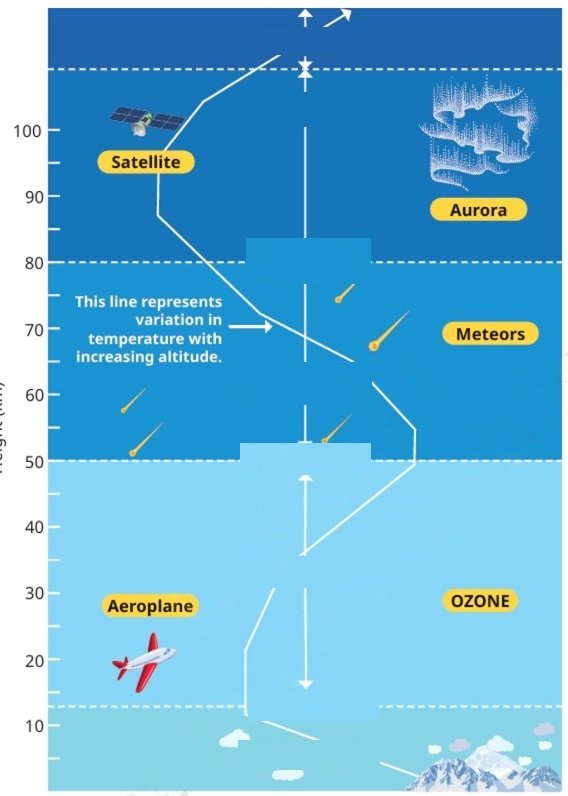
a) Troposphere
b) Stratosphere
c) Mesosphere
d) Thermosphere
Answer: d) Thermosphere
Q38. Refer to Figure. According to the diagram, which layer is directly above the tropopause?
a) Stratosphere
b) Mesosphere
c) Thermosphere
d) Exosphere
Answer: a) Stratosphere
Q39. Refer to Figure. In which zone do the Sun’s rays strike most directly?
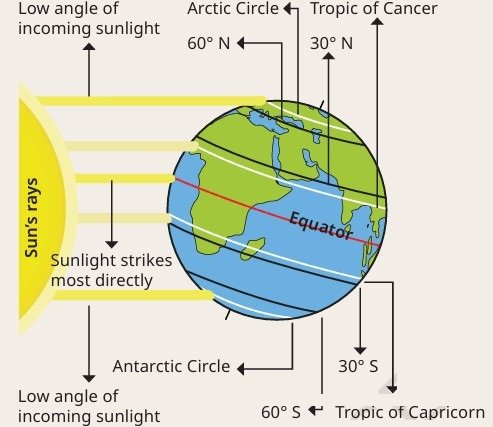
a) Frigid Zone
b) Torrid Zone
c) Temperate Zone
d) Polar Zone
Answer: b) Torrid Zone
Q40. Refer to Figure. According to the diagram, why is the temperature lower near the poles?
a) Insolation is higher
b) Sunlight falls at a low angle.
c) Air pressure is high.
d) Winds are stronger
Answer: b) Sunlight falls at a low angle.
Q41. Refer to Table. Which traditional season corresponds to July–August in the Gregorian calendar?
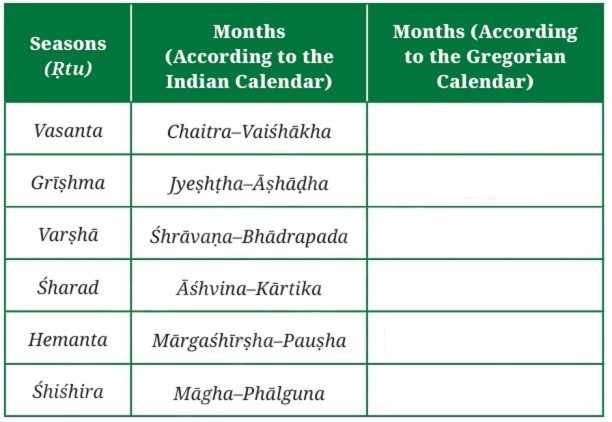
a) Vasanta
b) Grīṣhma
c) Varṣhā
d) Sharad
Answer: c) Varṣhā (Monsoon season)
Q42. Refer to Table. According to the traditional Indian calendar, which months represent Śhiśhira (winter)?
a) Māgha–Phālguna
b) Chaitra–Vaiśhākha
c) Jyeṣhṭha–Āṣhāḍha
d) Āśhvina–Kārtika
Answer: a) Māgha–Phālguna
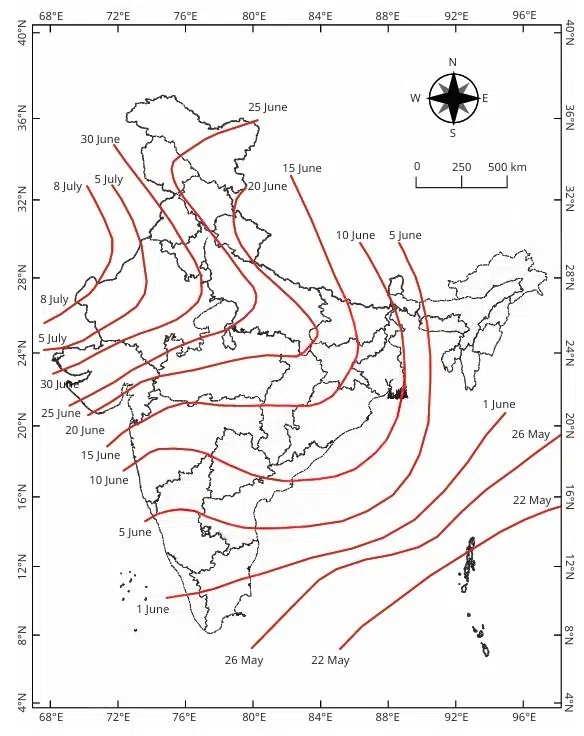
Q43. Refer to Figure. According to the advancing monsoon diagram, by which month does the monsoon usually cover most of India?
a) May
b) June
c) July
d) August
Answer: c) July
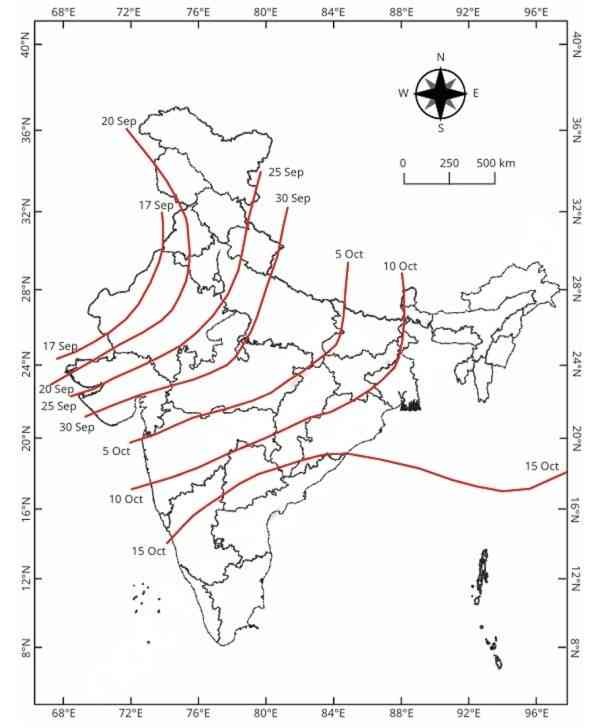
Q44. Refer to Figure. According to the retreating monsoon diagram, by which month does the monsoon withdraw from most parts of India?
a) September–October
b) November–December
c) January–February
d) March–April
Answer: a) September–October
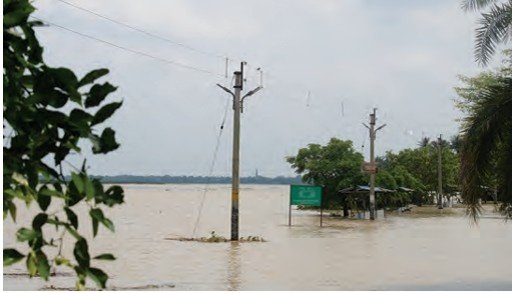
Q47. Refer to Figure. Which infrastructure shown in the diagram was damaged during the floods?
a) Airports
b) Roads and bridges
c) Railways only
d) Dams only
Answer: b) Roads and bridges
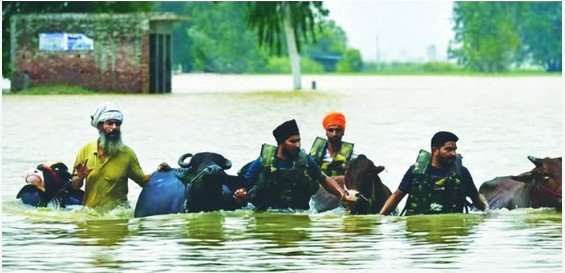
Q48. Refer to Figure. Relief operations during floods mainly aim to:
a) Increase rainfall
b) Provide safety, food, and shelter to affected people.
c) Build new embankments immediately.
d) Reduce silt in rivers
Answer: b) Provide safety, food, and shelter to affected people.
Disclaimer: The content that is present on our website is based on the NCERT Class 9 Social Science textbook and is provided for educational purposes only. All the content and images have been taken from Social Science Class 9 NCERT Textbook and CBSE Support material. Images and content shown above are the property of individual organizations and are used here for reference purposes only. To make it easy to understand, some of the content and images are generated by AI and cross-checked by the teachers.