
← Back to Class 9 Social Science MCQs
The Price Puzzle: What Drives the Market Class 9 MCQ questions based on the latest CBSE syllabus. This collection of multiple-choice questions covers important concepts such as demand, supply, market equilibrium, price determination, shifts in demand and supply, government intervention, and factors affecting market prices.
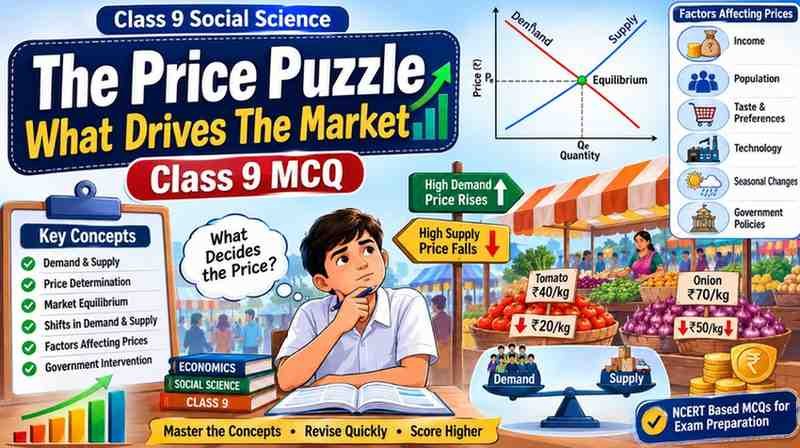
The Price Puzzle What Drives The Market Class 9 MCQ
Conceptual Recall
Q1. The price of goods and services in a market is mainly determined by:
a) Government rules
b) Demand and supply
c) Seller’s wish
d) Buyer’s mood
Answer: b) Demand and supply
Q2. When the supply of onions is more than the demand, the price will:
a) Increase
b) Decrease
c) Stay constant
d) Double
Answer: b) Decrease
Q3. The Law of Demand shows:
a) Direct relation between price and demand
b) Inverse relation between price and demand
c) No relation between price and demand
d) Constant demand at all prices
Answer: b) Inverse relation between price and demand
Q4. The demand curve generally slopes:
a) Upward
b) Downward
c) Horizontal
d) Vertical
Answer: b) Downward
Q5. Goods used together, like cars and petrol, are called:
a) Substitute goods
b) Complementary goods
c) Luxury goods
d) Inferior goods
Answer: b) Complementary goods
Q6. The principle that utility decreases as more units are consumed is called:
a) Law of Demand
b) Law of Supply
c) Diminishing Marginal Utility
d) Law of Equilibrium
Answer: c) Diminishing Marginal Utility
Q7. The law of supply shows:
a) As price rises, supply falls.
b) As price rises, supply rises.
c) Supply is constant at all prices.
d) Supply depends only on demand.
Answer: b) As price rises, supply rises.
Q8. The supply curve generally slopes:
a) Downward
b) Upward
c) Horizontal
d) Vertical
Answer: b) Upward
Q9. If wheat prices are low but chickpea prices are high, farmers will grow more chickpeas. This shows supply depends on:
a) Demand only
b) Price of related goods
c) Government rules
d) Consumer taste
Answer: b) Price of related goods
Q10. Improvement in technology generally leads to:
a) Lower supply
b) Higher cost of production
c) Higher supply
d) No change in supply
Answer: c) Higher supply
Q11. Market equilibrium occurs when:
a) Demand > Supply
b) Supply > Demand
c) Demand = Supply
d) Prices are fixed by the government.
Answer: c) Demand = Supply
Q12. At equilibrium, prices tend to:
a) Rise sharply
b) Fall continuously
c) Remain stable
d) Double automatically
Answer: c) Remain stable
Q13. In real-world markets, equilibrium is:
a) Permanent and stable
b) Constantly shifting due to changing conditions
c) Fixed by government
d) Independent of demand and supply
Answer: b) Constantly shifting due to changing conditions
Q14. The total money a business earns before expenses is called:
a) Profit
b) Revenue
c) Tariff
d) Utility
Answer: b) Revenue
Q15. A maximum price set by the government to prevent overcharging is called:
a) Price floor
b) Price ceiling
c) Monopoly price
d) Equilibrium price
Answer: b) Price ceiling
Q16. Goods like roads, parks, and streetlights provided by the government are called:
a) Private goods
b) Public goods
c) Luxury goods
d) Substitute goods
Answer: b) Public goods
Q17. If the government fixes the wheat price at ₹20 while the market price is ₹30, farmers may reduce production. This is an example of:
a) Price floor
b) Price distortion
c) Monopoly
d) Public goods provision
Answer: b) Price distortion
Q18. The ease of starting, running, and closing a business is called:
a) Profitability
b) Ease of doing business
c) Market equilibrium
d) Consumer welfare
Answer: b) Ease of doing business
Q19. A shopkeeper reduces vegetable prices in the evening. This is because:
a) Vegetables become fresher at night
b) Demand is lower in the evening.
c) The government fixes evening prices.
d) Sellers want to increase supply.
Answer: b) Demand is lower in the evening.
Q20. A flight seat costs ₹3,000 one day and ₹9,000 another day. This difference is due to:
a) Seasonal demand and supply changes
b) Airlines changing rules daily
c) Passengers’ bargaining power
d) Government taxes
Answer: a) Seasonal demand and supply changes
Application-Based
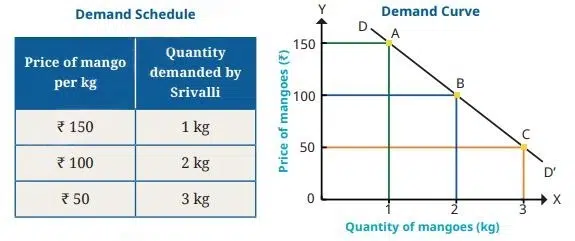
Q21. Srivalli bought 1 kg of mangoes at ₹150, 2 kg at ₹100, and 3 kg at ₹50. This example shows:
a) Law of Supply
b) Law of Demand
c) Law of Equilibrium
d) Law of Production
Answer: b) Law of Demand
Q22. Why is the market demand curve flatter than the individual demand curve?
a) Market demand is less responsive.
b) Market demand aggregates many consumers, so total response is larger
c) Individual demand is always constant.
d) The government fixes market demand.
Answer: b) Market demand aggregates many consumers, so total response is larger.
Q23. If coffee becomes expensive, demand for tea increases. This shows:
a) Effect of complementary goods
b) Effect of substitute goods
c) Effect of seasonality
d) Effect of income
Answer: b) Effect of substitute goods
Q24. Bookshops are crowded at the start of the academic session. This is due to:
a) Price fall of books
b) Seasonal demand
c) Diminishing utility
d) Population composition
Answer: b) Seasonal demand
Q25. At the start of mango season, supply is low, so prices are high. Mid-season, supply increases and prices fall. This shows:
a) Law of Demand
b) Law of Supply
c) Interaction of demand and supply
d) Government price control
Answer: c) Interaction of demand and supply
Q26. A farmer chooses to plant chickpeas instead of wheat because chickpea prices are higher. This shows:
a) Supply decisions depend on profitability.
b) Farmers always prefer chickpeas.
c) The government fixes crop choice.
d) Supply is unrelated to price.
Answer: a) Supply decisions depend on profitability
Q27. If more sellers enter the market, supply will:
a) Decrease and prices rise
b) Increase and prices fall
c) Stay constant
d) Depend only on demand
Answer: b) Increase and prices fall
Q28. Cold storage facilities for mangoes increase supply in distant markets. This is due to:
a) Seasonality
b) Technology improvement
c) Future expectations
d) Government subsidy
Answer: b) Technology improvement
Q29. At ₹40, demand for mangoes is 38 kg, but supply is only 6 kg. This situation shows:
a) Excess supply
b) Excess demand
c) Market equilibrium
d) Government control
Answer: b) Excess demand
Q30. At ₹150, the supply of mangoes is 43 kg, but the demand is only 8 kg. This situation shows:
a) Excess demand
b) Excess supply
c) Market equilibrium
d) No buyers in the market
Answer: b) Excess supply
Q31. During the COVID-19 pandemic, mask prices rose sharply because:
a) Supply exceeded demand
b) Demand surged faster than supply.
c) The government fixed higher prices.
d) Sellers stopped producing masks.
Answer: b) Demand surged faster than supply.
Q32. A hotel in Goa charges ₹1,500 in off-season but ₹25,000 on New Year’s Eve. This shows:
a) Prices are fixed permanently.
b) Prices change with demand and season.
c) Hotels always charge high tariffs.
d) Government controls hotel tariffs.
Answer: b) Prices change with demand and season.
Q33. During COVID-19, the government capped the price of sanitizers at ₹100 for 200 ml bottles. This was done to:
a) Increase profits of sellers
b) Ensure fair access to essential goods
c) Reduce production of sanitizers.
d) Encourage Black marketing.
Answer: b) Ensure fair access to essential goods.
Q34. Why is it difficult for private companies to provide public parks?
a) They cannot earn direct profit from them.
b) The government does not allow it.
c) People do not use parks.
d) Parks are not essential services
Answer: a) They cannot earn direct profit from them.
Q35. A small restaurant needs multiple permissions for food safety, fire safety, and pollution control. This shows:
a) Price distortion
b) Compliance burden
c) Monopoly regulation
d) Public goods provision
Answer: b) Compliance burden
Q36. Farmers may avoid investing in better seeds or irrigation if price controls reduce their returns. This shows:
a) Regulation encourages innovation
b) Regulation discourages innovation.
c) Regulation increases productivity.
d) Regulation has no effect on supply.
Answer: b) Regulation discourages innovation.
Assertion–Reason
Q37. Assertion (A): Shops announce discounts during festivals.
Reason (R): Sellers want to attract more buyers when demand is high.
a) Both A and R are true, and R is the correct explanation of A.
b) Both A and R are true, but R is not the correct explanation of A.
c) A is true, R is false.
d) A is false, R is true.
Answer: a) Both A and R are true, and R is the correct explanation of A.
Q38. Assertion (A): Demand is not just desire; it requires purchasing power.
Reason (R): Without ability to pay, willingness alone cannot create demand.
a) Both A and R are true, and R explains A.
b) Both A and R are true, but R does not explain A
c) A is true, R is false.
d) A is false, R is true.
Answer: a) Both A and R are true, and R explains A.
Q39. Assertion (A): Demand for printer cartridges rises when demand for printers increases.
Reason (R): Printers and cartridges are complementary goods.
a) Both A and R are true, and R explains A.
b) Both A and R are true, but R does not explain A
c) A is true, R is false.
d) A is false, R is true.
Answer: a) Both A and R are true, and R explains A.
Q40. Assertion (A): Higher prices attract new firms to the market.
Reason (R): Higher prices increase profitability, encouraging more sellers.
a) Both A and R are true, and R explains A.
b) Both A and R are true, but R does not explain A
c) A is true, R is false.
d) A is false, R is true.
Answer: a) Both A and R are true, and R explains A.
Q41. Assertion (A): If sellers expect prices to rise in the future, they may hold back supply now.
Reason (R): Future expectations influence current supply decisions.
a) Both A and R are true, and R explains A.
b) Both A and R are true, but R does not explain A
c) A is true, R is false.
d) A is false, R is true.
Answer: a) Both A and R are true, and R explains A.
Q42. Assertion (A): At equilibrium, the market is cleared.
Reason (R): There is neither a shortage nor a surplus at the equilibrium price.
a) Both A and R are true, and R explains A.
b) Both A and R are true, but R does not explain A
c) A is true, R is false.
d) A is false, R is true.
Answer: a) Both A and R are true, and R explains A.
Q43. Assertion (A): Market equilibrium in reality is never stable.
Reason (R): Wars, pandemics, technology, and events constantly shift demand and supply.
a) Both A and R are true, and R explains A.
b) Both A and R are true, but R does not explain A
c) A is true, R is false.
d) A is false, R is true.
Answer: a) Both A and R are true, and R explains A.
Q44. Assertion (A): The government sets minimum wages for workers.
Reason (R): To ensure workers earn enough for their hard work.
a) Both A and R are true, and R explains A.
b) Both A and R are true, but R does not explain A
c) A is true, R is false.
d) A is false, R is true.
Answer: a) Both A and R are true, and R explains A.
Q45. Assertion (A): Excessive government intervention can discourage entrepreneurship.
Reason (R): Heavy regulations and price controls reduce incentives to invest in new ideas.
a) Both A and R are true, and R explains A.
b) Both A and R are true, but R does not explain A
c) A is true, R is false.
d) A is false, R is true.
Answer: a) Both A and R are true, and R explains A.
Case-Based MCQ
Q46. Case Study: A farmer brings 100 kg of mangoes to the market. In the morning, many buyers come, and he sells at ₹80/kg. By evening, only 20 kg are left, and fewer buyers remain. He reduces the price to ₹50/kg.
Question: What does this situation show?
a) Prices fall when demand decreases
b) Prices rise when supply decreases.
c) The government fixes evening prices.
d) Sellers always lose money in the evening.
Answer: a) Prices fall when demand decreases.
Q47. Case Study: Alex buys 2 kg of mangoes at ₹150, 3 kg at ₹100, and 6 kg at ₹50. Israt buys 2 kg at ₹150, 4 kg at ₹100, and 9 kg at ₹50. Together with Srivalli’s demand, the total market demand at ₹50 is 18 kg.
Question: What does this case show?
a) Market demand is the sum of individual demands.
b) Market demand is always equal to individual demand
c) Market demand depends only on one consumer.
d) The market demand curve is steeper than the individual demand curve.
Answer: a) Market demand is the sum of individual demands.
Q48. Case Study: Before Diwali, people delay buying refrigerators, expecting festival discounts.
Question: What does this situation show?
a) Demand depends only on present prices.
b) Future price expectations influence current demand.
c) Demand is constant throughout the year
d) Government controls festival demand.
Answer: b) Future price expectations influence current demand.
Q49. Case Study: Sellers A, B, and C supply mangoes. At ₹50/kg, the total supply is 6 kg; at ₹100/kg, 12 kg; and at ₹150/kg, 18 kg.
Question: What does this case show?
a) Market supply is the sum of individual supplies.
b) Market supply is always equal to one seller’s supply.
c) Market supply does not change with price.
d) The market supply curve slopes downward.
Answer: a) Market supply is the sum of individual supplies.
Q50. Case Study: Potato wholesalers expect prices to rise during the peak season. They reduce current supply to sell later at higher prices.
Question: What does this case show?
a) Supply depends only on technology.
b) Supply is constant in all seasons.
c) Future price expectations affect supply.
d) Supply curve slopes downward
Answer: c) Future price expectations affect supply
Q51. Case Study: At ₹100, demand for mangoes is 12 kg, and supply is also 12 kg.
Question: What does this situation show?
a) Excess demand
b) Excess supply
c) Market equilibrium
d) Government-fixed price
Answer: c) Market equilibrium
Q52. Case Study: A hotel reduces tariffs by 40% overnight after a group cancels booking to quickly fill rooms.
Question: What does this situation show?
a) Prices remain fixed in hotels.
b) Prices adjust dynamically to demand and supply changes.
c) Hotels always reduce tariffs in December.
d) Government controls hotel prices.
Answer: b) Prices adjust dynamically to demand and supply changes
Q53. Case Study: Many families want a park in their neighborhood. But some think, “If others pay, I can use it without paying.” As a result, not enough money is collected, and the park is never built.
Question: What does this situation show?
a) Public goods often require government provision.
b) Parks are not needed by people.
c) Private companies can easily build parks.
d) Families always refuse to pay for public goods.
Answer: a) Public goods often require government provision.
Q54. Case Study: The government sets the maximum wheat price at ₹20/kg, while the market price is ₹30/kg. Farmers reduce production, leading to shortages.
Question: What does this case show?
a) Price floors increase supply.
b) Price ceilings can reduce producer incentives.
c) Government regulation always benefits farmers.
d) Market equilibrium is unaffected by regulation.
Answer: b) Price ceilings can reduce producer incentives.
Diagram-Based
Q55. In the demand-supply diagram, the point where the demand curve and supply curve meet is called:
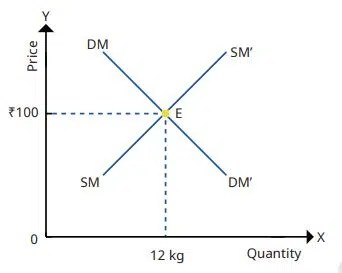
a) Maximum price
b) Minimum price
c) Equilibrium price
d) Seasonal price
Answer: c) Equilibrium price
Q56. In the demand curve diagram, points A, B, and C represent:
a) Different supply levels
b) Different demand quantities at different prices
c) Government-fixed prices
d) Seasonal variations only
Answer: b) Different demand quantities at different prices
Q57. Imagine a demand curve shifting right when income rises., When household income increases, the demand curve:
a) Shifts left
b) Shifts right
c) Becomes vertical
d) Remains unchanged
Answer: b) Shifts right
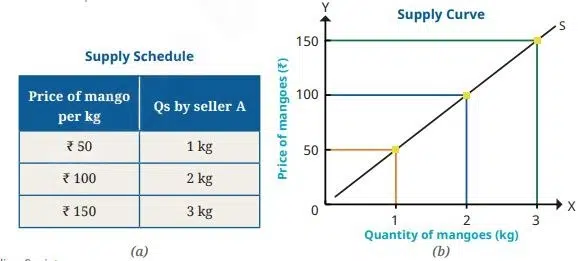
Q58. In the supply curve diagram, points A, B, and C represent:
a) Different demand levels
b) Different supply quantities at different prices
c) Government-fixed supply
d) Seasonal variations only
Answer: b) Different supply quantities at different prices
Q59. Imagine a supply curve shifting right when technology improves, when technology reduces production cost, the supply curve:
a) Shifts left
b) Shifts right
c) Becomes vertical
d) Remains unchanged
Answer: b) Shifts right
Q60. In the equilibrium diagram, point E represents:
a) Excess demand
b) Excess supply
c) Equilibrium price and quantity
d) Government intervention
Answer: c) Equilibrium price and quantity
Q61. Imagine a shifting equilibrium point on demand-supply curves, when demand for masks surged in 2020, the equilibrium point:
a) Shifted upward (higher price, higher quantity)
b) Shifted downward (lower price, lower quantity)
c) Stayed unchanged
d) Disappeared completely
Answer: a) Shifted upward (higher price, higher quantity)
Q62. Imagine a diagram showing a price ceiling and a price floor, a minimum wage set by the government is an example of:
a) Price ceiling
b) Price floor
c) Equilibrium price
d) Monopoly price
Answer: b) Price floor
Q63. Imagine a supply curve shifting left when producer incentives fall, when the government fixes prices below market levels, the supply curve:
a) Shifts right
b) Shifts left
c) Becomes vertical
d) Remains unchanged
Answer: b) Shifts left
Higher-Order Thinking (HOT)
Q64. Rumors spread that onion crops are damaged. Even before an actual shortage, prices rise sharply. This shows:
a) Prices depend only on actual supply.
b) Rumors and expectations also affect demand and price.
c) The government fixes onion prices.
d) Sellers always cheat buyers.
Answer: b) Rumors and expectations also affect demand and price.
Q65. If the price of mangoes falls from ₹150 to ₹50, Srivalli’s demand increases by 2 kg, but market demand increases by 12 kg. What does this difference highlight?
a) Individual demand is more elastic than market demand.
b) Market demand is more responsive because it combines many buyers.
c) Prices affect only one consumer
d) Elasticity does not depend on the number of buyers.
Answer: b) Market demand is more responsive because it combines many buyers.
Q66. India’s large population creates high demand for goods. What does this show?
a) Demand depends only on price.
b) Population size and composition influence demand.
c) Demand is unaffected by demographics.
d) The demand curve always slopes upward.
Answer: b) Population size and composition influence demand.
Q67. If wheat prices are low and chickpea prices are high, farmers shift to chickpeas. What does this highlight?
a) Supply depends only on demand.
b) Prices influence producers’ choices and future supply.
c) Farmers always grow chickpeas.
d) The supply curve is downward sloping.
Answer: b) Prices influence producers’ choices and future supply.
Q68. If fewer sellers are present in a market, supply is lower than demand, and prices rise. What does this highlight?
a) Number of sellers influences supply and price.
b) Supply depends only on technology
c) The demand curve always slopes downward.
d) The government fixes supply.
Answer: a) Number of sellers influences supply and price.
Q69. Why does the equilibrium price remain stable unless external factors change?
a) Because demand and supply are balanced
b) Because government fixes equilibrium
c) Because sellers stop producing
d) Because buyers stop purchasing
Answer: a) Because demand and supply are balanced
Q70. Fast fashion and overfishing increase demand today but harm future supply. What does this imply for equilibrium?
a) Equilibrium is unaffected by sustainability.
b) Short-term gains can disturb long-term equilibrium.
c) Equilibrium always remains stable.
d) The government fixes equilibrium permanently.
Answer: b) Short-term gains can disturb long-term equilibrium.
Q71. If the government stops providing sanitation and drainage systems, what problems might arise?
a) Cleaner environment
b) Improved profits for private firms
c) Poor living conditions and health issues
d) No effect on society
Answer: c) Poor living conditions and health issues
Q72. Why must democratic governments be careful while intervening in markets?
a) Because intervention always increases profits
b) Because excessive intervention can harm producers and discourage innovation
c) Because intervention has no effect on consumers
d) Because intervention makes markets perfectly stable
Answer: b) Because excessive intervention can harm producers and discourage innovation
Disclaimer: The content that is present on our website is based on the NCERT Class 9 Social Science textbook and is provided for educational purposes only. All the content and images have been taken from Social Science Class 9 NCERT Textbook and CBSE Support material. Images and content shown above are the property of individual organizations and are used here for reference purposes only. To make it easy to understand, some of the content and images are generated by AI and cross-checked by the teachers.
nice