
← Back to Class 9 Social Science NCERT Solutions
Atmosphere and Climate Class 9 NCERT Solutions? Here, you will find well-explained, step-by-step answers to all the textbook questions based on the latest CBSE syllabus. These solutions cover important topics such as the composition and layers of the atmosphere, weather and climate, factors affecting climate, air pressure, winds, humidity, and rainfall.
Atmosphere and Climate Class 9 NCERT Solution
Questions and activities
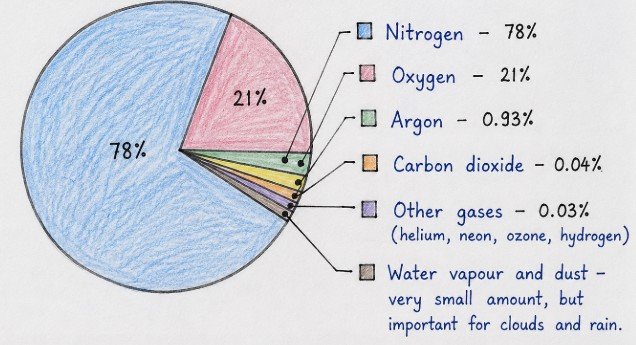
1. What is atmosphere? Explain its composition with the help of a pie diagram.
Answer: The atmosphere is a blanket of air around the Earth. It protects us from the Sun’s harmful rays and keeps Earth warm.
Composition:
- Nitrogen – 78%
- Oxygen – 21%
- Argon – 0.93%
- Carbon dioxide – 0.04%
- Other gases – 0.03% (helium, neon, ozone, hydrogen)
- Water vapour and dust – very small amount, but important for clouds and rain.
2. Draw a labelled diagram of the structure of atmosphere.
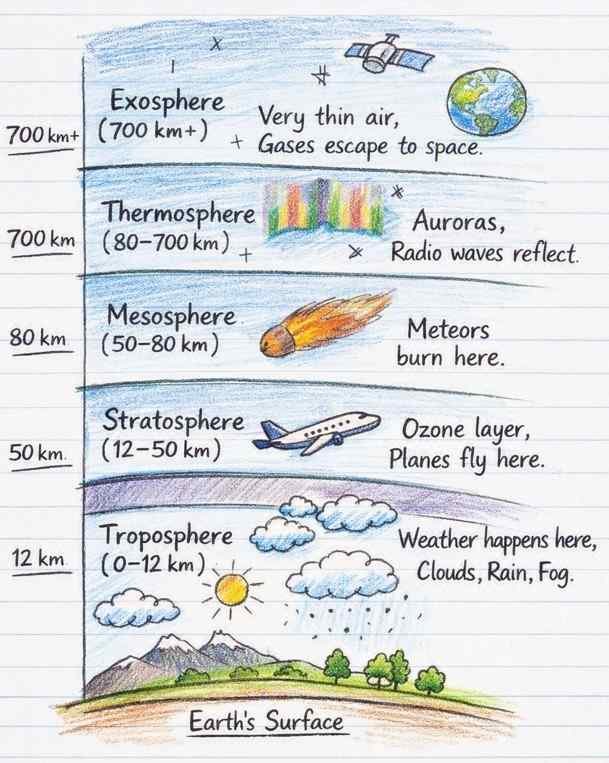
Answer: The Labelled diagram of the structure of atmosphere are –
3. Which are the four main seasons of India?
Answer: India has four main seasons according to the Indian Meteorological Department (IMD).
- Winter Season (December to April): The weather is cold during this time. Northern India feels much cooler than the southern parts.
- Summer or Pre‑Monsoon Season (April to June): The weather becomes very hot. Days are long and dry, and temperatures rise across the country.
- Monsoon or Rainy Season (June to September): Heavy rainfall occurs because of the south‑west monsoon winds. Rivers, lakes, and crops get plenty of water.
- Post‑Monsoon or Retreating Monsoon Season (October to December): Rainfall slowly decreases, and the weather turns cool and pleasant again.
4. Why do you not feel the pressure of the atmosphere?
Answer: The air around us is very heavy and presses on our body all the time. This force is called atmospheric pressure. But we do not feel it because the air pushes from all sides equally. At the same time, our body also has its own internal pressure that balances the outside pressure. Since both pressures cancel each other, we remain comfortable and do not feel the weight of the air.
5. In which layer of the atmosphere do aeroplanes fly and why?
Answer: Aeroplanes usually fly in the stratosphere, which is the second layer of the atmosphere, above the troposphere. This layer is chosen because it is calm and free from clouds, storms, and weather changes. Flying here makes the journey smoother and safer. The stratosphere also has less air resistance, so planes can save fuel and travel faster.
6. Distinguish between the following:
a. The troposphere and stratosphere
b. The south-west monsoon and north-east monsoon
Answer:
a) Troposphere vs Stratosphere
| Feature | Troposphere | Stratosphere |
|---|---|---|
| Height | 0–12 km | 12–50 km |
| Temperature | Falls with altitude | Rises with altitude |
| Weather | Rain, fog, hail, clouds | Calm, no weather |
| Special feature | Contains most water vapour | Contains ozone layer |
| Importance | All weather activity happens here | Aeroplanes fly here |
b) South‑West Monsoon vs North‑East Monsoon
| Feature | South‑West Monsoon | North‑East Monsoon |
|---|---|---|
| Time | June–September | October–February |
| Direction | Sea → Land | Land → Sea |
| Rainfall | Heavy rainfall in most of India | Rainfall mainly in Tamil Nadu, Andhra Pradesh |
| Cause | Land heats faster than sea | Land cools faster than sea |
| Importance | Main source of water for crops | Important for south‑east India rainfall |
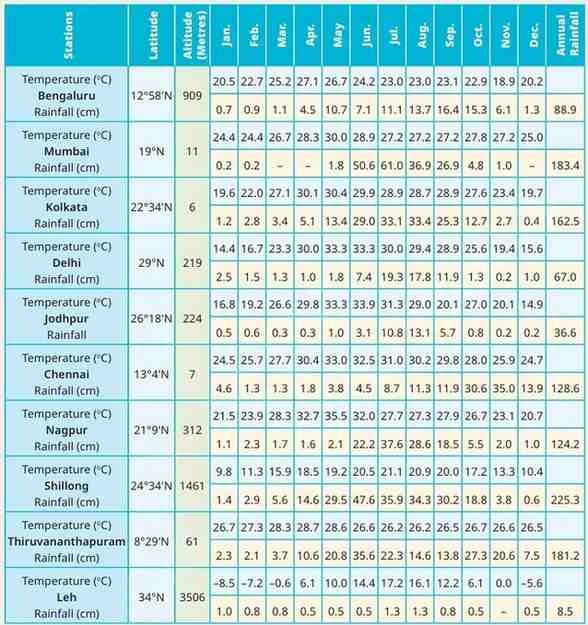
7. Do it yourself: Table 3.3 shows the average monthly temperatures and rainfall amounts for 10 representative stations. Study these figures on your own and convert them into ‘temperature and rainfall’ graphs. The visual representations will help you grasp their similarities and differences at a glance. One such graph (Fig. 3.14) is already prepared for you. See if you can arrive at some broad generalisations about our diverse climatic conditions.
7.1. Now look at Table 3.3 again. Re-arrange the 10 stations according to their distance from the equator.
Answer: From south to north (closest to farthest): Thiruvananthapuram → Chennai → Bengaluru → Mumbai → Nagpur → Kolkata → Shillong → Jodhpur → Delhi → Leh. This order shows how temperature generally decreases as we move away from the equator.
7.2 Find out:
- a. Two stations with the most extreme climate.
- b. Two stations influenced by retreating monsoons.
- c. The two hottest stations in the months of (i) February (ii) June
Answer:
a. Two stations with the most extreme climate:
- Leh (very cold, little rain)
- Jodhpur (very hot, very dry)
b. Two stations influenced by retreating monsoons:
- Chennai and Thiruvananthapuram (get rainfall in October–December).
c. Two hottest stations:
- February: Chennai and Thiruvananthapuram.
- June: Nagpur and Jodhpur.
7.3. Now find out:
- a. Why does Shillong experience more rainfall than Kolkata?
- b. Why does Delhi receive more rainfall than Jodhpur?
Answer:
a. Why Shillong gets more rainfall than Kolkata:
- Shillong is on hills facing the Bay of Bengal winds. Moist air rises and cools, causing heavy rain. Kolkata is on the plains, so it gets less rainfall.
b. Why Delhi gets more rainfall than Jodhpur:
- Delhi lies near the Himalayas, which stop monsoon winds and cause rain. Jodhpur is in the desert region, far from the sea, so it gets little rain.
7.4. Now think why
a. Thiruvananthapuram has an equable climate?
b. Chennai has more rainfall only after the fury of the monsoon is over in most parts of the country?
c. Leh has moderate precipitation almost throughout the year?
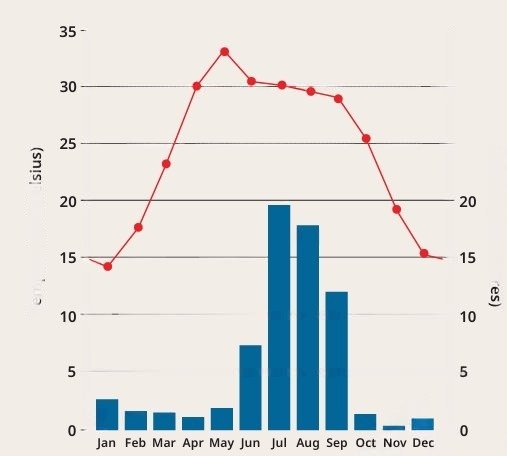
Answer:
a. Thiruvananthapuram has an equable climate:
- It is near the sea, so the ocean keeps temperatures mild all year.
b. Chennai gets more rainfall after the main monsoon:
- It faces the Bay of Bengal and receives rain from the north‑east monsoon after September.
c. Leh has moderate precipitation all year:
- Leh is high in the Himalayas, far from the sea. It gets little rain or snow because moist winds cannot reach easily.
7.5. Despite these differences across regions, can you observe any substantial evidence to conclude that the monsoons provide a very strong framework, lending overall climatic unity to the whole country?
Answer: Even though India has many different climates—hot deserts, cool mountains, rainy coasts—the monsoon winds connect them all. Every region depends on the monsoon for water, farming, and life. This shows that the monsoon gives India a strong climatic unity.
8. Collect pictures of houses and clothing of people from different regions of India. Examine whether they reflect any relationship with the climatic conditions or the relief of those regions.
Answer:
Houses and Climate
Rajasthan (hot desert):
- Thick walls, small windows → keep houses cool.
- Flat roofs → easy to sleep outside in summer nights.
Kerala (heavy rainfall):
- Sloping tiled roofs → rainwater flows off easily.
- Houses often raised on stilts in flood‑prone areas.
Kashmir (cold mountains):
- Wooden houses with sloping roofs → protect from snow.
- Small windows → keep warmth inside.
Clothing and Climate
Rajasthan:
- Light cotton clothes → protect from heat.
- Turbans → shield head from sun.
Kerala:
- Cotton dhotis and sarees → comfortable in humid climate.
Kashmir:
- Woollen clothes, pheran (long coat) → protect from cold.
- Kangri (fire pot) carried under clothes for warmth.
Disclaimer: The content that is present on our website is based on the NCERT Class 9 Science textbook and is provided for educational purposes only. All the content and images have been taken from Science Class 9 NCERT Textbook and CBSE Support material. Images and content shown above are the property of individual organizations and are used here for reference purposes only. To make it easy to understand, some of the content and images are generated by AI and cross-checked by the teachers.