
← Back to Class 9 Social Science NCERT Solutions
Elections Class 9 NCERT Solutions provide accurate, step-by-step answers to all the questions from the NCERT Class 9 Civics chapter “Elections.” These solutions are prepared according to the latest CBSE syllabus and help students understand important concepts such as the need for elections, democratic elections, the election process in India, the role of the Election Commission, political parties, and challenges to free and fair elections.
Elections Class 9 NCERT Solutions
Q1. Why are elections essential to a democratic system?
Answer: Elections are essential because they allow citizens to choose representatives who make decisions on their behalf. They ensure accountability, legitimacy, equality, and representation. Without regular elections, leaders could continue in power without people’s consent, which would weaken democracy.
Q2. How do electoral systems and rules shape political representation and fairness?
Answer: Electoral systems decide how votes are converted into seats. For example, India uses the First‑Past‑The‑Post system for Lok Sabha and Vidhan Sabha, and proportional representation for Rajya Sabha and Presidential elections. These rules shape fairness by deciding whether all groups get represented or only the majority voice is heard.
Q3. What role do institutions and laws play in ensuring free and fair elections?
Answer: Institutions like the Election Commission of India and laws like the Representation of the People Acts ensure elections are transparent. They regulate voter rolls, campaigns, symbols, and disputes. They also prevent corrupt practices, making elections fair and trustworthy.
Q4. What challenges do elections face in practice, and how can these challenges affect democracy?
Answer: Elections face challenges like misinformation, fake news, intimidation, misuse of money, and accessibility issues. If these are not controlled, elections lose fairness, and citizens lose trust in democracy. As the chapter says, “if fairness is not ensured, public confidence in electoral institutions may gradually weaken.”
Q5. What reforms have been introduced by the ECI to make voting more inclusive for the following groups?
Answer: The Election Commission has made voting more inclusive by introducing Braille EVMs, the Saksham app, and home voting for Persons with Disabilities. For Service Voters, the Electronically Transmitted Postal Ballot System (ETPBS) allows voting from outside their constituency. For Senior Citizens above 85, home voting was introduced in the 2024 elections. Prisoners are not allowed to vote, but persons in preventive detention retain their voting rights.
Q6. What are the various functions of the Election Commission of India? Which of these functions is most important for the conduct of free and fair elections? Explain.
Answer: The Election Commission prepares electoral rolls, registers parties, allots symbols, decides election schedules, supervises polling, counts votes, and resolves disputes. It also enforces the Model Code of Conduct and prevents corrupt practices. The most important function is ensuring free and fair elections, because without fairness, citizens lose trust in democracy and elections lose their meaning.
Q7. Elections are the soul of a democracy. Do you agree? Why or why not?
Answer: Yes, elections are the soul of democracy because they give every citizen an equal voice in choosing representatives. As the chapter says, “Elections are the most important process for exercising democratic rights.” Without elections, leaders would not be accountable, and democracy would lose legitimacy and equality.
Q8. Explain at least three differences between the national and state/regional political parties.
Answer: National parties contest elections across India and must secure votes or seats in multiple states, while state/regional parties are recognised only within one state. National parties are allotted symbols valid nationwide, whereas state parties’ symbols are valid only in their state. National parties influence national policies, while state parties focus mainly on local or regional issues.
Q9. Why should you vote? Arrange the following in the descending order of your choice. Discuss the reasons for your choice.
a. Opportunity to choose my representative
b. Makes me a responsible person
c. Opportunity to change the non-performing representative
d. Strengthens democracy
Answer: Voting is important because it gives citizens the opportunity to choose their representative, strengthens democracy, allows them to change a non‑performing leader, and makes them responsible citizens. My order of choice would be:
- Opportunity to choose my representative
- Opportunity to change the non‑performing representative
- Strengthens democracy
- Makes me a responsible person
This order is chosen because the most direct power of voting is to select or remove leaders, which directly affects governance. At the same time, voting builds responsibility and keeps democracy strong.
Q10. What is the Special Intensive Revision (SIR) initiative of the ECI? Explain the objectives and the necessity of conducting SIR.
Answer: The Special Intensive Revision (SIR) is an initiative of the Election Commission of India to update and correct electoral rolls. Its objectives are to ensure that no eligible citizen is left out, especially young voters who just turned 18, and that no ineligible names remain due to death, change of residence, or duplication. The necessity of SIR lies in maintaining accurate voter lists, which is essential for free and fair elections and for protecting the democratic right of every citizen to vote.
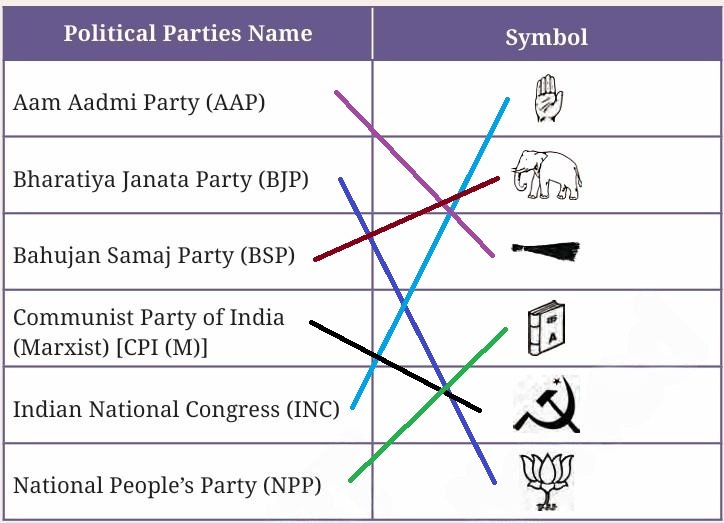
Q11. Match the political party name with its symbol.
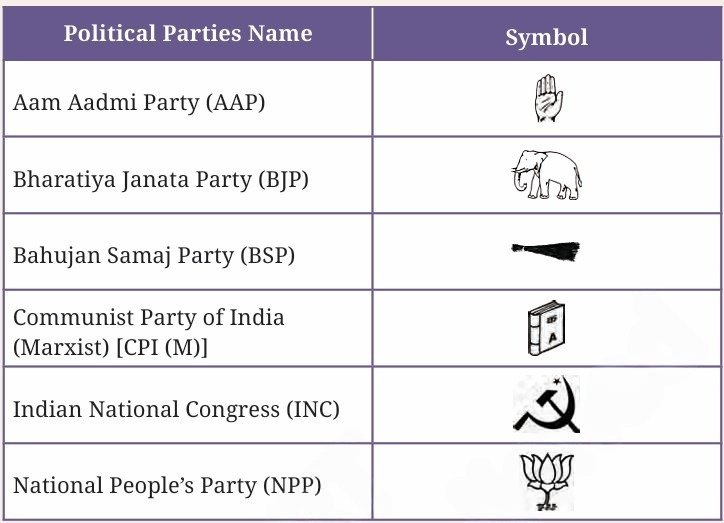
Answer:
Q12. Read the case study below and answer the following questions. Ishani and her mother were in the local market, day before the state assembly elections. She noticed wall writing and campaign posters pasted everywhere. Large groups of campaigners were distributing pamphlets and raising slogans in support of the respective candidates. Ishani has turned 18 and will be voting for the first time. She had registered to vote through the ECI’s online portal. The next morning, she, along with her mother and her disabled elder brother, went to the polling station, which was well guarded by the police personnel. A wheelchair was made available to them, and volunteers guided them to the polling booth. Inside the polling booth, there were only three people who were performing all duties. Ishani had forgotten her voter ID card and Aadhaar card, but her identity was verified with an alternative document. After casting her vote, she was also able to see the VVPAT slip. While leaving, she wondered how the police personnel vote, as they must be on duty from early morning till late evening. When she went home, she narrated her entire experience to her 89-year-old grandmother, who cast her vote from home.
a. What initiatives were taken by the ECI to enable the voters to cast their vote?
Answer: The Election Commission provided facilities like wheelchairs and volunteers for Persons with Disabilities, allowed alternative ID verification if voter ID was forgotten, used VVPAT slips for transparency, and introduced home voting for senior citizens above 85 years.
b. If Ishani was allowed to vote even without carrying her Voter ID card or Aadhaar card, which other document might she be carrying that is valid for voting?
Answer: She could use another valid document such as a passport, driving licence, PAN card, or service identity card approved by the ECI.
c. Cite the examples of violations of the Model Code of Conduct.
Answer: Wall writing, campaign posters pasted in public places, and loud slogans near the polling day are violations of the Model Code of Conduct.
d. Give a suitable title to the passage.
Answer: A First Experience of Voting in India
e. Find out how the police and army personnel cast their votes.
Answer: Police and army personnel are classified as service voters. They cast their votes using the Electronically Transmitted Postal Ballot System (ETPBS), which allows them to receive and submit ballots electronically from wherever they are posted.
Q13. A comparative chart of three countries is given below. Based on the information given in the chart, answer the questions.
| Country A | Country B | Country C | |
|---|---|---|---|
| Political Dimension | Written constitution, periodic elections, voting rights, party system varies from two-party to multi-party. | Written constitution, periodic elections, voting rights, one political party. | Written constitution, monarchy, no voting rights, no political party. |
| Economic Dimension | Average standard of living. | Above-average standard of living. | High standard of living. |
a. What is the difference between having a voting right in
a country with a multi-party system and another with a single-party system?
b. In which of the above countries would you like to stay and why?
Answer:
a. Difference in Voting Rights
- In a multi‑party system, voters have real choice among different parties and policies.
- In a single‑party system, voting exists but there is no real choice, since only one party contests.
b. Preferred Country
- I would choose Country A because it ensures political freedom and democratic rights, even if the economy is average. Freedom and accountability make life more meaningful than prosperity without choice.
Q14. What are the challenges to conducting free and fair elections?
Answer: Conducting elections in India is difficult because of misinformation and fake news, intimidation of voters, misuse of money power, and accessibility issues for persons with disabilities or elderly citizens. If these challenges are not controlled, elections lose fairness and citizens lose trust in democracy.
Q15. On the Stage. Elections are to be held in your school for the posts of Head Girl, Head Boy, and Sports Captain. Assume the roles of an Election Commissioner, Returning Officer, Polling Agent, Candidate, Campaigner, Polling Officer, Police Personnel, and a Journalist, and perform their roles while ensuring free, fair, and transparent elections.
Answer: This activity can be done as a role‑play. The Election Commissioner will announce the schedule and rules. The Returning Officer will check nominations. Polling Agents and Officers will supervise voting. Candidates and Campaigners will present their promises. Police Personnel will maintain discipline. The Journalist will report the process. Together, these roles show how elections are conducted fairly and transparently.
Q16. Try and make videos or audios on topics like: My Vote My Nation; No Voter to be Left Behind; How to Eliminate the Ill of Money Power, etc.
Answer: Students can prepare short awareness videos or audios. For example, “My Vote My Nation” can highlight the importance of voting. “No Voter to be Left Behind” can show facilities for senior citizens and PwDs. “Eliminate Money Power” can explain why bribery and corruption harm democracy. These creative projects spread awareness about responsible voting.
Q17. Select one national or state political party. Using authentic and reliable sources such as the Election Commission of India (ECI) website, the official website of the selected political party, and newspapers. Prepare a comparative chart of the last two State Legislative Assembly elections. The chart should include the following details for the chosen party:
a. Some promises made in the Election manifesto
b. Percentage of votes polled
c. Number of seats won
d. Number of women who contested
e. Number of women candidates elected. Present the data for both elections in a clear and comparative format, citing all sources used.
Answer: For this question, you need to choose one party (like INC, BJP, or a state party) and collect data from the ECI website, party manifestos, and newspapers. Then prepare a comparative chart showing promises, vote share, seats won, and women’s participation in the last two state elections.
Q18. Do you think ‘One Nation, One Election’ can improve the efficiency of the electoral process? Divide the class and discuss into two groups—one to examine its potential advantages and the other to analyse its limitations.
Disclaimer: The content that is present on our website is based on the NCERT Class 9 Science textbook and is provided for educational purposes only. All the content and images have been taken from Science Class 9 NCERT Textbook and CBSE Support material. Images and content shown above are the property of individual organizations and are used here for reference purposes only. To make it easy to understand, some of the content and images are generated by AI and cross-checked by the teachers.
Nice explaination I ever saw😊😊
very nice explanation