
← Back to Class 9 Social Science NCERT Solutions
Building Blocks in Economics: The Problem of Choice Class 9 NCERT Solutions provide accurate, step-by-step answers to all the questions from the NCERT Class 9 Economics chapter “Building Blocks in Economics: The Problem of Choice.” These solutions are prepared according to the latest CBSE syllabus and help students understand important concepts such as scarcity, choice, opportunity cost, resources, economic activities, production, and decision-making.
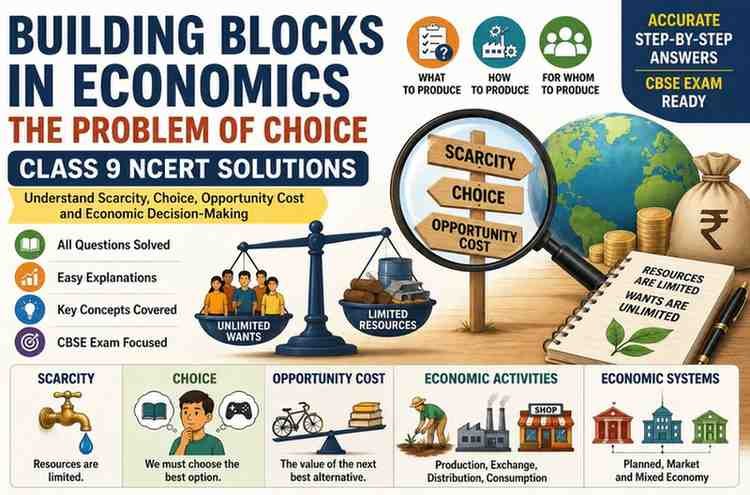
Building Blocks in Economics the Problem of Choice Class 9 NCERT Solutions
Q1. What does economics deal with?
Answer: Economics deals with the problem of scarcity and choice. Resources like land, labour, money, and technology are limited, but human wants are unlimited.
It studies how individuals, families, businesses, and governments make decisions to use these limited resources in the best way. For example, whether to spend money on food or save it, whether a farmer should grow wheat or barley, or whether the government should build hospitals or highways.
Q2. What are the key questions in economics?
Answer: Economics tries to answer three main questions that come from the problem of limited resources and unlimited wants:
- What to produce – Deciding which goods and services should be made and in what quantity.
- How to produce – Choosing the best way to make them, using labour, machines, or technology.
- For whom to produce – Deciding who will get the goods and services, based on people’s needs and income.
Q3. How do different economic systems address these questions?
Answer: Different economic systems answer the three key questions — what to produce, how to produce, and for whom to produce — in different ways:
- Planned economy: The government decides everything — what goods will be made, how they will be produced, and who will get them. Example: North Korea.
- Market economy: Decisions are made by buyers and sellers through demand and supply. Prices guide production and distribution. Example: USA, Japan.
- Mixed economy: Both government and private businesses share the role. The market works freely, but the government regulates and provides public goods. Example: India, Germany.
Q4. Why do you think people’s wants keep changing over time? How does this affect production in an economy? Why cannot all our wants be satisfied?
Answer: People’s wants change with income, lifestyle, and technology. This forces producers to adjust production to meet new demands. All wants cannot be satisfied because resources are limited, creating scarcity.
Q5. ‘Human wants are unlimited and keep changing’. How do you think this constant desire for more creates pressure on the environment? Can the fulfilment of wants and the extraction of resources be balanced?
Answer: Unlimited wants lead to overuse of resources, deforestation, pollution, and climate change. Balance can be achieved through sustainable use of resources, recycling, and eco‑friendly production.
Q6. Can you think of a resource in your region that is scarce but used wastefully? How could it be managed better?
Answer: In Village, water is scarce but often wasted in agriculture and households. It can be managed better by drip irrigation, rainwater harvesting, and awareness campaigns.
Q7. Which economic system—market, planned, or mixed—do you think gives people the most freedom? Which economic system is best suited for promoting innovation? Why?
Answer: A market economy gives the most freedom because people and enterprises decide production. It also promotes innovation due to competition. However, a mixed economy balances freedom with regulation, making it practical.
Q8. Critically examine why pure economic systems rarely exist in reality. Assess the limitations of such systems and justify why a mixed economy is often considered a more practical and effective approach in real-world contexts.
Answer: Pure systems rarely exist because planned economies limit innovation, while market economies ignore social welfare. A mixed economy is practical as it combines competition and innovation with government regulation and welfare.
Q9. A student has ₹100 and must choose between buying a notebook or saving the money for buying a tennis racket later. Which economic concept best explains this situation?
a. Demand
b. Opportunity cost
c. Production
d. Inflation
Answer: b. Opportunity cost
Q10. How does understanding opportunity cost improve the quality of economic decision-making?
Answer: It helps people and governments see what they give up when choosing one option over another, leading to better planning and efficient use of resources.
Q11. Can effective economic decisions be made without reliable data?
Answer: No. Reliable data is necessary to understand demand, supply, prices, and future risks. Without data, decisions may waste resources.
Q12. Support your answer with an example. Analyse how a country’s present economic choices can shape its long-term future. Why is it important to consider future consequences while making economic decisions today?
Answer: For example, if a country invests more in education and healthcare, it builds a strong workforce for the future. Present choices shape long‑term growth, so governments must consider future sustainability while making decisions today.
Q13. Identify a news article from any newspaper of your choice about a product or commodity (such as vegetables, fruits, fuel, or electronics) where producers or companies are deciding how much to produce or supply. Write 2–3 sentences explaining the example you found and why the production decision was made.
Answer: Example: A newspaper reported that farmers reduced onion supply due to poor rainfall. The decision was made because low water availability affected production, showing how natural factors influence supply.
Disclaimer: The content that is present on our website is based on the NCERT Class 9 Science textbook and is provided for educational purposes only. All the content and images have been taken from Science Class 9 NCERT Textbook and CBSE Support material. Images and content shown above are the property of individual organizations and are used here for reference purposes only. To make it easy to understand, some of the content and images are generated by AI and cross-checked by the teachers.