
← Back to Class 9 Social Science NCERT Solutions
State and Society up to 1000 CE Class 9 NCERT Solutions are prepared according to the latest CBSE Class 9 Social Science syllabus and help students understand every question in a simple and easy-to-follow manner. The chapter explains the evolution of states, kingdoms, administration, social structure, economy, trade, religion, and cultural developments in India up to 1000 CE.
State and Society up to 1000 CE Class 9 NCERT Solutions
Q1. How did political organisation change from the Vedic period to the age of large empires such as the Mauryas and the Guptas? Explain the administrative system of the early Indian states.
Answer: In the Vedic period, politics was simple — small clans (janas) led by a chief (rājā). Decisions were discussed in assemblies like sabha and samiti.
Later, clans settled in territories called janapadas, and bigger units called mahājanapadas appeared. Magadha grew powerful and gave rise to large empires like the Mauryas and Guptas.
Administrative system (short points)
- King: Supreme authority, responsible for protection and justice.
- Council of ministers: Helped the king in decisions.
- Saptāṅga (seven parts of state): King, ministers, territory, forts, treasury, army, allies.
- Provinces & districts: Empire divided into provinces, districts, and villages.
- Local officials: Governors, tax collectors, and village headmen managed daily work.
Q2. Describe the role of the king, important officers, and the methods used to govern large territories.
Answer: The king was the head of the state. His duty was to protect people, maintain law and order, and give justice.
Officers
- Ministers advised the king.
- Treasurer & tax collectors managed money.
- Commander‑in‑chief looked after the army.
- Legal advisors guided on justice.
Governing methods
Large empires were divided into provinces, districts, and villages. Local officials like governors and village headmen managed daily work. Important residents (bankers, artisans, caravan leaders) were often consulted.
Q3. After studying this chapter, what do you think were the most important features of the state and society in India before 1000 CE?
Answer: Indian society before 1000 CE was built on clans, dharma, and shared customs, while the state grew from small groups to big empires with organised administration and the ideal of unity under a powerful king.
Q4. What do early texts such as the Ṛigveda, Arthaśhāstra, and the Mahābhārata reveal about political and social life?
Answer: Early texts give us important clues about political and social life in ancient India:
- Ṛigveda: Shows early society organised into clans (janas). The rājā was a chief, not a powerful king. Assemblies like sabha and samiti allowed people to take part in decisions. It reflects a simple, kin‑based political system.
- Arthaśhāstra: Written by Kauṭilya, it explains duties of the king, importance of ministers, treasury, army, and allies (the Saptāṅga). It shows how large empires needed organised administration, taxation, and law enforcement.
- Mahābhārata: Describes ideals of kingship — rulers must protect people, ensure justice, and act fairly. It also highlights social duties, dharma, and the relationship between rulers and subjects.
Q5. What can we learn from early Indian society about varṇa and the role of women?
Answer: Early Indian society gives us two important lessons about varṇa and the role of women:
Varṇa system: Society was divided into groups based on work and duties. The four varṇas were Brahmins (priests, teachers), Kshatriyas (warriors, rulers), Vaishyas (farmers, traders), and Shudras (workers, service providers). This division organised society and gave each group a role in maintaining order.
Women’s role: Women took part in family, rituals, and sometimes education. In the Vedic period, some women composed hymns and joined discussions. Over time, their role became more limited, but texts still show that women were respected in household and cultural life.
Q6. Explain how assemblies like sabhā and samiti limited the power of the rājā. Which modern institutions perform similar functions today?
Answer: In the Vedic period, assemblies like sabha and samiti limited the power of the rājā.
- The sabha was a smaller body that discussed judicial matters.
- The samiti was a larger gathering where people took part in policy and political decisions.
- These assemblies meant the king could not rule alone; he had to listen to the community.
In modern times, similar roles are played by parliaments and legislatures. They check the power of leaders, make laws, and ensure people’s participation in governance.
Q7. What do the terms varṇa and jāti refer to in early Indian society? How were they different, and what factors may have contributed to the formation of various jātis?
Answer: In early Indian society, two important terms were used:
- Varṇa – This meant the four broad social groups: Brahmins (priests), Kshatriyas (warriors), Vaishyas (farmers/traders), and Shudras (workers). It was based on duties and status.
- Jāti – These were smaller groups within society, often linked to specific occupations, families, or local communities.
Difference:
Varṇa was a big framework dividing society into four classes, while jāti was more detailed and practical, showing everyday work and social identity.
Formation of jātis:
Many factors contributed —
- Occupation (farmers, artisans, traders, priests).
- Birth and family ties.
- Local customs and traditions.
- Migration and mixing of cultures.
Q8. Why do you think education in early India emphasised both knowledge and moral values? How might this have benefited society?
Answer: In early India, education was not only about learning skills or knowledge but also about moral values. Texts like the Vedas and Upaniṣhads taught ideas of truth, duty, respect, and self‑control along with subjects like language, rituals, and philosophy.
This was important because:
- Knowledge alone could make people clever, but values made them responsible and fair.
- It helped rulers, ministers, and citizens act with justice and honesty.
- It created unity in society by teaching respect, cooperation, and ethical living.
Q9. Look at the major trade routes of early India (Fig 5.12). How do you think these routes helped people in the exchange of goods, skills, beliefs, and cultural practices.
Answer: The trade routes of early India made life richer and more connected.
- They allowed goods like crops, metals, and spices to move from one region to another.
- People shared skills such as weaving, pottery, and metalwork.
- Beliefs like Buddhism and Hinduism spread to faraway lands.
- Cultural practices such as music, art, and language mixed, creating unity among different regions.
Q10. What might have been the advantages and challenges of ruling a large empire in the absence of modern communication systems?
Answer: Large empires gave unity and power but faced big problems in communication and control. Without modern systems, rulers depended on local officers and slow networks to govern effectively.
Q11. Many ideas about governance come from texts composed by scholars and advisors of the king. What might be some limitations of relying only on such sources?
Answer: Texts like the Ṛigveda, Arthaśhāstra, and Mahābhārata were written by scholars and advisors close to kings. They give us valuable ideas about governance, but relying only on them has limits:
- They often show the ideal picture of kingship and society, not the everyday reality.
- They reflect the views of elites (priests, advisors, rulers), not ordinary people like farmers, artisans, or women.
- They may ignore local customs and regional differences.
- They sometimes justify royal power, so they are not always neutral.
Q12. Read the source and answer the questions:
The Nāśhik cave inscription (2nd century CE) of Uṣhavadāta records: “Uṣhavadāta, son of Dinika, son-in-law of king Nahapāna … has bestowed this cave on the Saṁgha generally;
he has also given a perpetual endowment, three thousand—3000 kāhāpaṇas, which, for the members of the Saṁgha of any sect, and any origin dwelling in this cave, will serve as cloth money and money for outside life (kuśhaṇa);
and those kāhāpaṇas have been invested in guild dwelling at Govadhana—2000 in a weavers’ guild, interest one pratika (monthly) for the hundred, (and) 1000 in another weaver’s guild, interest three quarters of a paḍika (monthly) for the hundred.”
a. What does this source tell us about the economic role of guilds?
b. Why were guilds trusted with money deposits?
c. Identify the donor and the donees from the given source.
Answer:
a. Economic role of guilds
- The source shows that guilds acted like banks. Money was deposited with them, and they paid interest regularly. They supported trade and crafts like weaving.
b. Why guilds were trusted
- Guilds were trusted because they were stable, organised groups of artisans and traders. They managed money carefully, gave fixed interest, and ensured security of deposits.
c. Donor and donees
- Donor: Uṣhavadāta, son‑in‑law of King Nahapāna.
- Donees: The Saṁgha (Buddhist community) living in the cave, from any sect or origin.
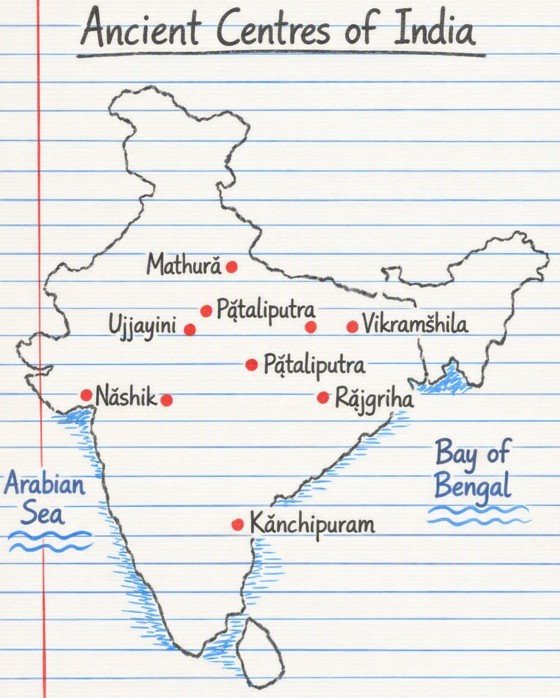
Q13. Mark and locate on the map of India the following important centres: Pāṭaliputra, Nāśhik, Ujjayinī, Vikramśhila, Kānchipuram, Mathurā, Rājgṛiha.
Answer:
Q14. Prepare a short presentation or poster on one of the following—
a. Life in the Vedic society
b. Early education system (gurukula)
c. Trade and guilds in early India
d. Role of women in early Indian society
Answer:
- Social life: People lived in tribes. Family was central. Elders were respected.
- Economy: Farming, cattle rearing, and simple trade were common. Cattle were wealth.
- Assemblies: Sabha and Samiti guided the king and limited his power.
- Religion: Worship of nature gods like Indra (rain), Agni (fire), Surya (sun). Rituals and hymns were important.
- Education: Learning of Vedas, discipline, and moral values. Gurukula system started.
- Role of women: Women took part in rituals, some were scholars, and family life was central.
Disclaimer: The content that is present on our website is based on the NCERT Class 9 Science textbook and is provided for educational purposes only. All the content and images have been taken from Science Class 9 NCERT Textbook and CBSE Support material. Images and content shown above are the property of individual organizations and are used here for reference purposes only. To make it easy to understand, some of the content and images are generated by AI and cross-checked by the teachers.