
← Back to Class 9 Social Science NCERT Solutions
Early Humans and Beginning of Civilisation Class 9 NCERT Solutions? Here, you will find simple, detailed, and step-by-step answers to all the textbook questions based on the latest CBSE syllabus. These NCERT solutions cover important topics such as the evolution of early humans, the Stone Age, discovery of fire, development of tools, agriculture, domestication of animals, the rise of settlements, and the beginning of civilisation.
Early Humans and Beginning of Civilisation Class 9 NCERT Solutions
Questions and activities
1. Do you think life became easier or more challenging after humans started farming? Give two reasons for your answer.
Answer: Life became both easier and more challenging after humans started farming. It became easier because people could grow food and store it, so they did not have to move around all the time. But it also became challenging because farming needed hard work, and people had to depend on weather and protect crops from floods or droughts.
2. The environment offers human societies both opportunities as well as challenges. Explain with reference to early farming communities and river-valley civilisations.
Answer: The environment gave early farming communities and river‑valley civilisations both opportunities and challenges. Rivers like the Indus, Nile, and Tigris‑Euphrates provided fertile soil, water for crops, and easy transport, which helped farming and trade. This was the big opportunity. But the same rivers also caused floods and droughts, which damaged crops and houses. Farming needed hard work, and people had to depend on nature. So, the environment helped humans grow food and build civilisations, but it also tested them with natural problems.
3. Why do historians divide early human history into different ages such as Stone Age, Bronze Age, and Iron Age? What does this classification tell us about human progress?
Answer: Historians divide early human history into Stone Age, Bronze Age, and Iron Age because people used different materials for tools in each period. This shows how humans made progress step by step — from stone tools to bronze tools and finally to iron tools, which were stronger and helped in farming, trade, and building civilisations.
4. Imagine you are a Neolithic farmer. Describe one day of your life. What challenges would you face that a hunter-gatherer would not?
Answer: As a Neolithic farmer, I live in a small village and spend my day growing crops like wheat, barley, or rice. I also look after animals such as cattle, sheep, and goats. My life is settled, with houses made of mud bricks and food stored in granaries.
The challenges I face are different from hunter‑gatherers. Farming depends on seasons and weather. Floods, droughts, or crop failure can make survival hard. I must work daily in the fields, unlike hunter‑gatherers who only searched for food.
5. Imagine that the Harappan script gets deciphered tomorrow. What new types of information do you think historians might learn?
Answer: If the Harappan script is understood, historians will learn new information about the Harappan civilisation. They may know the names of rulers and people, details of events, trade, and religion, and how society was organised. Written records could explain their political life, cultural practices, and daily activities.
6. Prepare a table with three columns—Palaeolithic, Mesolithic, and Neolithic—and fill in their distinctive features: tools, settlements, art, and subsistence.
Answer: Distinctive Features of Early Ages
| Palaeolithic | Mesolithic | Neolithic | |
|---|---|---|---|
| Tools | Large stone tools like hand axes, cleavers, scrapers | Small microlith tools, blades, bow and arrow | Polished stone tools, sickles, grinding stones |
| Settlements | Nomadic, lived in caves and rock shelters | Temporary camps, caves, rock shelters | Permanent villages with mud‑brick houses |
| Art | Cave paintings, body decoration | Cave art (Bhimbetka), beads, engravings | Pottery, ornaments, decorated tools |
| Subsistence | Hunting and gathering | Hunting, fishing, gathering wild grains | Farming, domestication of animals, food storage |
7. “Bronze Age civilisations developed independently but shared common features.” Examine this statement with reference to the civilisations given in the chapter.
Answer: Bronze Age civilisations like the Harappan, Mesopotamian, Egyptian, and Chinese developed independently in different river valleys. Each had its own local features — for example, Harappans used pictographic script, Mesopotamians built ziggurats, Egyptians developed hieroglyphs, and Chinese grew around the Huang He river.
But they also shared common features: all grew near rivers, practised agriculture, used bronze tools, developed trade, pottery, and urban centres. They had organised societies, craft production, and systems of writing or symbols.
8. Although rivers provided many benefits, they also created challenges for early societies. Discuss both the advantages and disadvantages of settling near rivers.
Answer: Rivers: Advantages and Disadvantages
Advantages:
- Rivers gave fertile soil for farming.
- They provided water for crops, animals, and people.
- Rivers helped in trade and transport.
- Civilisations like Harappan, Mesopotamian, Egyptian, and Chinese grew near rivers.
Disadvantages:
- Rivers also caused floods that destroyed crops and houses.
- Sometimes there were droughts when rivers dried up.
- People had to work hard to control water and protect settlements.
9. With the help of your teacher, find out more about the Code of Hammurabi. Why was it important? Do you think it was fair to all sections of society? Give reasons for your answer.
Answer: Importance of the Code
- First major written law code: 282 laws carved on a stone stele, displayed publicly.
- Covered daily life: family, property, trade, injury, and crime.
- Introduced “eye for an eye” justice: punishments matched the crime.
- Centralised authority: strengthened the king’s control and gave people a common legal framework.
- Protected weaker groups: some laws aimed to safeguard widows, orphans, and workers.
Was it fair?
- Not fully fair: penalties varied by social class and gender. For example, nobles and commoners received different punishments for the same crime.
- Harsh punishments: death or mutilation for certain offences.
- Progressive elements: gave rights in family law and worker protection, but still reflected inequality.
10. If you had to choose one major innovation from early civilisations that changed the world permanently, what would it be and why?
Answer: One major innovation from early civilisations was the invention of writing. It changed the world permanently because it allowed people to record names, events, trade, and laws. Writing helped in communication across generations, made history more accurate, and supported the growth of administration, culture, and knowledge.
11. Compare the social hierarchy and daily life of people in the Egyptian civilisation with those in Mesopotamia or China. What similarities and differences do you notice?
Answer: Egyptian, Mesopotamian, and Chinese civilisations all had strict social hierarchies, but while Egypt was ruled by divine pharaohs, Mesopotamia was organised into city‑states with kings and priests, and China developed dynasties with strong bureaucracies. Daily life in all three depended on farming, but their cultures and beliefs shaped differences.
Social Hierarchy
| Civilisation | Hierarchy | Key Features |
|---|---|---|
| Egypt | Pharaoh → officials → priests/nobles → soldiers/scribes → artisans/merchants → peasants/slaves | Pharaoh seen as a god; religion and afterlife central; rigid pyramid‑like structure. |
| Mesopotamia | King/royal family → priests/nobles → merchants/artisans → farmers/laborers → slaves | City‑states; ziggurats as religious centres; Hammurabi’s Code shaped law; more urban and trade‑focused. |
| China | King/emperor → nobles → officials/scholars → farmers → artisans → merchants → slaves | Mandate of Heaven justified rule; bureaucracy and family central; agriculture highly valued. |
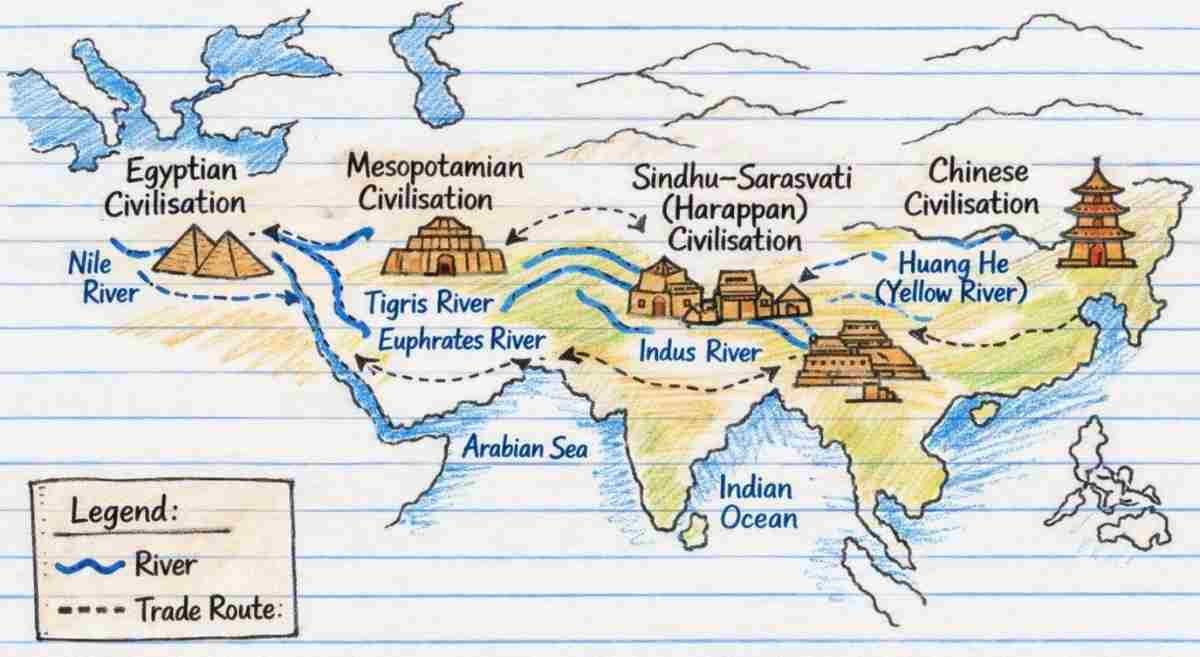
12. Activity: Using maps, locate the major rivers and civilisations of Mesopotamia, Egypt, China, and the Sindhu–Sarasvatī Valley. Mark the trade links between them.
Answer:
13. Activity: Choose one early civilisation (Mesopotamia, Egypt, or China) and prepare a mini-scrapbook or a presentation showing their innovations in tools, writing, art, and architecture. Include pictures, brief descriptions, and explain their significance.
Answer: The Egyptian civilisation made many important innovations. People used copper and bronze tools for farming and building great structures. They developed hieroglyphic writing on papyrus and stone to record laws, trade, and religious texts. Egyptian art included wall paintings, sculptures, and jewellery showing daily life and beliefs about the afterlife. Their architecture, especially the pyramids and temples, showed advanced engineering and strong religious faith. These achievements made Egypt one of the most organised and lasting civilisations in history.
Disclaimer: The content that is present on our website is based on the NCERT Class 9 Science textbook and is provided for educational purposes only. All the content and images have been taken from Science Class 9 NCERT Textbook and CBSE Support material. Images and content shown above are the property of individual organizations and are used here for reference purposes only. To make it easy to understand, some of the content and images are generated by AI and cross-checked by the teachers.
Best answers