
Keeping Time With The Skies Class 8 Notes explains how people have used the Sun, Moon, stars, and seasons to understand and measure time. This chapter covers the phases of the Moon, lunar, solar and luni-solar calendars, the Indian National Calendar, festivals linked with the Moon, and artificial satellites.
Keeping Time With The Skies Class 8 Notes
The moon looks different every night because of its phases. The phases happen as the Moon revolves around Earth. The sun lights up different parts of the moon, and we see only the bright part. That is why the whole moon is not visible every night. This is not due to the eclipse but due to the Moon’s revolution.
How Does the Moon’s Appearance Change and Why?
The moon does not look the same every day. Sometimes we see a large bright part, and sometimes only a small bright part. Sometimes the Moon cannot be seen at all.
This happens because the moon moves around the earth; the sun lights up different parts of it. We see only the bright portion, so its shape looks different each day. These different appearances of the Moon are called the phases of the Moon.
Phases of the Moon
The changing shapes of the bright portion of the Moon are called phases of the Moon.
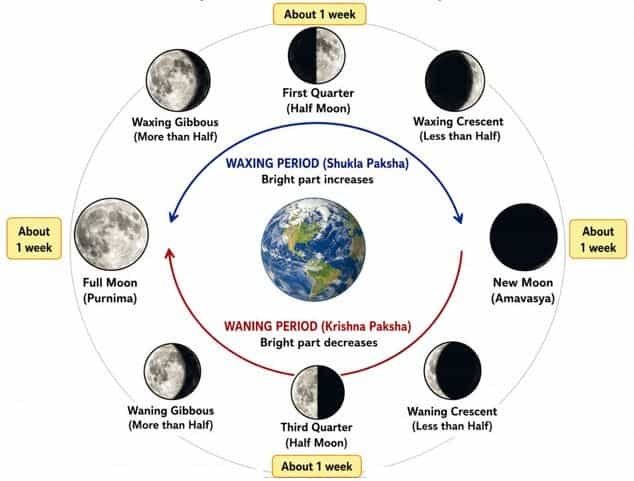
- After the full moon (Purnima), the bright part decreases; this is known as the waning period (Krishna Paksha).
- About 15 days after the Full Moon, the Moon reaches the New Moon phase, and its illuminated portion cannot be seen from Earth.
- Then the bright part increases; this is known as the waxing period (Shukla Paksha).
- In another 15 days the moon will become full again.
- This cycle from one full moon to the next takes about a month.
Locating the Moon
The Moon’s position changes every day because it moves around Earth.
- On a Full Moon day, the Moon is almost opposite the Sun in the sky.
- After the Full Moon, on each morning, the Moon appears a little closer to the Sun in the sky.
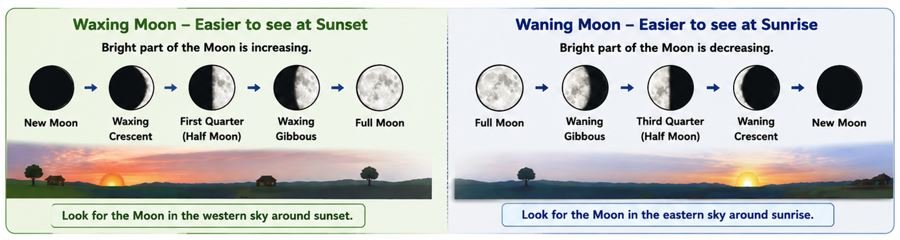
- A waxing Moon is easier to see around sunset. Its bright part is increasing.
- A waning Moon is easier to see around sunrise. Its bright part is decreasing.
- The Moon rises about 50 minutes later each day because it moves forward in its orbit around Earth.
Making sense of our observations
The shape of the Moon does not change. The Moon does not have its own light. It reflects sunlight.
- The half of the moon facing towards the sun gets sunlight and is illuminated.
- The other half remains dark, and it is non-illuminated.
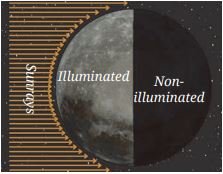
We can only see the illuminated part that faces Earth. The Moon moves around the Earth; because of this, we see a different amount of its illuminated part. This makes the moon appear different on different days.
Activity: Understanding Moon Phases
Take a ball with a stick. The ball represents the moon.
- Stand near a lamp. The lamp represents the sun.
- Your head represents the Earth.
- Hold the ball at arm’s length.
- Slowly turn around and observe the ball.
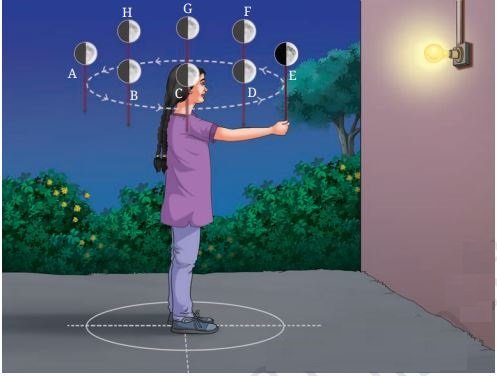
Observation: When the ball is opposite the lamp, you can see its fully illuminated side. This is the full moon. When the ball is towards the lamp, you will see the dark side. This is like the New Moon.
Phases of the Moon
The moon takes approximately one month to complete a revolution around Earth.
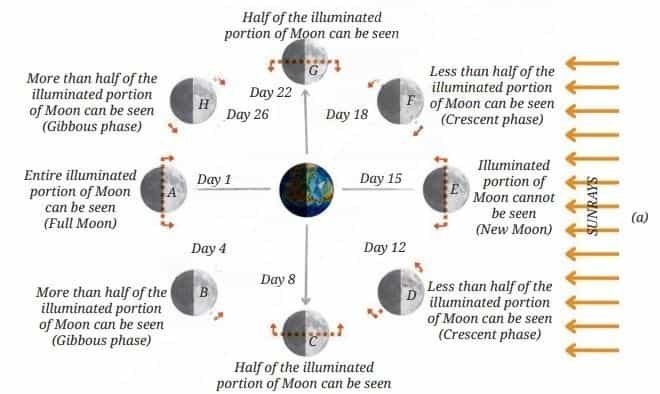
- New Moon: On the New Moon day the dark side of the Moon faces Earth, so we cannot see its illuminated part.
- Crescent Moon: Less than half of the illuminated part can be seen. This is called the crescent phase.
- Half Moon: In this, half of the illuminated part can be seen.
- Gibbous Moon: More than half of the illuminated part can be seen. This is called the gibbous phase.
- Full Moon: The entire illuminated part facing Earth can be seen. This is called the Full Moon.
After the full moon, the visible illuminated part starts becoming smaller again.
Waxing and Waning
The visible part of the Moon does not remain the same. It increases and decreases during the month.
- Waxing: When the visible illuminated part of the Moon increases, the Moon is said to be waxing.
- Waning: When the visible illuminated part of the Moon decreases, the Moon is said to be waning.
Why do people around Earth see nearly the same moon phase?
The complete earth rotation takes 24 hours. The moon takes around one month to complete one revolution around the earth. The earth rotates much faster than the moon; people from the different parts of Earth see nearly the same phase of the moon on a given day.
Why does the moon appear at a different place in the sky each day?
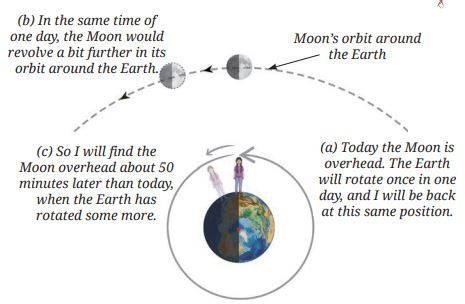
The moon moves around the earth. The Earth also rotates once every 24 hours. Since the Moon moves a little forward each day, it does not appear in the same place in the sky. So, the moon appears at a different position in the sky each day.
How Did Calendars Come into Existence?
Long ago, people did not have clocks or calendars. They looked at nature to understand and measure time. They noticed that some things in nature happen again and again in a regular way, like—
- The sun appears every day.
- The moon changes its shape in a regular pattern.
- The seasons repeat every year.
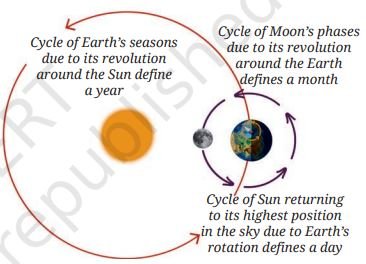
How did we get a day?
The Earth rotates on its axis. Because of the earth’s rotation, the sun rises in the east and sets in the west. The next day the same things will happen again.
The average time from the Sun’s highest position on one day to its highest position on the next day is about 24 hours. This is called a mean solar day.
How can we find when the sun is highest?
We can use the shadow of a stick.
- Fix a stick upright in the ground.
- Watch its shadow during the day.
- The shadow becomes shorter as the sun moves higher.
- The shadow is shortest when the sun is highest in the sky.
This helps us find the time when the sun is highest.
How did we get a month?
Every day the moon changes its shape. For example,
- New Moon → Crescent → Half Moon → Full Moon → Crescent → New Moon.
The moon takes about 29.5 days to complete its cycle. So, this cycle becomes the basis of a month.
How did we get a year?
The earth moves around the Sun. It takes about 365¼ days to complete one revolution. During this time, one complete cycle of seasons occurs like –
- Summer → Rainy/Winter → Spring → Summer
This complete cycle gives us a year.
Lunar calendars
People use the moon to measure time. They notice that the Moon goes through all its phases in about 29.5 days. This is called one lunar month.
How did they make a lunar calendar?
People noticed that one complete cycle of seasons has about 12 moon cycles. So,
- 1 lunar month ≈ 29.5 days
- 12 lunar months = 1 lunar year
- 1 lunar year ≈ 354 days
This became the basis of the lunar calendar.
What is the problem?
A solar year is about 365 days, but the lunar year is only about 354 days. So, there is a difference of about 11 days every year. Because of this difference, the seasons do not occur in the same lunar months every year.
Remember
- Moon cycle → Lunar month → 29.5 days
- 12 lunar months → Lunar year → 354 days
- Solar year → about 365 days
- Difference → about 11 days
Solar calendars
Previously, people wanted to know when seasons would come, especially for farming. This led to the development of solar calendars.
What is a solar calendar?
A solar calendar is based on the Earth’s movement around the Sun and the seasons. The Gregorian calendar, which we commonly use today, is a solar calendar.
Why do months have different numbers of days?
One year is about 365 days. So, the days are divided into different months:
- Some months have 30 days.
- Some months have 31 days.
- February normally has 28 days.
All the days make 365 days.
Tropical Year and Sidereal Year
A tropical year is the time between two successive spring equinoxes. The Gregorian calendar is based on the tropical year.
A sidereal year is the time taken by Earth to complete one revolution around the Sun when measured with respect to distant stars.
What is a leap year?
The Earth actually takes about 365¼ days to go around the Sun. The extra ¼ day each year adds up:
¼ + ¼ + ¼ + ¼ = 1 full day
So, after about four years, we need to add one extra day to the calendar. This is called a leap year. In the leap year, February has 29 days instead of 28 days.
Easy to Remember
- Solar calendar → Based on the sun and seasons
- Normal year → 365 days
- Leap year → 366 days
- Leap year → February has 29 days
Luni-solar calendars
A luni-solar calendar uses both the moon and the sun. The luni-solar system uses the Moon phases to make months. It also makes changes to keep the calendar in line with the season.
Why is an extra month added?
- One lunar month is about 29.5 days.
- 12 lunar months make about 354 days.
- A solar year is about 365 days.
So, a lunar year is about 11 days shorter.
This difference becomes bigger every year. After about 2-3 years, the difference becomes almost one full month. So, some calendars add one extra month. This extra month is called Adhika Maasa, or intercalary month. It helps to keep the Moon’s months and the seasons in step.
Amant and Purnimant Calendars
In an Amant calendar, a month starts after the New Moon and ends at the next New Moon. In a Purnimant calendar, a month starts after the Full Moon and ends at the next Full Moon.
Our Scientific Heritage
- Ancient people carefully observed the Sun, Moon and stars to understand time and seasons.
- The apparent northward movement of the Sun from December to June is called Uttarayan.
- The apparent southward movement of the Sun from June to December is called Dakshinayan.
- The solstices occur around June 21 and December 21. During the equinoxes, the Sun rises nearly in the East and sets nearly in the West.
- Ancient Indian texts such as the Taittirīya Saṁhitā and Surya Siddhanta recorded observations of these cycles.
Easy to Remember
- Moon → Lunar months
- Sun → Seasons
- Moon + Sun → Lunar-solar calendar
- Extra month → Adhika Maasa
The Indian National Calendar
The Indian government uses the Indian National Calendar along with the Gregorian calendar for official purposes. It is a solar calendar.
The Government of India set up the Calendar Reform Committee in 1952 to recommend a uniform national calendar. The Indian National Calendar was adopted from 21 March 1956. Meghnad Saha was the chairperson of this committee.
Important Points
- It has 365 days in a normal year.
- The year normally begins on 22 March.
- The months have 30 or 31 days.
- The names of the months come from traditional Indian calendars.
- In a normal year, the 2nd to 6th months have 31 days.
- The other months have 30 days.
What happens in a leap year?
In the leap year, one extra day is added to Chaitra, the first month. In the leap year, the new year begins on 21 March instead of 22 March.
Easy to Remember
- Indian National Calendar → Solar calendar
- Normal year → 365 days
- New Year → 22 March
- Leap year → Extra day added to Chaitra
- Leap-year new year → 21 March
Are Festivals Related to Astronomical Phenomena?
Yes. Many Indian festivals are connected with the Moon, Sun, and astronomical cycles. Some festivals are based on the phases of the Moon, while others follow solar or luni-solar calendars.
Festivals such as Makar Sankranti, Pongal, Bihu, Vaisakhi, Poila Baisakh and Puthandu follow a solar sidereal calendar. They usually occur around the same date in the Gregorian calendar each year.
Examples of festivals related to the Moon:
- Diwali → New Moon of Kartika
- Holi → Full Moon of Phalguna
- Buddha Purnima → Full Moon of Vaisakha
- Eid-ul-Fitr → After the crescent moon is sighted at the end of Ramadan
- Dussehra → 10th day of Ashwina
Why do festival dates change?
The Gregorian calendar is based on the solar year. Many Indian festivals are based on lunar or luni-solar calendars, while some festivals are based on a solar sidereal calendar; the date usually changes by less than a month because an extra month (Adhika Maasa) is added when needed.
What about purely lunar calendars?
The purely lunar calendar does not adjust for the difference between the lunar year and the solar year. Therefore, an Indian festival based only on the moon can move through different months of the Gregorian calendar over the years.
Why Do We Launch Artificial Satellites in Space?
The Moon is a natural satellite of Earth. It moves around Earth. People have also made artificial satellites. These are machines sent into space that move around Earth.
Many artificial satellites orbit about 800 km above Earth’s surface and take roughly 100 minutes to complete one orbit.
Why are satellites useful?
Satellites help us with:
- Communication – phones, TV and internet
- Navigation – finding places and directions
- Weather – watching clouds and storms
- Disasters – helping during floods and cyclones
- Science – studying Earth and space
ISRO has launched many satellites and space missions for these purposes. Some examples are Cartosat, AstroSat, Chandrayaan and Aditya L1.
Space Junk
Old satellites and parts of rockets can become space junk or space debris. They can collide with working satellites, so countries are working to reduce this problem.
Disclaimer: The content that is present on our website is based on the NCERT Class 8 Science textbook and is provided for educational purposes only. All the content and images have been taken from Science Class 8 NCERT Textbook. Images and content shown above are the property of individual organizations and are used here for reference purposes only. To make it easy to understand, some of the content and images are generated by AI and cross-checked by the teachers.