
← Back to Class 9 Social Science Notes
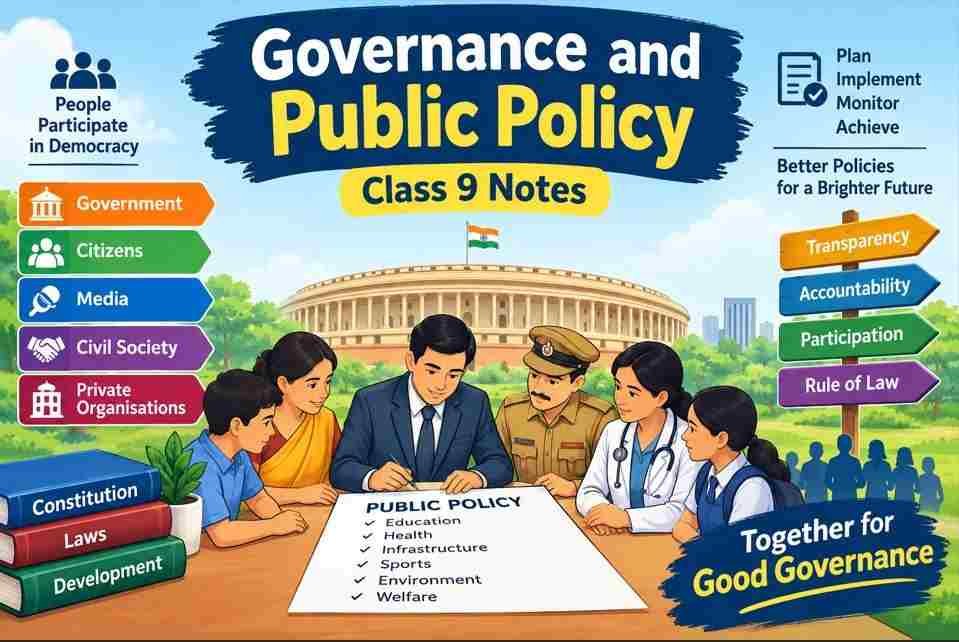
These Governance and Public Policy Class 9 Notes explain the important concepts of governance, public policy, and the role of the government in simple and easy language. Students will learn how public policies are made, implemented, and coordinated at different levels of government. These notes cover key topics, important points, and examples to help Class 9 students understand the chapter easily and prepare for their examinations.
Governance and Public Policy Class 9 Notes
Governance
The governance means the process of making decisions and carrying them out for the welfare of people. Good governance works for the welfare of the people. A democratic system is based on—
- Transparency (openness)
- Accountability (responsibility)
- Participation (people’s involvement)
- Rule of Law (everyone follows the law)
For example, when there is heavy rainfall in town, then many people and departments work together like –
- Municipal Corporation—cleans drains and removes garbage
- Public Works Department (PWD)—repairs roads
- Police – controls traffic
- Schools—inform students and parents
- Health Workers – prevent diseases
- Local Representatives—raise public concerns
- Citizens and Volunteers—help people and report problems.
In this situation one department is not able to handle all the problems; different departments take different responsibilities to handle this problem.
If there is no coordination between the departments, then work may be delayed, problems may increase, and people may suffer more.
Understanding Government and Governance
Solving public problems is very important, and it is only possible when the different government departments, organisations, and citizens work together.
They must make decisions, carry them out properly, and take responsibility for their work. This process is called governance.
- Government: The government is the authority or formal institution that provides public services. For example, the municipal corporation or panchayat, etc.
- Governance: Governance is the process or system of how the decisions are made and executed. For example, the governance identifies dark areas, installs street lights, repairs damaged lights, and takes feedback from citizens.
Difference Between Government and Governance
| Government | Governance |
|---|---|
| Refers to the institutions that exercise political authority | Refers to the process of decision-making and implementation |
| Includes the Legislature, the Executive, and the Judiciary | Includes government, citizens, media, civil society, and private organisations |
| Focuses on who governs | Focuses on how governing is carried out |
Evolution of Governance in India
Before the colonial rule, India had its own systems of governance based on local traditions and values. But when the colonial rule started, then the European rulers introduced their own governance system in India.
But after independence, India has adopted a constitution based on democratic values and Indian traditions.
India’s National Motto: Satyamev Jayate
During British rule, the Order of the Star of India used the motto “Heaven’s Light, Our Guide.”
After independence, India adopted “Satyamev Jayate,” which means Truth Alone Triumphs; it comes from the Mundaka Upanishad.
The Supreme Court of India has the motto “Yato Dharmastato Jayah,” which means where there is Dharma, there is victory. This motto is taken from the Mahabharata.
These mottos express the important values that guide the Indian institution.
The Sengol and Good Governance
In the time of India’s independence, on the night of 14-15 August 1947, the first prime minister, Jawaharlal Nehru, received the Sengol from the Adheenam saints of Tamil Nadu, who belonged to an old Shaivite tradition. The Sengol used during the Chola period.
The Sengol is the traditional symbol associated with rightful rule and good governance. In 2023, the Sengol was placed in India’s new Parliament building by Prime Minister Narendra Modi.
Mahatma Gandhi’s Idea of Ram Rajya
Mahatma Gandhi believed in Ram Rajya, an ideal system of governance based on
- Honesty
- Transparency
- Compassion
- Welfare of people
- Justice for all
Ancient Indian View of Governance
In ancient time, the governance was considered a responsibility rather than simply a way to exercise power. In the Vedic period, in the Ramayana and Mahabharata, the rulers were expected to protect people and work for the welfare of society.
What is Rajadharma?
Rajadharma means the duties and responsibilities of a ruler. They believe good governance means peace, prosperity, justice, and happiness for the people. The ruler’s most important duty was:
- Protecting people
- Following Dharma (righteous duty)
- Promoting public welfare
Kauṭilya’s View on Good Governance
Kautilya’s Arthashastra says that the happiness of a ruler depends on the happiness of the people. The Sanskrit slogan that was used that time was “प्रजासुखे सुखं राज्ञः प्रजानां च हिते हितम्।”
Sabha and Samiti in the Vedic Period
The Rigveda mentions two important institutions called Sabha and Samiti. Sabha is a place or assembly where people discussed matters related to governance and public welfare. Samiti was an assembly of people.
Good Governance
What is good governance?
Good governance is a governance that works honestly, fairly, and efficiently for the welfare of all the people. It helps the people to live safely, get public services, and enjoy their rights and freedoms. The good governance has the following benefits:
- Maintain law and order.
- Protect citizens’ rights and freedom.
- Provide education, healthcare, and transport.
- Ensure justice and fairness.
- Treat everyone equally before the law.
- Build trust between citizens and the government.
Who Helps in Good Governance?
Good governance is not only the responsibility of the government. It is a responsibility of the citizens and different organizations also.
- Government: The government makes laws and policies and provides public services.
- Citizens: Citizens have to elect their representatives, follow the law, and take part in public activities.
- Media: Media give the information about the public issues and bring important problems to public attention.
- Civil Society Organizations (NGO): Work with communities and spread awareness about social problems.
- Private Sector: It helps to create jobs, carry out business activities, and develop new ideas and technologies.
When all these work together, then the governance becomes more effective and people benefit.
Features of Good Governance
There are seven important features of good governance—
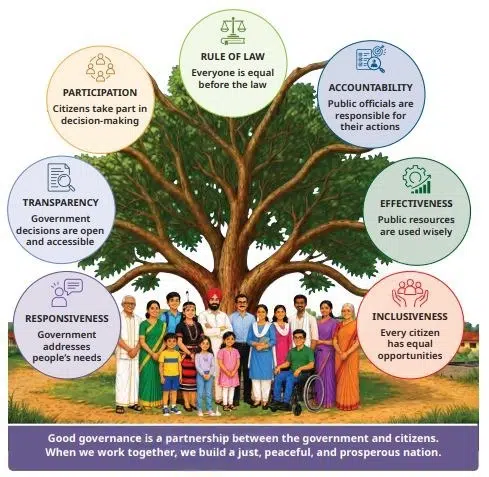
- Participation: Citizens take part in decision-making.
- Transparency: The government decisions should be open and easy to understand.
- Responsiveness: Governments have to quickly respond to people’s needs and problems.
- Rule of Law: Everyone is equal before the law.
- Accountability: Public officials are responsible for their actions.
- Effectiveness: Government uses public resources wisely.
- Inclusiveness: Every citizen gets equal opportunities.
Challenges to Good Governance
The needs and expectations of the people may change over time. So, the government must continue to improve its services and solve new problems. Some of the major challenges of good governance are
- Poor Coordination: The government departments may not work together properly.
- Unequal Access to Public Services: Some people may not get education, healthcare, or other services.
- Corruption and Misuse of Power: Public resources may not reach the right people.
- Misinformation and Fake News: False information can create confusion among people.
To Overcome These Challenges
- Government should work effectively.
- Officials have to perform their duties honestly.
- Citizens should be responsible.
- Government departments should coordinate with one another.
- Public services should reach all sections of society.
- People should check information before believing or sharing it.
- E-governance is the most important way to improve governance. It uses digital technology to make government services easier, faster, and more transparent.
National Good Governance Day
25 December is celebrated as Good Governance Day in India. It marks the birth anniversary of former Prime Minister Atal Bihari Vajpayee. It highlights the importance of honest, responsible, and effective government services.
E-Governance: Technology for Better Governance
What is E-Governance?
When the government provides the information and services using digital technologies like computers, the internet, or any other digital technology, it is known as e-governance. It helps the people to communicate with government departments, submit applications, receive information, and give feedback. It helps to make the government services faster, easier, and more convenient. For example, UMANG, Aadhaar, DigiLocker, etc.
Benefits of E-Governance
- It reduces paperwork.
- It saves people’s time.
- It allows people to access many services online.
- It reduces the need to visit government offices.
- It makes information easier to access.
- It can improve transparency and accountability.
Public Policy
The Meaning of Public Policy
Public policy is a plan made by the government to solve problems and promote public welfare. For example, if many children in an area cannot attend school, the government may introduce a program to improve access to education.
Public policy connects governance with practical action. It turns public concerns and government priorities into plans, programs, and solutions. Examples of Public Policy in Daily Life –
- Roads
- Traffic signals
- Clean drinking water
- Electricity
- Public parks
- Waste collection services
- Healthcare services
- Education facilities
For example, suppose a school notices too much plastic waste inside the school campus. The school principal discussed this problem with teachers, students, and parents and decided on the “Plastic-Free Campus Policy”. Under this policy—
- Students are encouraged to use reusable water bottles.
- The use of plastic bags is discouraged.
- Separate dustbins are placed around the school to collect different types of waste.
- Awareness programs are organized every month.
- Teachers monitor the campaign.
These plans help to reduce plastic water and keep the school clean. This is an example of policy where the clean plan helps to solve the problem and achieve a goal. Through the public policy the government decides—
What problem needs to be solved?
- Why it needs to be solved.
- Who will be responsible for solving it?
- How the plan will be carried out.
- How its success will be checked.
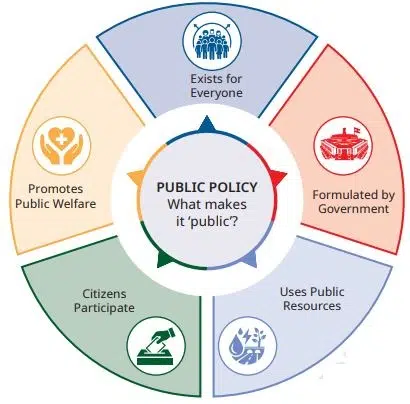
What is ‘Public’ about Public Policy?
The word ‘public’ refers to all the people living in a society or community. A policy becomes public policy when it is made for the public benefit, implemented by public institutions, and often
financed with public money collected through taxes. Public policies address issues that concern society as a whole, such as education, healthcare, transportation, sanitation, environmental protection, and public safety.
Public policy: What makes it ‘public’?
Difference Between Public Policy and Other Policies
| Other Policies | Public Policies |
|---|---|
| Apply to a particular organization or group. | Address problems affecting society on a larger scale. |
| A school may make rules about mobile phone use. | The government may make policies to improve education. |
| A company may have a work-from-home policy. | The government may make policies to improve public transport. |
| A housing society may make parking rules. | The government may make policies to improve road safety. |
Participants in the Public Policy Process
The government is not able to make the policies alone. Many people and organizations help to identify problems, suggest solutions, and implement decisions. These participants may be government officials, experts, organizations, and ordinary citizens.
Case Study: A Ramp for Better Healthcare
Suppose a 72-year-old woman visits a hospital for a health check-up. She want to climb stairs to reach the hospital but there is no ramp or handrail to help her. One another person using a wheelchair also finds it difficult to enter inside the hospital.
Patients decided to raise the issue with hospital authorities and local representatives.
The district administration asks the Public Works Department (PWD) and the Health Department to inspect the hospital.
The authorities discuss with doctors, hospital staff, experts, and senior citizens. After discussions, the government approves funds to make the hospital more accessible.
What Does This Case Study Teach Us?
It shows how a public policy moves from identifying a problem to a solution.
The Making of a Public Policy
A public policy is developed through a series of steps. It does not happen through a single decision. The process begins by identifying a problem or a need, collecting information, discussing it with the expert, and then finding a solution. After considering different stages, the government prepares and approves a policy. Main Stages of the Policy Process –
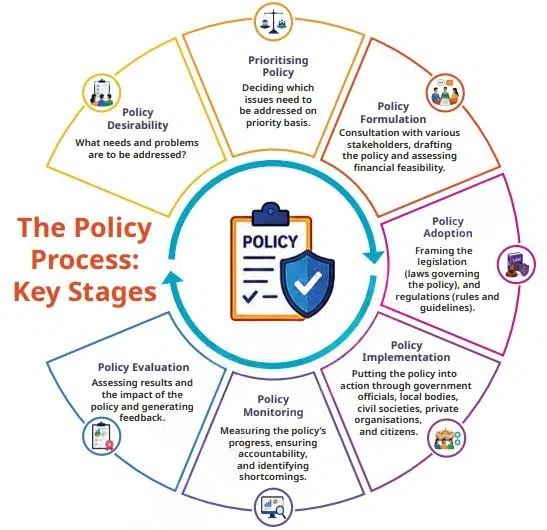
- Policy Desirability and Prioritization: The government identifies the problem and decides which of the problems needs attention first.
- Policy Formulation: The government discusses with experts, citizens, and other stakeholders and checks whether the plan is financially possible.
- Policy Adoption: The authorities approve the policy and establish the necessary laws, rules, or guidelines.
- Policy Implementation: The government departments, local bodies, organizations, and other responsible groups put the policy into action.
- Policy Monitoring: The government checks the progress of the policy and identifies how to implement it.
- Policy Evaluation: The government studies whether the policy has achieved its goals and benefited people.
- Feedback and improvement. The feedback is collected, and the policy is changed or improved when necessary.
National Education Policy (NEP) 2020: A Collaborative Journey
NEP 2020 is a good example of public policy. NEP was established in 1986. Over time, society and technology changed. This created a need to review the education system. The government took the initiative to develop a new education policy in 2015. In 2017, an expert committee was formed and approved on July 29, 2020.
Difference Between Policy, Programme, and Scheme
A policy gives the main direction and goal. A program explains the plan for achieving that goal. A scheme provides specific services or benefits to help put the plan into action.
| Policy | Program | Scheme |
|---|---|---|
| Gives the overall direction and goal. | Explains the approach to achieve the goal. | Provides specific benefits or services. |
| Tells us what the government wants to achieve and why. | Explains how the goal will be approached. | Helps deliver the planned benefits to people. |
Policy Coordination: Key to Good Governance
What is policy coordination?
Policy coordination means different people, departments, and organizations working together to successfully implement a policy.
A policy can succeed only when everyone performs their responsibilities and cooperates with each other.
Example: Khelo Bharat Niti 2025
The Government of India launched Khelo Bharat Niti 2025 to improve sports in the country. The aim is to:
- Promote sports culture.
- Improve fitness and health.
- Find talented athletes
- Build sports infrastructure.
- Make India stronger in sports.
The success of Khelo Bharat Niti 2025 depends on the cooperation of all these people and organisations.
Different people have different responsibilities:
- Families: They should encourage children, especially girls, to take part in sports.
- Central and State Governments: They should encourage all students, including students with disabilities, to play sports.
- Local Authorities: They should maintain playgrounds and parks.
- Scientists and Innovators: They should develop better sports equipment and suggest good nutrition for sportspersons.
- Central Government: It should make sports policies, provide funds and understand how sports improve health and help India build good relations with other countries.
Role of Different Levels of Government
CENTRAL GOVERNMENT
- Provides policy framework
- Provides funding
STATE GOVERNMENT
- Hosts national games
- Builds infrastructure
BLOCK LEVEL
- Organises sports events and camps
- Supports local talent and facilities
SPORTS PROMOTION INSTITUTIONS
- Provide coaching and training
- Offer equipment and facilities
PRIVATE ORGANISATIONS AND INDIVIDUALS
- Provide funding and sponsorships
- Invest in research and better equipment
CITIZENS
- Encourage children, especially girls
- Provide feedback and support local talent
Disclaimer: The content that is present on our website is based on the NCERT Class 9 Social Science textbook and is provided for educational purposes only. All the content and images have been taken from Social Science Class 9 NCERT Textbook and CBSE Support material. Images and content shown above are the property of individual organizations and are used here for reference purposes only. To make it easy to understand, some of the content and images are generated by AI and cross-checked by the teachers.