
← Back to English Class 9 Kaveri
Believe in Yourself Class 9 NCERT Solutions provides simple and easy-to-understand answers to all the questions from the chapter. The chapter teaches students the importance of self-confidence, positive thinking, determination, and believing in their own abilities. It encourages learners to face challenges with courage, learn from their mistakes, and keep working towards their goals.
Believe in Yourself Class 9 NCERT Solutions
Check your Understanding
I. Based on your understanding of the poem, select the correct central idea for each stanza from the options given.
Stanza 1
(i) Facing challenges requires personal responsibility and a clear focus on one’s future.
(ii) Facing challenges is a journey best taken with support and guidance from others.
Answer: (i) Facing challenges requires personal responsibility and a clear focus on one’s future.
Stanza 2
(i) Fear and uncertainty make it difficult to make choices as the future approaches.
(ii) Facing the future with confidence makes choices easier and more straightforward.
Answer: (i) Fear and uncertainty make it difficult to make choices as the future approaches.
Stanza 3
(i) Personal growth involves finding balance between comfort and change.
(ii) Personal growth requires leaving behind comfort and embracing change.
Answer: (ii) Personal growth requires leaving behind comfort and embracing change.
Stanza 4
(i) The first step towards change may feel easy if you place your trust in others to guide you and provide support.
(ii) The first step towards change is difficult, but having self-belief and confidence helps you stay on track.
Answer: (ii) The first step towards change is difficult, but having self‑belief and confidence helps you stay on track.
II. Rhyme Scheme
Fill in the blank to complete the following sentence.
The poem follows a simple, yet effective rhyme scheme _ that flows steadily through each stanza.
Answer: ABAB
III. Tone
State whether the following statements are true or false.
1. The overall tone of the poem is motivational and encouraging.
Answer: True
2. The tone shifts from thoughtful in the beginning to one of determination by the end of the poem.
Answer: True
IV. Speaker
Fill in the blanks with the correct options from those given in the brackets.
The speaker in this poem is not distant; rather, he/ she comes across as a (stranger/guide) who understands the struggle and is encouraging the reader to take ___ (interest in/control of) his/her own future.
The use of direct address ‘You’ creates a close connection, as though the speaker is __. (talking directly to the reader/addressing the reader from a distance)
Answer:
- guide
- control of
- talking directly to the reader
V. Imagery
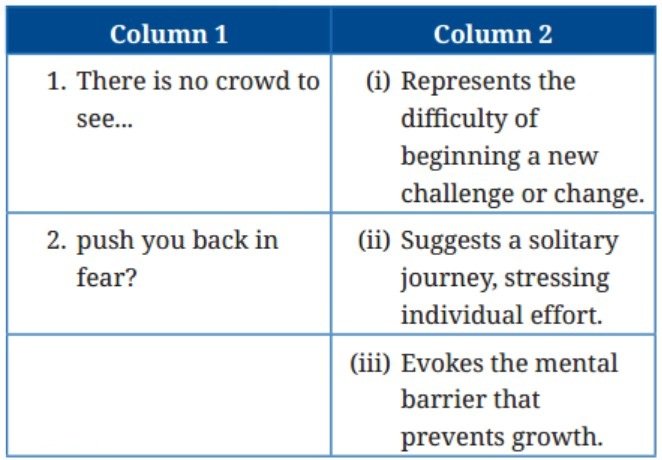
Match the phrases from the poem in Column 1 with the imagery they represent in Column 2. An extra representation is given.
Answer:
| Column 1 | Column 2 |
|---|---|
| 1. There is no crowd to see… | (ii) Suggests a solitary journey, stressing individual effort. |
| 2. push you back in fear? | (iii) Evokes the mental barrier that prevents growth. |
VI. Symbolism
Select the words/phrases from the box below to complete the given sentences.
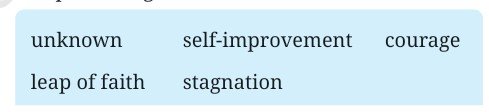
2. Comfort and the status quo represent _ and fear of change, symbolising the comfort zone that holds one back.
Answer: stagnation
3. he future symbolises the __, the potential for change and success that lies ahead but requires ___________to step into.
Answer: unknown and courage
4. The first step symbolises the initial required to begin the journey of __ or personal development.
Answer: leap of faith and self‑improvement
VII. Metaphor
The poet uses a metaphor in the line, ‘The first step is the hardest’. Explain why this is metaphorical.
Answer: The line “The first step is the hardest” is metaphorical because it does not literally mean walking or taking a physical step. Instead, it symbolises the beginning of any new journey, challenge, or change in life. The “first step” stands for the initial effort or decision, which often feels most difficult due to fear, doubt, or uncertainty. Once this metaphorical step is taken, the path ahead becomes easier and clearer.
VIII. The poem uses antithesis in a couple of lines.
| Antithesis is a rhetorical device that pairs contrasting or opposite ideas in a parallel grammatical structure to highlight differences or create emphasis. It simplifies complex ideas through contrast, making them easier for readers or listeners to understand. Consider the famous quote from Neil Armstrong when he stepped onto the moon: “Setting foot on the moon may be a small step for a man, but a giant leap for mankind.” Here, the antithesis lies in contrasting the ‘small step’ for an individual with the ‘giant leap’ for all humanity. The parallel structure of the two phrases highlights the incredible significance of this event, presenting it as both a personal and massive achievement. Other examples: > Speech is silver, but silence is gold. > Patience is bitter, but it has a sweet fruit. > Man proposes, God disposes. |
Identify the lines from the poem that show antithesis and explain why it is so.
Answer: The poem uses antithesis in the line “The first step is the hardest, but the journey ahead becomes easier.” This is antithetical because it contrasts the difficulty of beginning with the ease that follows once progress is made. The parallel structure highlights the difference between the initial struggle and the smoother path that comes later, making the idea of growth and change easier to understand.
Another example is “Fear may hold you back, but courage pushes you forward.” Here, the opposite ideas of fear and courage are placed side by side to emphasise the importance of overcoming inner barriers.
Critical Reflection
I Read the extract given below and answer the questions that follow.
1. Step up to the challenge
There is no crowd to see,
It’s just you and the future
And where you want to be.
(i) What does the line, ‘There is no crowd to see’ suggest about facing challenges?
Answer: It suggests that facing challenges is a personal and solitary journey, where success depends on one’s own effort rather than public recognition.
(ii) Complete the following suitably. The line ‘It’s just you and the future’ suggests that _.
Answer: the responsibility for shaping one’s future lies entirely with the individual
(iii) Fill in the blank with the appropriate word/ phrase from the extract.
Latha will __ her efforts to improve her vocal performance by practicing harder each day.
Answer: step up
(iv) Select the most suitable title for the extract.
A. The Struggles of Change
B. Facing the Future Alone
C. A Journey of Growth
D. The Power of Fear
Answer: C. A Journey of Growth
(v) Complete the analogy by using a word from the extract. achieve: goal : : face : _
Answer: challenge
II Answer the following questions.
1. What is the significance of the metaphor, ‘The first step is the hardest’ in the context of personal growth?
Answer: It highlights that beginning any new journey or change feels most difficult because of fear and uncertainty. Once the first step is taken, progress becomes easier.
2. What message does the antithesis in the poem convey about the nature of personal development?
Answer: The antithesis conveys that fear can hold you back, but courage pushes you forward. It shows that growth requires overcoming inner conflict and choosing confidence over doubt.
3. Do you think the poet’s message is realistic in the context of real-world struggles? (Clue: Evaluate whether simply ‘believing in yourself’ is enough to overcome obstacles or other factors are also necessary.)
Answer: Yes, but with balance. Simply believing in yourself is important but not enough. Real-world struggles also require planning, resources, guidance, and persistence along with self-belief.
4. Consider a situation where you or someone you know had to take a difficult first step towards a goal. How does the poem’s message about the importance of self-belief apply to this situation?
Answer: For example, when I had to speak in front of a large audience for the first time, it felt like the “hardest step.” The poem’s message about self-belief helped me overcome fear, and once I began, the rest of the speech flowed more easily.
Vocabulary in Context
I. The phrase ‘status quo’ is a Latin expression that translates to ‘the state in which’ or ‘the existing state of affairs.’ Over time, it has become a popular term used in English to refer to the current situation or condition, especially when things remain unchanged.
There are other Latin terms commonly used in English. Read a few given below along with their meanings.
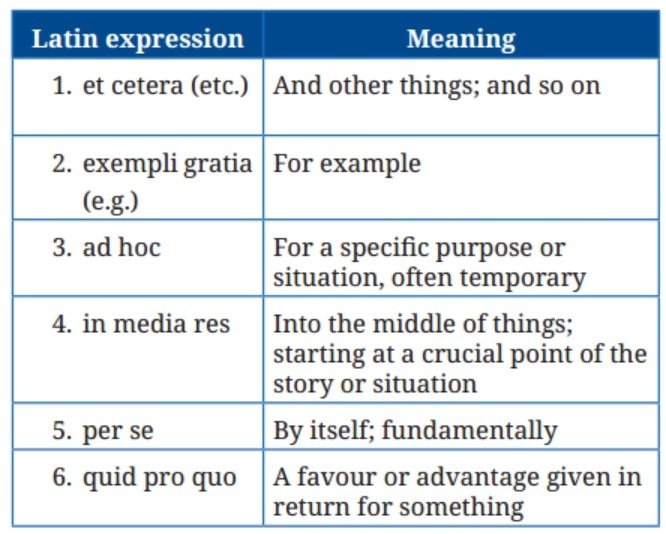
Now, fill in the blanks in the given sentences with the Latin expressions used in English from the table.
(i) I enjoy reading fantasy books, _ Harry Potter and Magical Paint Brush.
Answer: exempli gratia (e.g.)
(ii) After helping Tanya with the homework, Ritu asked for a _ to borrow her notes next time.
Answer: quid pro quo
(iii) I love all kinds of outdoor activities, such as trekking, hiking, biking, _.
Answer: et cetera
(iv) The park is not very special _; it becomes more fun when you visit with friends.
Answer: per se
(v) We created an _ team to organise the school festival.
Answer: ad hoc
(vi) The movie started _, with the hero already fighting the villain in a huge battle.
Answer: in media res
II. The line , ‘Will it pull you forward/or push you back in fear?’ is a rhetorical question.

1. Read the following rhetorical questions and state what they intend to achieve.
(i) Isn’t it obvious that we must act now? Don’t we all have a responsibility to make a change?
Answer: These rhetorical questions intend to urge immediate action and highlight collective responsibility.
(ii) Will we let fear control us, or will we rise above it?
Answer: This rhetorical question intends to motivate courage and inspire determination to overcome fear.
2. Match the situations in Column 1 to the rhetorical questions in Column 2.
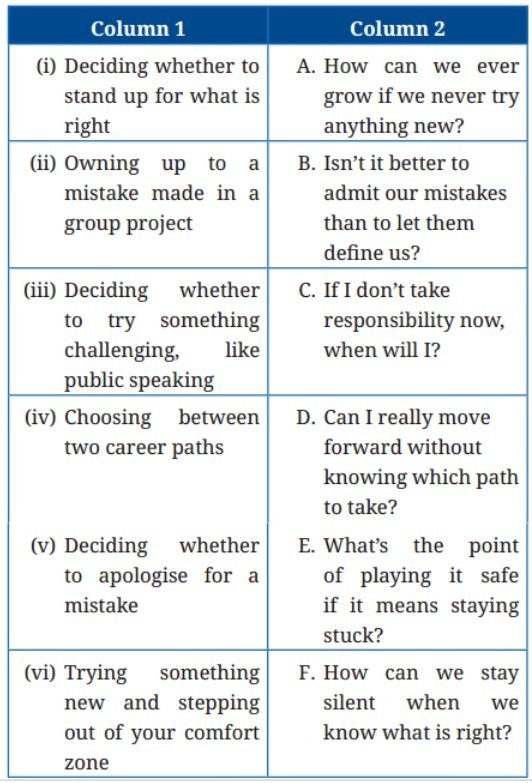
Answer:
(i) Deciding whether to stand up for what is right
Answer: F. How can we stay silent when we know what is right?
(ii) Owning up to a mistake made in a group project
Answer: B. Isn’t it better to admit our mistakes than to let them define us?
(iii) Deciding to try something challenging, like public speaking
Answer: A. How can we ever grow if we never try anything new?
(iv) Choosing between two career paths
Answer: D. Can I really move forward without knowing which path to take?
(v) Deciding whether to apologise for a mistake
Answer: C. If I don’t take responsibility now, when will I?
(vi) Trying something new and stepping out of your comfort zone
Answer: E. What’s the point of playing it safe if it means staying stuck?
Listen and Respond
I. You will listen to a conversation between two friends.
As you listen, answer the following questions in one to three exact words that you hear. (Transcript for teacher on page 275)
1. How did the boy feel before the play ?
Answer: Nervous and unsure
2. According to the girl, where does confidence come from?
Answer: Preparation and practice
3. What was the girl finally sure about regarding the boy?
Answer: He will succeed
II You will once again listen to the conversation. As you listen, select the four true statements from 1–7 given below.
- The boy feels confident but is worried about freezing on stage.
- The girl encourages the boy to push through his doubts by trusting in his preparation.
- The boy thinks that the audience will be supportive regardless of his performance.
- The girl believes that self-doubt is a normal part of preparing for a big performance.
- The boy feels that his preparation is not enough and doubts his abilities, even though he has practiced.
- The girl suggests that the boy should avoid feeling nervous and perform perfectly.
- The girl believes that pushing through nervousness will help the boy grow and build confidence.
Answer: The four true statements are:
- (2) The girl encourages the boy to push through his doubts by trusting in his preparation.
- (4) The girl believes that self‑doubt is a normal part of preparing for a big performance.
- (5) The boy feels that his preparation is not enough and doubts his abilities, even though he has practiced.
- (7) The girl believes that pushing through nervousness will help the boy grow and build confidence.
Speaking Activity
I. Work in pairs. Read the three Sayings/Proverbs given below. For each one, think of a real-life situation where it could apply. Do the suggested role play and use the Saying/Proverb.
Remember:
Before diving into a real-life situation, briefly explain the meaning of the saying.
Describe the situation in the following way—
- Introduction: Briefly explain the saying.
- Situation/Example: Share a personal story or relate the saying to something familiar.
- Conclusion: Reflect on what the saying teaches or what you learned from the experience.
For the role-play, work in pairs to create the dialogues first and then enact. Take turns to choose your sayings/proverbs.
Answer:
Saying/Proverb 1: “Where there’s a will, there’s a way.”
- Introduction: This proverb means that if you are determined, you can overcome obstacles and achieve your goal.
- Situation/Example: A student wants to prepare for a tough entrance exam but has limited resources. With strong willpower, he studies daily and uses library books.
- Conclusion: The proverb teaches that determination helps us find solutions even in difficult situations.
Role‑play Dialogue:
- Friend A: I don’t think I can clear this exam; I don’t have coaching.
- Friend B: Don’t lose hope. Where there’s a will, there’s a way. If you study hard, you’ll succeed.
Saying/Proverb 2: “Rome wasn’t built in a day.”
- Introduction: This proverb means that great achievements take time and patience.
- Situation/Example: A student is learning guitar but feels frustrated after only a few weeks.
- Conclusion: The proverb reminds us that progress is slow, but consistent effort leads to success.
Role‑play Dialogue:
- Friend A: I’ve been practicing guitar for two weeks, but I still make mistakes.
- Friend B: Don’t worry. Rome wasn’t built in a day. Keep practicing, and you’ll improve.
Saying/Proverb 3: “No pain, no gain.”
- Introduction: This proverb means that success requires effort, struggle, and sometimes discomfort.
- Situation/Example: A student trains daily for a sports competition, even though it is tiring.
- Conclusion: The proverb teaches that hard work and sacrifice are necessary for achievement.
Role‑play Dialogue:
- Friend A: Training every morning is exhausting.
- Friend B: True, but no pain, no gain. Your effort will pay off in the competition.
Sayings/Proverbs
1. Don’t judge a book by its cover.
- Situation to consider: Have you ever misjudged someone based on their appearance or first impression? What happened?
- Role-play: One student acts as someone who judges others based on their looks or first impressions. The other student plays someone who shows the true personality after a deeper conversation, proving that appearances can be deceptive.
Answer:
- Introduction: This proverb means that appearances can be deceptive, and true worth is revealed only after deeper understanding.
- Situation/Example: A student misjudges a quiet classmate as unfriendly, but later discovers that the classmate is kind and helpful.
- Conclusion: The proverb teaches us not to form opinions based only on looks or first impressions.
Role‑play Dialogue:
- Student A: I thought you were unfriendly because you never talked much.
- Student B: Actually, I’m just shy. Once you got to know me, you saw I enjoy helping others.
- Student A: You’re right. Don’t judge a book by its cover.
2. Actions speak louder than words.
- Situation to consider: Think of a time when someone’s actions proved more valuable than their words.
- Role-play: One student talks about how they will improve their grades, and the other shows how they actually put in the effort. Compare the impact of talking versus doing.
Answer:
- Introduction: This proverb means that what people do is more important than what they say.
- Situation/Example: A student promises to improve grades but another actually studies hard and shows results.
- Conclusion: The proverb reminds us that actions prove sincerity more than words.
Role‑play Dialogue:
- Student A: I’ll definitely score better this time.
- Student B: I didn’t just say it—I studied every day and my marks improved.
- Student A: You’re right. Actions speak louder than words.
3. When the going gets tough, the tough get going.
- Situation to consider: Can you think of a time when you faced a difficult challenge but didn’t give up?
- Role-play: One student plays someone who is giving up on a tough school project, while the other encourages that student to keep going. Show how perseverance leads to success despite difficulties.
Answer:
- Introduction: This proverb means that strong people rise to challenges instead of giving up.
- Situation/Example: A student struggles with a difficult school project but keeps working until it is completed successfully.
- Conclusion: The proverb teaches us that perseverance and courage help us overcome difficulties.
Role‑play Dialogue:
- Student A: This project is too hard. I feel like quitting.
- Student B: Don’t give up. When the going gets tough, the tough get going. Keep trying—you’ll finish it.
- Student A: Thanks, I’ll keep working on it.
Writing Task
I. Your class is conducting the morning assembly. You have been asked to deliver a speech on the topic, ‘Turning Challenges into Opportunities’. Draft this speech by following the guidelines given below.
- Opening paragraph: Greet the audience and introduce yourself. Begin with a quotation, a question or a surprising fact. State the purpose of your speech and provide an overview of what you will be talking about.
- Paragraphs 2 and 3 — Body of the speech: Divide the body of your speech into two paragraphs, each focusing on a different main point or idea. Use transition words, anecdotes, statistics, and other supporting evidence to strengthen your points.
- Concluding paragraph: Summarise the main points of your speech. End with a statement that leaves a lasting impression on the audience and convey your thanks.
- Use formal language to present ideas clearly
- Use persuasive tone — don’t you agree …/…, isn’t it?
Answer: Speech
Good morning respected Principal, teachers, and friends. I am Anurag from Class IX. “Opportunities often come disguised as difficulties.” Isn’t it true that challenges test us but also help us grow?
Challenges build resilience. When we struggle, we learn to adapt and improve. For example, a tough subject may feel discouraging, but with effort it becomes a chance to sharpen our skills.
Challenges also spark innovation. Problems push us to think creatively and find new solutions. Many great ideas were born from obstacles, don’t you agree?
To conclude, challenges are not barriers but stepping stones. Let us face them with courage and turn them into opportunities for success. Thank you.
Disclaimer: The content that is present on our website is based on the NCERT Class 9 English textbook and is provided for educational purposes only. All the content and images have been taken from English Class 9 NCERT Textbook and CBSE Support material. Images and content shown above are the property of individual organizations and are used here for reference purposes only. To make it easy to understand, some of the content and images are generated by AI and cross-checked by the teachers.