
How Nature Works in Harmony Class 8 Notes provides simple, clear, and NCERT-based explanations of the important concepts covered in the chapter. Students will learn about ecosystems, biotic and abiotic components, interactions among organisms, food chains, food webs, decomposers, ecosystem balance, and the importance of biodiversity.
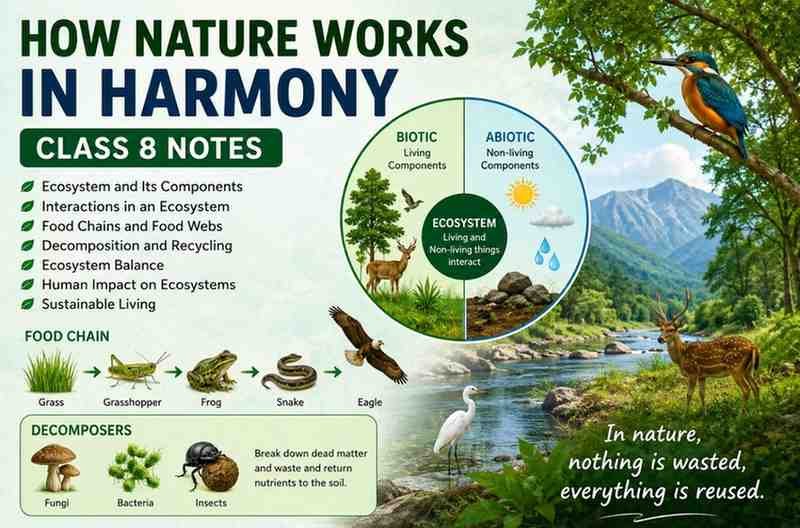
How Nature Works in Harmony Class 8 Notes
In some parts of India like Odisha, Jharkhand, West Bengal, Assam, and Chhattisgarh, elephants often come into farms and villages.
This happens because there is less food in the forest, Cutting trees for roads and building, If the farm, village, or roads come between the wildlife corridors, then also the elephants enter to the human areas.
Nature is connected like a chain. If one part is broken, like a forest, then it affects animals, people, and crops.
How Do We Experience and Interpret Our Surroundings?
A habitat is a place where the organism lives. It may be a pond, forest, farm, or even a tree. Every habitat has two main components:
- Biotic components: In biotic components come living things like plants, birds, animals, insects, and fish.
- Abiotic components: In abiotic components come non-living things like air, water, sunlight, soil, and temperature.
On the earth, different habitats have different non-living conditions. For example, a pound has fish, frogs, water, algae, and oxygen. On the other hand, the forest has trees, grass, birds, soil, and sunlight.
To survive, the organisms need suitable food, water, oxygen, space, and shelter. Different organisms can survive together in the same habitat by using resources in different ways. This helps them coexist in harmony.
Who All Live Together in Nature?
In nature, many living things stay together in the same place. For example, in a pond you will see many fishes; this group of fishes is called a population of fish.
A population means when the same kind of organisms live together in one habitat at one time. For example, 20 grass plants in the garden will be called a population of grass.
But in a habitat, there is never only one type of organism. If only one type of organism lived in one place, then the food shortage would be there and there would be too much competition. So, that way the plant, animal, and microorganisms live together.
When the many populations, like fish, frogs, plants, etc., share the same habitat, then they form a community.
- Biotic components = living things (plants, animals, microbes).
- Abiotic components = non-living things (water, soil, air, sunlight).
In this community all living things depend on each other for survival and live in balance
Does Every Organism in a Community Matter?
Every organism in a community has an important role in nature. Organisms depend on each other, and a change in one population can affect many other organisms.
Activity: How Fish Affect Plants
The scientists studied two ponds—
- Pond A: Pond A had fish and many flowering plants around it.
- Pond B: Pond B had no fish and fewer flowering plants around it.
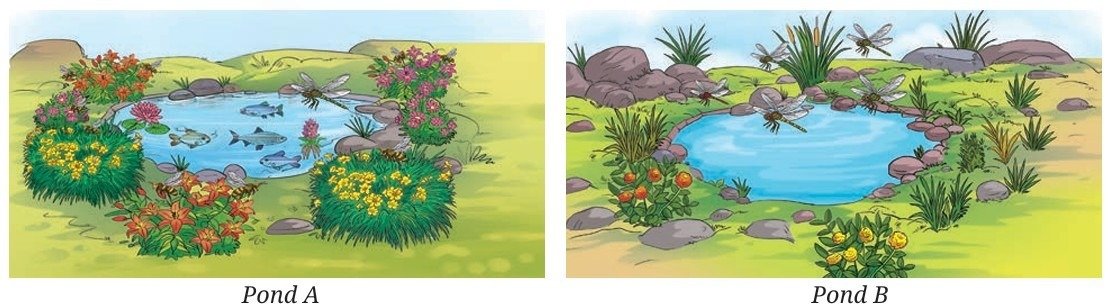
Observation: The scientists observe an interesting relationship between the organisms in Pond A. In Pond A fish eat dragonfly larvae. Therefore, ponds with fish have fewer dragonflies. The dragonflies eat insects such as flies, bees, and butterflies. When there are fewer dragonflies, more bees, flies, and butterflies are present. Bees, flies, and butterflies help in pollination by carrying pollen from one flower to another flower; because of this, flowering plants produce more seeds.
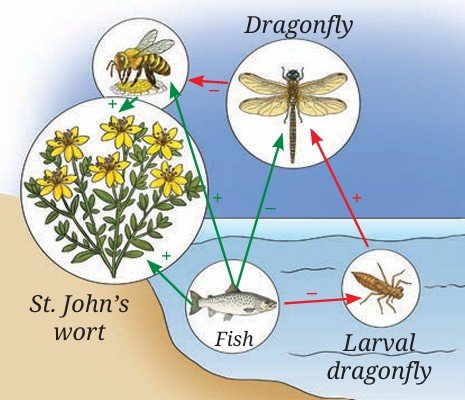
The study shows that all the organisms in a community are connected to one another. A change in one part of a community can affect other parts.
- Fish, dragonflies, bees, butterflies, and plants are biotic components because they are living.
- Water, temperature, and nutrients are abiotic components because they are non-living.
What if there is overfishing?
If humans catch too many fish, then the number of fish in pounds may decrease. Then the dragonfly population will increase, and dragonflies will eat more bees, flies, and butterflies. This can reduce pollination and may affect seed production in plants.
What Are the Different Types of Interactions Among Organisms and their Surroundings?
Every living organism does not live alone; they interact with other living things and with non-living things around them. Like plants, they need sunlight, water, air, and soil to grow. Animals depend on plants and other animals for food. These relationships are called interactions. There are three types of interactions—
| Criterion 1: Interactions between biotic and abiotic components | Criterion 2: Interaction between two abiotic components | Criterion 3: Interaction among the biotic components |
|---|---|---|
| Earthworms live in moist soil. | The day temperature is high due to the bright sunlight. | A frog eats insects |
| Many microbes are present in the pond. | Water is evaporating fast due to the sunlight. | A water snake eats fish. |
| A fish lays eggs in water. | Air current is blowing slowly on the water surface creating gentle waves. | Frogs and fish may compete for small insect larvae. |
| The soil near the pond is moist. | A fish lays eggs in water near vegetation to protect them from other fish or frogs. |
What is an ecosystem?
An ecosystem is a place where living organisms interact with one another and with non-living things around them. There are two main types of natural ecosystems—
- Aquatic Ecosystem: An ecosystem found mainly in water. For example, ponds, rivers, and lakes.
- Terrestrial Ecosystem: An ecosystem found mainly on land. For example, forests, grasslands, farms, and areas around large trees such as banyan and mango trees. Farmland is a human-made ecosystem because people create and manage it.
Can Ecosystems Overlap?
Yes, the different ecosystems can meet and interact with each other. For example, a river may flow through an area containing mountains, forests, grasslands, and farmland. The river is an aquatic ecosystem, while the forest, grassland, and farmland are terrestrial ecosystems.
How Do Living Organisms Depend on Non-Living Things?
Living organisms need abiotic components to survive, like plants making food by photosynthesis; they require sunlight, carbon dioxide, and water. Soil provides nutrients to the plant, air provides oxygen, and water is essential for almost all living organisms. So, biotic components depend on abiotic components.
How Do Living Organisms Affect Non-Living Things?
The relationship also works in the opposite direction. All the living organisms can affect their surroundings like
- Plants release oxygen during photosynthesis.
- Plant roots hold soil in place and help prevent soil erosion.
- Plants help the soil retain moisture.
- Plants can help cool the surrounding air.
Therefore, the biotic and abiotic components affect each other.
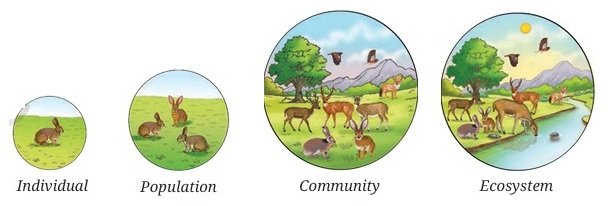
From an Individual to an Ecosystem
The living organism has four levels—
- Individual → Population → Community → Ecosystem
- Individual: One organism. For example, one deer.
- Population: A group of organisms of the same kind living in an area. For example, a group of deer.
- Community: Different populations living together. For example, deer, trees, birds, insects, and foxes living in a forest.
- Ecosystem: A community of living organisms together with the non-living surroundings. For example, a forest with plants, animals, microorganisms, soil, air, water, sunlight, and temperature
How Do Plants and Animals Get Food?
1. Producers
The plants make their food through photosynthesis. Therefore, they are called producers or autotrophs. “Auto” means self, and “troph” means food. So, the autotroph means an organism that makes its own food. For example, green plants
2. Consumers
The organisms that cannot make their own food and depend on other organisms for food are called consumers or heterotrophs. “Hetero” means “other,” and “troph” means “food.” The animals are the example of consumers. There are three types of consumers—
- Herbivores: The animals that eat only plants or plant products, like deer.
- Carnivores: The animals that eat other animals, like leopards, vultures, and tigers.
- Omnivores: The animals that eat both plants and animals, like crows, foxes, and mice.
Who Eats Whom?
In an ecosystem, the organisms depend on one another for food. This relationship between organisms that is based on feeding is called feeding relationships.
What Is a Food Chain?
A food chain is a simple sequence that shows who eats whom in an ecosystem. For example, in grassland, grass → grasshopper → frog → snake → eagle. The arrows show the direction of the food and energy flow.

Trophic Levels
All the organisms in a food chain have a particular position called a trophic level. For example,
- First Trophic Level – Producers: In this, green plants make their own food by photosynthesis. For example, grass, millet, etc.
- Second Trophic Level – Herbivores: The animals that eat plants, like deer, hares, grasshoppers, and mice.
- Third Trophic Level – Small Carnivores: In this the animals eat herbivores or smaller animals like frogs, some birds, etc.
- Higher Trophic Levels – Larger Carnivores: These animals eat other animals, for example, eagles, tigers, lions, and vultures.
What Is a Food Web?
In nature, organisms do not depend on only one type of food. For example, a frog may eat different insects, and a snake may eat frogs, birds, or other animals. Each of the organisms may be eaten by two or more types of organisms. Thus, in an ecosystem, the food chains are interlinked with each other to form a network called a food web.
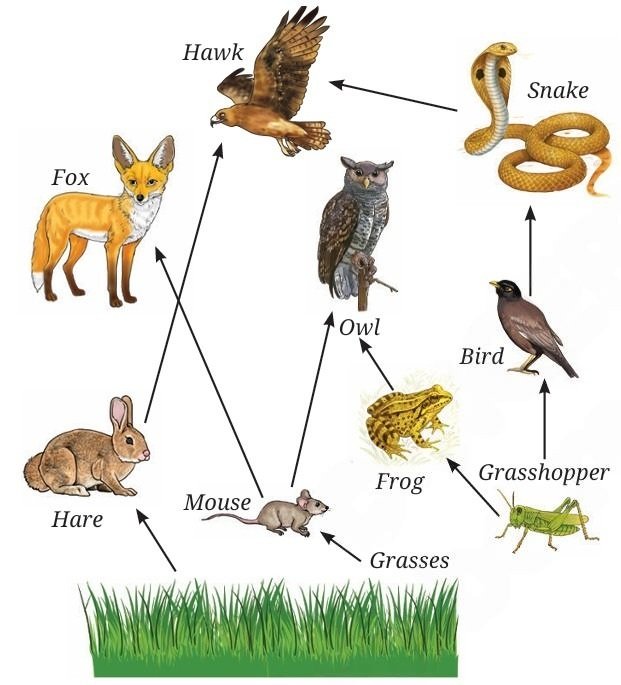
Food Chain vs. Food Web
| Food Chain | Food Web |
|---|---|
| Shows one simple feeding path | Shows many connected feeding paths |
| Usually looks like a line | Looks like a network |
| Shows one “who eats whom” sequence | Shows several feeding relationships |
| Example: Grass → Hare → Eagle | Many food chains connected together |
What Happens to Waste in Nature?
Nature has a natural recycling system. The dead plants, animals, and waste are broken down by the organisms such as fungi and bacteria.
This process is called decomposition. These organisms that break down the dead matter are called decomposers or saprotrophs. Decomposition returns important nutrients to the soil, which helps the plants use for growth.
- Dead matter → Decomposers → Nutrients in soil → New plants
How Does One Change Lead to Another?
We already learn in nature everything is connected. A small change in one part can cause many other changes, like—
- Pollution in pond: If there is pollution in the pond, then fewer plants → less oxygen → fewer fish → more insects → more pests in farms → more pesticides → environmental damage.
- Decline in Frog: In the 1980s in India, large numbers of frogs were collected for their legs for export. This decreases the frog population. If the frog population decreases, then the insects will increase, and farmers will require more agricultural pests, which can harm the environment, soil, and water. To prevent the ecological balance, the Government of India banned the export of frog legs.
An ecosystem remains balanced when organisms and their surroundings interact in a way that keeps populations and resources stable. This balance is dynamic, not fixed, and can be disrupted by natural or human-made changes.
How Do Interactions Maintain Balance in Ecosystems?
Organisms may compete for limited resources such as food, water, space, and sunlight. Competition helps control the population size of organisms. Without competition, one species might increase too much and disturb the ecosystem. Other Types of Interactions –
- Mutualism: Both organisms benefit. For example: Honeybees and flowers.
- Commensalism: One organism benefits while the other is not affected. For example: Orchids on trees.
- Parasitism: One organism benefits while the other is harmed. For example: Ticks on the body of dogs.
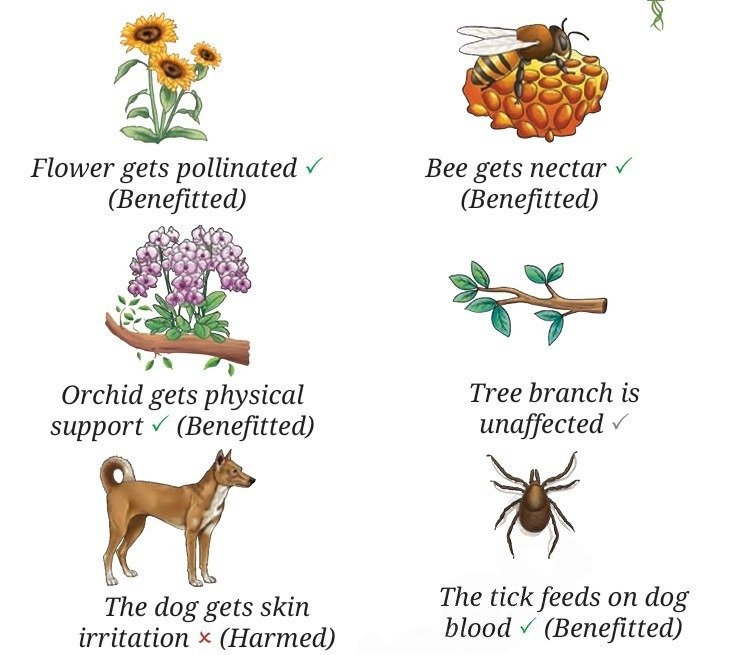
What Are the Benefits of an Ecosystem?
Ecosystems are very important because living and non-living components work together to support life. Humans also depend on ecosystems for many things like fresh air, food, timber, fibers, medicines, and fertile soil. Nature and human life are closely connected.
The Sundarbans: The Sundarbans has the world’s largest mangrove forest, located around the Ganges and Brahmaputra river delta in India and Bangladesh. The Sundarbans are important because—
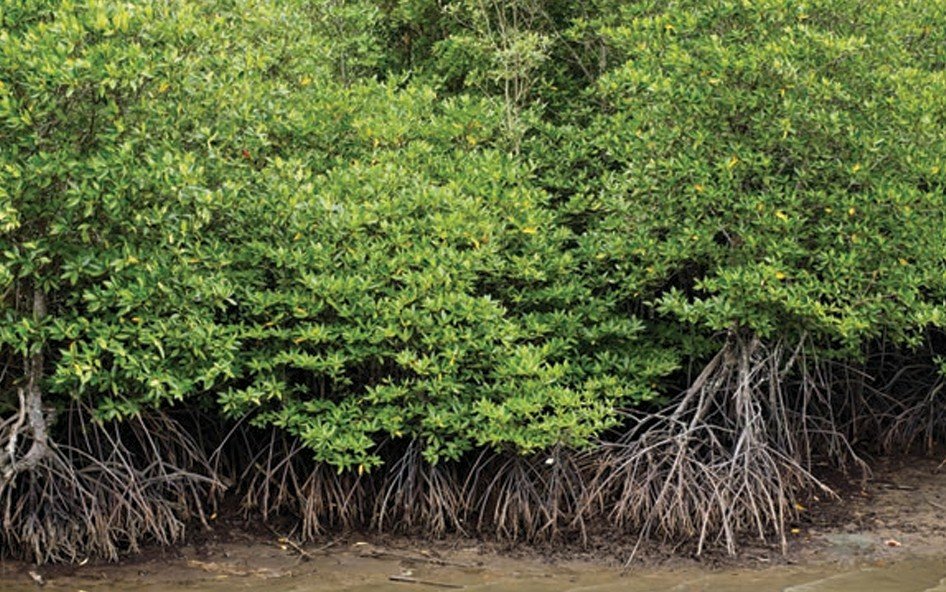
- They are home to many plants and animals.
- Mangrove forests help protect coastal areas from strong winds, storms, and floods.
- Trees absorb carbon dioxide and release oxygen.
- They support many species, including endangered animals.
- UNESCO declared the Sundarbans a World Heritage Site in 1987.
Human activities are damaging the ecosystem, like cutting mangrove trees, overuse of forest resources, illegal hunting, industrial pollution, and untreated sewage. This activity can disturb the natural balance of the ecosystem.
Human-Made Ecosystems
The human can also create their own ecosystem to meet their needs, like farms, fish ponds or parks. This ecosystem needs human care and management. If this ecosystem can be designed and managed properly, then humans can support biodiversity, reduce pollution and provide useful spaces for people.
Healthy Ecosystems and Farming
Farming provides food for people and is an important livelihood in India. The Green Revolution in the mid-20th century increased food production through the use of –
- Tractors and machines
- Synthetic fertilisers
- Pesticides
- Improved farming methods
When excessive use of some of these methods can harm the environment.
Problems Caused by Unsustainable Farming
- Too many chemical fertilisers can reduce soil fertility.
- Excessive pesticides can harm useful organisms.
- Too much groundwater extraction can reduce water availability.
- Growing the same crop repeatedly can reduce biodiversity.
- Excessive ploughing and irrigation can disturb organisms such as earthworms.
- Some pests can become resistant to pesticides.
- Reduced biodiversity can affect pollinators.
How Can Farming Become More Sustainable?
Farmers can use methods that protect both crops and nature, such as:
- Reducing unnecessary use of chemical fertilisers and pesticides
- Protecting useful insects and soil organisms
- Maintaining soil health
- Growing different types of crops instead of only one crop repeatedly
- Using water carefully
- Exploring organic and natural farming methods
Disclaimer: The content that is present on our website is based on the NCERT Class 8 Science textbook and is provided for educational purposes only. All the content and images have been taken from Science Class 8 NCERT Textbook. Images and content shown above are the property of individual organizations and are used here for reference purposes only. To make it easy to understand, some of the content and images are generated by AI and cross-checked by the teachers.