
The Parliamentary System Legislature and Executive Class 8 Notes, The Parliamentary System is an important part of India’s democracy. In this chapter, students learn about the Legislature and Executive, the two Houses of Parliament—Lok Sabha and Rajya Sabha—and their roles in making laws and running the government. The chapter also explains the functions of Parliament, the role of the President, Prime Minister and Council of Ministers, Question Hour, financial accountability, separation of powers, checks and balances, and the role of citizens in strengthening democracy.
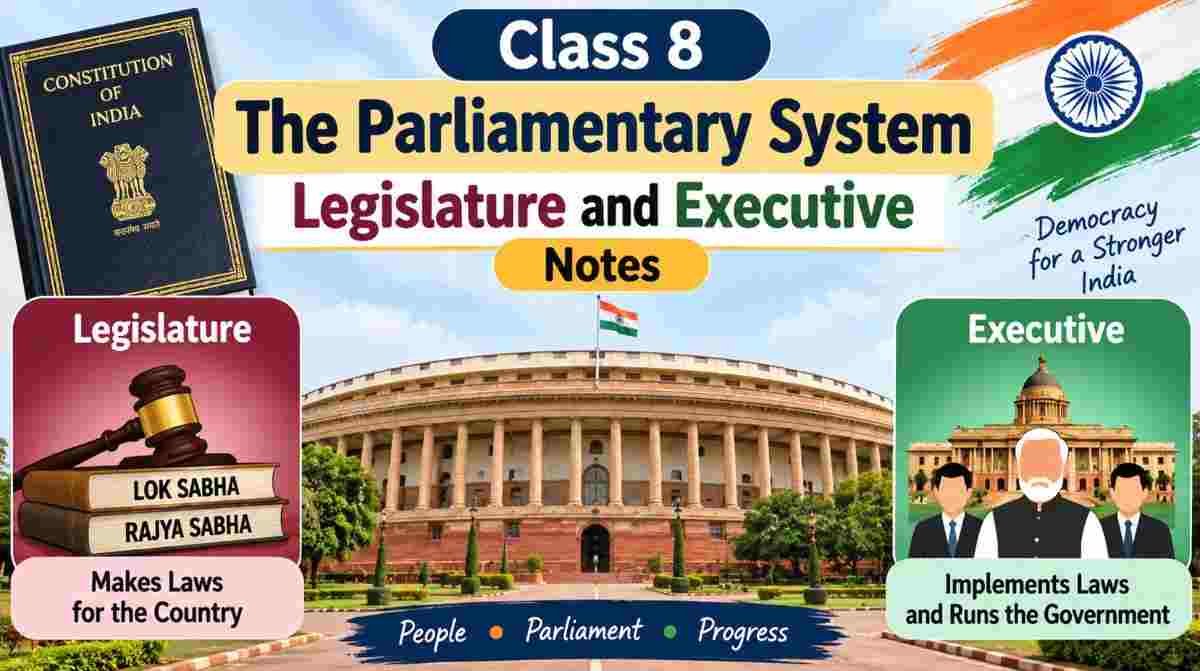
The Parliamentary System Legislature and Executive Class 8 Notes
India struggled against British colonial rule for many years and became independent. Many of the people made sacrifices for the freedom of the country.
The first important step was the Constitution of India. One important principle is universal adult franchise. It means every adult citizen of India has the right to vote.
The first Lok Sabha was formed in 1952. Since then, there have been 17 Lok Sabhas. The 18th Lok Sabha was formed in June 2024.
Composition of the Parliament of India
The Parliament of India has three parts—
- The President
- Lok Sabha – House of the People or Lower House
- Rajya Sabha – Council of States or Upper House
The Lok Sabha and Rajya Sabha are called the two Houses of Parliament because of this. India has a bicameral system, which means “Bi” means two and “Cameral” means house or chamber. So, “bicameral” means having two houses.
Why does India have two houses?
While making the Constitution, there was a long discussion about whether India should have two houses or not. They finally come, and that one house would not be enough to deal with newly independent India. Therefore, a second house called the Rajya Sabha was created.
What is federalism?
India follows federalism. Federalism means that the power of government is shared between the central government, state government, and local government. This helps to maintain a balance between the unity of the country and the interests of different states and local areas.
Function of the Parliament
Every house of the parliament has a presiding officer. The officer makes sure that the discussions and debates happen in an orderly way.
- Lok Sabha: The member of Lok Sabha elects a speaker. The Speaker conducts the meeting in the Lok Sabha. Maintain discipline and ensure that the rules are followed.
- Rajya Sabha: The Vice President of India is the Chairperson of the Rajya Sabha. The chairperson conducts the meeting and makes sure that the discussion is done properly.
Legislative and Executive Functions
The Parliament also has an important legislative function, meaning making laws for the country. Parliament also has an important role in making sure that the government works according to the law. The Union Executive is a person who is responsible for carrying out the decisions and laws for the government. The Union Executive consists of
- The President
- The Vice President
- The Council of Ministers, headed by the Prime Minister
The Council of Ministers are chosen from members of both Houses of Parliament, and the Council of Ministers is responsible to the Lok Sabha.
Legislative Functions of the Parliament
There are multiple responsibilities given by the Constitution of India to the Parliament. These functions are divided into four parts—
- Constitutional Functions
- Lawmaking
- Executive Accountability
- Financial Accountability
1. Constitutional Functions
The Parliament has a responsibility to protect and follow the important value of the Indian Constitution. This can be done using the following ways:
✔ Parliamentary Democracy
The Indian government follows the parliamentary democracy, like all the citizens of India have a right to vote. This is called Universal Adult Franchise.
✔ Separation of Powers
The government powers are divided into three organs like
- Legislature—makes laws
- Executive – implements and runs the government
- Judiciary—gives justice and interprets laws
This is called separation of the powers.
✔Federalism
The parliament maintaining the federalism in India means the power is shared between the central government, state government, and local government.
✔Fundamental Rights and Directive Principles
Parliament makes laws and policies to protect fundamental rights and follow the Directive Principle of State Policy given in the Constitution.
2. Lawmaking
One of the most important functions is making laws for the country. The Constitution provides a proper process for making laws, like Bill → discussion and approval in Parliament → President’s approval → Act. An act is a law that has been passed through the proper process. For example, the Right of Children to Free and Compulsory Education Act, 2009 (RTE), was made through this process.
3. Executive Accountability
The Prime Minister and Council of Ministers are the parts of the Union Executive. They are responsible for—
- Implementing and enforcing laws.
- Running the government.
- Taking decisions for the day-to-day working of the country.
- Working according to the Constitution and laws.
The Council of Ministers is answerable to the Lok Sabha.
What is Question Hour in Parliament?
The question hour is an important way where the Parliament checks the work of the government. During this time MPs can ask ministers questions about the—
- Government policies
- Government activities
- Decisions taken by the government
The government ministers have to answer these questions and explain their actions. This helps to make the government accountable. Parliamentary committees also check the work of different ministries.
4. Financial Accountability
The Parliament also has a responsibility to check how the government uses public money. The government makes an annual budget. The parliament approves the budget and checks how the money is planned to be spent. Parliament also checks how the funds are given to different ministries and departments.
Executive Functions of Parliament
The Executive is responsible for implementing laws and running government. In India, the main part of the Union Executive is—
- The President
- The Prime Minister
- The Council of Ministers
1. The President
The President of India is the head of the executive. This means that the president is the formal head, and the government is mainly run by the prime minister and the council of ministers. The President—
- Appoints the Prime Minister.
- Appoints other ministers.
- Calls meetings of Parliament.
- Gives approval (assent) to Bills passed by Parliament.
The Council of Ministers can give help and advice to the President. In some situations, the president can use discretionary powers. For example, if no political party gets the majority in a Lok Sabha election, then the president can decide whom to invite to form the government.
2. The Prime Minister and the Council of Ministers
The Prime Minister runs the government of India. The president appoints the leader from the majority party or coalition in the Lok Sabha as the prime minister.
The prime minister needs support from the Lok Sabha member to run the government. The main functions of the Prime Minister are—
- Leads the Council of Ministers.
- Advises the President.
- Coordinates the work of different ministries.
- Helps decide national policies.
- Runs the government with the Council of Ministers.
The Prime Minister and the Council of Ministers are collectively responsible to the Lok Sabha.
✔Role of the Government in Lawmaking
Many Bills that are discussed in Parliament are introduced by the government. When the Parliament passes the law, then the government is responsible for implementing it.
✔Role of Civil Servants
The civil servants are the permanent government officials who help the government work. They are also called administrators or bureaucrats. They:
- Help implement laws and government policies.
- Work under the direction of ministers.
- Help government departments work smoothly.
The Judiciary — Role of Checks and Balances
The judiciary is a very important branch of the government that applies laws and protects democracy and the constitution. The judiciary works through courts. The main function of the Judiciary –
- Interprets laws and explains their meaning.
- Solves disputes between people, organisations, and governments.
- Protects the fundamental rights of citizens.
- Makes sure that the government follows the Constitution.
- Checks whether laws made by Parliament follow the Constitution.
The judiciary is also called the custodian of the constitution because it helps to protect the constitution and makes sure that the rules are followed.
How does the judiciary check the government?
The Legislature makes laws. The Executive implements these laws. The judiciary checks whether both are working according to the Constitution. If Parliament makes a law that goes against the Constitution, then the judiciary can examine the law.
If the Executive does anything wrong or violates the Constitution, then the Judiciary can take action according to the law.
Separation of Powers and Checks and Balances
The three important organs of the government are –
- Legislature → Makes laws
- Executive → Runs the government and implements laws
- Judiciary → Interprets laws and checks whether they follow the Constitution
This division of power is called separation of powers. The system in which these organs check each other’s powers is called ‘checks and balances’.
Legislative and Executive Functions at the State Level
The Central Government has Parliament to make laws and run the government. Every state in India has its own legislature and executive. The state legislature is known as the State Legislature.
The elected members of the State Legislature are called Members of Legislative Assembly (MLAs). MLAs make laws on subjects given to the states under the State List and also on subjects in the Concurrent List.
Structure of State Legislatures
State legislatures can have one house or two houses.
- Unicameral Legislature: The unicameral legislature means only having one house, which is called Vidhan Sabha (Legislative Assembly).
- Bicameral Legislature: The ‘bicameral’ means having two houses. The two houses are the Vidhan Sabha, which is known as the lower house, and the Vidhan Parishad, which is known as the upper house or legislative council.
The State has a bicameral legislature –
- Andhra Pradesh
- Bihar
- Karnataka
- Maharashtra
- Telangana
- Uttar Pradesh
The other states have a unicameral legislature.
Challenges to the Effective Functioning of the Legislatures
The Parliament has some important responsibilities in the Centre and in State Assemblies. They –
- Make laws.
- Check the work of the government.
- Approve the government budget.
- Discuss important issues of the country.
- Discuss development plans and international relations.
- Raise the problems and complaints of people.
However, legislatures also face some challenges like –
- Some members are absent regularly.
- Some members do not cooperate with each other.
- Members may not communicate properly.
- The quality of debates may sometimes become poor.
- Question hours may be disrupted.
- Important discussions may not happen properly.
Sessions of Parliament
The parliament meeting was conducted three times in a year. These meetings are called sessions. The three main sessions are –
- Budget Session
- Monsoon Session
- Winter Session
Each session has several sittings. A sitting is a meeting of Parliament where the members –
- Discuss proposed laws.
- Discuss important matters.
- Ask questions of the government.
- Seek explanations from ministers.
Usually, Parliament works for about 6 hours a day during a session. The working hours can be increased when there is an urgent need to complete important work. State Assemblies also have similar sessions and sittings.
Why Are Disruptions a Problem?
Parliament and State Assemblies should be places where members discuss issues peacefully and thoughtfully. They should discuss laws and problems in the interest of the people. But some time –
- Debates are disrupted.
- Sessions end earlier than planned.
- Important bills may take a long time to be discussed and passed.
Sometimes, debates may become angry or biased instead of focusing seriously on people’s problems.
Role of Citizens
The citizens also have an important role in making democracy stronger. People should –
- Stay informed about important issues.
- Ask questions.
- Share their opinions.
- Take part in public discussions.
- Discuss government policies in a respectful way.
- Communicate with their elected representatives.
Citizens also participate in discussions when the government organises the meeting before making policies. When people take an active and responsible part in democracy, they can help the government make better policies.
Young People and Democracy
The young people and different background people are entering public life. Technology has made the information easier for all citizens like –
- Get information.
- Share their views.
- Communicate with representatives.
- Take part in discussions about government.
Young people are the future of the voters of India. Their choice and participation play an important role in strengthening Parliament and State Assemblies.
Disclaimer: The content that is present on our website is based on the NCERT Class 8 Social Science textbook and is provided for educational purposes only. All the content and images have been taken from Socail Science Class 8 NCERT Textbook. Images and content shown above are the property of individual organizations and are used here for reference purposes only. To make it easy to understand, some of the content and images are generated by AI and cross-checked by the teachers.
I’m reading this, 2 days for my exam
I read this before my exam which is going to start in 2 hours💀😅😂