
Factors of Production Class 8 Notes explain the basic resources required to produce goods and services. These factors include Land, Labour, Capital, Entrepreneurship, and Technology. Students will learn how these factors work together in the production process, the role of entrepreneurs, the importance of human capital, supply chains, and the responsible use of natural resources.
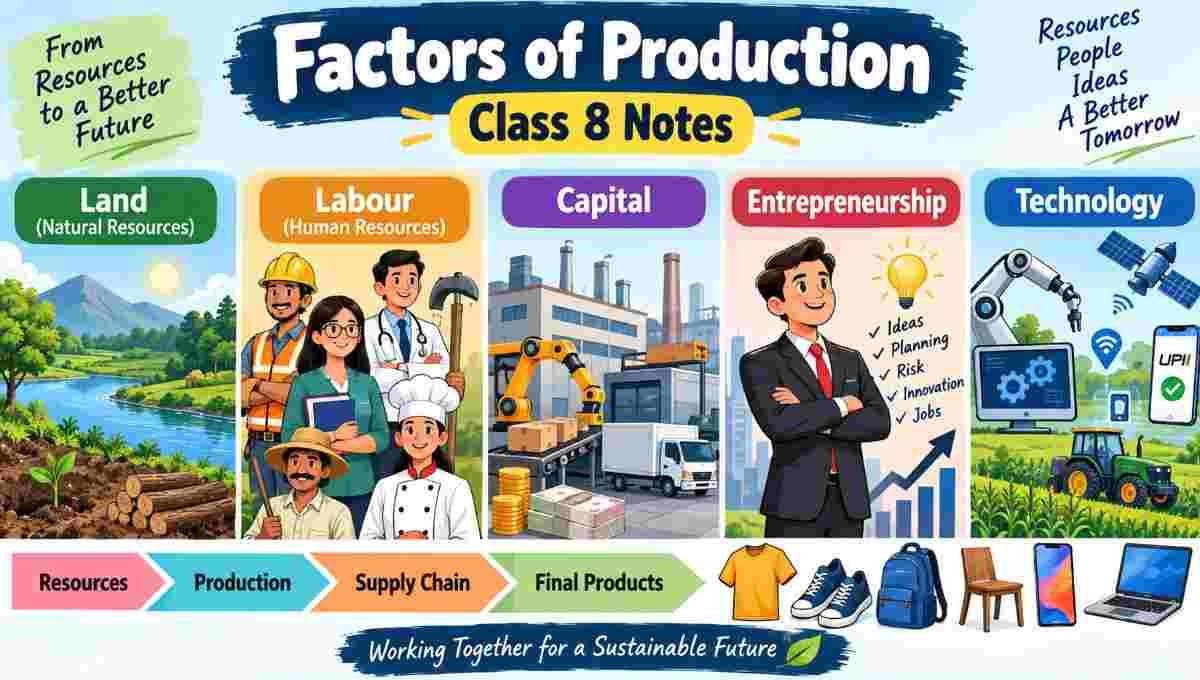
Factors of Production Class 8 Notes
Every product goes through a production process and becomes a final product like clothes, shoes, school bags, furniture, phones, computers, etc.
What are factors of production?
The resources or inputs used to produce goods and services are called factors of production. Businesses or enterprises combine various inputs or factors of production to create goods and services, which also generate opportunities for people to engage in economic activities. There are four main factors of production –
- Land – Natural resources such as land, water, forests and minerals.
- Labour – The physical or mental work done by people.
- Capital – Things used to produce goods, such as machines, tools, buildings and money.
- Entrepreneurship – The ability to start and manage a business and take decisions.
Technology helps businesses produce more goods using the same or fewer resources. For example, a machine can help a factory make more products in less time.
Factors of Production
1. Land (natural resources)
The word ‘land’ in economics encompasses not only geographical land but also natural resources like soil, forests, water, air, sunlight, minerals, oil, and natural gas.
2. Labour (human resources)
Labour means the physical and mental work done by people to produce goods and services. for example –
- Farmers grow crops.
- Carpenters make furniture.
- Teachers teach students.
- Doctors treat patients.
- Construction workers build houses.
a. People as a resource
People are an important resource because they use their knowledge, skills and abilities to produce goods and services. For example:
- A scientist develops new technology.
- A chef creates new dishes.
- A police officer maintains law and order.
b. Facilitators of human capital
The human capital can develop using –
- Education and Training: Education gives knowledge, and training helps us to improve our skills. If the people have both, then they can do better jobs.
- Good Health: The healthy people can work and learn better.
c. Social and Cultural Values
Hard-working people, punctuality and continuous improvement help people to work better. Kaizen is a Japanese idea that means continuous improvement.
d. Challenges to human capital
Human capital and a young population are very important in India. Literacy is an important characteristic of the population and helps enhance the skills and productivity of human capital. According to World Bank estimates for 2023:
- 85% of adult males in India are literate.
- 70% of adult females are literate.
India has improved in many areas, but there are still challenges in developing human capital.
According to the Economic Survey of India 2024, about 65% of India’s population is below 35 years of age.
Demographic Dividend
‘Demographic dividend’ means the benefit a country can get when it has many young and working people.
Capital
Enterprises also required capital; capital means money used to produce goods and services. An example of the capital is –
- Machines and tools
- Computers
- Vehicles
- Shops and factories
- Furniture and equipment
- Money
There are multiple sources where we can get capital, like –
- Personal savings
- Family and friends
- Bank loans
- Stock market – Large companies can raise money by selling shares to the public.
Entrepreneurship
Entrepreneurship means starting and running a business or creating something new to solve a problem. An entrepreneur is a person who:
- Finds a problem and thinks of a solution.
- Takes risks by investing time and money.
- Combines land, labour and capital.
- Makes important business decisions.
- Creates new products or services.
- Creates jobs for other people.

Technology: An Enabler of Production
Technology is a scientific knowledge that helps to make work easier and better. For example, a camera can change the light into an electrical signal and create a digital picture. Day by day technology is improving. New technologies make our work faster, easier, and more efficient. For example:
- UPI allows us to make payments quickly with just a few clicks.
- Weather technology helps farmers know about the weather in advance.
- GPS helps find the shortest route to transport goods.
- Email has replaced many letters because it is faster and cheaper.
The old technology is not always replaced; some simple tools are still useful today. For example, pulleys and wheelbarrows are still used.
How are the Factors Connected?
The factors of production are connected with –
- Land
- Labour
- Capital
- Enterpreneurship
- Technology
Above all, factors help to produce goods and services. Different products need different factors, which means it depends on the product. For example,
- Agriculture, construction and handicrafts need more workers. So, they are called labour-intensive activities.
- Semiconductor chips and satellites need expensive machines, equipment and technology. So, they are called capital-intensive activities.
All the factors depend on each other. If any important factor is not used for the mission, then production may become slow or stop completely. The technology can change how much of each factor is needed. For example, using more machines in farming can reduce the need for human labour.
What Is a Supply Chain?
A supply chain is a network of people, organisations, resources, activities and technology that helps in producing and selling goods. If the supply chain is disturbed, then the production can stop. For example, during the COVID-19 pandemic, many of the businesses faced problems because they depended on material coming from other places.
Role of the Entrepreneur
The entrepreneur decides how the different resources should be used. Money is also needed to arrange resources such as –
- land or factory space,
- machines,
- materials, and
- skilled workers.
Responsibilities towards Factors of Production
When we produce goods and services, we use natural resources like land, water, and minerals. These resources are limited, so we must use them carefully.
1. Protect Natural Resources
We have taken care of natural resources; businesses should not harm the environment while producing goods. For example,
- Leather factories provide the jobs and income, but their waste can pollute rivers and soil.
- Old electronic devices should be recycled properly.
Producers should reduce waste, use natural resources carefully, prevent pollution, protect the environment, and follow sustainable practices. Sustainable practices mean using resources today without reducing their availability for future generations.
2. Responsibility Towards Workers
Businesses also have to take care of the workers.
- Fair compensation and working conditions: Employers need to ensure that workers are paid fairly for their labor and that they work in a safe environment.
- Skill development and training: There is a responsibility to invest in training and education to ensure that workers develop the skills necessary to remain competitive in the labor market.
- Workplace rights and protections: Laws and regulations for workers’ rights relating to fair treatment, preventing discrimination, and providing benefits like health care or paid leave should be adhered to.
3. Corporate Social Responsibility (CSR)
The Corporate Social Responsibility (CSR) means the business should also take care of society and the environment, not only about making profits. Businesses can practice CSR by:
- Reducing pollution
- Protecting the environment and biodiversity
- Supporting local communities
- Taking care of workers
- Treating employees and customers respectfully
Disclaimer: The content that is present on our website is based on the NCERT Class 8 Social Science textbook and is provided for educational purposes only. All the content and images have been taken from Socail Science Class 8 NCERT Textbook. Images and content shown above are the property of individual organizations and are used here for reference purposes only. To make it easy to understand, some of the content and images are generated by AI and cross-checked by the teachers.