
Test your knowledge of Reshaping India’s Political Map Class 8 with these important multiple-choice questions. This MCQ collection covers key events, political changes, the formation and reorganisation of regions, and important developments that shaped India’s political map. These questions are useful for Class 8 Social Science revision, practice, and exam preparation.
Reshaping India’s Political Map Class 8 MCQ
Conceptual Recall MCQs
Q. The term “medieval” in Indian history generally refers to:
A) 5th–10th centuries
B) 11th–17th centuries
C) 18th–19th centuries
D) 2nd–7th centuries
Answer: B) 11th–17th centuries
Q. Which of the following was NOT a dynasty of the Delhi Sultanate?
A) Mamluks
B) Khiljis
C) Tughlaqs
D) Mauryas
Answer: D) Mauryas
Q. Narasimhadeva I of the Eastern Ganga kingdom is remembered for:
A) Defeating the Mongols in Delhi
B) Repelling Delhi Sultanate invasions and building the Konark Sun Temple
C) Establishing the Bahmani Sultanate
D) Founding the Vijayanagara Empire
Answer: B) Repelling Delhi Sultanate invasions and building the Konark Sun Temple
Q. The Hoysalas ruled mainly in which present‑day region?
A) Rajasthan
B) Karnataka
C) Odisha
D) Bengal
Answer: B) Karnataka
Q. Krishnadevaraya composed the Telugu epic poem:
A) Ramayana
B) Āmuktamālyada
C) Mahabharata
D) Silappadikaram
Answer: B) Āmuktamālyada
Q. Which temple in Vijayanagara is famous for its “musical pillars”?
A) Konark Sun Temple
B) Vitthala Temple
C) Tirupati Temple
D) Virūpāksha Temple
Answer: B) Vitthala Temple
Q. Babur defeated Ibrahim Lodi in 1526 at the First Battle of Panipat. What was the result?
A) Establishment of the Delhi Sultanate
B) Foundation of the Mughal Empire
C) Rise of the Vijayanagara Empire
D) End of the Maratha rule
Answer: B) Foundation of the Mughal Empire
Q. Which Mughal ruler is best remembered as the builder of the Taj Mahal?
A) Babur
B) Akbar
C) Jahangir
D) Shah Jahan
Answer: D) Shah Jahan
Q. Aurangzeb crowned himself emperor in 1658 and took the title:
A) Shahenshah
B) Alamgir (“conqueror of the world”)
C) Sultan‑i‑Azam
D) Padshah‑i‑Hind
Answer: B) Alamgir (“conqueror of the world”)
Q. Who is remembered as a valiant queen of the Gond kingdom who fought Akbar’s general in 1564?
A) Razia Sultan
B) Rani Durgavati
C) Rani Lakshmibai
D) Chand Bibi
Answer: B) Rani Durgavati
Q. Maharana Pratap fought the Mughal army at:
A) Battle of Khanwa
B) Battle of Talikota
C) Battle of Haldighati
D) Battle of Saraighat
Answer: C) Battle of Haldighati
Q. The Ahoms migrated from present‑day:
A) Afghanistan
B) Myanmar
C) Nepal
D) Tibet
Answer: B) Myanmar
Q. Who compiled the Guru Granth Sahib for the first time?
A) Guru Nanak
B) Guru Arjan
C) Guru Gobind Singh
D) Guru Tegh Bahadur
Answer: B) Guru Arjan
Q. What was the iqta system under the Delhi Sultanate?
A) Land grants to peasants for farming
B) Territories assigned to nobles to collect taxes for the Sultan’s treasury
C) A military training system for soldiers
D) A system of religious education
Answer: B) Territories assigned to nobles to collect taxes for the Sultan’s treasury
Q. What was the mainstay of the Indian economy between the 13th and 17th centuries?
A) Trade and shipping
B) Agriculture
C) Temple donations
D) Artisanal crafts
Answer: B) Agriculture
Q. Which coins were introduced by the Mughals?
A) Gold dinar and silver dirham
B) Rupaya of silver and dam of copper
C) Copper paise and bronze shilling
D) Silver pound and copper penny
Answer: B) Rupaya of silver and dam of copper
Application-Based MCQs
Q. Muhammad bin Tughlaq shifted his capital from Delhi to Daulatabad. What was his likely reason?
A) To escape Mongol invasions
B) To control empire from a central location
C) To punish Delhi citizens
D) To expand trade with the south
Answer: B) To control empire from a central location
Q. If Ala-ud-din Khilji had not repelled Mongol invasions, what might have happened?
A) India would have become part of the Mongol Empire
B) The Mughal Empire would have started earlier
C) The Khilji dynasty would have expanded faster
D) The Lodis would have risen sooner
Answer: A) India would have become part of the Mongol Empire
Q. The Musunuri Nayakas united over 75 chieftains to defeat the Delhi Sultanate in Warangal. What does this event show?
A) The strength of Mongol invasions
B) The importance of unity among local rulers against foreign powers
C) The decline of Vijayanagara Empire
D) The rise of Mughal Empire
Answer: B) The importance of unity among local rulers against foreign powers
Q. Rana Kumbha built the Kumbhalgarh Fort in the Aravalli hills. Why was such a location chosen?
A) Easy access to trade routes
B) Strategic defense with forests and steep slopes
C) Close to the capital Delhi
D) To expand agriculture
Answer: B) Strategic defense with forests and steep slopes
Q. Portuguese travellers were treated well in Vijayanagara because:
A) They brought silk and spices
B) They sold horses, which the king did not want enemies to acquire
C) They helped build temples
D) They supported Krishnadevaraya in wars
Answer: B) They sold horses, which the king did not want enemies to acquire
Q. Domingo Paes compared Vijayanagara to Rome. What does this suggest about the city?
A) It was small but prosperous
B) It was large, well‑planned, and full of trade and abundance
C) It was only a religious centre
D) It was declining during his visit
Answer: B) It was large, well‑planned, and full of trade and abundance
Q. Babur described India as a “country of few charms” but chose to stay. Why?
A) He disliked Central Asia
B) India’s wealth, artisans, and fertile land made it suitable for empire building
C) He wanted to spread Christianity
D) He was forced by Timur’s descendants
Answer: B) India’s wealth, artisans, and fertile land made it suitable for empire building
Q. Akbar abolished the jizya tax and promoted sulh‑i kul. What was the impact of this policy?
A) It created hostility among Rajputs
B) It encouraged tolerance and gained support from Hindu rulers
C) It weakened Mughal administration
D) It led to the decline of trade
Answer: B) It encouraged tolerance and gained support from Hindu rulers
Q. Aurangzeb spent the last 25 years of his life fighting wars in the Deccan. What was one major consequence of this?
A) Strengthening of Mughal finances
B) Rapid decline of Mughal power after his death
C) Expansion of trade routes
D) End of Rajput resistance
Answer: B) Rapid decline of Mughal power after his death
Q. The Jat peasantry rebelled against Mughal officers in the 17th century. What does this reflect?
A) The prosperity of Mughal agriculture
B) The harsh exploitation faced by peasants under Mughal rule
C) The decline of tribal kingdoms
D) The rise of the Sikh Empire
Answer: B) The harsh exploitation faced by peasants under Mughal rule
Q. Maharana Pratap used guerrilla warfare against the Mughals. What does this show?
A) Dependence on large armies
B) Effective use of terrain and small forces against bigger armies
C) Decline of Rajput resistance
D) Alliance with the Mughals
Answer: B) Effective use of terrain and small forces against bigger armies
Q. The Ahoms used the paik system to maintain their army. What was its main advantage?
A) It allowed rulers to build infrastructure and maintain a large force without a permanent army
B) It reduced agricultural productivity
C) It weakened tribal unity
D) It forced peasants into slavery
Answer: A) It allowed rulers to build infrastructure and maintain a large force without a permanent army
Q. Guru Tegh Bahadur chose martyrdom rather than conversion to Islam. What does this reflect?
A) His political ambition
B) His commitment to religious freedom and protection of others
C) His alliance with the Rajputs
D) His opposition to Guru Gobind Singh
Answer: B) His commitment to religious freedom and protection of others
Q. Akbar introduced the mansabdari system. What was its main purpose?
A) To maintain a permanent central army
B) To assemble troops quickly without keeping a permanent army
C) To reduce the number of jagirdars
D) To abolish land taxes
Answer: B) To assemble troops quickly without keeping a permanent army
Q. The hundi system allowed merchants to transfer money safely across regions. What modern practice does this resemble?
A) Online shopping
B) Modern banking and cheques
C) Agricultural subsidies
D) Temple donations
Answer: B) Modern banking and cheques
Q. Temples acted as centres of economic activity. Which of the following BEST explains this role?
A) They only collected donations for rituals
B) They provided credit, funded trade, and built infrastructure like tanks and dharmashālās
C) They were used only for worship and festivals
D) They were controlled by foreign merchants
Answer: B) They provided credit, funded trade, and built infrastructure like tanks and dharmashālās
Assertion–Reason MCQs
Q. Assertion (A): Muhammad bin Tughlaq’s introduction of token currency failed.
Reason (R): People began counterfeiting copper coins, causing economic decline.
A) Both A and R are true, and R explains A
B) Both A and R are true, but R does not explain A
C) A is true, R is false
D) A is false, R is true
Answer: A) Both A and R are true, and R explains A
Q. Assertion (A): Most sultans of the Delhi Sultanate ruled for long stable periods.
Reason (R): Successions were peaceful and orderly.
A) Both A and R are true
B) Both A and R are false
C) A is true, R is false
D) A is false, R is true
Answer: B) Both A and R are false
Q. Assertion (A): The Hoysalas remained independent in southern India for a long time.
Reason (R): They successfully resisted several attacks from the Delhi Sultanate.
A) Both A and R are true, and R explains A
B) Both A and R are true, but R does not explain A
C) A is true, R is false
D) A is false, R is true
Answer: A) Both A and R are true, and R explains A
Q. Assertion (A): The Bahmani Sultanate eventually broke into five smaller states.
Reason (R): Former governors declared autonomy and formed the Deccan Sultanates.
A) Both A and R are true, and R explains A
B) Both A and R are true, but R does not explain A
C) A is true, R is false
D) A is false, R is true
Answer: A) Both A and R are true, and R explains A
Q. Assertion (A): Krishnadevaraya patronised scholars in multiple languages.
Reason (R): He wanted Vijayanagara to be a centre of cultural renaissance.
A) Both A and R are true, and R explains A
B) Both A and R are true, but R does not explain A
C) A is true, R is false
D) A is false, R is true
Answer: A) Both A and R are true, and R explains A
Q. Assertion (A): The Battle of Talikota in 1565 marked the decline of Vijayanagara.
Reason (R): A coalition of Deccan Sultanates defeated Ramaraya’s forces and destroyed the city.
A) Both A and R are true, and R explains A
B) Both A and R are true, but R does not explain A
C) A is true, R is false
D) A is false, R is true
Answer: A) Both A and R are true, and R explains A
Q. Assertion (A): Babur relied heavily on gunpowder and artillery in the First Battle of Panipat.
Reason (R): These new weapons gave him a decisive advantage over Ibrahim Lodi’s forces.
A) Both A and R are true, and R explains A
B) Both A and R are true, but R does not explain A
C) A is true, R is false
D) A is false, R is true
Answer: A) Both A and R are true, and R explains A
Q. Assertion (A): Akbar’s reign combined brutality and tolerance.
Reason (R): He ordered massacres at Chittorgarh but also promoted interfaith dialogues and abolished jizya.
A) Both A and R are true, and R explains A
B) Both A and R are true, but R does not explain A
C) A is true, R is false
D) A is false, R is true
Answer: A) Both A and R are true, and R explains A
Q. Assertion (A): Aurangzeb reimposed the jizya tax on non‑Muslims.
Reason (R): He wanted to strengthen Islamic practices and distinguish his rule from Akbar’s tolerance.
A) Both A and R are true, and R explains A
B) Both A and R are true, but R does not explain A
C) A is true, R is false
D) A is false, R is true
Answer: A) Both A and R are true, and R explains A
Q. Assertion (A): Aurangzeb’s succession to the throne was peaceful.
Reason (R): He was chosen by his father Shah Jahan without conflict.
A) Both A and R are true
B) Both A and R are false
C) A is true, R is false
D) A is false, R is true
Answer: B) Both A and R are false
Q. Assertion (A): The Bhils supported Maharana Pratap in his resistance against the Mughals.
Reason (R): Their knowledge of the Aravalli terrain and skill as archers strengthened his forces.
A) Both A and R are true, and R explains A
B) Both A and R are true, but R does not explain A
C) A is true, R is false
D) A is false, R is true
Answer: A) Both A and R are true, and R explains A
Q. Assertion (A): The Ahoms were defeated by the Mughal army at Saraighat in 1671.
Reason (R): The Mughal army had more men and river boats.
A) Both A and R are true, and R explains A
B) Both A and R are true, but R does not explain A
C) A is true, R is false
D) A is false, R is true
Answer: C) A is true, R is false
Q. Assertion (A): Guru Gobind Singh established the Khalsa in 1699.
Reason (R): It was a martial brotherhood committed to justice, equality, and defence of the faith.
A) Both A and R are true, and R explains A
B) Both A and R are true, but R does not explain A
C) A is true, R is false
D) A is false, R is true
Answer: A) Both A and R are true, and R explains A
Q. Assertion (A): Todar Mal introduced an efficient revenue system under Akbar.
Reason (R): He carried out detailed surveys of land, crop yields, and prices to fix revenue fairly.
A) Both A and R are true, and R explains A
B) Both A and R are true, but R does not explain A
C) A is true, R is false
D) A is false, R is true
Answer: A) Both A and R are true, and R explains A
Q. Assertion (A): Expansion of irrigation systems increased agricultural productivity.
Reason (R): It allowed farmers to grow multiple crops such as rice, wheat, pulses, sugarcane, cotton, and jute.
A) Both A and R are true, and R explains A
B) Both A and R are true, but R does not explain A
C) A is true, R is false
D) A is false, R is true
Answer: A) Both A and R are true, and R explains A
Q. Assertion (A): India imported more goods than it exported during this period.
Reason (R): Merchants from Arabia and Persia settled in Indian ports.
A) Both A and R are true, and R explains A
B) Both A and R are true, but R does not explain A
C) A is true, R is false
D) A is false, R is true
Answer: D) A is false, R is true
Case/Experiment-Based MCQ
Q. Read the case: Timur invaded Delhi in the late 14th century, killing thousands and enslaving many. He wrote that his aim was “to wage war with the infidels and to gain something by plundering their wealth.”
Which of the following BEST explains the impact of Timur’s invasion?
A) Delhi prospered economically after his attack
B) The Lodis rose to power after the chaos left behind
C) Timur established permanent rule in India
D) The Mongols controlled Delhi after Timur’s withdrawal
Answer: B) The Lodis rose to power after the chaos left behind
Q. Case: Harihara and Bukka, once governors under Muhammad bin Tughlaq, rejected Delhi’s authority and founded the Vijayanagara Empire. According to folklore, they chose Hampi as their capital after seeing a hare chase hounds, interpreted by their guru Vidyaranya as a symbol of resilience.
What does this story mainly highlight?
A) The importance of military alliances
B) The role of folklore and symbolism in political decisions
C) The decline of the Bahmani Sultanate
D) The rise of the Mughal Empire
Answer: B) The role of folklore and symbolism in political decisions
Q. Case: Domingo Paes described Vijayanagara as “the best provided city in the world” with countless people, abundant markets, and water conduits.
What does this description mainly highlight?
A) The city’s military strength
B) The city’s prosperity, urban planning, and thriving trade
C) The decline of Vijayanagara after Talikota
D) The religious importance of Tirupati
Answer: B) The city’s prosperity, urban planning, and thriving trade
Q. Case: Himu, chief minister under the Sur rulers, briefly captured Delhi and ruled as Hemchandra Vikramaditya. He was defeated at the Second Battle of Panipat by Akbar.
What does this event show about Mughal consolidation?
A) The Mughal Empire was unstable after Babur
B) Akbar’s victory ensured Mughal dominance in Delhi
C) The Sur Empire permanently replaced the Mughals
D) Rajputs controlled Delhi after Himu’s defeat
Answer: B) Akbar’s victory ensured Mughal dominance in Delhi
Q. Case: Rani Durgavati of the Garha kingdom fought bravely against Akbar’s general in 1564. Despite being outnumbered, she led her army of 20,000 soldiers and 1,000 elephants. Wounded, she chose death over capture.
What does her story mainly symbolise?
A) Decline of Gond kingdoms
B) Regional pride, bravery, and resistance against Mughal expansion
C) The rise of Rajput power in Rajasthan
D) The importance of elephants in Mughal warfare
Answer: B) Regional pride, bravery, and resistance against Mughal expansion
Q. Case: In the Battle of Saraighat (1671), Lachit Borphukan led 10,000 Ahom soldiers against 30,000 Mughal troops. Using rivers, forests, and guerrilla tactics, the Ahoms defeated the Mughals.
What does this battle mainly highlight?
A) Weakness of Mughal artillery
B) Importance of geography and local knowledge in warfare
C) Decline of Rajput resistance
D) Rise of the Maratha Empire
Answer: B) Importance of geography and local knowledge in warfare
Q. Case: Guru Arjan was tortured to death by Jahangir after supporting his rebellious son. His son Guru Hargobind responded by forming a Sikh army and introducing martial training.
What does this shift mainly highlight?
A) The decline of Sikhism as a spiritual movement
B) The transformation of Sikhism into both a spiritual and military force
C) The rise of Mughal tolerance
D) The end of Sikh resistance
Answer: B) The transformation of Sikhism into both a spiritual and military force
Q. Case: A farmer in the Sultanate period had to pay one‑fifth of his produce as land revenue. Later, under some rulers, this tax rose to half.
What impact would this increase most likely have?
A) Farmers became wealthier and expanded trade
B) Farmers lost land and became bonded labourers
C) Farmers stopped growing food crops
D) Farmers shifted to temple management
Answer: B) Farmers lost land and became bonded labourers
Diagram/Visual-Based MCQ
Q. Refer to Figure (territories of Tughlaqs and Lodis). Which statement is correct?
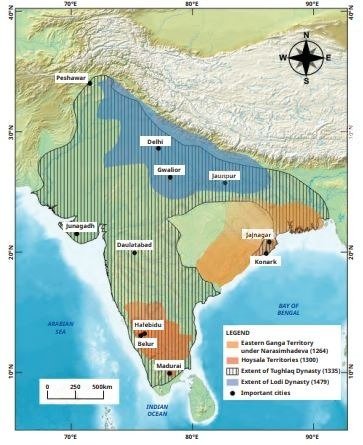
A) The Lodis controlled a larger area than the Tughlaqs
B) The Tughlaqs controlled most of northern India in the 14th century
C) The Hoysalas ruled over Delhi during the Sultanate period
D) The Eastern Gangas defeated the Khiljis and ruled Delhi
Answer: B) The Tughlaqs controlled most of northern India in the 14th century
Q. Refer to Figure (map of Deccan kingdoms). Which statement is correct?
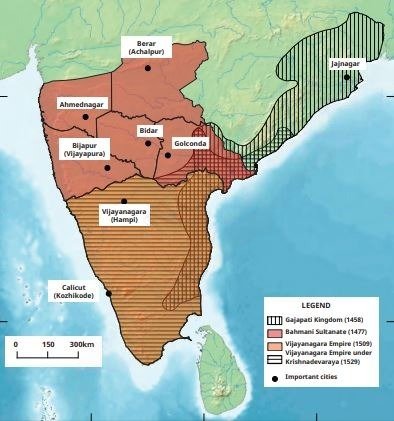
A) The Bahmani Sultanate controlled most of northern India
B) The Vijayanagara Empire expanded under Krishnadevaraya in the 16th century
C) The Gajapati rulers of Odisha ruled over Hampi
D) The Deccan Sultanates were united under one ruler
Answer: B) The Vijayanagara Empire expanded under Krishnadevaraya in the 16th century
Q. Figure shows the Vitthala temple’s mahāmandapa with intricately carved pillars. What unique feature is noted about these pillars?
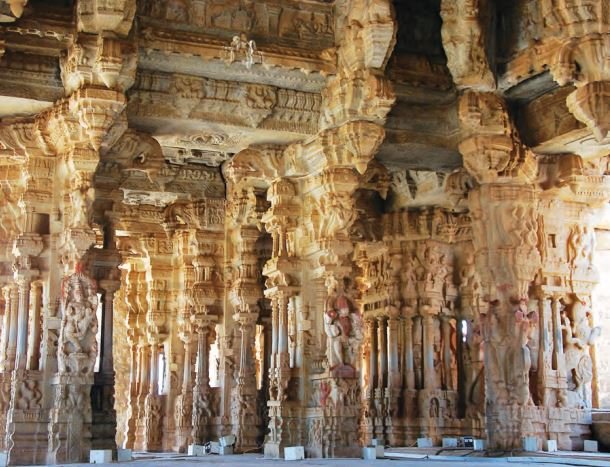
A) They were made of gold
B) They produced musical notes when struck
C) They were built by Portuguese travellers
D) They were destroyed in the Battle of Talikota
Answer: B) They produced musical notes when struck
Q. Refer to Figure (map of Mughal expansion). Which statement is correct?
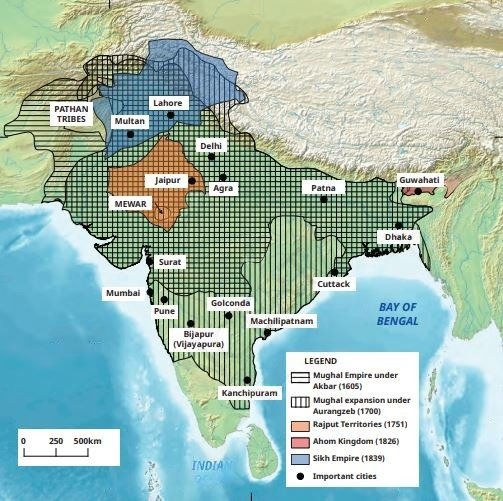
A) Akbar’s empire in 1605 was smaller than the Lodis’ territory
B) Aurangzeb expanded the Mughal Empire further after Akbar
C) The Sikh Empire controlled Delhi in Akbar’s time
D) The Ahom Kingdom was part of Akbar’s empire
Answer: B) Aurangzeb expanded the Mughal Empire further after Akbar
Q. Figure shows Mughal expansion under Aurangzeb. Which statement is correct?
A) Aurangzeb expanded the empire to its greatest territorial extent
B) The Mughal Empire shrank under Aurangzeb compared to Akbar
C) Aurangzeb ruled only northern India
D) The Ahom Kingdom was part of Aurangzeb’s empire
Answer: A) Aurangzeb expanded the empire to its greatest territorial extent
Q. Figure shows the Mewar emblem with a Bhil warrior. What does this symbolise?
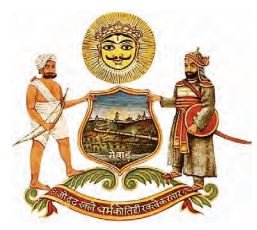
A) Rajput alliance with the Mughals
B) Respect for Bhil contributions in Mewar’s military tradition
C) Decline of Bhil culture
D) Bhils ruling Mewar independently
Answer: B) Respect for Bhil contributions in Mewar’s military tradition
Q. Figure shows Abul Fazl with his chronicles. Which of the following works did he write describing Akbar’s administration?
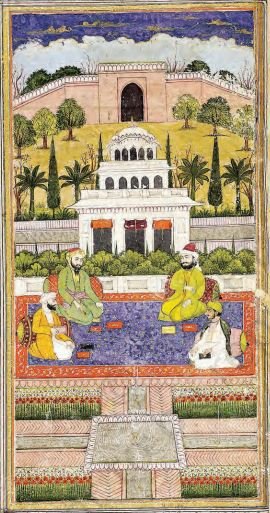
A) Baburnama
B) Ain‑i‑Akbari
C) Razmnama
D) Pañchatantra
Answer: B) Ain‑i‑Akbari
Q. Figure shows a Persian wheel used to draw water from wells or tanks. What was its main purpose?
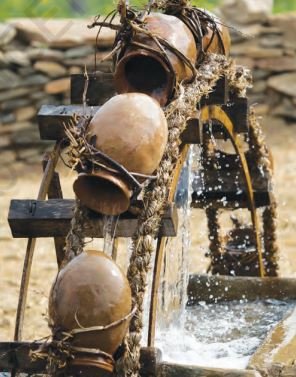
A) To grind grain into flour
B) To irrigate fields and support agriculture
C) To transport goods across rivers
D) To measure land revenue
Answer: B) To irrigate fields and support agriculture
Disclaimer: The content that is present on our website is based on the NCERT Class 8 Social Science textbook and is provided for educational purposes only. All the content and images have been taken from Socail Science Class 8 NCERT Textbook. Images and content shown above are the property of individual organizations and are used here for reference purposes only. To make it easy to understand, some of the content and images are generated by AI and cross-checked by the teachers.