
← Back to Class 10 Study Material
Acids, Bases and Salts Class 10 Extra Questions and Answers provide additional practice for important concepts from the chapter. These questions cover acids and bases, indicators, pH scale, chemical reactions, salts, and their common uses.
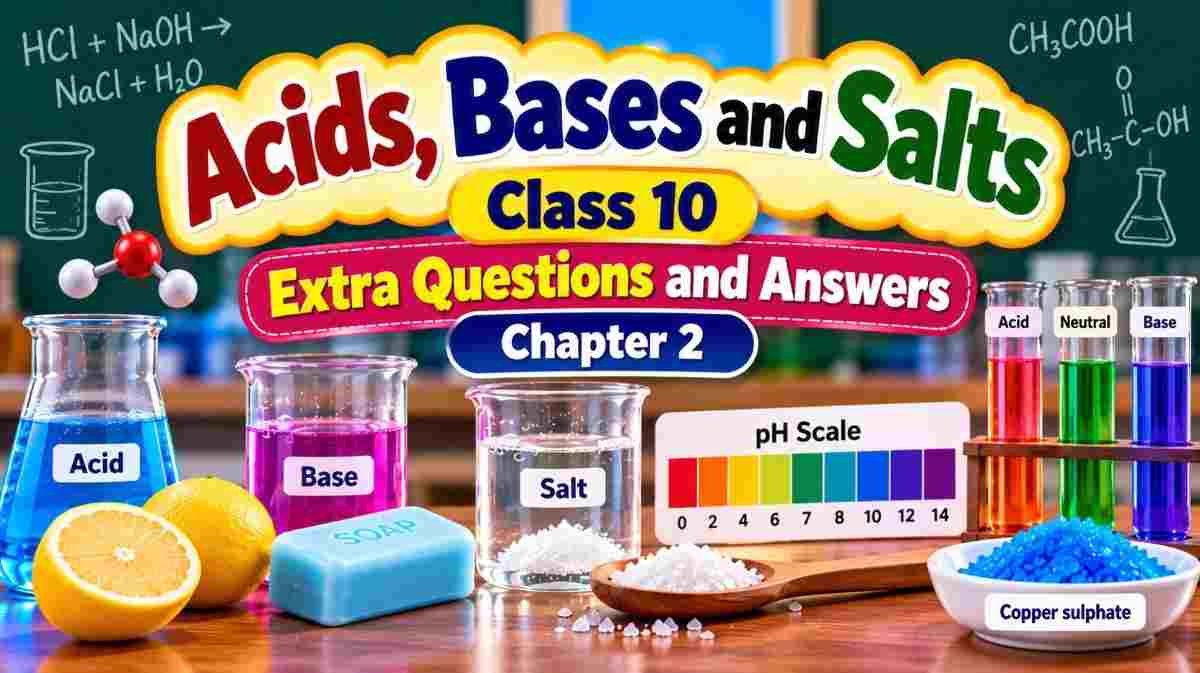
Acids Bases and Salts Class 10 Extra Questions and Answers
Important Questions
Q. Explain why acids taste sour and bases taste bitter. How can we test them without tasting?
Answer: Acids taste sour because they release hydrogen ions (H⁺) in water. Bases taste bitter because they release hydroxide ions (OH⁻). We do not taste them directly. Instead, we use indicators like litmus, turmeric, methyl orange, or phenolphthalein to test acids and bases safely.
Q. Write a balanced equation for the neutralisation of NaOH with HCl. Why is this reaction important in daily life?
Answer: NaOH(aq) + HCl(aq) → NaCl(aq) + H₂O(l)
This reaction is important because acids and bases cancel each other’s effect. Neutralisation is used in medicine (antacids), agriculture (soil treatment), and daily life (removing acidity).
Q. Write the general equation for the reaction of an acid with a metal. Illustrate with zinc and dilute sulphuric acid.
Answer: General equation: Acid + Metal → Salt + Hydrogen gas
Example: Zn + H₂SO₄ → ZnSO₄ + H₂↑
Here zinc reacts with dilute sulphuric acid to form zinc sulphate and hydrogen gas.
Q. What is a neutralisation reaction? Give one example with equation.
Answer: Neutralisation reaction is when an acid reacts with a base to form salt and water.
Example: HCl + NaOH → NaCl + H₂O
Q. Why must hydrogen ions in aqueous solution always be written as H⁺(aq) or H₃O⁺?
Answer: Hydrogen ions cannot exist alone. In water, they combine with water molecules to form hydronium ions (H₃O⁺). That is why we write H⁺(aq) or H₃O⁺.
Q. What happens to the concentration of H₃O⁺ or OH⁻ ions when an acid or base is diluted with water?
Answer: When an acid or base is diluted, the number of ions per unit volume decreases. The solution becomes weaker. This process is called dilution.
Q. What is the pH scale? Explain the range of values and what they represent.
Answer: The pH scale measures hydrogen ion concentration. It ranges from 0 to 14.
- pH < 7 → Acidic solution
- pH = 7 → Neutral solution
- pH > 7 → Basic solution
Lower pH means stronger acid, higher pH means stronger base.
Q. Differentiate between strong and weak acids with examples.
Answer:
- Strong acids: Produce more H⁺ ions in water. Example: HCl, H₂SO₄.
- Weak acids: Produce fewer H⁺ ions in water. Example: CH₃COOH (acetic acid).
Q. What is meant by the “family of salts”? Give two examples.
Answer: Salts having the same positive or negative ion belong to one family.
- Example: NaCl and Na₂SO₄ are sodium salts.
- Example: NaCl and KCl are chloride salts.
Q. Explain how salts can be neutral, acidic, or basic with suitable examples.
Answer:
- Neutral salts: Strong acid + strong base. Example: NaCl.
- Acidic salts: Strong acid + weak base. Example: NH₄Cl.
- Basic salts: Weak acid + strong base. Example: Na₂CO₃.
Q. What is Plaster of Paris? Write its chemical formula.
Answer: Plaster of Paris is calcium sulphate hemihydrate. It is a white powder used for plastering, making toys, and supporting fractured bones. Formula: CaSO₄·½H₂O
Q. How is Plaster of Paris obtained from gypsum? Write the balanced equation.
Answer: Plaster of Paris is made by heating gypsum at 373 K. Equation: CaSO₄·2H₂O → CaSO₄·½H₂O + 1½H₂O
Reason‑Based Questions
Q. Why does blue litmus turn red in acid but red litmus turns blue in base?
Answer: Acids release hydrogen ions (H⁺) in water. These ions change blue litmus to red. Bases release hydroxide ions (OH⁻). These ions change red litmus to blue.
Q. Why should curd and sour substances not be kept in brass or copper vessels?
Answer: Curd and sour substances contain acids. Acids react with brass or copper to form poisonous salts. These salts make food harmful.
Q. Why does tooth decay start when pH of mouth falls below 5.5?
Answer: Tooth enamel is made of calcium phosphate. It is corroded when pH falls below 5.5 because acids formed by bacteria dissolve it. This causes tooth decay.
Q. Why does a burning candle make a ‘pop’ sound when brought near a bubble formed during reaction of zinc with acid?
Answer: The gas formed is hydrogen. Hydrogen burns with a ‘pop’ sound when tested with a burning candle. This confirms hydrogen gas.
Q. Why does dry HCl gas not change the colour of dry litmus paper, but HCl solution does?
Answer: Dry HCl gas does not produce ions without water, so it shows no acidic character. In solution, HCl produces H⁺ ions, so it changes litmus colour.
Q. Why is it recommended to add acid slowly to water and not water to acid during dilution?
Answer: Dilution of acid is highly exothermic. Adding water to acid causes sudden heat and splashing. Adding acid slowly to water is safe because heat spreads evenly.
Q. Why does higher hydronium ion concentration correspond to lower pH value?
Answer: pH is the measure of hydrogen ion concentration. More H₃O⁺ ions mean stronger acidity. Stronger acidity gives lower pH value.
Q. Why is the pH of a neutral solution always 7?
Answer: In neutral solution, H⁺ ions and OH⁻ ions are equal. This balance gives pH = 7.
Q. Why are large crystals of rock salt often brown in colour?
Answer: Rock salt crystals contain impurities. These impurities make the crystals brown.
Q. Why is bleaching powder used to disinfect drinking water?
Answer: Bleaching powder releases chlorine. Chlorine kills germs in water. That is why it is used for disinfection.
Q. Why is half a water molecule shown in the formula of Plaster of Paris (CaSO₄·½H₂O)?
Answer: Two formula units of CaSO₄ share one water molecule. That is why half a water molecule is written in the formula.
Q. Why does Plaster of Paris set into a hard mass when mixed with water?
Answer: Plaster of Paris reacts with water to form gypsum. Gypsum is a hard solid. This property makes Plaster of Paris set quickly.
Application‑Based Questions
Q. A person suffers from acidity. Which substance will you suggest as remedy and why?
Answer: I will suggest baking soda solution or antacids. They are mild bases. They neutralise the excess acid in the stomach and give relief.
Q. Explain two uses of bleaching powder in daily life.
Answer:
- It is used to disinfect drinking water because it releases chlorine which kills germs.
- It is used for bleaching cotton, linen, and wood pulp in paper factories.
Q. How does sodium hydrogencarbonate act in soda‑acid fire extinguishers?
Answer: Sodium hydrogencarbonate decomposes to release carbon dioxide gas. CO₂ does not support burning, so it puts out the fire.
Q. Sodium carbonate reacts with dilute HCl to produce effervescence. Write the equation and explain how lime water can be used to test the gas evolved.
Answer:Equation: Na₂CO₃ + 2HCl → 2NaCl + H₂O + CO₂↑
The gas evolved is carbon dioxide. When passed through lime water, it turns milky due to formation of calcium carbonate.
Q. How can phenolphthalein be used to show neutralisation between NaOH and HCl?
Answer: Phenolphthalein is pink in base (NaOH). When HCl is added, the pink colour disappears. This shows neutralisation.
Q. A student mixes concentrated sulphuric acid with water. The beaker becomes hot. Explain the reason and precautions to be taken.
Answer: The process is highly exothermic. Heat is released when acid mixes with water. Precaution: Always add acid slowly to water with stirring, never add water to acid.
Q. Bases soluble in water are called alkalis. Give two examples and mention one use of alkalis in daily life.
Answer: Examples: Sodium hydroxide (NaOH), Potassium hydroxide (KOH).
Use: NaOH is used in making soap.
Q. Explain two uses of sodium hydrogencarbonate in daily life.
Answer: It is used in baking powder. CO₂ released makes cakes soft and spongy.
It is used in antacids to neutralise excess acid in the stomach.
Q. How does washing soda help in removing permanent hardness of water?
Answer: Washing soda reacts with calcium and magnesium ions in hard water. It forms insoluble carbonates. This removes hardness.
Q. Why is Plaster of Paris used by doctors for supporting fractured bones?
Answer: Plaster of Paris sets quickly into a hard solid when mixed with water. It keeps fractured bones in the right position.
Q. Mention two uses of Plaster of Paris in decoration and construction.
Answer:
- It is used for making decorative items and toys.
- It is used for smooth finishing of walls and ceilings.
Case‑Based Questions
Q. A farmer finds his soil sample has pH 4.5.
- What does this indicate about the soil?
- Suggest one method to improve soil condition.
- Why is soil pH important for plant growth?
Answer: The soil is strongly acidic. To improve soil, lime (CaO), slaked lime (Ca(OH)₂), or chalk (CaCO₃) can be added. Soil pH is important because plants grow best in a suitable pH range. Very acidic soil reduces fertility and affects crop growth.
Q. Soil pH and Crops: A farmer finds effervescence when dilute HCl is added to his soil sample.
- Which compound is present in soil?
- Write the balanced equation for the reaction.
- How can this affect crop growth?
Answer: The compound present is calcium carbonate (CaCO₃).
Equation: CaCO₃ + 2HCl → CaCl₂ + H₂O + CO₂↑
Excess carbonate changes soil balance and can affect crop growth by reducing nutrient availability.
Q. The HCl gas is tested with dry and wet blue litmus paper.
- What is observed in each case?
- What conclusion can be drawn about the acidic character of HCl gas and HCl solution?
Answer:
- With dry litmus paper: No colour change.
- With wet litmus paper: Blue litmus turns red.
- Conclusion: HCl shows acidic character only in solution because it produces H⁺ ions in water.
Q. A farmer tests soil pH using universal indicator and finds pH = 4.5.
- What does this indicate about the soil?
- Suggest one method to improve soil condition.
- Why is soil pH important for plant growth?
Answer: The soil is strongly acidic. It can be treated with lime or slaked lime to reduce acidity. Soil pH is important because plant roots absorb nutrients properly only in the right pH range.
Q. In the chlor‑alkali process, electrolysis of brine produces three useful products.
- Name the products.
- State one use of each.
- Why is this process called “chlor‑alkali”?
Answer:
- Products: Sodium hydroxide (NaOH), Chlorine (Cl₂), Hydrogen (H₂).
- Uses: NaOH is used in soap making, Cl₂ is used in bleaching powder, H₂ is used as fuel.
- It is called chlor‑alkali because chlorine (chlor) and alkali (NaOH) are formed together.
Q. A student heats gypsum at 373 K.
- What product is formed?
- Write the chemical equation.
- Why is this product called Plaster of Paris?
Answer: The product formed is Plaster of Paris (CaSO₄·½H₂O).
Equation: CaSO₄·2H₂O → CaSO₄·½H₂O + 1½H₂O
It is called Plaster of Paris because it was first prepared in Paris and sets quickly into a hard mass when mixed with water.
Experiment‑Based Questions
Q. Copper Sulphate Crystals: When copper sulphate crystals are heated in a dry boiling tube, they turn white. On adding a few drops of water, the blue colour reappears.
- What does this show about the presence of water of crystallisation in salts?
- Write the chemical formula of hydrated copper sulphate.
Answer: This shows that copper sulphate crystals contain water of crystallisation. On heating, water is lost and the salt turns white. When water is added again, the blue colour returns.
Formula: CuSO₄·5H₂O
Q. Electrolysis of Brine: Describe the products formed when electricity is passed through an aqueous solution of sodium chloride (brine). Mention one important use of each product.
Answer: Electrolysis of brine produces sodium hydroxide, chlorine, and hydrogen.
- NaOH: used in soap making.
- Cl₂: used in bleaching powder.
- H₂: used as fuel.
Q. Reaction of Zinc with Dilute Sulphuric Acid: Zinc granules are added to dilute sulphuric acid in a test tube.
- What observations are made on the surface of zinc granules?
- How is the gas evolved tested?
- Write the balanced chemical equation for the reaction.
Answer: Bubbles form on the zinc granules. The gas evolved is hydrogen. It is tested by bringing a burning candle near the gas; it burns with a ‘pop’ sound. Equation: Zn + H₂SO₄ → ZnSO₄ + H₂↑
Q. Reaction of Copper Oxide with Dilute Hydrochloric Acid: Copper oxide is treated with dilute hydrochloric acid.
- What colour change is observed in the solution?
- Write the balanced chemical equation for the reaction.
Answer: The solution turns blue‑green because copper(II) chloride is formed. Equation: CuO + 2HCl → CuCl₂ + H₂O
Q. Preparation of Hydrogen Chloride Gas: Describe the preparation of hydrogen chloride gas in the laboratory.
- How is the gas tested with dry and wet litmus paper?
- What inference is drawn about the acidic character of HCl gas and HCl solution?
Answer: HCl gas is prepared by adding concentrated sulphuric acid to solid NaCl.
- With dry litmus paper: no colour change.
- With wet litmus paper: blue litmus turns red.
Inference: HCl shows acidic character only in solution because it produces H⁺ ions in water.
Q. Dilution of Sulphuric Acid: Concentrated sulphuric acid is added slowly to water in a beaker.
- What observation is made regarding temperature?
- Is the process exothermic or endothermic?
- Why is it recommended to add acid to water and not water to acid?
Answer: The beaker becomes hot. The process is exothermic. Acid must be added slowly to water because adding water to acid causes sudden heat and splashing.
Q. Testing pH of Saliva: Explain how pH paper can be used to test the nature of saliva before and after meals. What difference in pH values is observed and why?
Answer: Saliva before meals shows higher pH (basic). After meals, pH decreases because acids are produced during digestion. pH paper shows this change in colour.
Q. Testing Soil pH: Describe the procedure for testing soil pH using universal indicator paper. What conclusion can be drawn about the ideal soil pH required for healthy plant growth?
Answer: Soil is mixed with water, filtered, and tested with universal indicator paper. The colour shows soil pH. Ideal soil pH is near neutral, suitable for healthy plant growth.
Q. Family of Salts: Write the chemical formulae of potassium sulphate, sodium carbonate, and ammonium chloride. Identify the acids and bases from which each of these salts is obtained.
Answer:
- K₂SO₄: from H₂SO₄ and KOH.
- Na₂CO₃: from H₂CO₃ and NaOH.
- NH₄Cl: from HCl and NH₄OH.
Q. Water of Crystallisation in Copper Sulphate: When copper sulphate crystals are heated, they turn white. On adding water, the blue colour reappears.
- What does this show about water of crystallisation?
- Explain why salts containing water of crystallisation appear dry but are not actually dry.
Answer: This shows that water of crystallisation gives colour to salts. Salts appear dry but contain fixed water molecules inside their structure.
Q. Extension – Gypsum and Plaster of Paris: Copper sulphate crystals lose water of crystallisation on heating. Gypsum also loses water molecules on heating at 373 K to form Plaster of Paris.
- Explain the similarity in both cases.
- Write the chemical equation for the formation of Plaster of Paris from gypsum.
Answer: Both salts lose water of crystallisation on heating and change form.
Equation: CaSO₄·2H₂O → CaSO₄·½H₂O + 1½H₂O
Differentiate Questions
Q. Differentiate between strong acids and weak acids with examples.
Answer:
- Strong acids: Produce more H⁺ ions in water. Example: HCl, H₂SO₄.
- Weak acids: Produce fewer H⁺ ions in water. Example: CH₃COOH (acetic acid).
Q. Differentiate between sodium hydrogencarbonate (baking soda) and sodium carbonate (washing soda) in terms of formula, preparation, and uses.
Answer:
- Sodium hydrogencarbonate: Formula NaHCO₃, prepared using NaCl, used in baking powder, antacids, fire extinguishers.
- Sodium carbonate: Formula Na₂CO₃·10H₂O, prepared by heating NaHCO₃ and recrystallisation, used in glass, soap, paper industries, and removing hardness of water.
Q. Differentiate between metallic oxides and non‑metallic oxides with suitable examples.
Answer:
- Metallic oxides: React with acids to form salt and water, basic in nature. Example: CuO + HCl → CuCl₂ + H₂O.
- Non‑metallic oxides: React with bases to form salt and water, acidic in nature. Example: CO₂ + Ca(OH)₂ → CaCO₃ + H₂O.
Q. Differentiate between reactions of sodium carbonate and sodium hydrogencarbonate with dilute HCl.
Answer:
- Sodium carbonate: Na₂CO₃ + 2HCl → 2NaCl + H₂O + CO₂↑
- Sodium hydrogencarbonate: NaHCO₃ + HCl → NaCl + H₂O + CO₂↑
Both release CO₂, but sodium carbonate reacts faster with more effervescence.
Q. Differentiate between what happens when acids and bases are dissolved in water.
Answer:
- Acids: Produce H⁺ ions (or H₃O⁺ ions). Example: HCl → H⁺ + Cl⁻.
- Bases: Produce OH⁻ ions. Example: NaOH → Na⁺ + OH⁻.
Q. Differentiate between bases and alkalis with examples.
Answer:
- Bases: Substances that produce OH⁻ ions, may or may not dissolve in water. Example: Cu(OH)₂.
- Alkalis: Bases that dissolve in water. Example: NaOH, KOH.
Q. Differentiate between strong bases and weak bases with examples.
Answer:
- Strong bases: Produce more OH⁻ ions in water. Example: NaOH, KOH.
- Weak bases: Produce fewer OH⁻ ions in water. Example: NH₄OH.
Q. Differentiate between salts formed from strong acid + weak base and weak acid + strong base.
Answer:
- Strong acid + weak base: Acidic salt. Example: NH₄Cl.
- Weak acid + strong base: Basic salt. Example: Na₂CO₃.
Q. Differentiate between sodium hydrogencarbonate and sodium carbonate in terms of formula, preparation, and uses.
Answer:
- Sodium hydrogencarbonate: NaHCO₃, prepared from NaCl, used in baking powder, antacids, fire extinguishers.
- Sodium carbonate: Na₂CO₃·10H₂O, prepared by heating NaHCO₃ and recrystallisation, used in industries and cleaning.
Q. Differentiate between gypsum and Plaster of Paris with chemical formulae and uses.
Answer:
- Gypsum: CaSO₄·2H₂O, used in cement and soil treatment.
- Plaster of Paris: CaSO₄·½H₂O, used in plastering, decoration, and supporting fractured bones.
Q. Differentiate between gypsum and Plaster of Paris in terms of formula, preparation, and uses.
Answer:
- Gypsum: Formula CaSO₄·2H₂O, heated at 373 K to form Plaster of Paris, used in cement.
- Plaster of Paris: Formula CaSO₄·½H₂O, prepared from gypsum, used in medical and decorative work.
Q. Differentiate between salts with water of crystallisation (e.g., CuSO₄·5H₂O) and salts without water of crystallisation.
Answer:
- With water of crystallisation: Contain fixed water molecules, often coloured. Example: CuSO₄·5H₂O (blue).
- Without water of crystallisation: Do not contain water molecules, often white. Example: Anhydrous CuSO₄ (white).
Competency‑Based Questions
Q. Explain with examples how natural, synthetic, and olfactory indicators help in identifying acids and bases.
Answer:
- Natural indicators: Litmus changes blue to red in acid and red to blue in base.
- Synthetic indicators: Phenolphthalein is pink in base, colourless in acid.
- Olfactory indicators: Onion smell disappears in base but remains in acid.
Q. Discuss the importance of pH in (i) digestion, (ii) tooth decay, and (iii) self‑defence in plants/animals.
Answer:
- Digestion: Stomach acid (HCl) helps in digestion. Antacids neutralise excess acid.
- Tooth decay: Starts when pH of mouth falls below 5.5. Acid corrodes enamel.
- Self‑defence: Bee sting injects acid, nettle sting injects methanoic acid. Relief is given by mild bases like baking soda.
Q. Why does dilute HCl conduct electricity but glucose solution does not?
Answer: Dilute HCl produces ions in water, so it conducts electricity. Glucose does not produce ions, so it does not conduct electricity.
Q. Explain why all acids show similar chemical properties in aqueous solution.
Answer: In water, all acids release H⁺ ions. These ions give acids their common properties like sour taste, reaction with metals, and neutralisation.
Q. Write the ionic equation for neutralisation of an acid with a base. Why is this reaction important in everyday life?
Answer: Equation: H⁺(aq) + OH⁻(aq) → H₂O(l)
Importance: Neutralisation is used in antacids, soil treatment, and many daily life processes.
Q. How can a universal indicator be used to judge the strength of an acid or base?
Answer: Universal indicator shows different colours at different pH values. Strong acids give low pH (red), weak acids give higher pH (orange/yellow). Strong bases give high pH (blue/purple).
Q. Explain how antacids help in relieving indigestion using the concept of pH.
Answer: Indigestion is caused by excess acid in the stomach. Antacids are mild bases. They neutralise the acid and bring pH back to normal, giving relief.
Q. Discuss the importance of pH in (i) aquatic life, (ii) tooth decay, and (iii) self‑defence in plants/animals.
Answer:
- Aquatic life: Acid rain lowers pH of rivers, making survival difficult.
- Tooth decay: pH below 5.5 corrodes enamel.
- Self‑defence: Bee sting and nettle sting use acids; bases neutralise them.
Q. Why is universal indicator more useful than litmus paper in judging strength of acids and bases?
Answer: Litmus only shows whether a substance is acidic or basic. Universal indicator shows exact pH value and strength of acid or base.
Q. Explain why common salt is considered an important raw material for many chemicals.
Answer: Common salt (NaCl) is used to make sodium hydroxide, bleaching powder, baking soda, and washing soda. That is why it is an important raw material.
Q. What is water of crystallisation? Give examples of salts containing water of crystallisation.
Answer: Water of crystallisation is fixed water molecules present in salts. Examples: CuSO₄·5H₂O (blue crystals), CaSO₄·2H₂O (gypsum).
Q. Explain how the property of Plaster of Paris to set quickly makes it useful in (i) medical field, (ii) construction, and (iii) making decorative materials.
Answer: Plaster of Paris sets quickly into a hard mass.
- Medical: Used to support fractured bones.
- Construction: Used for smooth finishing of walls.
- Decoration: Used for making toys and decorative items.
Q. Why are metallic oxides like CaSO₄ considered basic, and how does this relate to the formation of Plaster of Paris?
Answer: Metallic oxides react with acids to form salt and water, so they are basic. Gypsum (CaSO₄·2H₂O) on heating forms Plaster of Paris (CaSO₄·½H₂O), which is used in construction and medicine.
Disclaimer: The content that is present on our website is based on the NCERT Class 10 Science textbook and is provided for educational purposes only. All the content and images have been taken from Science Class 10 NCERT Textbook. Images and content shown above are the property of individual organizations and are used here for reference purposes only. To make it easy to understand, some of the content and images are generated by AI and cross-checked by the teachers.