
← Back to Class 10 Study Material
Control and Coordination is an important chapter in Class 10 Science. These extra questions and answers cover important topics such as the nervous system, reflex actions, the human brain, coordination in plants, plant hormones, and animal hormones. The questions are based on NCERT concepts and written in simple language to help students understand the chapter, revise important topics, and prepare effectively for exams.
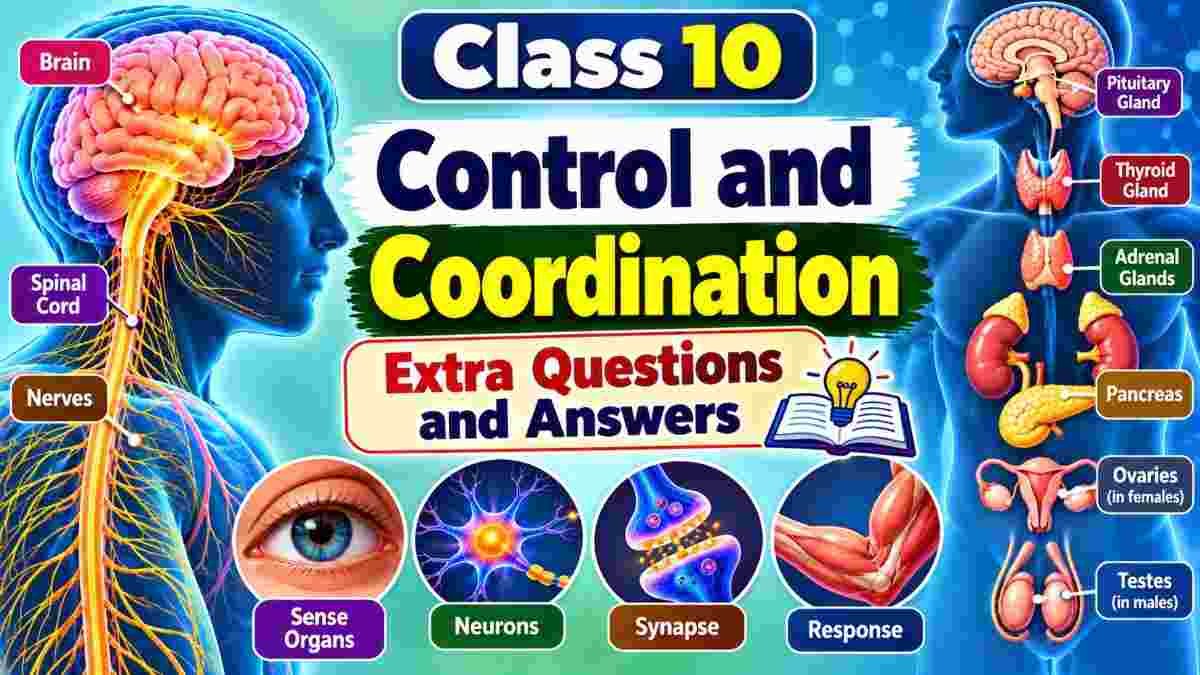
Control and Coordination Class 10 Extra Questions and Answers
Important Questions
Q. What is meant by control and coordination in living organisms? Why is it necessary?
Answer: Control and coordination means linking and regulating different activities of the body. It is necessary so that organisms can respond properly to changes in the environment and keep body functions working smoothly.
Q. Name the two systems in animals that provide control and coordination.
Answer: The two systems are the nervous system and the endocrine (hormonal) system.
Q. What are receptors? Explain with suitable examples.
Answer: Receptors are special tips of nerve cells that detect information from the environment. Example: gustatory receptors detect taste, and olfactory receptors detect smell.
Q. Draw and label the structure of a neuron.
Answer: A neuron has three main parts:
- Dendrites – receive information
- Cell body – processes information
- Axon – carries impulse to the next cell
Q. How does information travel in a neuron?
Answer: Information is received at dendrites, travels as an electrical impulse to the cell body, then along the axon. At the axon end, it changes into chemical signals which cross the synapse to the next cell.
Q. What is meant by reflex action? Give two examples.
Answer: Reflex action is a quick, automatic response to a stimulus without thinking. Examples: pulling hand back from a hot object, blinking when bright light falls on eyes.
Q. What is a reflex arc? Draw and label its diagram.
Answer: Reflex arc is the pathway of nerves that connects receptors to muscles for quick response. It includes receptor, sensory neuron, spinal cord, motor neuron, and effector.
Q. Name the three major parts of the human brain.
Answer: The three parts are fore‑brain, mid‑brain, and hind‑brain.
Q. What is the function of the spinal cord?
Answer: The spinal cord controls reflex actions and also carries information between the brain and the rest of the body.
Q. How is the brain protected in our body?
Answer: The brain is protected inside a bony skull and surrounded by a fluid‑filled balloon which absorbs shocks.
Q. What are the two types of movements shown by plants? Explain with examples.
Answer: Plants show:
- Growth‑independent movement – e.g., Mimosa leaves folding when touched.
- Growth‑dependent movement – e.g., shoots bending towards light.
Q. What is meant by immediate response to stimulus in plants? Give one example.
Answer: Immediate response is quick movement without growth. Example: leaves of Mimosa plant fold when touched.
Q. Define tropic movements. Name any four types of tropism in plants.
Answer: Tropic movements are directional growth movements in response to stimuli. Types: phototropism, geotropism, hydrotropism, chemotropism.
Q. What is the role of auxin in phototropism?
Answer: Auxin collects on the shady side of the shoot, makes cells grow longer there, so the shoot bends towards light.
Q. Name four plant hormones and state their main functions.
Answer:
- Auxins – help in stem growth and bending towards light.
- Gibberellins – help in stem elongation.
- Cytokinins – promote cell division.
- Abscisic acid – inhibits growth and causes wilting.
Q. What are hormones? Name the gland that secretes adrenaline.
Answer: Hormones are chemical messengers secreted by endocrine glands. Adrenaline is secreted by the adrenal glands.
Q. What changes are brought about in the body by adrenaline during emergency situations?
Answer: Adrenaline increases heartbeat, breathing rate, and blood supply to muscles. It prepares the body for “fight or flight” in emergencies.
Q. Why is iodised salt important in our diet?
Answer: Iodine is needed for the thyroid gland to make thyroxin. Without iodine, goitre disease may occur, causing swelling of the neck.
Q. Name the hormone secreted by the thyroid gland. What is its function?
Answer: The thyroid gland secretes thyroxin. It regulates metabolism of carbohydrates, proteins, and fats for balanced growth.
Q. Which gland secretes growth hormone? What happens if it is secreted in less or excess amounts?
Answer: The pituitary gland secretes growth hormone. Deficiency causes dwarfism, excess causes gigantism.
Q. Name the hormones responsible for changes during puberty in males and females.
Answer: Testosterone in males and oestrogen in females.
Q. Which hormone regulates blood sugar levels? Name the gland that secretes it.
Answer: Insulin regulates blood sugar. It is secreted by the pancreas.
Reason‑Based Questions
Q. Why do we not appreciate the full taste of food when our nose is blocked?
Answer: Taste and smell are closely connected. Smell adds to the taste of food. When the nose is blocked, smell is not detected, so food does not taste fully.
Q. Why must nervous impulses be converted into chemical signals at synapses?
Answer: The gap between two neurons (synapse) cannot be crossed by electrical impulses. So impulses are converted into chemical signals which then start a new electrical impulse in the next neuron.
Q. Why is controlled movement important for survival of organisms?
Answer: Controlled movement helps organisms respond correctly to changes in the environment. For example, withdrawing the hand from a hot object prevents injury.
Q. Why do plants bend towards sunlight?
Answer: Plants bend towards sunlight because auxin hormone collects on the shady side of the shoot, makes cells grow longer there, and the shoot bends towards light.
Q. Why is coordination between sense organs and muscles necessary?
Answer: Sense organs detect changes in the environment and muscles act according to signals. Coordination ensures proper response, like running when danger is seen.
Q. Why are reflex actions faster than voluntary actions?
Answer: Reflex actions are controlled by the spinal cord directly without involving the brain. This makes them faster than voluntary actions which need thinking.
Q. Why are reflex arcs formed in the spinal cord instead of the brain?
Answer: Reflex arcs are formed in the spinal cord to save time. If signals went to the brain first, response would be slow and injury could occur.
Q. Why is the fore‑brain called the main thinking part of the brain?
Answer: The fore‑brain receives sensory information, interprets it, stores memory, and makes decisions. It controls voluntary actions, so it is the main thinking part.
Q. Why do we continue to have reflex arcs even after complex neuron networks evolved?
Answer: Reflex arcs give quick responses which are important for survival. Even with complex brain networks, reflex arcs are more efficient for urgent situations.
Q. Why is the cerebellum important for voluntary actions?
Answer: The cerebellum controls precision, posture, and balance in voluntary actions like walking or riding a bicycle. Without it, movements would be uncoordinated.
Q. Why do the leaves of the Mimosa plant fold when touched?
Answer: The leaves fold because plant cells lose water and change shape quickly when touched. This is an immediate response to stimulus without growth.
Q. Why do tendrils of pea plants coil around a support?
Answer: Tendrils coil because the part touching the support grows slower than the opposite side. This uneven growth makes the tendril wrap around the support.
Q. Why do shoots bend towards light while roots bend away from light?
Answer: Shoots show positive phototropism by bending towards light for photosynthesis. Roots show negative phototropism by bending away from light to grow into soil.
Q. Why is abscisic acid called a growth‑inhibiting hormone?
Answer: Abscisic acid stops growth and causes effects like wilting of leaves. That is why it is called a growth‑inhibiting hormone.
Q. Why do plants need chemical coordination instead of electrical impulses?
Answer: Plants do not have nervous tissue. They use hormones which diffuse slowly and reach all cells to coordinate growth and responses.
Q. Why is adrenaline called the “fight or flight” hormone?
Answer: Adrenaline prepares the body for emergencies by increasing heartbeat, breathing, and blood supply to muscles. It helps in fighting or running away.
Q. Why does deficiency of iodine in diet cause goitre?
Answer: Iodine is needed for making thyroxin hormone. Without iodine, thyroxin is not produced properly, leading to swelling of the thyroid gland in the neck (goitre).
Q. Why do some people suffer from dwarfism or gigantism?
Answer: Growth hormone from the pituitary gland controls height. Deficiency causes dwarfism, while excess causes gigantism.
Q. Why are feedback mechanisms important in hormone secretion?
Answer: Feedback mechanisms control the amount of hormone secreted. For example, when blood sugar rises, insulin secretion increases; when sugar falls, insulin secretion decreases.
Q. Why is insulin necessary for maintaining blood sugar levels?
Answer: Insulin helps cells absorb sugar from blood and use it for energy. Without insulin, blood sugar rises and causes harmful effects.
Application‑Based Questions
Q. Explain with an example how animals respond to changes in their environment.
Answer: Animals respond by detecting changes through receptors and acting with muscles. Example: when a cat sees a mouse, its eyes detect the movement, the brain processes it, and muscles help the cat run after the mouse.
Q. How does the structure of a neuron help in transmission of impulses?
Answer: A neuron has dendrites to receive information, a cell body to process it, and an axon to carry impulses. At the axon end, impulses change into chemical signals to pass to the next cell. This structure makes transmission possible.
Q. Why does touching a hot object immediately make us withdraw our hand?
Answer: Heat is detected by receptors in the skin. Impulses travel through sensory neurons to the spinal cord, then through motor neurons to muscles. Muscles contract quickly, making us withdraw the hand to avoid injury.
Q. How does the nervous system help us in whispering instead of shouting in class?
Answer: The nervous system controls muscles according to the situation. It sends signals to control voice muscles softly, so we whisper instead of shouting.
Q. How does blocking the nose during eating affect the taste of food?
Answer: Smell adds to taste. When the nose is blocked, smell is not detected, so food tastes different and less enjoyable.
Q. Explain the sequence of events when a person touches a hot object.
Answer: Receptors in the skin detect heat → sensory neurons carry impulse to spinal cord → spinal cord sends impulse through motor neurons → muscles contract → hand is withdrawn quickly.
Q. How does the reflex arc help in protecting us from danger?
Answer: Reflex arc gives quick response without involving the brain. It saves time and protects us from harm, like pulling hand from flame.
Q. How does the fore‑brain help us in voluntary actions like writing or talking?
Answer: The fore‑brain receives information, interprets it, and sends signals to motor areas. These signals control voluntary muscles for actions like writing or talking.
Q. How does the hind‑brain control involuntary actions like breathing and blood pressure?
Answer: The hind‑brain, especially the medulla, controls involuntary actions like breathing, heartbeat, blood pressure, and vomiting automatically.
Q. How does the cerebellum help us in activities like walking in a straight line or riding a bicycle?
Answer: The cerebellum maintains posture, balance, and precision of voluntary actions. It helps us walk steadily and ride a bicycle without falling.
Q. Explain the activity with germinating bean seeds kept in a flask inside a cardboard box. What does it show?
Answer: In the activity, shoots bend towards light and roots away from light. This shows phototropism in shoots and geotropism in roots.
Q. How does auxin help a plant bend towards light when light falls from one side?
Answer: Auxin collects on the shady side of the shoot, makes cells grow longer there, so the shoot bends towards light.
Q. How does chemotropism help in reproduction of plants?
Answer: Chemotropism helps pollen tubes grow towards ovules due to chemical signals. This ensures fertilisation in plants.
Q. How does hydrotropism help roots in survival of plants?
Answer: Roots grow towards water due to hydrotropism. This helps plants absorb water from soil and survive.
Q. How does wilting of leaves occur due to abscisic acid?
Answer: Abscisic acid inhibits growth and causes leaves to lose water. This results in wilting of leaves.
Q. Explain how adrenaline prepares the body to face emergency situations.
Answer: Adrenaline increases heartbeat, breathing rate, and blood supply to muscles. It reduces blood supply to skin and digestive system. These changes prepare the body for “fight or flight.”
Q. How does thyroxin regulate metabolism of carbohydrates, proteins, and fats?
Answer: Thyroxin controls metabolism by balancing the breakdown and use of carbohydrates, proteins, and fats. This provides energy and supports growth.
Q. How does insulin maintain blood sugar levels in the body?
Answer: Insulin helps cells absorb sugar from blood and use it for energy. It lowers blood sugar when it rises too high.
Q. How does growth hormone affect the height of a person?
Answer: Growth hormone regulates growth of bones and tissues. Deficiency causes dwarfism, while excess causes gigantism.
Q. How does the secretion of testosterone and oestrogen bring about changes during puberty?
Answer: Testosterone in males causes changes like facial hair and deep voice. Oestrogen in females causes changes like development of breasts and menstrual cycle.
Case‑Based Questions
Q. Case Study: A student put sugar in his mouth. It tasted sweet. Then he blocked his nose and tasted sugar again.
☑️ What receptors detect taste?
Answer: The taste of sugar is detected by gustatory receptors present on the tongue.
☑️ Why was the taste different when the nose was blocked?
Answer: When the nose was blocked, olfactory receptors could not detect smell. Since smell adds to taste, the food tasted different.
☑️ What does this experiment show about taste and smell?
Answer: This experiment shows that taste and smell are closely connected and both are needed to fully appreciate food.
Q. Case Study: A boy touched a hot plate and immediately pulled back his hand.
☑️ Which receptors detected the heat?
Answer: The thermoreceptors in the skin detected the heat.
☑️ How was the impulse carried to muscles?
Answer: The impulse travelled through sensory neurons to the spinal cord, then through motor neurons to muscles.
☑️ Why is this response important?
Answer: This quick response is important because it protects the body from injury.
Q. Case Study: A student whispered to his friend in class instead of shouting.
☑️ Why was whispering chosen instead of shouting?
Answer: Whispering was chosen because the situation required a soft and controlled response.
☑️ What does this show about controlled movement?
Answer: This shows that movements are controlled according to events in the environment.
☑️ Which system helps in such control?
Answer: The nervous system helps in such control.
Q. Case Study: A boy touched a flame and immediately pulled back his hand.
☑️ Which receptors detected the heat?
Answer: The skin receptors detected the heat.
☑️ How was the impulse carried to the muscles?
Answer: The impulse was carried through a reflex arc in the spinal cord.
☑️ Why was this response quick?
Answer: The response was quick because the spinal cord controlled the action directly without involving the brain.
Q. Case Study: A student saw his favourite food and his mouth started watering.
☑️ Which type of action is this?
Answer: This is an involuntary action.
☑️ Which part of the brain controls this action?
Answer: It is controlled by the hind‑brain (medulla).
☑️ Why can we not control such actions by thinking?
Answer: Such actions are automatic and cannot be controlled by conscious thought.
Q. Case Study: A patient suffered damage to the cerebellum.
☑️ Which activities will be affected?
Answer: Activities like walking straight, riding a bicycle, and picking up objects would be affected.
☑️ Why is the cerebellum important for posture and balance?
Answer: The cerebellum is important because it maintains posture and balance.
☑️ How does the cerebellum ensure precision in voluntary actions?
Answer: It ensures accuracy and coordination in voluntary actions.
Q. Case Study: A student touched the leaves of a Mimosa plant and observed that they folded.
☑️ What type of movement is this?
Answer: This is an immediate response to stimulus (growth‑independent movement).
☑️ How is the information transmitted in the plant?
Answer: Information is transmitted by electro‑chemical signals from cell to cell.
☑️ How do plant cells bring about this movement?
Answer: Plant cells lose or gain water, changing their shape and causing the leaves to fold.
Q. Case Study: A student kept a flask with germinating seeds in a box with one side open towards light. After a few days, shoots bent towards light and roots away from light.
☑️ What type of movement is shown by shoots and roots?
Answer: Shoots show phototropism (towards light) and roots show geotropism (towards gravity).
☑️ Which hormone is responsible for bending of shoots?
Answer: The hormone auxin is responsible for bending of shoots.
☑️ What conclusion can be drawn from this activity?
Answer: This activity shows that plants respond to environmental stimuli by directional growth movements.
Q. Case Study: A farmer observed that tendrils of pea plants coil around a stick kept near them.
☑️ Why do tendrils coil around the stick?
Answer: The side touching the stick grows slower, while the opposite side grows faster, making the tendril coil.
☑️ Which type of movement is this?
Answer: This is a growth‑dependent movement (tropic movement).
☑️ How does this help the plant?
Answer: It helps the plant cling to support and climb upwards.
Q. Case Study: A student saw a squirrel running away quickly when frightened.
☑️ Which hormone was secreted in the squirrel’s body?
Answer: The hormone adrenaline was secreted.
☑️ How did this hormone prepare the body for quick action?
Answer: Adrenaline increased heartbeat, breathing rate, and blood supply to muscles, preparing the body for quick action.
☑️ Which gland secretes this hormone?
Answer: It is secreted by the adrenal glands.
Q. Case Study: A person was advised to use iodised salt to prevent goitre.
☑️ Which hormone requires iodine for its synthesis?
Answer: The hormone thyroxin requires iodine for its synthesis.
☑️ What is the function of this hormone?
Answer: Thyroxin regulates metabolism of carbohydrates, proteins, and fats.
☑️ What symptom is seen in goitre patients?
Answer: A swollen neck is the main symptom of goitre.
Q. Case Study: A boy was very short in height while his friend was extremely tall.
☑️ Which hormone is responsible for this difference?
Answer: The growth hormone is responsible.
☑️ Which gland secretes this hormone?
Answer: It is secreted by the pituitary gland.
☑️ What happens if this hormone is secreted in less or excess amounts?
Answer: Deficiency causes dwarfism, while excess causes gigantism.
Q. Case Study: A patient suffering from diabetes was given insulin injections.
☑️ Which gland normally secretes insulin?
Answer: Insulin is secreted by the pancreas.
☑️ What is the role of insulin in the body?
Answer: Insulin helps cells absorb glucose from blood and use it for energy, thus lowering blood sugar.
☑️ Why is insulin therapy necessary in diabetes?
Answer: In diabetes, insulin is not secreted properly, so injections are necessary to control blood sugar levels.
Competency‑Based Questions
Q. Explain how receptors, neurons, and muscles together help in responding to environmental changes.
Answer: Receptors detect changes like heat, light, or smell. Neurons carry impulses from receptors to the brain or spinal cord. Muscles receive impulses and act, such as contracting or relaxing. Together they help organisms respond correctly to the environment.
Q. Describe step by step how an impulse travels in a neuron.
Answer:
- Information is received at dendrites.
- It travels as an electrical impulse to the cell body.
- Then it moves along the axon.
- At the axon end, the impulse triggers chemicals.
- These chemicals cross the synapse and start a new impulse in the next neuron.
Q. How does the nervous system ensure proper coordination between sense organs and muscles?
Answer: Sense organs detect changes and send signals to the brain. The brain processes information and sends signals to muscles. Muscles act according to signals. This coordination ensures proper responses like running, speaking, or withdrawing from danger.
Q. Explain the role of synapse in transmission of impulses.
Answer: Synapse is the gap between two neurons. Electrical impulses cannot cross directly. At synapse, impulses change into chemical signals which cross the gap and start a new impulse in the next neuron.
Q. How do nervous and muscular tissues work together to produce movement?
Answer: Nervous tissue carries signals to muscles. Muscle cells respond by changing shape and contracting. This produces movement like walking, writing, or speaking.
Q. Explain how reflex arcs are designed to provide quick responses in animals.
Answer: Reflex arcs connect receptors directly to muscles through the spinal cord. This bypasses the brain and saves time. Quick responses protect animals from danger, like pulling hand from flame.
Q. Describe the structure and functions of the fore‑brain, mid‑brain, and hind‑brain.
Answer:
- Fore‑brain: Main thinking part, controls voluntary actions, memory, and senses.
- Mid‑brain: Controls reflexes of eyes and ears.
- Hind‑brain: Includes cerebellum and medulla; controls balance, posture, and involuntary actions like breathing and heartbeat.
Q. Explain how voluntary, involuntary, and reflex actions differ from each other.
Answer:
- Voluntary actions: Controlled by brain, need thinking (e.g., writing).
- Involuntary actions: Automatic, controlled by hind‑brain (e.g., heartbeat).
- Reflex actions: Quick, automatic, controlled by spinal cord (e.g., pulling hand from hot object).
Q. How do neurons, spinal cord, and brain coordinate together in control and coordination?
Answer: Neurons carry impulses from receptors to spinal cord and brain. The spinal cord controls reflex actions. The brain processes information and controls voluntary actions. Together they coordinate body functions.
Q. Explain how muscle cells bring about movement when they receive nerve impulses.
Answer: Muscle cells have special proteins. When nerve impulses reach them, proteins change shape and arrangement. This makes muscle cells shorten and produce movement.
Q. Explain how plants show immediate response to stimulus without having nervous or muscular tissue.
Answer: Plants use electrical‑chemical signals from cell to cell. Plant cells change shape by losing or gaining water. This causes quick movements like folding of Mimosa leaves.
Q. Describe the role of auxins, gibberellins, cytokinins, and abscisic acid in plant growth and development.
Answer:
- Auxins: Help stem growth and bending towards light.
- Gibberellins: Help stem elongation.
- Cytokinins: Promote cell division, found in fruits and seeds.
- Abscisic acid: Inhibits growth, causes wilting of leaves.
Q. Explain with examples how plants show tropic movements in response to light, gravity, water, and chemicals.
Answer:
- Phototropism: Shoots bend towards light.
- Geotropism: Roots grow downwards due to gravity.
- Hydrotropism: Roots grow towards water.
- Chemotropism: Pollen tubes grow towards ovules.
Q. How do plant cells change shape to bring about movement in response to touch?
Answer: Plant cells change shape by losing or gaining water. This swelling or shrinking changes their form, causing movement like folding of Mimosa leaves.
Q. Compare growth‑dependent and growth‑independent movements in plants with suitable examples.
Answer:
- Growth‑dependent: Movement due to growth, e.g., shoots bending towards light.
- Growth‑independent: Movement without growth, e.g., Mimosa leaves folding when touched.
Q. Explain the role of adrenaline in emergency situations with reference to heart, breathing, and blood supply.
Answer: Adrenaline increases heartbeat, breathing rate, and blood supply to muscles. It reduces blood supply to skin and digestive system. These changes prepare the body for fight or flight.
Q. Describe the functions of thyroxin, growth hormone, testosterone, oestrogen, and insulin.
Answer:
- Thyroxin: Regulates metabolism of carbohydrates, proteins, and fats.
- Growth hormone: Controls growth and height.
- Testosterone: Causes male puberty changes.
- Oestrogen: Causes female puberty changes.
- Insulin: Regulates blood sugar levels.
Q. Explain how feedback mechanisms regulate hormone secretion in the body.
Answer: Feedback mechanisms control hormone levels. Example: when blood sugar rises, pancreas secretes more insulin. When sugar falls, insulin secretion decreases.
Q. Compare the functions of plant hormones and animal hormones in control and coordination.
Answer:
- Plant hormones: Control growth and movements (auxins, gibberellins, cytokinins, abscisic acid).
- Animal hormones: Control metabolism, growth, puberty, and emergency responses (thyroxin, insulin, testosterone, adrenaline).
Q. Explain how the endocrine system works as a second way of control and coordination in animals.
Answer: The endocrine system uses hormones secreted by glands. Hormones travel in blood to target organs and control functions like metabolism, growth, puberty, and emergency responses. It works along with the nervous system to coordinate the body.
HOTS Question
Q. Analyse why nervous impulses must be transmitted very quickly in animals. What would happen if impulses were slow?
Answer: Nervous impulses must be transmitted quickly because animals need immediate responses to survive. For example, withdrawing the hand from a hot object or escaping from danger requires fast action. If impulses were slow, animals would not react in time, leading to injury or even death. Quick transmission ensures safety and survival.
Q. Analyse why reflex actions are considered evolutionary adaptations. How do they increase the chances of survival in animals?
Answer: Reflex actions are automatic and very fast. They evolved because the brain’s thinking process is too slow for urgent situations. Reflex arcs allow animals to respond instantly to harmful stimuli, like pulling back from fire or blinking in bright light. This adaptation increases survival chances by protecting the body from injury and danger.
Q. Analyse why chemical coordination through hormones is more suitable for plants than electrical impulses. How does this adaptation help plants survive in their environment?
Answer: Plants do not have nervous tissue or muscles, so electrical impulses cannot work. Instead, they use hormones for chemical coordination. Hormones diffuse slowly and reach all cells, helping plants grow in the right direction and respond to light, gravity, water, and chemicals. This adaptation helps plants survive by ensuring proper growth and reproduction even without a nervous system.
Q. Analyse why precise secretion of hormones is essential for survival. What would happen if hormones were secreted in excess or in very little amounts?
Answer: Hormones control important functions like metabolism, growth, puberty, and blood sugar. They must be secreted in exact amounts. If secreted in excess, problems like gigantism or high blood sugar occur. If secreted in very little amounts, problems like dwarfism, goitre, or diabetes occur. Precise secretion ensures balance in the body and survival of the organism.
Disclaimer: The content that is present on our website is based on the NCERT Class 10 Science textbook and is provided for educational purposes only. All the content and images have been taken from Science Class 10 NCERT Textbook. Images and content shown above are the property of individual organizations and are used here for reference purposes only. To make it easy to understand, some of the content and images are generated by AI and cross-checked by the teachers.