
← Back to Class 10 Study Material
Control and Coordination is an important chapter in Class 10 Science. These MCQs cover important NCERT concepts related to the nervous system, reflex actions, human brain, coordination in plants, hormones, and tropic movements. The questions are written in simple language and are useful for quick revision, practice, and exam preparation.
Control and Coordination Class 10 MCQ
Conceptual Recall MCQ
Q. Which of the following receptors is correctly matched with its function?
a) Olfactory receptor – detects taste
b) Gustatory receptor – detects smell
c) Photoreceptor – detects light
d) Thermoreceptor – detects sound
Answer: c) Photoreceptor – detects light
Q. Which structure protects the spinal cord?
a) Skull
b) Vertebral column
c) Rib cage
d) Cerebellum
Answer: b) Vertebral column
Q. How do muscle cells bring about movement?
a) By electrical impulses only
b) By changing shape using special proteins
c) By secreting hormones
d) By absorbing water like plant cells
Answer: b) By changing shape using special proteins
Q. Which statement correctly explains feedback control in insulin secretion?
a) Insulin secretion increases when blood sugar falls
b) Insulin secretion decreases when blood sugar rises
c) Insulin secretion increases when blood sugar rises
d) Insulin secretion is independent of blood sugar levels
Answer: c) Insulin secretion increases when blood sugar rises
Q. Which of the following is an involuntary action?
a) Writing an essay
b) Clapping hands
c) Beating of the heart
d) Moving a chair
Answer: c) Beating of the heart
Q. Which statement best describes the role of hypothalamus?
a) Controls voluntary muscle movement
b) Releases factors that regulate pituitary hormones
c) Produces insulin directly
d) Controls balance and posture
Answer: b) Releases factors that regulate pituitary hormones
Q. Which statement correctly differentiates electrical impulses from hormonal communication?
a) Electrical impulses are slower but reach all cells
b) Hormonal communication is faster but limited to connected cells
c) Electrical impulses are faster but limited to connected cells
d) Hormonal communication is faster and continuous
Answer: c) Electrical impulses are faster but limited to connected cells
Q. Which part of the brain is responsible for maintaining posture and balance of the body?
a) Cerebrum
b) Cerebellum
c) Medulla oblongata
d) Mid-brain
Answer: b) Cerebellum
Q. Which of the following movements in plants is independent of growth?
a) Folding of Mimosa leaves
b) Bending of shoot towards light
c) Growth of pollen tube towards ovule
d) Tendril coiling around support
Answer: a) Folding of Mimosa leaves
Q. A gardener notices that pea plant tendrils coil around a nearby stick. Which explanation is correct?
a) Growth is faster on the side touching the stick
b) Growth is faster on the side away from the stick
c) Growth occurs equally on both sides
d) Growth stops completely on the tendril
Answer: b) Growth is faster on the side away from the stick
Q. Which plant hormone is responsible for bending of shoots towards light?
a) Gibberellin
b) Auxin
c) Cytokinin
d) Abscisic acid
Answer: b) Auxin
Q. Which hormone prepares the body for emergency situations like fight or flight?
a) Thyroxin
b) Adrenaline
c) Insulin
d) Growth hormone
Answer: b) Adrenaline
Application-Based MCQ
Q. A student accidentally touches a hot pan and immediately withdraws his hand. Which structure is primarily responsible for this quick action?
a) Cerebrum
b) Spinal cord
c) Medulla oblongata
d) Cerebellum
Answer: b) Spinal cord
Q. A boy is riding a bicycle and suddenly loses balance. Which part of his brain is most likely not functioning properly?
a) Cerebrum
b) Cerebellum
c) Medulla oblongata
d) Fore-brain
Answer: b) Cerebellum
Q. A farmer sprays gibberellins on his crop. What will be the most likely effect?
a) Inhibition of growth
b) Promotion of stem elongation
c) Wilting of leaves
d) Reduction in cell division
Answer: b) Promotion of stem elongation
Q. A person suffers from swollen neck due to iodine deficiency. Which hormone is directly affected?
a) Adrenaline
b) Thyroxin
c) Insulin
d) Testosterone
Answer: b) Thyroxin
Assertion–Reason MCQ
Q. Assertion (A): Reflex actions are controlled by the spinal cord.
Reason (R): Reflex arcs allow faster responses without involving the brain.
a) Both A and R are true, and R is the correct explanation of A
b) Both A and R are true, but R is not the correct explanation of A
c) A is true, but R is false
d) A is false, but R is true
Answer: a) Both A and R are true, and R is the correct explanation of A
Q. Assertion (A): Medulla in the hind-brain controls involuntary actions like heartbeat and breathing.
Reason (R): These actions can be easily controlled by thinking.
a) Both A and R are true, and R is the correct explanation of A
b) Both A and R are true, but R is not the correct explanation of A
c) A is true, but R is false
d) A is false, but R is true
Answer: c) A is true, but R is false
Q. Assertion (A): Plants can transmit information from one cell to another.
Reason (R): They use specialised nervous tissue like animals.
a) Both A and R are true, and R is the correct explanation of A
b) Both A and R are true, but R is not the correct explanation of A
c) A is true, but R is false
d) A is false, but R is true
Answer: c) A is true, but R is false
Q. Assertion (A): Cytokinins are found in high concentration in fruits and seeds.
Reason (R): Cytokinins promote cell division in rapidly growing tissues.
a) Both A and R are true, and R is the correct explanation of A
b) Both A and R are true, but R is not the correct explanation of A
c) A is true, but R is false
d) A is false, but R is true
Answer: a) Both A and R are true, and R is the correct explanation of A
Q. Assertion (A): Growth hormone deficiency during childhood leads to dwarfism.
Reason (R): Growth hormone regulates growth and development of the body.
a) Both A and R are true, and R is the correct explanation of A
b) Both A and R are true, but R is not the correct explanation of A
c) A is true, but R is false
d) A is false, but R is true
Answer: a) Both A and R are true, and R is the correct explanation of A
Case/Experiment-Based MCQ
Q. Case Study: During lunch, Riya blocked her nose while eating food. She noticed that the taste of food was less enjoyable compared to normal.
Which of the following explains this observation?
a) Taste perception is independent of smell
b) Olfactory receptors contribute to flavour perception
c) Blocking the nose enhances gustatory sensation
d) Reflex arc prevents taste sensation
Answer: b) Olfactory receptors contribute to flavour perception
Q. Case Study: A patient suffered damage to the cerebellum.
Which of the following activities will be most affected?
a) Digesting food
b) Walking in a straight line
c) Beating of the heart
d) Salivation
Answer: b) Walking in a straight line
Q. Case Study: A student placed germinating bean seeds in a box with light entering only from one side. After 3 days, shoots bent towards light while roots grew away from light.
Q. Which conclusion can be drawn?
a) Shoots show geotropism, roots show phototropism
b) Shoots show phototropism, roots show geotropism
c) Shoots show phototropism, roots show negative phototropism
d) Shoots show chemotropism, roots show hydrotropism
Answer: c) Shoots show phototropism, roots show negative phototropism
Q. Case Study (Activity 6.2): A student kept germinating bean seeds in a box with light entering from one side. After 3 days, shoots bent towards light and roots grew away from light.
Q. Which of the following explains this observation?
a) Shoots show positive phototropism, roots show negative phototropism
b) Shoots show negative geotropism, roots show positive geotropism
c) Shoots show chemotropism, roots show hydrotropism
d) Shoots show positive geotropism, roots show negative geotropism
Answer: a) Shoots show positive phototropism, roots show negative phototropism
Q. Case Study: A patient has high blood sugar levels. The doctor prescribes insulin injections.
Q. Which of the following explains the role of insulin?
a) Increases blood sugar by breaking glycogen
b) Decreases blood sugar by promoting glucose uptake
c) Increases protein metabolism only
d) Stimulates secretion of adrenaline
Answer: b) Decreases blood sugar by promoting glucose uptake
Diagram/Visual-Based MCQ
Q. In the given diagram of a neuron, identify the part where information is acquired:
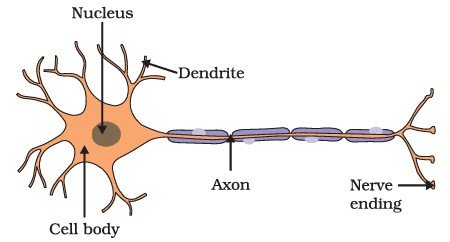
a) Axon terminal
b) Dendritic tip
c) Cell body
d) Synapse
Answer: b) Dendritic tip
Q. In the labelled diagram of the human brain, which part is the main thinking region that controls voluntary actions?
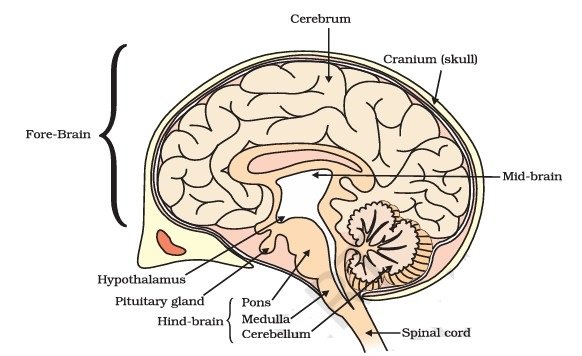
a) Mid-brain
b) Hind-brain
c) Fore-brain
d) Medulla
Answer: c) Fore-brain
Q. In Figure (Sensitive plant), leaves fold when touched because:
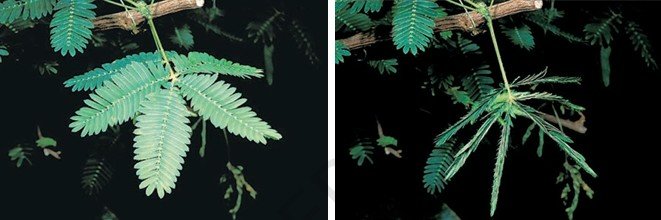
a) Plant muscles contract like animals
b) Plant cells change shape by altering water content
c) Auxin accumulates on the touched side
d) Gibberellins inhibit cell division
Answer: b) Plant cells change shape by altering water content
Q. In Figure (Response of plant to light), why do shoots bend towards light?
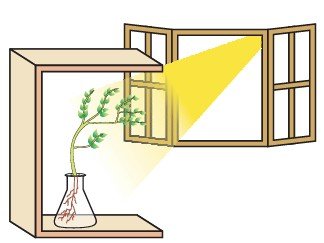
a) Auxin accumulates on the lighted side, causing faster growth
b) Auxin accumulates on the shaded side, causing faster growth
c) Gibberellins inhibit growth on the shaded side
d) Abscisic acid promotes growth on the lighted side
Answer: b) Auxin accumulates on the shaded side, causing faster growth
Q. In Figure (Endocrine glands), which gland secretes testosterone in males and oestrogen in females?
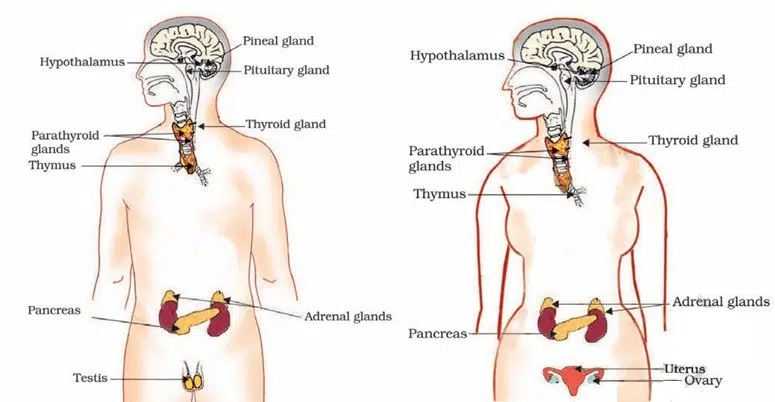
a) Thyroid gland
b) Pituitary gland
c) Pancreas
d) Gonads
Answer: d) Gonads
Disclaimer: The content that is present on our website is based on the NCERT Class 10 Science textbook and is provided for educational purposes only. All the content and images have been taken from Science Class 10 NCERT Textbook. Images and content shown above are the property of individual organizations and are used here for reference purposes only. To make it easy to understand, some of the content and images are generated by AI and cross-checked by the teachers.