
← Back to Class 10 Study Material
Carbon and Its Compounds is an important chapter in Class 10 Science. These extra questions and answers help students understand important concepts such as covalent bonding, properties of carbon compounds, homologous series, nomenclature, chemical reactions, ethanol, ethanoic acid, soaps and detergents. The questions are written in simple language and are useful for revision, exam preparation, and strengthening NCERT-based concepts.
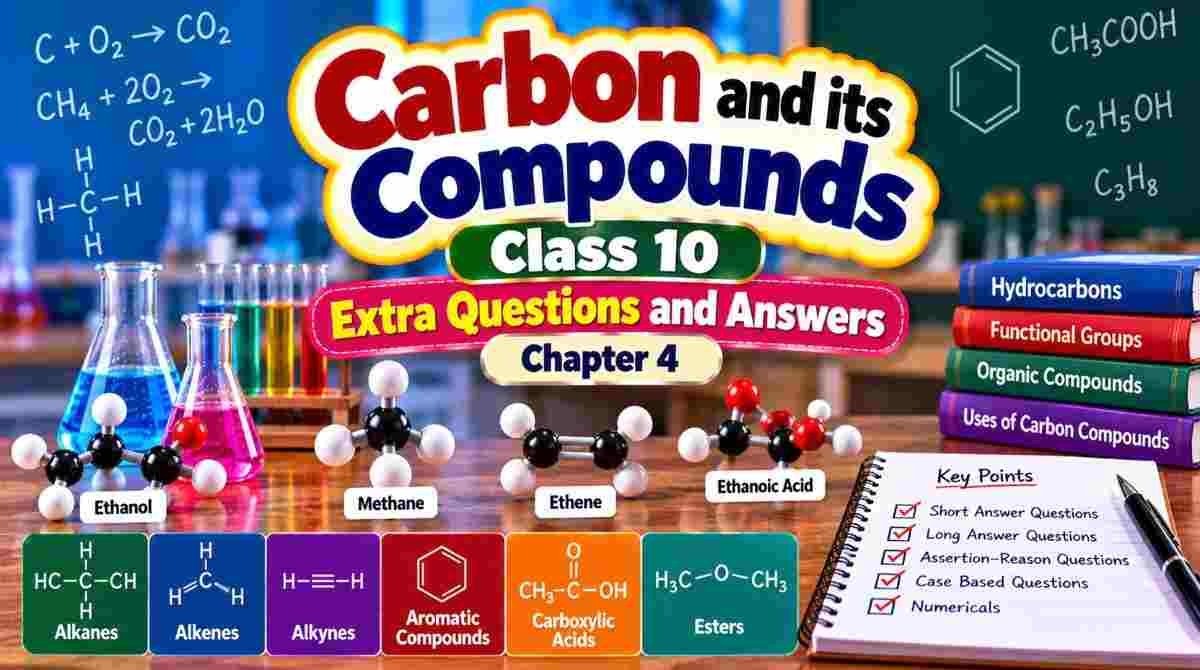
Carbon and Its Compounds Class 10 Extra Questions and Answers
Important Questions
Q. Why does carbon form covalent bonds instead of ionic bonds?
Answer: Carbon has 4 valence electrons. To form an ionic bond, it would need to gain 4 electrons (making C⁴⁻) or lose 4 electrons (making C⁴⁺). Both require too much energy. So, carbon shares electrons with other atoms and forms covalent bonds.
Q. Draw the electron dot structure of methane (CH₄).
Answer: In methane, carbon shares its 4 valence electrons with 4 hydrogen atoms. Each hydrogen shares 1 electron.
H
|
H—C—H
|
H
Each atom completes its outer shell.
Q. Define allotropes of carbon. Name three allotropes and write one property of each.
Answer: Allotropes are different forms of the same element with different physical properties.
- Diamond – hardest natural substance.
- Graphite – soft, slippery, good conductor of electricity.
- Fullerene (C₆₀) – spherical shape like a football.
Q. What is catenation? Why is this property more pronounced in carbon than in silicon?
Answer: Catenation is the ability of an element to form long chains with itself. Carbon shows strong catenation because the C–C bond is very strong and stable. Silicon also shows catenation but its bonds are weaker, so chains are short.
Q. Define saturated and unsaturated carbon compounds with examples.
Answer:
- Saturated compounds – contain only single bonds. Example: methane (CH₄), ethane (C₂H₆).
- Unsaturated compounds – contain double or triple bonds. Example: ethene (C₂H₄), ethyne (C₂H₂).
Q. Why does carbon form millions of compounds compared to other elements?
Answer: Carbon forms millions of compounds because of two properties:
- Catenation – ability to form long chains.
- Tetravalency – ability to bond with 4 atoms, including O, H, N, Cl, etc.
Q. Define structural isomers with an example.
Answer: Compounds with the same molecular formula but different structures are called structural isomers. Example: Butane (C₄H₁₀) has two isomers – straight chain and branched chain.
Q. Write the molecular formula of cyclohexane and benzene.
Answer:
- Cyclohexane: C₆H₁₂
- Benzene: C₆H₆
Q. What are hydrocarbons? Name their three types with examples.
Answer: Hydrocarbons are compounds made of carbon and hydrogen only.
- Alkanes (saturated): methane (CH₄)
- Alkenes (double bond): ethene (C₂H₄)
- Alkynes (triple bond): ethyne (C₂H₂)
Q. Write balanced equations for the combustion of methane and ethanol.
Answer:
- CH₄ + 2O₂ → CO₂ + 2H₂O + heat
- C₂H₅OH + O₂ → CO₂ + H₂O + heat
Q. Define oxidising agents with examples.
Answer: Substances that add oxygen or remove hydrogen are called oxidising agents. Examples: alkaline potassium permanganate (KMnO₄), acidified potassium dichromate (K₂Cr₂O₇).
Q. What is denatured alcohol? Why is it prepared?
Answer: Ethanol mixed with poisonous substances (like methanol) is called denatured alcohol. It is prepared to prevent misuse of ethanol as a drink.
Q. What is vinegar? Why is pure ethanoic acid called glacial acetic acid?
Answer:
- Vinegar is a dilute solution of ethanoic acid (CH₃COOH) in water.
- Pure ethanoic acid freezes at 290 K and looks like ice, so it is called glacial acetic acid.
Q. Write the chemical equations for the reaction of ethanoic acid with sodium hydroxide and sodium carbonate.
Answer:
- CH₃COOH + NaOH → CH₃COONa + H₂O
- 2CH₃COOH + Na₂CO₃ → 2CH₃COONa + H₂O + CO₂
Q. Define esterification. Why are esters used in perfumes and flavouring agents?
Answer: Esterification is the reaction of an alcohol with a carboxylic acid to form an ester and water.
- Example: CH₃COOH + C₂H₅OH → CH₃COOC₂H₅ + H₂O
Esters have sweet smell and pleasant taste, so they are used in perfumes and flavouring agents.
Why/Reason-Based
Q. Why do most carbon compounds have low melting and boiling points compared to ionic compounds?
Answer: Carbon compounds are covalent. They have weak forces between molecules. Less energy is needed to break these forces, so they have low melting and boiling points. Ionic compounds have strong electrostatic forces, so they need more energy.
Q. Why are covalent compounds generally poor conductors of electricity?
Answer: Covalent compounds do not form ions. Since no free charged particles are present, they cannot conduct electricity.
Q. Why is diamond the hardest natural substance while graphite is soft and slippery?
Answer: In diamond, each carbon atom is bonded to 4 others in a rigid 3D structure, making it very hard. In graphite, carbon atoms form layers with weak forces between them, so layers slide easily, making it soft and slippery.
Q. Why are unsaturated hydrocarbons more reactive than saturated hydrocarbons?
Answer: Unsaturated hydrocarbons have double or triple bonds. These bonds are easier to break and take part in reactions. Saturated hydrocarbons have only single bonds, which are more stable.
Q. Why does carbon form strong bonds with other elements?
Answer: Carbon is small in size. Its nucleus holds shared electrons tightly. This makes carbon bonds strong and stable.
Q. Why is pure silicon less stable in forming long chains compared to carbon?
Answer: Silicon atoms are larger. Their bonds are weaker than carbon-carbon bonds. So, silicon chains break easily and are less stable.
Q. Why does butane show isomerism while propane does not?
Answer: Butane (C₄H₁₀) can form two structures – straight chain and branched chain. Propane (C₃H₈) has only one possible structure, so no isomerism.
Q. Why are benzene and cyclohexane considered cyclic compounds?
Answer: Their carbon atoms are arranged in a ring. Benzene has 6 carbons with alternating double bonds. Cyclohexane has 6 carbons with single bonds in a ring.
Q. Why do functional groups decide the chemical properties of organic compounds?
Answer: Functional groups like –OH, –COOH, –CHO give specific properties. For example, –OH makes alcohols, –COOH makes acids. The carbon chain only supports them, but the group decides reactions.
Q. Why do saturated hydrocarbons generally give a clean flame while unsaturated hydrocarbons give a sooty flame?
Answer: Saturated hydrocarbons burn completely, giving a clean blue flame. Unsaturated hydrocarbons burn incompletely, producing carbon particles (soot) and yellow flame.
Q. Why does ethanol react with sodium to evolve hydrogen gas?
Answer: Ethanol has –OH group. Sodium reacts with it to form sodium ethoxide and hydrogen gas. Reaction: 2C₂H₅OH + 2Na → 2C₂H₅ONa + H₂↑
Q. Why is a mixture of oxygen and ethyne used for welding instead of ethyne and air?
Answer: Ethyne with oxygen burns at very high temperature (~3000°C), enough to melt metals. Ethyne with air burns at lower temperature, not suitable for welding.
Q. Why are carboxylic acids considered weak acids compared to mineral acids?
Answer: Carboxylic acids (like CH₃COOH) do not ionise completely in water. Mineral acids (like HCl, H₂SO₄) ionise fully. So, carboxylic acids are weak acids.
Q. Why does soap form scum in hard water but detergents do not?
Answer: Hard water has calcium and magnesium salts. Soap reacts with them to form insoluble scum. Detergents do not react with these salts, so they clean well even in hard water.
Q. Why does the ionic end of soap interact with water while the hydrocarbon tail interacts with oil?
Answer: Soap has two parts – ionic end (hydrophilic) and hydrocarbon tail (hydrophobic). The ionic end dissolves in water, while the tail dissolves in oil. This helps remove dirt and grease.
Application-Based
Q. Methane is used as a fuel. Explain why it is suitable for this purpose.
Answer: Methane burns completely in oxygen to give carbon dioxide and water with lots of heat. It produces a clean flame and no soot, so it is a good fuel.
Q. Why is graphite used as an electrode in cells even though it is a non‑metal?
Answer: Graphite has free electrons between its layers. These electrons move easily, so graphite conducts electricity. That is why it is used as an electrode.
Q. Why is Buckminsterfullerene (C‑60) called so?
Answer: C‑60 has carbon atoms arranged like a football. This design looks like the geodesic dome made by architect Buckminster Fuller. So, it is called Buckminsterfullerene.
Q. Explain why alcohols like methanol, ethanol, propanol, and butanol show similar chemical properties.
Answer: All these alcohols have the same functional group –OH. The chemical properties depend on the functional group, not the length of the carbon chain.
Q. How does the presence of a –Cl group change the properties of a hydrocarbon chain?
Answer: The –Cl group is a functional group. It changes the reactivity of the hydrocarbon chain and gives new properties like forming haloalkanes.
Q. Write the general formula for alkanes, alkenes, and alkynes.
Answer:
- Alkanes: CₙH₂ₙ₊₂
- Alkenes: CₙH₂ₙ
- Alkynes: CₙH₂ₙ₋₂
Q. Explain the role of concentrated sulphuric acid in the dehydration of ethanol.
Answer: Concentrated H₂SO₄ removes water (H₂O) from ethanol. Ethanol changes into ethene gas. This is called dehydration.
Q. Why are vegetable oils hydrogenated in the presence of nickel catalyst?
Answer: Vegetable oils are unsaturated. When hydrogen is added in presence of nickel, they become saturated fats. This makes oils solid and useful for making ghee and margarine.
Q. How is ethanol used as a fuel?
Answer: Ethanol burns with oxygen to give carbon dioxide and water. It produces heat and a clean flame. It is mixed with petrol to make fuel called gasohol.
Q. Explain the role of concentrated sulphuric acid in esterification.
Answer: In esterification, alcohol reacts with acid to form ester. Concentrated H₂SO₄ acts as a catalyst and removes water formed in the reaction.
Q. How does saponification help in the preparation of soap?
Answer: Saponification is the reaction of an ester with a base (like NaOH). It produces soap and alcohol. This process is used in soap making.
Q. Why are detergents preferred over soaps for washing clothes in hard water?
Answer: In hard water, soap forms scum with calcium and magnesium salts. Detergents do not form scum, so they clean better in hard water.
Case-Based
Case Study: A student studied the bonding in water, nitrogen, and ammonia.
Q. How many single bonds are present in water?
Answer: Water (H₂O) has two single bonds between oxygen and two hydrogen atoms.
Q. What type of bond is present in nitrogen molecule?
Answer: Nitrogen (N₂) has a triple bond between two nitrogen atoms.
Q. Draw the electron dot structure of ammonia (NH₃).
Answer: In ammonia, nitrogen shares electrons with three hydrogen atoms.
Structure:
H
|
H—N—H
..
Case Study: A student studied methane (CH₄), ethane (C₂H₆), ethene (C₂H₄), and ethyne (C₂H₂).
Q. Which of these are saturated hydrocarbons?
Answer: Methane (CH₄) and ethane (C₂H₆) are saturated hydrocarbons.
Q. Which are unsaturated hydrocarbons?
Answer: Ethene (C₂H₄) and ethyne (C₂H₂) are unsaturated hydrocarbons.
Q. Arrange them in increasing order of reactivity and explain why.
Answer: Reactivity order: methane < ethane < ethene < ethyne.
Reason: Unsaturated hydrocarbons with double/triple bonds are more reactive than saturated hydrocarbons.
Case Study: A student studied methane (CH₄), ethane (C₂H₆), propane (C₃H₈), and butane (C₄H₁₀). He observed that each successive member differs by a –CH₂ unit.
Q. What is this series called?
Answer: This series is called the homologous series.
Q. Write the difference in molecular masses between methane and ethane.
Answer: Methane (CH₄) = 16 u, Ethane (C₂H₆) = 30 u. Difference = 14 u.
Q. Why do these compounds show gradation in physical properties but similar chemical properties?
Answer: Physical properties depend on molecular mass, so they change gradually. Chemical properties depend on the functional group (same in all), so they remain similar.
Case Study: A student burnt camphor, alcohol, and naphthalene. He observed:
- Camphor → clean flame
- Alcohol → clean flame
- Naphthalene → yellow sooty flame with black deposit
Answer the following:
Q. Which compounds are saturated and which are unsaturated?
Answer: Camphor and alcohol are saturated. Naphthalene is unsaturated.
Q. Why did naphthalene produce soot?
Answer: Naphthalene has double bonds. It burns incompletely, producing carbon particles (soot).
Q. What conclusion can be drawn about combustion of hydrocarbons?
Answer: Saturated hydrocarbons burn with a clean flame. Unsaturated hydrocarbons burn with a yellow, sooty flame.
Case Study: A student added dilute ethanoic acid to sodium carbonate. Effervescence was observed and the gas turned lime‑water milky.
Q. Identify the gas evolved.
Answer: The gas evolved is carbon dioxide (CO₂).
Q. Write the balanced chemical equation for the reaction.
Answer:
2CH₃COOH + Na₂CO₃ → 2CH₃COONa + H₂O + CO₂↑
Q. What test confirms the presence of this gas?
Answer: Passing the gas through lime water turns it milky, confirming CO₂.
Experiment-Based
Q. Describe how you would experimentally show that carbon compounds are poor conductors of electricity.
Answer: Take a beaker with distilled water and dissolve a carbon compound like sugar or alcohol. Connect electrodes and a bulb. The bulb does not glow because no ions are present. This shows carbon compounds are poor conductors.
Q. Write the steps to draw the electron dot structure of ethene (C₂H₄).
Answer:
- Link two carbon atoms with a single bond.
- Each carbon has 2 valencies left unsatisfied.
- Put a double bond between carbons.
- Attach 2 hydrogens to each carbon.
Final structure: H₂C=CH₂.
Q. How can synthetic diamonds be prepared?
Answer: Synthetic diamonds are made by subjecting pure carbon to very high pressure and temperature. They look like natural diamonds but are smaller.
Q. Describe the step‑wise method to draw the electron dot structure of ethane.
Answer:
- Link two carbon atoms with a single bond.
- Each carbon has 3 valencies left.
- Attach 3 hydrogens to each carbon.
Final structure: C₂H₆.
Q. How can you experimentally distinguish between saturated and unsaturated hydrocarbons?
Answer: Add bromine water to both. Saturated hydrocarbons do not change the colour. Unsaturated hydrocarbons decolourise bromine water because they add bromine across double/triple bonds.
Q. Write the equations for the combustion of methane and ethene.
Answer:
- CH₄ + 2O₂ → CO₂ + 2H₂O + heat
- C₂H₄ + 3O₂ → 2CO₂ + 2H₂O + heat
Q. How can you experimentally show that benzene is unsaturated?
Answer: Add bromine water to benzene. The colour slowly disappears, showing benzene has unsaturation (double bonds).
Q. Write the steps to name a three‑carbon chain with a ketone group.
Answer:
- Three carbon chain → propane.
- Ketone group suffix → “one”.
- Remove “e” from propane → propanone.
Q. Write the equation for the reaction of ethanol with sodium.
Answer:
- 2C₂H₅OH + 2Na → 2C₂H₅ONa + H₂↑
Q. How can you experimentally show incomplete combustion of hydrocarbons?
Answer: Burn a hydrocarbon with limited air supply. The flame becomes yellow and produces black soot on a metal plate. This shows incomplete combustion.
Q. How can you experimentally distinguish between an alcohol and a carboxylic acid?
Answer:
- Add sodium carbonate: carboxylic acid produces bubbles of CO₂.
- Add sodium metal: alcohol produces hydrogen gas.
- Thus, acids and alcohols can be distinguished.
Compare/Differentiate
Q. Differentiate between saturated and unsaturated carbon compounds with examples.
Answer:
- Saturated compounds – only single bonds (e.g., methane CH₄, ethane C₂H₆).
- Unsaturated compounds – double or triple bonds (e.g., ethene C₂H₄, ethyne C₂H₂).
Q. Compare the properties of diamond and graphite.
Answer:
- Diamond – hardest natural substance, does not conduct electricity.
- Graphite – soft, slippery, good conductor of electricity.
Q. Distinguish between ionic and covalent compounds on the basis of melting point and conductivity.
Answer:
- Ionic compounds – high melting/boiling points, conduct electricity in molten/solution state.
- Covalent compounds – low melting/boiling points, poor conductors of electricity.
Q. Differentiate between saturated and unsaturated hydrocarbons.
Answer:
- Saturated hydrocarbons (alkanes): single bonds, less reactive. Example: propane (C₃H₈).
- Unsaturated hydrocarbons (alkenes/alkynes): double/triple bonds, more reactive. Example: ethene (C₂H₄), ethyne (C₂H₂).
Q. Compare the bonding in ethane, ethene, and ethyne.
Answer:
- Ethane (C₂H₆): single bond between carbons.
- Ethene (C₂H₄): double bond between carbons.
- Ethyne (C₂H₂): triple bond between carbons.
Q. Distinguish between catenation and tetravalency.
Answer:
- Catenation: ability of carbon to form long chains with itself.
- Tetravalency: ability of carbon to form 4 bonds with other atoms.
Q. Compare straight chain, branched chain, and ring hydrocarbons with examples.
Answer:
- Straight chain: carbon atoms in a line (butane C₄H₁₀).
- Branched chain: carbon atoms with side branches (isobutane C₄H₁₀).
- Ring: carbon atoms in a closed ring (cyclohexane C₆H₁₂, benzene C₆H₆).
Q. Distinguish between prefix and suffix in nomenclature of organic compounds.
Answer:
- Prefix: added before name to show substituent (e.g., chloro in chloropropane).
- Suffix: added after name to show functional group (e.g., –ol in propanol).
Q. Differentiate between complete and incomplete combustion of hydrocarbons.
Answer:
- Complete combustion: gives CO₂ + H₂O + clean flame.
- Incomplete combustion: gives CO + soot + yellow flame.
Q. Compare the properties of ethanol and methanol.
Answer:
- Ethanol (C₂H₅OH): drinkable in small amounts, used in fuel and industry.
- Methanol (CH₃OH): poisonous, used as solvent and antifreeze.
Q. Distinguish between addition and substitution reactions with examples.
Answer:
- Addition reaction: unsaturated hydrocarbons add atoms. Example: C₂H₄ + H₂ → C₂H₆.
- Substitution reaction: saturated hydrocarbons replace atoms. Example: CH₄ + Cl₂ → CH₃Cl + HCl.
Q. Differentiate between soaps and detergents.
Answer:
- Soaps: made from natural oils, form scum in hard water.
- Detergents: synthetic, work well even in hard water.
Q. Compare the properties of ethanoic acid and hydrochloric acid.
Answer:
- Ethanoic acid (CH₃COOH): weak acid, partially ionises, used in vinegar.
- Hydrochloric acid (HCl): strong acid, fully ionises, highly corrosive.
Q. Distinguish between esterification and saponification reactions.
Answer:
- Esterification: alcohol + acid → ester + water (sweet smell).
- Saponification: ester + base → soap + alcohol.
Competency-Based
Q. Explain how tetravalency and catenation make carbon versatile.
Answer: Carbon has tetravalency (forms 4 bonds) and catenation (forms long chains). Together, these allow carbon to make millions of stable compounds with different structures.
Q. Why does carbon form millions of compounds while silicon forms only a few?
Answer: Carbon forms strong C–C bonds due to its small size. Silicon atoms are larger, so Si–Si bonds are weaker. Hence, carbon makes millions of compounds, silicon only a few.
Q. How does the bonding in methane ensure noble gas configuration for all atoms?
Answer: In methane (CH₄), carbon shares 4 electrons with 4 hydrogens. Each hydrogen gets 2 electrons (like helium), and carbon gets 8 electrons (like neon). All atoms achieve noble gas configuration.
Q. Explain how catenation and tetravalency together make carbon versatile.
Answer: Catenation allows carbon to form chains, rings, and branches. Tetravalency allows bonding with many elements (H, O, N, Cl). Together, they make carbon compounds diverse and stable.
Q. Why is carbon considered the backbone of organic chemistry?
Answer: Organic chemistry studies carbon compounds. Carbon’s ability to form strong bonds and millions of compounds makes it the backbone of organic chemistry.
Q. How does the small size of carbon atom contribute to the stability of carbon compounds?
Answer: Small size means the nucleus holds shared electrons tightly. This makes C–C and C–H bonds strong and stable.
Q. Explain how homologous series helps in systematic study of organic compounds.
Answer: Homologous series has compounds with the same functional group and differ by –CH₂ unit. Their chemical properties are similar, physical properties show gradual change. This helps systematic study.
Q. Why is the suffix –e removed when naming compounds like propanone?
Answer: In nomenclature, if the suffix begins with a vowel (like “one”), the final “e” of alkane is dropped. So propane → propanone.
Q. How does the reactivity of alkenes and alkynes differ from alkanes?
Answer: Alkenes and alkynes have double/triple bonds, so they are more reactive. Alkanes have only single bonds, so they are less reactive.
Q. Explain how combustion, oxidation, addition, and substitution reactions illustrate the chemical properties of carbon compounds.
Answer:
- Combustion: carbon compounds burn to give CO₂ and H₂O.
- Oxidation: alcohols oxidise to acids.
- Addition: unsaturated hydrocarbons add hydrogen.
- Substitution: saturated hydrocarbons replace atoms (e.g., CH₄ + Cl₂).
Q. Why is ethanol soluble in water in all proportions?
Answer: Ethanol has –OH group. It forms hydrogen bonds with water molecules. So, it dissolves in water in all proportions.
Q. How does methanol affect the human body differently from ethanol?
Answer: Ethanol in small amounts is drinkable. Methanol is poisonous; it damages nerves, causes blindness, and can be fatal.
Q. Explain how micelles help in cleaning oily dirt from clothes.
Answer: Soap molecules form micelles. Their hydrocarbon tails dissolve in oil, and ionic heads dissolve in water. This lifts oily dirt and washes it away.
Q. Why is the soap solution cloudy while pure water is transparent?
Answer: Soap forms micelles (tiny clusters) in water. These scatter light, making the solution cloudy. Pure water has no micelles, so it is transparent.
Q. How does alloying change the properties of metals like iron (linking with stainless steel example)?
Answer: Alloying mixes metals with other elements. Pure iron rusts easily. Stainless steel (iron + chromium + nickel) does not rust and is stronger. Alloying improves properties.
Disclaimer: The content that is present on our website is based on the NCERT Class 10 Science textbook and is provided for educational purposes only. All the content and images have been taken from Science Class 10 NCERT Textbook. Images and content shown above are the property of individual organizations and are used here for reference purposes only. To make it easy to understand, some of the content and images are generated by AI and cross-checked by the teachers.