
← Back to Class 9 Social Science MCQs
Practice the most important From Ideas to Startups Class 9 MCQs with answers to test your understanding of entrepreneurship and startup development. These multiple-choice questions cover key concepts such as identifying business opportunities, generating ideas, solving problems, planning a startup, and understanding the role of entrepreneurs. Revise these MCQs to strengthen your knowledge and prepare for your Class 9 examinations.
From Ideas to Startups Class 9 MCQ
Conceptual Recall MCQs
Q. What is entrepreneurship?
a) A process of spending money without planning
b) A process of converting an idea into a business venture
c) A method of avoiding risks completely
d) A way of collecting taxes
Answer: b) A process of converting an idea into a business venture
Q. Who is an entrepreneur?
a) A person who only invests money in banks
b) A person who avoids making business decisions
c) A person who identifies opportunities and creates value through innovation
d) A person who works only in government offices
Answer: c) A person who identifies opportunities and creates value through innovation
Q. Which of the following is an important task performed by an entrepreneur?
a) Ignoring customer needs
b) Avoiding all risks
c) Refusing to make decisions
d) Identifying problems and solving them with innovative solutions
Answer: d) Identifying problems and solving them with innovative solutions
Q. What is profit?
a) Money borrowed from a bank
b) Money earned after paying the costs of producing and selling goods and services
c) Total sales without deducting expenses
d) Government tax collected from businesses
Answer: b) Money earned after paying the costs of producing and selling goods and services
Q. What is a business plan?
a) A list of employees in a company
b) A written document explaining business goals and steps to achieve them
c) A record of taxes paid
d) A report only for investors
Answer: b) A written document explaining business goals and steps to achieve them
Q. Which of the following is a key consideration while preparing a business plan?
a) Weather forecast only
b) Family traditions only
c) Location, customers, costs, and marketing
d) Political elections only
Answer: c) Location, customers, costs, and marketing
Q. What are functional areas of a business?
a) Different taxes paid by a business
b) Different buildings owned by a business
c) Main divisions that perform specific functions to help a business run smoothly
d) Government departments controlling businesses
Answer: c) Main divisions that perform specific functions to help a business run smoothly
Q. Which functional area is responsible for managing money in a business?
a) Human Resources
b) Marketing and Sales
c) Management and Operations
d) Finance and Accounting
Answer: d) Finance and Accounting
Q. Which functional area focuses on hiring, training, and managing employees?
a) Human Resources
b) Marketing and Sales
c) Finance and Accounting
d) Operations
Answer: a) Human Resources
Q. What is accounting?
a) Promoting products to customers
b) Recording and tracking financial transactions of a business
c) Producing goods in a factory
d) Recruiting employees
Answer: b) Recording and tracking financial transactions of a business
Q. What is revenue?
a) Money borrowed from a bank
b) Tax paid to the government
c) Total money earned from the sale of goods and services
d) Money spent on business expenses
Answer: c) Total money earned from the sale of goods and services
Q. What are fixed costs?
a) Costs that change with production levels
b) Costs that remain constant regardless of production volume
c) Costs related only to advertising
d) Costs paid only once
Answer: b) Costs that remain constant regardless of production volume
Q. Which of the following is an example of a variable cost?
a) Rent
b) Insurance
c) Building maintenance
d) Raw materials
Answer: d) Raw materials
Q. What is inventory?
a) Money invested in shares
b) Goods, materials, and assets held for production or resale
c) List of customers
d) Employees working in a business
Answer: b) Goods, materials, and assets held for production or resale
Q. What is a startup?
a) A government department
b) A young company offering an innovative product or service
c) A large multinational company
d) A non-profit organisation only
Answer: b) A young company offering an innovative product or service
Q. What is a unicorn startup?
a) A startup owned by the government
b) A startup operating in rural areas
c) A startup valued at over 1 billion dollars
d) A startup that has completed 100 years
Answer: c) A startup valued at over 1 billion dollars
Q. What is the main objective of the Startup India initiative?
a) To increase imports
b) To promote entrepreneurship and innovation
c) To reduce employment opportunities
d) To encourage foreign migration
Answer: b) To promote entrepreneurship and innovation
Q. What does Atmanirbhar Bharat focus on?
a) Increasing dependence on imports
b) Reducing innovation
c) Making India self-reliant through innovation and local solutions
d) Limiting business activities
Answer: c) Making India self-reliant through innovation and local solutions
Q. Which of the following is identified as a major startup hub in India?
a) Jaipur
b) Bengaluru
c) Panaji
d) Shimla
Answer: b) Bengaluru
Q. Which sector is related to digital payments?
a) Agri-tech
b) Health-tech
c) E-commerce
d) Fin-tech
Answer: d) Fin-tech
Application-Based MCQs
Q. A group of students notices that many children in their locality want healthy snacks. They start a small business selling homemade baked snacks. Which entrepreneurial skill are they demonstrating?
a) Identifying an opportunity
b) Avoiding innovation
c) Ignoring customer needs
d) Reducing production
Answer: a) Identifying an opportunity
Q. A bakery owner chooses a busy location near a school and market. What is the main advantage of this decision?
a) Lower product quality
b) Increased customer reach
c) Reduced need for employees
d) Elimination of competition
Answer: b) Increased customer reach
Q. Before opening a bakery, Rohan estimates the cost of ovens, ingredients, rent, and salaries. Which part of the business plan is he working on?
a) Promotion
b) Human Resources
c) Money and Costs
d) Location
Answer: c) Money and Costs
Q. A bakery introduces mini cake jars at lower prices along with premium cakes. What is the likely purpose of this strategy?
a) To reduce customer choices
b) To attract different types of customers
c) To increase production costs
d) To avoid making profits
Answer: b) To attract different types of customers
Q. A startup regularly collects customer feedback and improves its products. Which business objective is being achieved?
a) Ignoring competition
b) Reducing production
c) Increasing taxes
d) Improving customer satisfaction
Answer: d) Improving customer satisfaction
Q. A bakery owner carefully checks the quality of cakes before they are sold to customers. Which functional area is mainly involved?
a) Marketing and Sales
b) Human Resources
c) Management and Operations
d) Finance and Accounting
Answer: c) Management and Operations
Q. A business wants to calculate whether it earned a profit or loss this month. Which document would be most useful?
a) Employee Register
b) Profit and Loss Account
c) Attendance Sheet
d) Marketing Plan
Answer: b) Profit and Loss Account
Q. A bakery hires a new cashier and provides training on billing software. Which functional area is responsible?
a) Finance and Accounting
b) Management and Operations
c) Marketing and Sales
d) Human Resources
Answer: d) Human Resources
Q. A bakery launches a social media campaign and offers discounts during a festival season. Which functional area is mainly responsible?
a) Marketing and Sales
b) Finance and Accounting
c) Human Resources
d) Operations
Answer: a) Marketing and Sales
Q. A bakery spends more money on flour and sugar because the number of customer orders has increased. These expenses are best classified as:
a) Fixed Costs
b) Variable Costs
c) Taxes
d) Investments
Answer: b) Variable Costs
Q. A young entrepreneur creates an app that helps farmers monitor crop health using technology. This startup would most likely belong to which sector?
a) Health-tech
b) Fin-tech
c) Agri-tech
d) Hospitality
Answer: c) Agri-tech
Q. A startup develops an online platform through which patients can consult doctors from home. Which field does this startup belong to?
a) Health-tech
b) E-commerce
c) Manufacturing
d) Logistics
Answer: a) Health-tech
Q. A startup founder’s first business fails despite sincere efforts. Based on the chapter, what should be the most appropriate response?
a) Give up entrepreneurship permanently
b) Ignore the reasons for failure
c) Learn from the experience and develop stronger ideas
d) Stop taking any future risks
Answer: c) Learn from the experience and develop stronger ideas
Q. A company develops a mobile application that allows customers to buy products online. Which startup sector does it represent?
a) Fin-tech
b) E-commerce
c) Agri-tech
d) Education Services
Answer: b) E-commerce
Q. A startup creates jobs for hundreds of young people while introducing innovative products. What contribution is it making to the nation?
a) Increasing unemployment
b) Slowing economic growth
c) Reducing innovation
d) Supporting employment and economic growth
Answer: d) Supporting employment and economic growth
Assertion–Reason MCQs
Q. Assertion (A): Entrepreneurs play an important role in society.
Reason (R): They create innovative solutions that address customer needs and problems.
a) Both A and R are true, and R is the correct explanation of A.
b) Both A and R are true, but R is not the correct explanation of A.
c) A is true, but R is false.
d) A is false, but R is true.
Answer: a) Both A and R are true, and R is the correct explanation of A.
Q. Assertion (A): A business plan helps entrepreneurs make better decisions.
Reason (R): It provides a roadmap for achieving business goals.
a) Both A and R are true, and R is the correct explanation of A.
b) Both A and R are true, but R is not the correct explanation of A.
c) A is true, but R is false.
d) A is false, but R is true.
Answer: a) Both A and R are true, and R is the correct explanation of A.
Q. Assertion (A): All entrepreneurs avoid taking risks.
Reason (R): Entrepreneurs often invest their time and money in uncertain situations.
a) Both A and R are true.
b) A is true, but R is false.
c) A is false, but R is true.
d) Both A and R are false.
Answer: c) A is false, but R is true.
Q. Assertion (A): Understanding customer needs is important before starting a business.
Reason (R): Customer preferences help determine products and services offered.
a) Both A and R are true, and R is the correct explanation of A.
b) Both A and R are true, but R is not the correct explanation of A.
c) A is true, but R is false.
d) A is false, but R is true.
Answer: a) Both A and R are true, and R is the correct explanation of A.
Q. Assertion (A): Functional areas help businesses operate efficiently.
Reason (R): Each area performs specialised tasks and coordinates with other areas.
a) Both A and R are true, and R is the correct explanation of A.
b) Both A and R are true, but R is not the correct explanation of A.
c) A is true, but R is false.
d) A is false, but R is true.
Answer: a) Both A and R are true, and R is the correct explanation of A.
Q. Assertion (A): Human resources are important for business growth.
Reason (R): Employees contribute skills and effort to business operations.
a) Both A and R are true, and R is the correct explanation of A.
b) Both A and R are true, but R is not the correct explanation of A.
c) A is true, but R is false.
d) A is false, but R is true.
Answer: a) Both A and R are true, and R is the correct explanation of A.
Q. Assertion (A): Revenue and profit are the same.
Reason (R): Profit is calculated after deducting expenses from revenue.
a) Both A and R are true.
b) A is true, but R is false.
c) A is false, but R is true.
d) Both A and R are false.
Answer: c) A is false, but R is true.
Q. Assertion (A): Fixed costs remain the same even when production changes.
Reason (R): Rent is generally paid regardless of the number of products produced.
a) Both A and R are true, and R is the correct explanation of A.
b) Both A and R are true, but R is not the correct explanation of A.
c) A is true, but R is false.
d) A is false, but R is true.
Answer: a) Both A and R are true, and R is the correct explanation of A.
Q. Assertion (A): Failure can be an important part of an entrepreneur’s journey.
Reason (R): Unsuccessful attempts provide valuable lessons for future ventures.
a) Both A and R are true, and R is the correct explanation of A.
b) Both A and R are true, but R is not the correct explanation of A.
c) A is true, but R is false.
d) A is false, but R is true.
Answer: a) Both A and R are true, and R is the correct explanation of A.
Q. Assertion (A): Startups contribute to economic growth.
Reason (R): They create employment opportunities and encourage innovation.
a) Both A and R are true, and R is the correct explanation of A.
b) Both A and R are true, but R is not the correct explanation of A.
c) A is true, but R is false.
d) A is false, but R is true.
Answer: a) Both A and R are true, and R is the correct explanation of A.
Q. Assertion (A): Atmanirbhar Bharat promotes self-reliance.
Reason (R): It encourages innovation and local solutions.
a) Both A and R are true, and R is the correct explanation of A.
b) Both A and R are true, but R is not the correct explanation of A.
c) A is true, but R is false.
d) A is false, but R is true.
Answer: a) Both A and R are true, and R is the correct explanation of A.
Q. Assertion (A): Entrepreneurship has no role in achieving Viksit Bharat 2047.
Reason (R): Entrepreneurship helps create jobs and drive innovation.
a) Both A and R are true.
b) A is true, but R is false.
c) A is false, but R is true.
d) Both A and R are false.
Answer: c) A is false, but R is true.
Case Study-Based MCQ
Q. Seven women in Mumbai started making papads with only ₹80 and borrowed equipment. They worked together, maintained consistent quality, and shared profits equally. Over time, their small initiative grew into a large cooperative enterprise with thousands of members. What was the most important factor behind the success of their venture?
a) Large initial investment
b) Government ownership
c) Foreign funding
d) Teamwork, quality, and dedication
Answer: d) Teamwork, quality, and dedication
Q. Mohan Singh Oberoi started as a hotel desk clerk. Instead of performing only his assigned duties, he learned every aspect of hotel operations. Later, he purchased a small hotel and transformed it into a successful business. Which entrepreneurial quality is best reflected in this case?
a) Curiosity and willingness to learn
b) Avoidance of responsibility
c) Dependence on luck alone
d) Fear of taking risks
Answer: a) Curiosity and willingness to learn
Q. ABC Bakery earned ₹2,95,000 from sales during a month. Its total expenses, including raw materials, rent, salaries, utilities, advertising, and interest on a loan, amounted to ₹2,22,000. After paying ₹13,000 as tax, the bakery recorded a profit. According to the case, what was the bakery’s Profit After Tax (PAT)?
a) ₹73,000
b) ₹2,95,000
c) ₹60,000
d) ₹13,000
Answer: c) ₹60,000
Q. A bakery owner notices that customer orders are increasing rapidly. To meet demand, she hires additional bakers, trains them in hygiene standards, and ensures they work in a comfortable environment. Which functional area is playing the most important role in this situation?
a) Finance and Accounting
b) Human Resources
c) Marketing and Sales
d) Taxation
Answer: b) Human Resources
Q. Aman started a small technology-based business that helps local shopkeepers sell products online. Initially, his startup struggled, and customer response was low. Instead of shutting down completely, he analysed the problems, improved the platform, and successfully expanded the business after a year. What entrepreneurial lesson is best reflected in this case?
a) Failure should always be avoided
b) Entrepreneurs should stop after their first setback
c) Business success depends only on luck
d) Learning from failure helps build stronger businesses
Answer: d) Learning from failure helps build stronger businesses
Q. Priya launches a startup that provides digital payment solutions to small businesses. The company grows rapidly, hires many employees, and helps local shops adopt modern payment methods. Which contribution of startups is most clearly shown in this case?
a) Decreasing productivity
b) Increasing unemployment
c) Creating jobs and promoting innovation
d) Reducing economic activity
Answer: c) Creating jobs and promoting innovation
Diagram/Visual-Based MCQs
Q. Refer to Figure (Elements of Entrepreneurship). Which element helps an entrepreneur identify new possibilities and develop creative solutions?

a) Innovation
b) Taxes
c) Debt
d) Inflation
Answer: a) Innovation
Q. Refer to Figure (Tasks Performed by an Entrepreneur). Which task shows an entrepreneur’s willingness to face uncertainty?
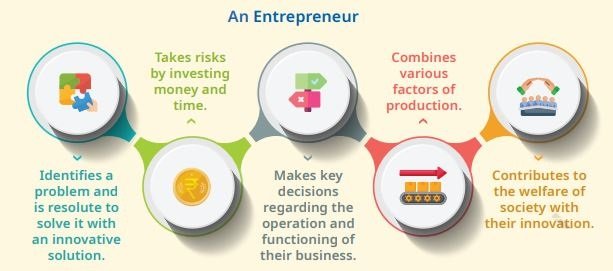
a) Avoiding customers
b) Taking risks by investing money and time
c) Closing the business early
d) Reducing product quality
Answer: b) Taking risks by investing money and time
Q. Refer to Figure (Key Considerations in Making a Business Plan). Which factor helps an entrepreneur decide who will buy the product or service?
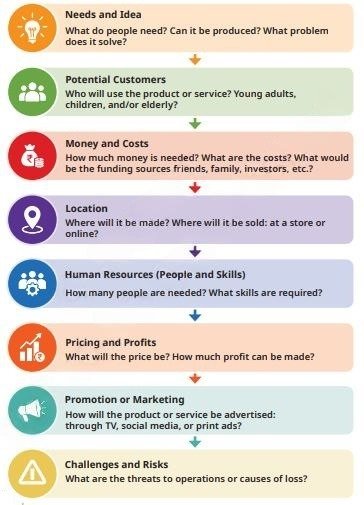
a) Pricing and Profits
b) Location
c) Potential Customers
d) Human Resources
Answer: c) Potential Customers
Q. Refer to Figure (Key Considerations in Making a Business Plan). Which consideration focuses on threats that may disrupt operations or cause losses?
a) Promotion
b) Challenges and Risks
c) Potential Customers
d) Location
Answer: b) Challenges and Risks
Q. Refer to Figure (Functional Areas of a Business). Which functional area focuses on budgeting, financial health, and cash flow management?
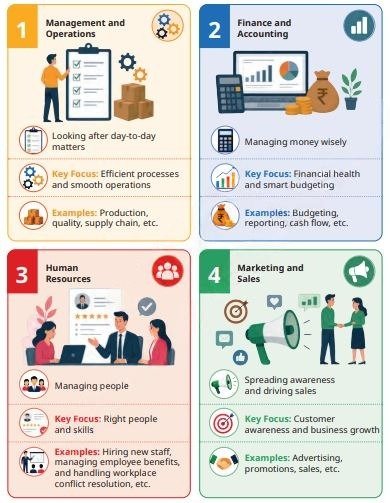
a) Marketing and Sales
b) Human Resources
c) Management and Operations
d) Finance and Accounting
Answer: d) Finance and Accounting
Q. Refer to Figure (Functional Areas of a Business). Which functional area mainly focuses on customer awareness and business growth?
a) Management and Operations
b) Finance and Accounting
c) Marketing and Sales
d) Human Resources
Answer: c) Marketing and Sales
Q. Profit Formula. If a business earns ₹4,00,000 in revenue and spends ₹3,20,000 on expenses, what will be its profit?
a) ₹7,20,000
b) ₹80,000
c) ₹3,20,000
d) ₹4,00,000
Answer: b) ₹80,000
Higher-Order Competency-Based MCQs
Q. Why did the Lijjat Papad founders insist on maintaining consistent quality from the beginning?
a) To reduce production
b) To avoid competition
c) To build customer trust and business growth
d) To increase prices immediately
Answer: c) To build customer trust and business growth
Q. A student wants to start an online bakery business. Which combination is most important before launching the venture?
a) Customer needs, costs, and marketing strategy
b) Holidays, weather, and hobbies
c) Tax rates only
d) Competitor profits only
Answer: a) Customer needs, costs, and marketing strategy
Q. Why is choosing the right location important for a business?
a) It guarantees success without effort
b) It helps reach more customers and increase sales opportunities
c) It eliminates all business risks
d) It removes the need for advertising
Answer: b) It helps reach more customers and increase sales opportunities
Q. What is the most important lesson from the story “From a Dead Mouse to Riches”?
a) Wealth can only be inherited
b) Success depends entirely on luck
c) Opportunities should be ignored if resources are limited
d) Small opportunities can become big successes through intelligence and hard work
Answer: d) Small opportunities can become big successes through intelligence and hard work
Q. Why is it important for different functional areas of a business to work together?
a) To avoid customer satisfaction
b) To reduce communication completely
c) To ensure smooth operations and achievement of business goals
d) To eliminate all business risks
Answer: c) To ensure smooth operations and achievement of business goals
Q. A bakery has excellent products but very few customers know about them. Which functional area should be strengthened first?
a) Human Resources
b) Marketing and Sales
c) Finance and Accounting
d) Inventory Management
Answer: b) Marketing and Sales
Q. Why is maintaining accurate accounting records important for entrepreneurs?
a) It helps track performance and make informed decisions
b) It guarantees higher profits
c) It eliminates competition
d) It reduces production automatically
Answer: a) It helps track performance and make informed decisions
Q. The Chettiar community became well known for successful entrepreneurship mainly because of their:
a) Dependence on formal banks only
b) Avoidance of business risks
c) Strong ethics, accounting skills, and long-term vision
d) Focus only on agriculture
Answer: c) Strong ethics, accounting skills, and long-term vision
Q. Which lesson can modern entrepreneurs learn from the Chettiar community?
a) Business success depends only on luck
b) Sustainable businesses can be built through discipline, trust, and careful planning
c) Growth is possible only through foreign trade
d) Accounting records are not important
Answer: b) Sustainable businesses can be built through discipline, trust, and careful planning
Q. Why is perseverance considered important for startup founders?
a) Because every startup becomes successful immediately
b) Because perseverance helps entrepreneurs continue learning and improving despite setbacks
c) Because it guarantees investors’ support
d) Because it removes all business risks
Answer: b) Because perseverance helps entrepreneurs continue learning and improving despite setbacks
Q. How does entrepreneurship support the vision of Viksit Bharat 2047?
a) By reducing innovation
b) By discouraging local businesses
c) By creating employment, encouraging innovation, and empowering communities
d) By increasing dependence on foreign solutions
Answer: c) By creating employment, encouraging innovation, and empowering communities
Q. Which statement best reflects the message of Swami Vivekananda’s quote, “Arise, awake and stop not till the goal is reached”?
a) Entrepreneurs should avoid challenges
b) Success comes without effort
c) People should depend entirely on others
d) Determination and continuous effort are essential for success
Answer: d) Determination and continuous effort are essential for success
Q. Why are startups important for a self-reliant India?
a) They promote local innovation and solve problems using domestic solutions
b) They eliminate the need for technology
c) They reduce employment opportunities
d) They discourage entrepreneurship
Answer: a) They promote local innovation and solve problems using domestic solutions
Q. A student develops an affordable water-purification device for rural communities. Besides earning profits, what broader entrepreneurial contribution is being demonstrated?
a) Limiting innovation
b) Ignoring social needs
c) Creating value for society through problem-solving
d) Avoiding economic development
Answer: c) Creating value for society through problem-solving
Disclaimer: The content that is present on our website is based on the NCERT Class 9 Social Science textbook and is provided for educational purposes only. All the content and images have been taken from Social Science Class 9 NCERT Textbook and CBSE Support material. Images and content shown above are the property of individual organizations and are used here for reference purposes only. To make it easy to understand, some of the content and images are generated by AI and cross-checked by the teachers.