
← Back to Class 9 Social Science MCQs
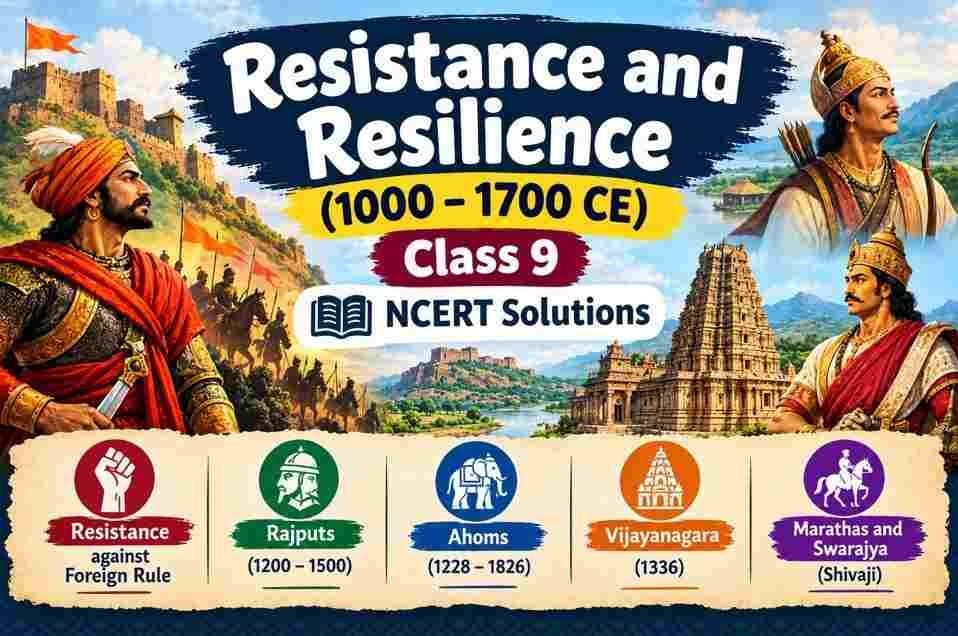
Explore Resistance and Resilience (1000–1700 CE) Class 9 NCERT Solutions to understand the important topics of this history chapter in simple and easy language. These solutions cover the resistance movements and regional powers of medieval India, including the Rajputs, Ahoms, Vijayanagara Empire, and Marathas under Chhatrapati Shivaji Maharaj. Students can use these question answers to understand historical events, revise important concepts, and prepare for their examinations.
Resistance and Resilience Class 9 NCERT Solutions
Q. How did Indian rulers use resistance and alliances to safeguard their lands?
Answer: Indian rulers used military resistance, alliances, diplomacy, and confederacies to protect their territories. The Rajputs, Ahoms, Vijayanagara rulers, Marathas, Sikhs, and Jats fought against invading powers and defended their political authority and cultural identity. They also used local knowledge, forts, and guerrilla warfare to strengthen their resistance.
Q. What factors contributed to the resilience of different kingdoms and communities during this period?
Answer: The resilience of kingdoms and communities came from their strong cultural traditions, shared beliefs, military strength, local support, economic resources, and ability to adapt to changing situations. Agriculture, trade, temples, community cooperation, and spiritual traditions helped them survive and recover from difficulties.
Q. How did the Bhakti tradition foster a sense of solidarity?
Answer: The Bhakti tradition promoted devotion, equality, and inclusion. Bhakti saints used local languages and devotional songs to connect with people. Community singing, satsang, and nām kīrtan brought people together and reduced social divisions. This created a feeling of unity and solidarity among different communities.
Q. How did the expansion of agriculture, trade, and commerce keep the economy sound?
Answer: The expansion of agriculture increased food production and land revenue. Improved irrigation systems helped farmers grow more crops. Trade and commerce connected different regions through markets and trade routes. Merchant communities, financial instruments like hundis, and Indian Ocean trade increased wealth and supported economic stability.
Q. Choose the most appropriate answer. Resistance and resilience are closely connected because:
a. Resistance always involves warfare.
b. Resilience enables communities to endure difficulties and sustain resistance.
c. Resistance is possible only when a kingdom has a large army.
d. Resilient societies avoid all forms of conflict.
Answer: (b) Resilience enables communities to endure difficulties and sustain resistance.
Q. Why and how did groups such as the Sikhs, Marathas, and Rajputs assert their political power and identity during periods of changing political authority?
Answer: The Sikhs, Marathas, and Rajputs asserted their political power by resisting external control and defending their territories. They used military strength, alliances, forts, and local support to protect their identity and independence. The Sikhs organised themselves into the Khalsa, the Marathas promoted the idea of Swarājya, and the Rajputs fought many battles to preserve their sovereignty.
Q. Why did some Rajput rulers decide to negotiate alliances with the Mughal power?
Answer: Some Rajput rulers negotiated alliances with the Mughals for political and strategic reasons. These alliances helped them maintain stability, protect their kingdoms, and gain important positions in the Mughal administration. The Mughals also needed Rajput military and administrative support to strengthen their empire.
Q. Imagine a market in a port town of India such as Surat, Masulipatnam, or Puducherry. You are a foreign trader from Italy or France and want to make a deal of cotton textiles. How would you secure the product in the local market? Whose help would you seek and what kind of challenges would you face?
Answer: As a foreign trader, I would seek the help of local merchants, brokers, money-changers, and dubhāshīs (interpreters). They would help me find good-quality cotton textiles and negotiate prices. I might face challenges such as language differences, checking the quality of goods, understanding local trade practices, and price fluctuations. Hundis and local merchant networks would help me conduct business safely.
Q. Watch any video at the given link and analyse the various functions of forts and fortresses. How did rulers perceive the importance of forts in terms of strategic concerns?
Answer: Forts were used for defence, administration, storage of food and weapons, and protection during attacks. They served as military bases and centres of governance. Rulers considered forts important because they provided security, controlled trade routes, supported guerrilla warfare, and helped kingdoms withstand long sieges.
Q. What architectural changes occurred in temple construction during the period under study? How do these changes reflect upon the resilient nature of Indian civilisation?
Answer: During this period, many temples were built in less visible locations, narrow lanes, and often resembled ordinary houses. Tall shikharas and elaborate exteriors were sometimes avoided. These changes helped protect temples from destruction. They show the resilience of Indian civilisation because people adapted their architecture while continuing their religious and cultural traditions.
Q. A kingdom has limited military resources but possesses fertile agricultural land, strong local support, and detailed knowledge of its terrain. Explain two ways in which these resources could contribute to the kingdom’s resilience when faced with a threat.
Answer:
- Fertile agricultural land can provide food and revenue, helping the kingdom support its people and soldiers during difficult times.
- Strong local support and knowledge of the terrain can help the kingdom use guerrilla tactics, launch surprise attacks, and defend itself more effectively against stronger enemies.
Q. Consider the following statement: “A tradition becomes more resilient when people can carry it with them.” Do you agree? Explain using examples from the Bhakti tradition.
Answer: Yes, I agree. A tradition becomes more resilient when people can practise it anywhere. The Bhakti tradition encouraged devotion through bhajans, kirtans, and recitation of God’s name, which did not depend on temples alone. Bhakti saints used local languages and community singing, making devotion accessible to all people. This helped preserve spiritual traditions even during difficult times.
Q. Voices from the Past: A Bhakti Saint
Answer: I am a Bhakti saint. Resilience means remaining devoted to God despite difficulties. I spread the message of devotion through songs and hymns in the language of common people. Even when circumstances changed, I continued to guide people on the path of faith, equality, and devotion.
Q. Voices from the Past: A Rajput Soldier
Answer: I am a Rajput soldier. Resilience means facing challenges with courage and determination. I protect my kingdom, culture, and people even in difficult situations. No matter how powerful the enemy is, I continue to fight to defend my land and honour.
Q. Design a Fort
Answer: This fort is protected by strong defensive walls and a watchtower to detect enemies. The water source and food storage help people survive during a long siege. The residential complex provides shelter, while the administrative area helps in governance. The escape route offers a safe exit during emergencies. This design allows the kingdom to resist attacks and remain self-sufficient for a long time.
Disclaimer: The content that is present on our website is based on the NCERT Class 9 Social Science textbook and is provided for educational purposes only. All the content and images have been taken from Social Science Class 9 NCERT Textbook and CBSE Support material. Images and content shown above are the property of individual organizations and are used here for reference purposes only. To make it easy to understand, some of the content and images are generated by AI and cross-checked by the teachers.