
Describing Motion Around Us Class 9 MCQs with Answers, designed according to the latest CBSE Class 9 Science syllabus. This collection includes carefully selected multiple-choice questions covering all the important topics such as distance and displacement, speed, velocity, acceleration, uniform and non-uniform motion, equations of motion, and graphical representation of motion.
Describing Motion Around Us Class 9 MCQ
Conceptual Recall MCQs
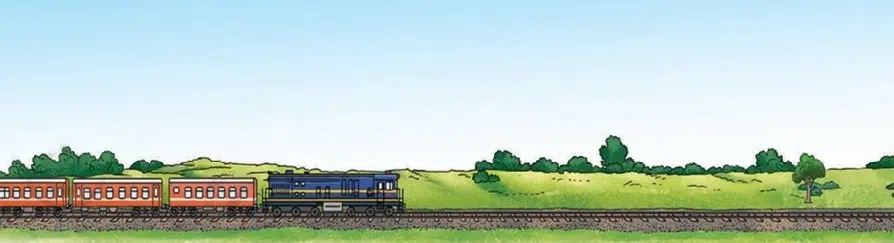
1. Which type of motion is shown when a train moves on a straight track?
a) Circular motion
b) Linear motion
c) Rotational motion
d) Oscillatory motion
Answer: b) Linear motion
2. When do we say an object is at rest?
a) When its position changes with time
b) When its position does not change with respect to a reference point
c) When it moves in a circle
d) When it moves forward and backward
Answer: b) When its position does not change with respect to a reference point
3. Which of the following is a vector quantity?
a) Distance
b) Displacement
c) Speed
d) Time
Answer: b) Displacement
4. What is the SI unit of both distance and displacement?
a) Kilogram
b) Meter
c) Second
d) Newton
Answer: b) Metre
5. The formula for average speed is:
a) Displacement ÷ time interval
b) Total distance traveled ÷ time interval
c) Velocity ÷ time interval
d) Acceleration ÷ time interval
Answer: b) Total distance traveled ÷ time interval
6. Which of the following is a vector quantity?
a) Average speed
b) Average velocity
c) Distance
d) Time
Answer: b) Average velocity
7. The formula for average acceleration is:
a) Distance ÷ time
b) Velocity ÷ time
c) Change in velocity ÷ time interval
d) Displacement ÷ time interval
Answer: c) Change in velocity ÷ time interval
8. The SI unit of average acceleration is:
a) m/s
b) m/s²
c) km/h
d) N
Answer: b) m/s²
9. In a position-time graph, a straight line indicates
a) Accelerated motion
b) Constant velocity
c) Object at rest
d) Non-uniform motion
Answer: b) Constant velocity
10. In a velocity–time graph, the slope of the line represents:
a) Velocity
b) Displacement
c) Acceleration
d) Speed
Answer: c) Acceleration
11. Which of the following is a kinematic equation?
a) v = u + at
b) F = ma
c) W = F · d
d. P = w/t
Answer: a) v = u + at
12. The kinematic equations are valid only when:
a) Velocity is constant.
b) Acceleration is constant.
c) Force is variable.
d) Motion is circular.
Answer: b) Acceleration is constant.
13. In uniform circular motion, the speed of the object is:
a) Constant
b) Increasing
c) Decreasing
d) Zero
Answer: a) Constant
14. The distance traveled in one revolution of a circle of radius R is
a) R
b) 2R
c) 𝜋R
d) 2𝜋R
Answer: d) 2𝜋R
Application-Based MCQs
15. An athlete runs on a straight track from point O to point A. If O is taken as the reference point, how is her position described?
a) Only by distance from O
b) By distance and direction from O
c) Only by time taken
d) Only by speed
Answer: b) By distance and direction from O
16. If a car moves 40 m to the right of O and then 20 m to the left of O, what is its final position?
a) 60 m right of O
b) 20 m right of O
c) 20 m left of O
d) At O
Answer: b) 20 m right of O
17. An athlete runs from O to A (100 m), then back to B (60 m from O). What is the total distance traveled and displacement?
a) Distance = 160 m, Displacement = 40 m
b) Distance = 100 m, displacement = 60 m.
c) Distance = 60 m, displacement = 100 m
d) Distance = 40 m, Displacement = 160 m
Answer: a) Distance = 160 m, Displacement = 40 m
18. A ball is thrown vertically upward and returns to the starting point O. What is its displacement at the end?
a) Equal to distance traveled
b) Zero
c) Greater than the distance traveled
d) Negative value
Answer: b) Zero
19. Sarang swims from one end of a pool to the other and back in 50 s. If the pool length is 25 m, what is his average speed?
a) 0.5 m/s
b) 1 m/s
c) 2 m/s
d) 25 m/s
Answer: b) 1 m/s
20. In the same case, what is Sarang’s average velocity?
a) 25 m/s
b) 1 m/s
c) 0 m/s
d) 0.5 m/s
Answer: c) 0 m/s
21. A bus increases its velocity from 10 m/s to 15 m/s in 10 s. What is its average acceleration?
a) 0.25 m/s²
b) 0.5 m/s²
c) 1.5 m/s²
d) 5 m/s²
Answer: b) 0.5 m/s²
22. The same bus slows down from 15 m/s to rest in 5 s. What is its average acceleration?
a) +3 m/s²
b) –3 m/s²
c) +0.5 m/s²
d) –0.5 m/s²
Answer: b) –3 m/s²
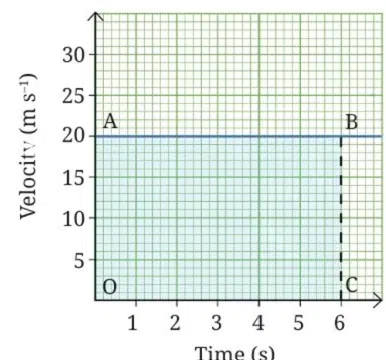
23. From the velocity–time graph, a car moves at a constant velocity of 20 m/s for 6 s. What is its displacement?
a) 20 m
b) 120 m
c) 100 m
d) 60 m
Answer: b) 120 m
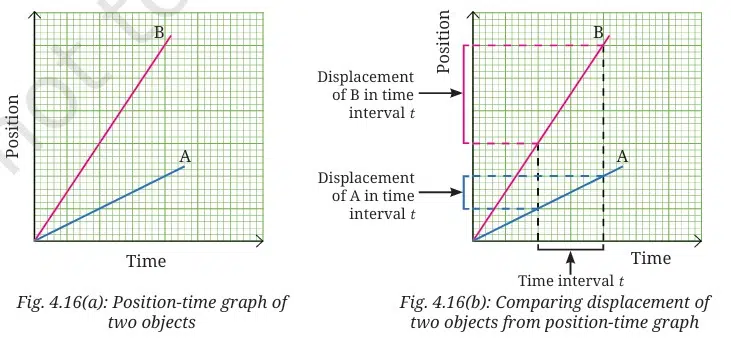
24. In Fig. 4.16a, two objects A and B are shown. If the slope of B’s line is steeper than A’s, which has a higher velocity?
a) Object A
b) Object B
c) Both are equal.
d) Cannot be determined
Answer: b) Object B
25. A car moving with initial velocity u = 10 m/s accelerates at a = 2 m/s² fort = 5 s. What is its final velocity?
a) 15 m/s
b) 20 m/s
c) 25 m/s
d) 30 m/s
Answer: c) 20 m/s
26. Using s = ut + (1/2)at², find the displacement of the same car in 5 s.
a) 50 m
b) 75 m
c) 100 m
d) 125 m
Answer: b) 75 m
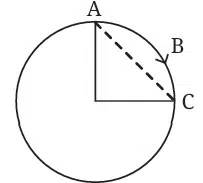
27. A child on a merry-go-round moves from A to B to C. The displacement from A to C is:
a) Equal to arc ABC.
b) Zero
c) Straight line AC
d) Equal to circumference
Answer: c) Straight line AC
28. An athlete runs along a hexagonal track. How many times does the athlete change direction in one round?
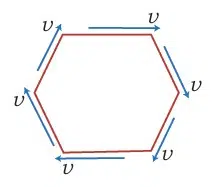
a) 4
b) 6
c) Infinite
d) 2
Answer: b) 6
Assertion–Reason MCQs
29. Assertion (A): The position of an object is described with respect to a reference point.
Reason (R): Without a fixed point, we cannot measure distance or direction.
a) Both A and R are true, and R explains A.
b) Both A and R are true, but R does not explain A.
c) A is true, R is false.
d) A is false, and R is true.
Answer: a) Both A and R are true, and R explains A.
30. Assertion (A): Positions to the right of O are taken as positive.
Reason (R): Positions to the left of O are taken as negative.

a) Both A and R are true, and R explains A.
b) Both A and R are true, but R does not explain A.
c) A is true, R is false.
d) A is false, and R is true.
Answer: a) Both A and R are true, and R explains A.
31. Assertion (A): Displacement can be zero even when distance traveled is not zero.
Reason (R): Displacement depends only on initial and final positions, not on the path length.
a) Both A and R are true, and R explains A.
b) Both A and R are true, but R does not explain A.
c) A is true, R is false.
d) A is false, and R is true.
Answer: a) Both A and R are true, and R explains A.
32. Assertion (A): Magnitude of displacement is always less than or equal to distance traveled.
Reason (R): Distance is the total path length, while displacement is the shortest distance between two points.
a) Both A and R are true, and R explains A.
b) Both A and R are true, but R does not explain A.
c) A is true, R is false.
d) A is false, and R is true.
Answer: a) Both A and R are true, and R explains A.
33. Assertion (A): Average speed has only magnitude, not direction.
Reason (R): It is calculated using total distance travelled.
a) Both A and R are true, and R explains A.
b) Both A and R are true, but R does not explain A.
c) A is true, R is false.
d) A is false, and R is true.
Answer: a) Both A and R are true, and R explains A.
34. Assertion (A): Average velocity requires both magnitude and direction.
Reason (R): It is calculated using displacement, which is a vector quantity.
a) Both A and R are true, and R explains A.
b) Both A and R are true, but R does not explain A.
c) A is true, R is false.
d) A is false, and R is true.
Answer: a) Both A and R are true, and R explains A.
35. Assertion (A): Acceleration can be zero even if an object is moving fast.
Reason (R): Acceleration depends on change in velocity, not on velocity itself.
a) Both A and R are true, and R explains A.
b) Both A and R are true, but R does not explain A.
c) A is true, R is false.
d) A is false, and R is true.
Answer: a) Both A and R are true, and R explains A.
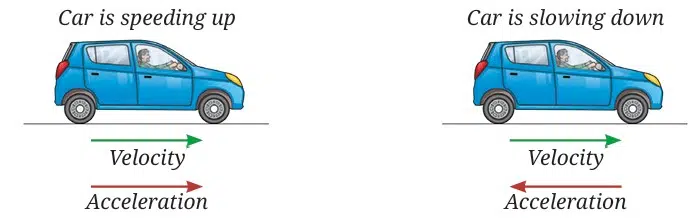
36. Assertion (A): When velocity increases, acceleration is in the direction of velocity.
Reason (R): When velocity decreases, acceleration is opposite to the direction of velocity.
a) Both A and R are true, and R explains A.
b) Both A and R are true, but R does not explain A.
c) A is true, R is false.
d) A is false, and R is true.
Answer: a) Both A and R are true, and R explains A.
37. Assertion (A): The slope of a position–time graph gives velocity.
Reason (R): Slope represents rate of change of position with respect to time.
a) Both A and R are true, and R explains A.
b) Both A and R are true, but R does not explain A.
c) A is true, R is false.
d) A is false, and R is true.
Answer: a) Both A and R are true, and R explains A.
38. Assertion (A): The area under a velocity–time graph gives displacement.
Reason (R): Displacement = velocity × time interval.
a) Both A and R are true, and R explains A.
b) Both A and R are true, but R does not explain A.
c) A is true, R is false.
d) A is false, and R is true.
Answer: a) Both A and R are true, and R explains A.
39. Assertion (A): The equation v² = u² + 2as can be used to calculate displacement without knowing time.
Reason (R): This equation is derived by eliminating time from other kinematic equations.
a) Both A and R are true, and R explains A.
b) Both A and R are true, but R does not explain A.
c) A is true, R is false.
d) A is false, and R is true.
Answer: a) Both A and R are true, and R explains A.
40. Assertion (A): In straight-line motion, signs of u, v, a, and s indicate direction.
Reason (R): Kinematic equations are vector equations, not scalar.
a) Both A and R are true, and R explains A.
b) Both A and R are true, but R does not explain A.
c) A is true, R is false.
d) A is false, and R is true.
Answer: a) Both A and R are true, and R explains A.
41. Assertion (A): In uniform circular motion, acceleration is non-zero.
Reason (R): The direction of velocity continuously changes.
a) Both A and R are true, and R explains A.
b) Both A and R are true, but R does not explain A.
c) A is true, R is false.
d) A is false, and R is true.
Answer: a) Both A and R are true, and R explains A.
42. Assertion (A): Average velocity of an object in one complete revolution is zero.
Reason (R): Displacement after one revolution is zero.
a) Both A and R are true, and R explains A.
b) Both A and R are true, but R does not explain A.
c) A is true, R is false.
d) A is false, and R is true.
Answer: a) Both A and R are true, and R explains A.
Case/Experiment-Based MCQ
43. Case Study: An athlete starts at O, runs 60 m forward to point A, then runs back 20 m to point B.
Q: What is her displacement and total distance traveled?
a) Displacement = 40 m, Distance = 80 m
b) Displacement = 60 m; distance = 60 m
c) Displacement = 20 m, distance = 40 m
d) Displacement = 40 m; Distance = 60 m
Answer: d) Displacement = 40 m, Distance = 60 m
44. Case Study: A ball is thrown upward from O, reaches B, then falls back to O.
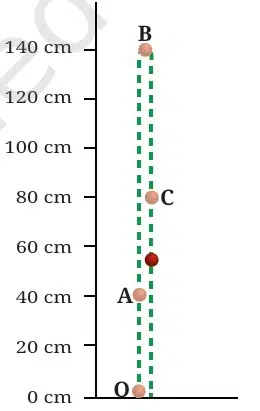
Q: Which statement is correct about its motion?
a) Distance traveled = displacement at all points
b) Displacement is always greater than distance.
c) Distance traveled is greater than or equal to displacement.
d) Displacement is never zero.
Answer: c) Distance traveled is greater than or equal to displacement.
45. Case Study: Two postmen start from opposite ends of a 210 yojana distance. One walks 9 yojanas/day; the other, 5 yojanas/day.
Q: After how many days will they meet?
a) 10 days
b) 15 days
c) 20 days
d) 25 days
Answer: b) 15 days
46. Case Study: An object is dropped from a height. Its velocity increases by equal amounts (9.8 m/s) in every successive second.
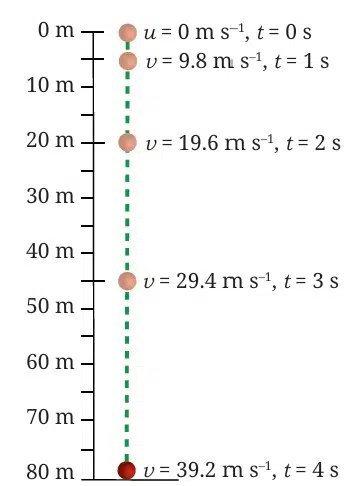
Q: What is the average acceleration of the object during free fall?
a) 0 m/s²
b) 9.8 m/s²
c) 19.6 m/s²
d) Variable acceleration
Answer: b) 9.8 m/s²
47. Case Study: A bus first accelerates from rest to 15 m/s in 30 s, then decelerates to rest in another 30 s.
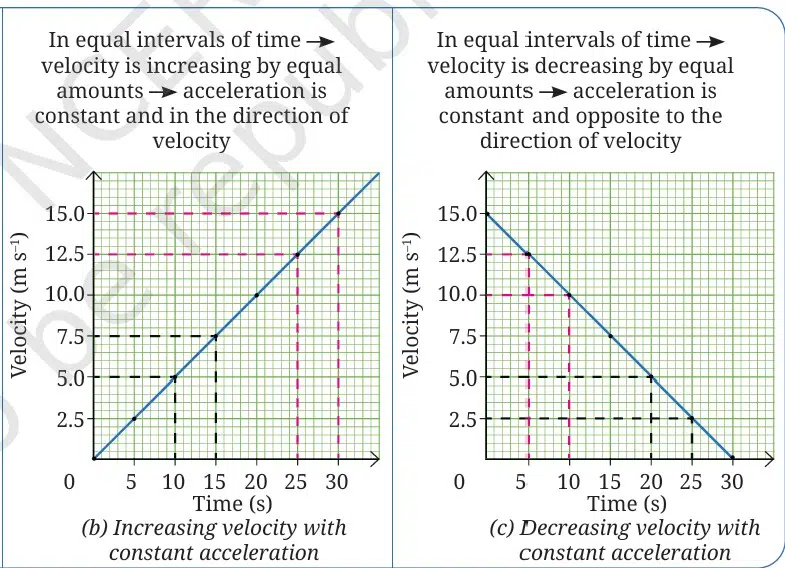
Q: What is the average acceleration during acceleration and deceleration phases?
a) +0.5 m/s² and –0.5 m/s²
b) +1 m/s² and –1 m/s²
c) +0.25 m/s² and –0.25 m/s²
d) Zero in both cases
Answer: a) +0.5 m/s² and –0.5 m/s²
48. Case Study: A car moving at 54 km/h (15 m/s) applies brakes, causing acceleration of -4 m/s².
Q: What is the stopping distance?
a) 15 m
b) 28.1 m
c) 54 m
d) 112.5 m
Answer: b) 28.1 m
49. Case Study: A marble moves inside a ring in circular motion. When the ring is lifted, the marble moves in a straight line.

Q: Why does this happen?
a) Because speed becomes zero
b) Because velocity continues along the tangent at the release point
c) Because acceleration becomes infinite
d) Because displacement becomes zero
Answer: b) Because velocity continues along the tangent at the release point.
Diagram-Based MCQ
50. In the diagram showing the athlete’s position, what does the plus (+) sign indicate?
a) Motion backward from O
b) Motion forward/right from O
c) Motion in a circle
d) Motion at rest
Answer: b) Motion forward/right from O
51. In the diagram of the athlete’s motion, when will the displacement be zero?
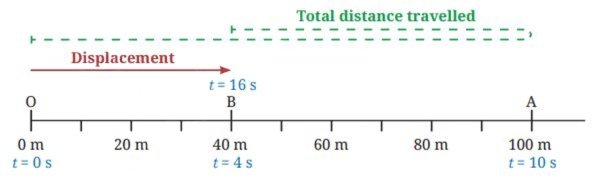
a) When the athlete stops at A
b) When the athlete stops at B
c) When the athlete returns to O
d) When an athlete runs continuously forward
Answer: c) When the athlete returns to O
52. In the diagram of Sarang swimming, why is his average velocity zero?
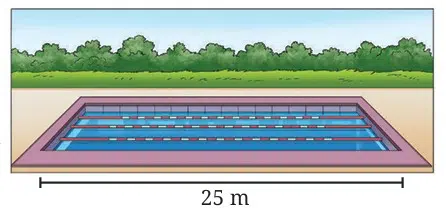
a) Because he swims slowly
b) Because his displacement after 50 s is zero
c) Because his distance traveled is zero
d) Because his speed is constant
Answer: b) Because his displacement after 50 s is zero.
53. In the diagram of acceleration, when a car slows down, the direction of acceleration is
a) Same as velocity
b) Opposite to velocity
c) Perpendicular to velocity
d) Random
Answer: b) Opposite to velocity
54. In the position–time graph, the line is parallel to the time axis. What does this indicate?
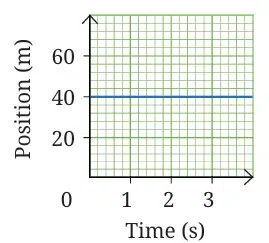
a) Object in uniform motion
b) Object at rest
c) Object accelerating
d) Object moving backward
Answer: b) Object at rest
55. In the velocity–time graph, the slope of the line represents:
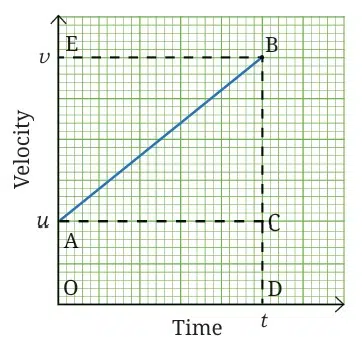
a) Velocity
b) Acceleration
c) Displacement
d) Time
Answer: b) Acceleration
56. In Figure, the velocity of an object at point B in circular motion is
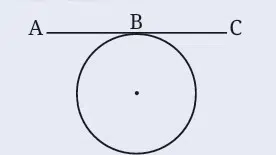
a) Along the radius OB
b) Along the tangent at B
c) Along the circumference
d) Opposite to tangent
Answer: b) Along the tangent at B
Disclaimer: The content that is present on our website is based on the NCERT Class 9 Science textbook and is provided for educational purposes only. All the content and images have been taken from Science Class 9 NCERT Textbook and CBSE Support material. Images and content shown above are the property of individual organizations and are used here for reference purposes only. To make it easy to understand, some of the content and images are generated by AI and cross-checked by the teachers.