
Exploring Mixtures and Their Separation Class 9 MCQs based on the latest NCERT syllabus and CBSE guidelines. This collection includes comprehensive, competency-based, case-based, assertion-reason, and application-oriented multiple-choice questions to help students strengthen their understanding of mixtures, separation techniques, solutions, suspensions, colloids, and related concepts.
Exploring Mixtures and Their Separation Class 9 MCQ
Conceptual Recall
Q1. A well-stirred mixture of sugar and water is:
(a) Homogeneous mixture
(b) Heterogeneous mixture
(c) Suspension
(d) Colloid
Answer: (a) Homogeneous mixture
Q2. Which of the following is a heterogeneous mixture?
(a) Vinegar in water
(b) Soda water
(c) Sand in water
(d) Salt in water
Answer: (c) Sand in water
Q3. In a sugar–water solution, sugar is the _ and water is the _.
(a) Solvent, Solute
(b) Solute, Solvent
(c) Mixture, Solution
(d) None of these
Answer: (b) Solute, Solvent
Q4. The concentration of a solution means
(a) The total mass of solvent only
(b) The amount of solute dissolved in a given amount of solvent/solution
(c) The taste of the solution
(d) The color of the solution
Answer: (b) The amount of solute dissolved in a given amount of solvent/solution
Q5. The maximum amount of solute that dissolves in 100 g of solvent at a given temperature is called:
(a) Concentration
(b) Solubility
(c) Saturation
(d) Solution
Answer: (b) Solubility
Q6. A solution that cannot dissolve more solute at a given temperature is called
(a) Unsaturated solution
(b) Saturated solution
(c) Dilute solution
(d) Concentrated solution
Answer: (b) Saturated solution
Q7. Crystallization is used to:
(a) Separate insoluble solids from liquids
(b) Purify solids based on solubility differences
(c) Separate immiscible liquids
(d) Prepare suspensions
Answer: (b) Purify solids based on solubility differences
Q8. A crystal is __________
(a) A solid with irregular arrangement of particles
(b) A solid with particles arranged in a regular geometric pattern
(c) A liquid with dissolved particles
(d) A gas condensed into liquid
Answer: (b) A solid with particles arranged in a regular geometric pattern
Q9. Distillation separates liquids based on:
(a) Difference in color
(b) Difference in boiling points
(c) Difference in solubility
(d) Difference in density
Answer: (b) Difference in boiling points
Q10. Paper chromatography is used to separate:
(a) Miscible liquids
(b) Colored pigments
(c) Insoluble solids
(d) Gases
Answer: (b) Colored pigments
Q11. Oil and water form separate layers because they are
(a) Miscible liquids
(b) Immiscible liquids
(c) Homogeneous mixture
(d) Suspension
Answer: (b) Immiscible liquids
Q12. Camphor changes directly from solid to vapor on heating. This process is called the following:
(a) Evaporation
(b) Sublimation
(c) Condensation
(d) Deposition
Answer: (b) Sublimation
Q13. The scattering of light by particles in a mixture is called:
(a) Reflection
(b) Refraction
(c) Tyndall Effect
(d) Dispersion
Answer: (c) Tyndall Effect
Q14. The Tyndall effect is observed in:
(a) Solutions only
(b) Suspensions and colloids
(c) Pure liquids only
(d) Gases only
Answer: (b) Suspensions and colloids
Q15. Blood is classified as a:
(a) Solution
(b) Suspension
(c) Colloid
(d) Pure substance
Answer: (c) Colloid
Q16. The particle size in colloids is:
(a) Less than 1 nm
(b) Between 1 and 1000 nm
(c) More than 1000 nm
(d) Cannot be measured
Answer: (b) Between 1 and 1000 nm
Application-Based
Q17. If oil is added to water in a beaker, the mixture will:
(a) Form a homogeneous solution
(b) Show uniform composition
(c) Separate into two layers
(d) Completely dissolve
Answer: (c) Separate into two layers
Q18. A student stirs chalk powder in water. After some time, the particles settle down. This shows that chalk powder in water is ________.
(a) Solution
(b) Suspension
(c) Colloid
(d) Homogeneous mixture
Answer: (b) Suspension
Q19. Farmers must mix the right amount of pesticide with water. If too much pesticide is added, what may happen?
(a) Crops will be protected better.
(b) Crops, soil, and environment may be damaged.
(c) Crops will grow faster.
(d) Nothing will change.
Answer: (b) Crops, soil, and environment may be damaged.
Q20. A saline drip in hospitals contains 0.9% m/v sodium chloride. This means:
(a) 0.9 g of salt in 100 g of water
(b) 0.9 g of salt in 100 mL of solution
(c) 9 g of salt in 100 mL of solution
(d) 0.9 mL of salt in 100 mL of solution
Answer: (b) 0.9 g of salt in 100 mL of solution
Q21. The solubility of gases in liquids generally:
(a) Increases with temperature
(b) Decreases with temperature
(c) Remains constant
(d) First increases, then decreases
Answer: (b) Decreases with temperature
Q22. If a saturated solution is prepared at a high temperature and then cooled slowly, what will happen?
(a) More solute will dissolve
(b) Crystals of solute will form.
(c) The solution will remain unchanged.
(d) The solvent will evaporate.
Answer: (b) Crystals of solute will form.
Q23. A saturated solution of compound B at 60 °C contains 287 g solute in 100 g water. On cooling to 40°C, only 241 g can remain dissolved. What happens to the extra solute?
(a) It evaporates
(b) It forms crystals.
(c) It dissolves more
(d) It disappears.
Answer: (b) It forms crystals.
Q24. If a hot saturated solution of copper sulfate is cooled rapidly in ice water, the crystals formed will be:
(a) Larger and well-shaped
(b) Smaller and less well-formed
(c) Blue and shiny
(d) Not formed at all
Answer: (b) Smaller and less well-formed
Q25. A mixture of acetone and water can be separated by distillation because
(a) Acetone dissolves in water.
(b) Their boiling points differ by about 44°C.
(c) Acetone is heavier than water.
(d) Water evaporates first.
Answer: (b) Their boiling points differ by about 44°C.
Q26. A student places a strip of paper with a black ink spot in water. The ink separates into different colors. This shows that:
(a) Ink is a pure substance.
(b) Ink is a mixture of dyes.
(c) Ink dissolves completely in water.
(d) Ink cannot be separated.
Answer: (b) Ink is a mixture of dyes.
Q27. Mustard oil floats on water in a separating funnel because
(a) Oil is heavier than water.
(b) Oil is lighter than water.
(c) Oil dissolves in water.
(d) Oil evaporates quickly.
Answer: (b) Oil is lighter than water.
Q28. Powdered alum is added to muddy water. The alum acts as:
(a) Solvent
(b) Coagulant
(c) Suspension
(d) Filtrate
Answer: (b) Coagulant
Q29. A fine beam of sunlight enters a dark room through a small hole. The path of light becomes visible because
(a) Light reflects from the walls.
(b) Dust and smoke particles scatter the light.
(c) The room is dark.
(d) The hole is small.
Answer: (b) Dust and smoke particles scatter the light.
Q30. Milk is an example of an emulsion because
(a) It is a suspension of sugar crystals.
(b) It is oil-in-water with proteins acting as emulsifying agents.
(c) It is a homogeneous solution.
(d) It is a pure liquid.
Answer: (b) It is oil-in-water with proteins acting as emulsifying agents.
Q31. Milk is an example of a colloid because
(a) Its particles settle on standing
(b) Its particles are invisible but dispersed uniformly.
(c) It is a pure liquid.
(d) It contains only one substance.
Answer: (b) Its particles are invisible but dispersed uniformly.
Q32. Ice cream is considered a colloid because:
(a) It is a suspension of sugar crystals.
(b) It contains dispersed particles that do not settle.
(c) It is a homogeneous solution.
(d) It is a pure solid.
Answer: (b) It contains dispersed particles that do not settle.
Assertion–Reason
Q33. Assertion (A): A solution always remains homogeneous.
Reason (R): The particles in a solution are very small and cannot be seen by the naked eye.
(a) Both A and R are true, and R is the correct explanation of A.
(b) Both A and R are true, but R is not the correct explanation of A.
(c) A is true, R is false.
(d) A is false, R is true.
Answer: (a) Both A and R are true, and R is the correct explanation of A.
Q34. Assertion (A): ORS must be prepared in the correct proportion of salt, sugar, and water.
Reason (R): Changing the proportion of salt or sugar will still give ORS.
(a) Both A and R are true, and R is the correct explanation of A.
(b) Both A and R are true, but R is not the correct explanation of A.
(c) A is true, R is false.
(d) A is false, R is true.
Answer: (c) A is true, R is false.
Q35. Assertion (A): Solubility of solid solutes in liquids generally increases with temperature.
Reason (R): Heating increases the kinetic energy of particles, helping solute particles mix with solvent.
(a) Both A and R are true, and R is the correct explanation of A.
(b) Both A and R are true, but R is not the correct explanation of A.
(c) A is true, R is false.
(d) A is false, R is true.
Answer: (a) Both A and R are true, and R is the correct explanation of A.
Q36. Assertion (A): Crystallization can be used to purify solids.
Reason (R): Solubility of solids changes with temperature, allowing separation.
(a) Both A and R are true, and R is the correct explanation of A.
(b) Both A and R are true, but R is not the correct explanation of A.
(c) A is true, R is false.
(d) A is false, R is true.
Answer: (a) Both A and R are true, and R is the correct explanation of A.
Q37. Assertion (A): Fractional distillation is used in petroleum refineries.
Reason (R): The components of crude oil have small differences in boiling points.
(a) Both A and R are true, and R is the correct explanation of A.
(b) Both A and R are true, but R is not the correct explanation of A.
(c) A is true, R is false.
(d) A is false, R is true.
Answer: (a) Both A and R are true, and R is the correct explanation of A.
Q38. Assertion (A): Centrifugation separates heavier particles from lighter ones.
Reason (R): Spinning creates an outward force that pushes heavier particles outward.
(a) Both A and R are true, and R is the correct explanation of A.
(b) Both A and R are true, but R is not the correct explanation of A.
(c) A is true, R is false.
(d) A is false, R is true.
Answer: (a) Both A and R are true, and R is the correct explanation of A.
Q39. Assertion (A): Colloids do not settle over time.
Reason (R): Colloidal particles are uniformly dispersed throughout the mixture.
(a) Both A and R are true, and R is the correct explanation of A.
(b) Both A and R are true, but R is not the correct explanation of A.
(c) A is true, R is false.
(d) A is false, R is true.
Answer: (a) Both A and R are true, and R is the correct explanation of A.
Q40. Assertion (A): The path of light is visible in a colloid.
Reason (R): Colloidal particles scatter light passing through them.
(a) Both A and R are true, and R is the correct explanation of A.
(b) Both A and R are true, but R is not the correct explanation of A.
(c) A is true, R is false.
(d) A is false, R is true.
Answer: (a) Both A and R are true, and R is the correct explanation of A.
Case-Based MCQ
Q41. In Activity 5.1, three groups prepare mixtures:
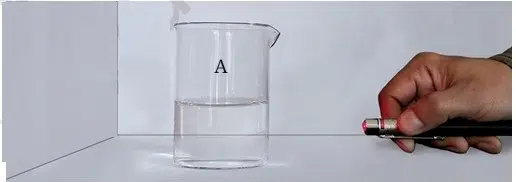
- Group A: Salt + Water
- Group B: Chalk powder + water
- Group C: Milk + Water
Case Question: Which group’s mixture will scatter light when a laser beam passes through it?
(a) Group A only
(b) Group B only
(c) Group C only
(d) Both Group B and Group C
Answer: (d) Both Group B and Group C
Q42. Case Study: Dilip Mahalanabis developed ORS to treat dehydration. WHO later popularized it worldwide.
Why is the correct concentration of ORS important?
(a) Too little salt/sugar will not rehydrate properly.
(b) Too much salt/sugar can harm the patient.
(c) Correct proportion saves lives during diarrhea/cholera.
(d) All of the above
Answer: (d) All of the above
Q43. Case Study: In Activity 5.2, solubility curves of compounds A and B are plotted.
- At 20 °C, compound A dissolves less than at 60 °C.
- At 20 °C, compound B dissolves less than at 60 °C.
- Compound A shows a sharper increase in solubility with temperature than compound B.
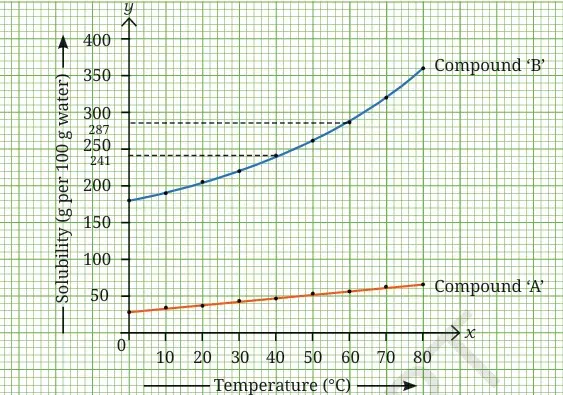
Based on this, which statement is correct?
(a) Compound A is more soluble than B at all temperatures.
(b) Compound B is more soluble than A at all temperatures.
(c) Compound A’s solubility increases more rapidly with temperature than B’s.
(d) Compound B’s solubility decreases with temperature.
Answer: (c) Compound A’s solubility increases more rapidly with temperature than B.
Q44. Case Study: A student prepares a hot saturated solution of copper sulfate. He divides it into two parts:
- Part 1 cooled slowly at room temperature.
- Part 2 cooled rapidly in ice water.
Which observation is correct?
(a) Part 1 forms larger, well-shaped crystals.
(b) Part 2 forms larger, well-shaped crystals.
(c) Both form identical crystals.
(d) No crystals form in either part.
Answer: (a) Part 1 forms larger, well-shaped crystals.
Q45. Case Study: In Kannauj, perfumes like Mitti ka Ittar are made using the traditional Deg-Bhapka distillation method.
Why is distillation suitable for perfume extraction?
(a) It separates liquids with close boiling points.
(b) It captures fragrance vapors and condenses them into liquid.
(c) It removes color from flowers.
(d) It evaporates water only.
Answer: (b) It captures fragrance vapors and condenses them into liquid.
Q46. Case Study: In Activity 5.1, a laser beam was passed through three mixtures:
- Mixture A: Salt + Water → Path not visible
- Mixture B: Chalk powder + Water → Path visible
- Mixture C: Milk + Water → Path visible
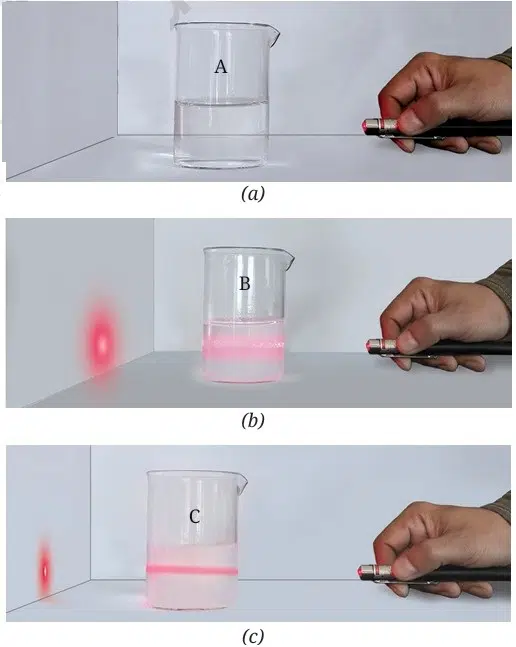
Which conclusion is correct?
(a) Mixture A is a solution, Mixture B is a suspension, and Mixture C is a colloid.
(b) Mixture A is a suspension, Mixture B is a solution, and Mixture C is a colloid.
(c) Mixture A is a colloid, Mixture B is a suspension, and Mixture C is a solution.
(d) All three are solutions.
Answer: (a) Mixture A is a solution, Mixture B is a suspension, and Mixture C is a colloid.
Q47. Case Study: Blood is separated into plasma, platelets, and red blood cells by centrifugation. Yet, blood is not a suspension. Why?
(a) Blood cells are visible to the naked eye.
(b) Blood cells are too small to be seen directly but remain dispersed.
(c) Blood is a pure liquid.
(d) Blood is a homogeneous solution.
Answer: (b) Blood cells are too small to be seen directly but remain dispersed.
Q48. Case Study: A student heats a mixture of camphor and sand in a china dish with a funnel placed above it.
Observation: White solid deposits form on the funnel wall, while sand remains in the dish.
Which conclusion is correct?
(a) Sand undergoes sublimation.
(b) Camphor undergoes sublimation.
(c) Neither camphor nor sand dissolves in water.
(d) Sand evaporates faster than camphor.
Answer: (b) Camphor undergoes sublimation.
Diagram-Based MCQ
Q49. Refer to Fig. 5.1 and Fig. 5.2 below.
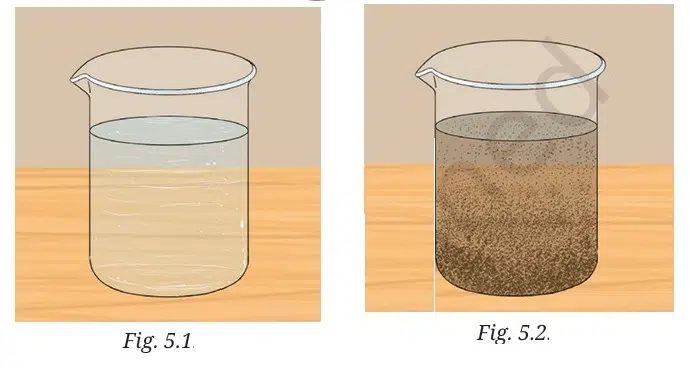
Which figure shows a homogeneous mixture?
(a) Fig. 5.1
(b) Fig. 5.2
(c) Both Fig. 5.1 and Fig. 5.2
(d) Neither Fig. 5.1 nor Fig. 5.2
Answer: (a) Fig. 5.1
Q50. Refer to the figure below. Which product shows mass by volume percentage (% (m/v) on its label?
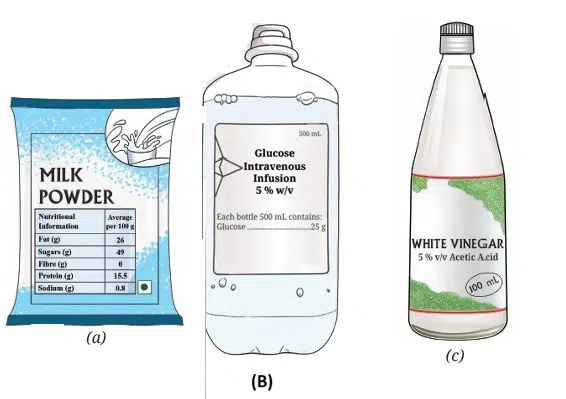
(a) Milk powder
(b) Glucose solution
(c) Vinegar
(d) Spice mixture
Answer: (b) Glucose solution
Q51. Refer to Figure (Solubility curves). At 80 °C, which compound has higher solubility?
(a) Compound A
(b) Compound B
(c) Both are equal.
(d) Neither dissolves
Answer: (a) Compound A
Q52. Refer to Figure (Salt manufacturing from seawater). Which step is involved in obtaining salt crystals?
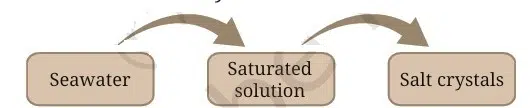
(a) Filtration of seawater
(b) Evaporation of water
(c) Cooling seawater
(d) Mixing seawater with acid
Answer: (b) Evaporation of water
Q53. Refer to Figure (Distillation setup). Which part cools the vapors into liquid?
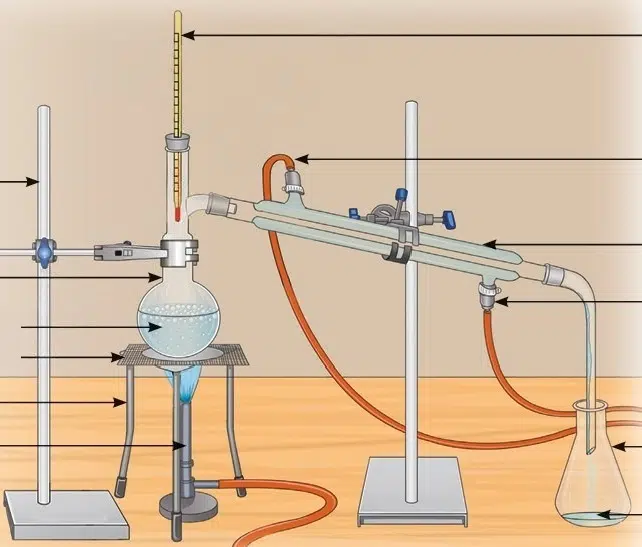
(a) Burner
(b) Thermometer
(c) Condenser
(d) Conical flask
Answer: (c) Condenser
Q54. Refer to Figure (Floodlights in a stadium). The visibility of light beams is due to the following:

(a) Reflection of light from the ground
(b) Refraction of light in air
(c) Scattering of light by dust and smoke particles
(d) Absorption of light by air
Answer: (c) Scattering of light by dust and smoke particles
Q55. Refer to Figure. Which diagram shows a colloid?
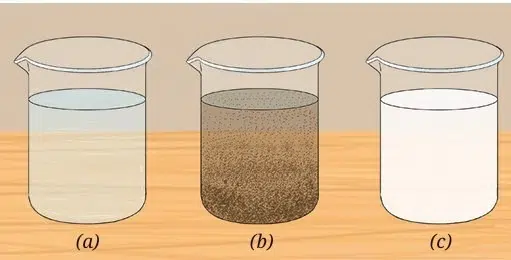
(a) Fig. a
(b) Fig. b
(c) Fig. c
(d) None of these
Answer: (c) Fig. c
Q56. Refer to Figure (Separating funnel). Which layer is collected first when separating oil and water?
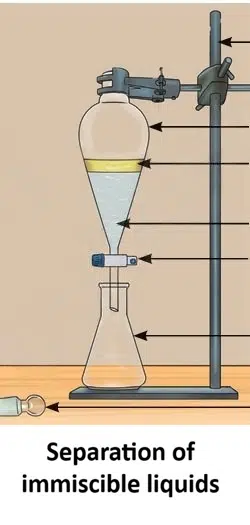
(a) Oil layer (upper)
(b) Water layer (lower)
(c) Both together
(d) Neither
Answer: (b) Water layer (lower)
Disclaimer: The content that is present on our website is based on the NCERT Class 9 Science textbook and is provided for educational purposes only. All the content and images have been taken from Science Class 9 NCERT Textbook and CBSE Support material. Images and content shown above are the property of individual organizations and are used here for reference purposes only. To make it easy to understand, some of the content and images are generated by AI and cross-checked by the teachers.