
Earth as a System: Energy, Matter and Life Class 9 Notes provide a clear and easy-to-understand explanation of how the Earth functions as an interconnected system. These NCERT-based notes cover the four major Earth spheres—atmosphere, hydrosphere, geosphere, and biosphere—along with the flow of energy from the Sun, the cycling of matter, and the interactions that sustain life on Earth.
Earth as a System Energy Matter and Life Class 9 Notes
Life on the Earth depends on the flow of energy; this energy comes from the sun and heat from inside the earth and chemical reactions in air, water, and rocks.
What is the Earth System?
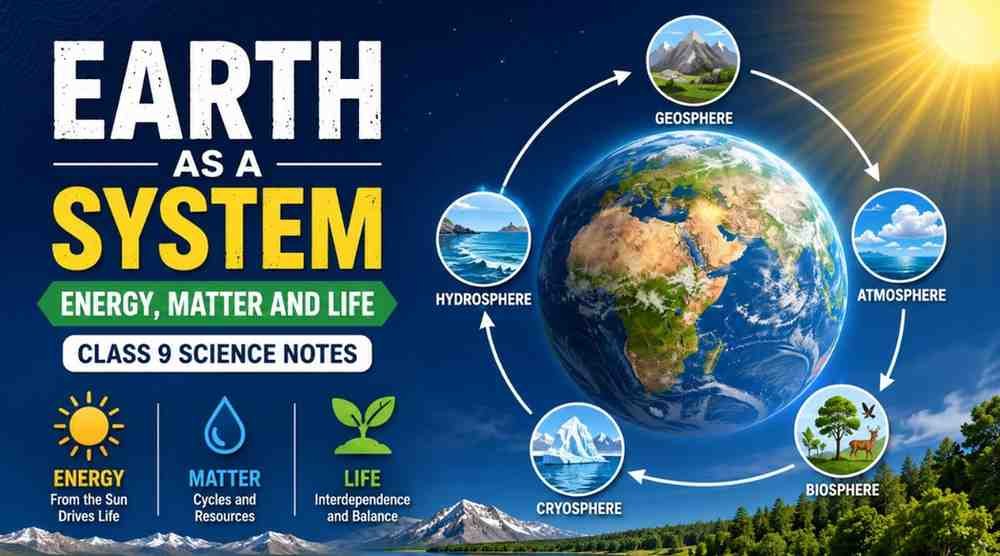
The earth is made up of five connected parts called earth’s spheres.
- Geosphere: The geosphere is the solid part of the earth, like soil, rocks, mountains, deserts, plateaus, and the earth’s interior.
- Hydrosphere: The hydrosphere includes all liquid water on earth, like rivers, oceans, groundwater, lakes, etc.
- Cryosphere: The Cryosphere is the frozen water on the earth, like glaciers, polar ice caps, ice, and snow.
- Atmosphere: The atmosphere is the layer of the air surrounding the earth, like oxygen for breathing, clouds, weather, wind, etc.
- Biosphere: The biosphere includes all living organisms and the places where they live, like humans, animals, plants, mangroves, coral reefs, forests, etc.
All the above five spheres work together. If one sphere changes, the others are also affected. For example, if the water of the Arabian Sea becomes warmer, then more water evaporates, which can change the southwest monsoon. Because of this, some places will receive heavy rainfall and floods, and others will receive very little rainfall.
Uneven Heating of the Earth
The Sun is the main source of energy; the Sun sends the energy in the form of electromagnetic (EM) waves. These waves can travel through empty space (vacuum) at the speed of 3 × 10⁸ m/s (about 300 million meters per second).
Electromagnetic (EM) Spectrum
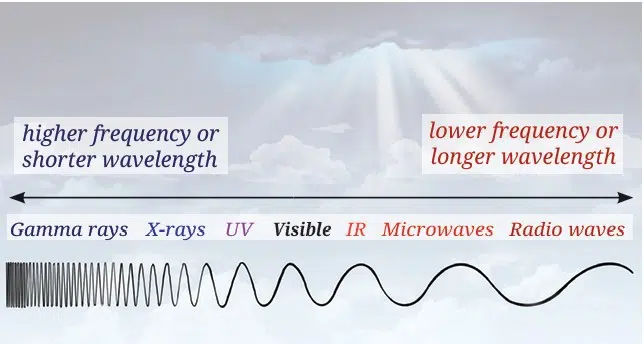
The electromagnetic spectrum is the complete range of EM waves. The highest energy to lowest energy of the waves are
- Gamma rays
- X-rays
- Ultraviolet (UV) rays
- Visible light
- Infrared (IR) rays
- Microwaves
- Radio waves
- Gamma rays and X-rays have very high energy and can be harmful to living things.
99% of the sun’s energy reaches Earth in the form of –
- Ultraviolet (UV) rays
- Visible light
- Infrared (IR) rays
These three different types of radiation are very important for climate and life on the earth.
1. Ultraviolet (UV) Rays
These are the most harmful rays, but ozone layers are absorbed in the upper atmosphere. The ozone layer protects humans, plants, and animals from this harmful radiation. UV rays help to warm the upper atmosphere.
2. Visible Light
This light provides energy for photosynthesis, which helps the plants to make food. It also helps to warm the land and water.
3. Infrared (IR) Rays
The infrared rays help to heat the earth’s surface and give out this heat to the atmosphere. Some of the heat trapped by the greenhouse gases like –
- Carbon dioxide (CO₂)
- Methane (CH₄)
- Water vapor
What is insolation?
The amount of the Sun’s radiation that reaches the Earth’s surface is called insolation. It is responsible for warming the Earth’s surface and its atmosphere.
What is solar constant?
The solar constant is the average amount of solar energy received at the top of the Earth’s atmosphere. Its value is approximately 1.4 kW/m² (or 1400 J/s/m²). This energy is available before it is absorbed, reflected, or scattered by the atmosphere.
Why is the actual energy less?
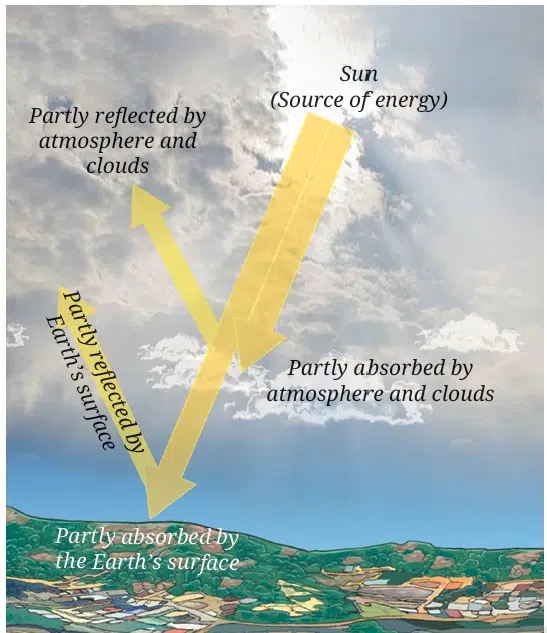
When the sunlight reaches the Earth’s surface, then—
- Some energy is absorbed by gases.
- Some is scattered by dust and air particles.
- Some is reflected by clouds.
Under the clear sky, the earth’s surface receives about 1 kW/m² of solar energy.
Example: How much solar energy will be received by a 1 m² area in one hour if the insolation on the surface of the Earth were 1 kW/m²?
Answer:
Given
- Insolation = 1 kW/m² = 1000 J/s/m²
- Area = 1 m²
- Time = 1 hour = 3600 seconds
Formula
- Energy = Intensity × Area × Time
Calculation
- Energy = 1000 × 1 × 3600
- Energy = 3,600,000 J
- Energy = 3.6 × 10⁶ J
A 1 m² area receives 3.6 × 10⁶ joules (3,600,000 J) of solar energy in 1 hour.
Interaction of solar radiation on the Earth’s surface
Different materials absorb sunlight in different ways—
- Land heats up faster compared to water.
- Different soils also heat up at different rates.
- Dark-colored surfaces absorb more sunlight and become hotter.
- Light-colored surfaces reflect more sunlight and stay cool.
What is Albedo?
Albedo is the percentage of sunlight that a surface reflects back into space. The word “albedo” comes from a Latin word meaning “whiteness.” High albedo reflects more sunlight and absorbs less heat and stays cool. For example, ice, snow, and white surfaces.
| Material | Albedo |
|---|---|
| Snow | 0.80 – 0.90 |
| Ice | 0.50 – 0.70 |
| Crushed rock | 0.25 – 0.30 |
| Light-colored soil | 0.30 – 0.40 |
| Black soil | 0.05 – 0.15 |
| Ocean water | 0.05 – 0.10 |
Why Are Polar Regions So Cold?
The snow and ice have high albedo. They reflect most of the sun’s rays; because of this, the snow absorbs very little heat and remains very cold.
Why are Black Soil and Oceans Warmer?
The black soil and ocean water have very low albedo. They absorb more solar energy and become warmer than snowy regions.
What is re-radiation of heat?
All the objects that can become hot can give heat. This is called re-radiation. For example, concrete absorbs a lot of heat in the day and releases this stored heat at night. So, people felt hot at night during summer. In mud and wooden houses, walls absorb less heat and release less heat at night. Therefore, they stay cooler in summer.
Latitude and Earth’s shape
The earth is spherical (round); because of this, the sun’s light does not fall equally on all places. The place near the equator receives more direct sunlight and near the poles receive slanting sunlight and are colder.
- Earth’s Tilt and Seasons
- The Earth’s axis is tilted.
Because of this tilt:
- Different parts of the Earth receive different amounts of sunlight during the year.
- Seasons (summer, winter, spring, and autumn) occur.
- The length of day and night also changes throughout the year.
Role of the atmosphere
The atmosphere is a protective blanket of gases that surrounds the earth, and the earth’s gravity holds the atmosphere around the earth. The main gases in the atmosphere are
- Nitrogen (N₂) – 78%
- Oxygen (O₂) – 21%
- Other gases (1%)—argon, carbon dioxide (CO₂), water vapor, and others
Different layers of the atmosphere
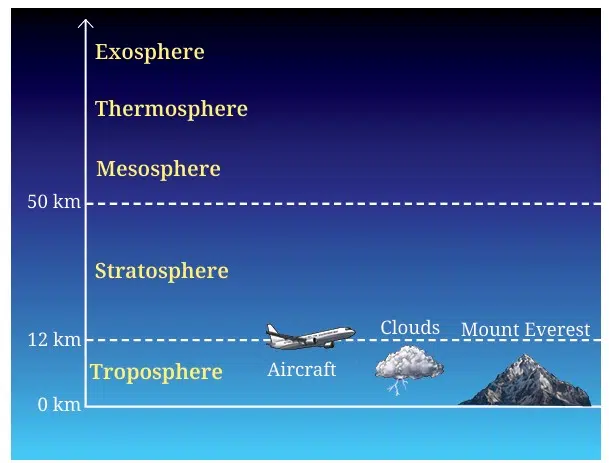
1. Troposphere (0–12 km)
The troposphere is the lowest layer of the atmosphere. Almost all weather changes happen here, like rain, wind, and storms. The earth heats the layer from below, and when we go up, the temperature decreases approximately 6.5°C for every 1 km.
2. Stratosphere (12 – 50 km)
In this ozone layer is found, and ozone absorbs harmful ultraviolet (UV) rays from the sun; because of this, the temperature increases from this height. Weather does not occur in this layer.
3. Other Layers
Above the stratosphere, there are the mesosphere, thermosphere, and exosphere. These layers have only a small effect on Earth’s climate. Outer space begins at about 100 km above the earth’s surface.
Main Features of Atmospheric Layers
| Layer | Approximate altitudes | Features |
|---|---|---|
| Troposphere | 0 – 12 km | Weather formation; temperature decreases with height |
| Stratosphere | 12 – 50 km | Ozone layer absorbs UV; temperature increases with height |
Importance of the Atmosphere
The atmosphere protects life on earth in two different ways—
- If blocks harmful sun rays: The ozone layer absorbs most harmful UV rays. Clouds and gases also absorb some sunlight.
- It Keeps the Earth Warm: The earth’s surface absorbs sunlight and gives out heat as infrared (IR) radiation. Greenhouse gases also trap some of the heat.
Why is Venus hotter than Mercury?
The mercury is closer to the sun; Venus is hotter because Venus has a very thick atmosphere. It contains a large amount of carbon dioxide (CO₂). This causes an extremely strong greenhouse effect, trapping a huge amount of heat.
Uneven Heating Causes Wind and Ocean Currents
Wind is the movement of air from a high-pressure area to a low-pressure area. These pressure differences are mainly caused by the uneven heating of the Earth’s surface by the Sun.
- Land heats up faster than water.
- Warm air rises and creates low pressure.
- Cool air moves into this area from a high-pressure region.
- This movement of air is called wind.
1. Local winds
The heating of the earth’s surface also creates local winds such as –
- Valey Breeze
- Mountain Breeze
These winds are common in the mountain areas like Shimla, Dehradun, and Himalayan Valleys.
Valley Breeze (During the Day)
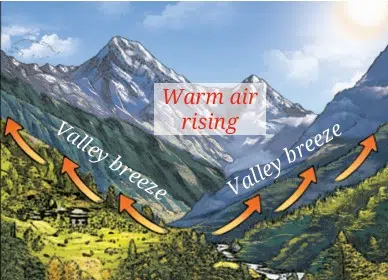
In the daytime, the mountain slopes heat up faster than the valley floor. This air above the slopes becomes warm and light; the warm air rises and creates a low-pressure area. The cooler air from the valley moves up the mountain slopes to replace it. This movement of the air is called a valley breeze.
Mountain Breeze (During the Night)
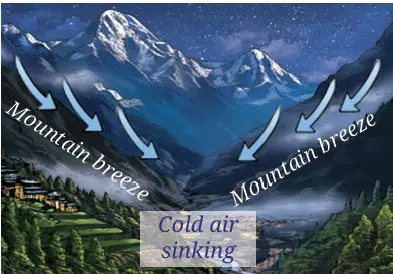
At night, the mountain slopes cool faster than the valley; the air above the slopes becomes cool and heavy. This cool air flows down into the valley. This movement of the air is called a mountain breeze.
Importance of Local Winds
Local winds help to:
- Control the local weather.
- Maintain temperature.
- Carry moisture.
- Support agriculture.
- Improve soil and crop health.
2. Planetary winds
Uneven heating of the Earth between the equator and the poles creates belts of low and high pressure. This large-scale pressure difference sets the air in motion over long distances, giving rise to planetary winds.
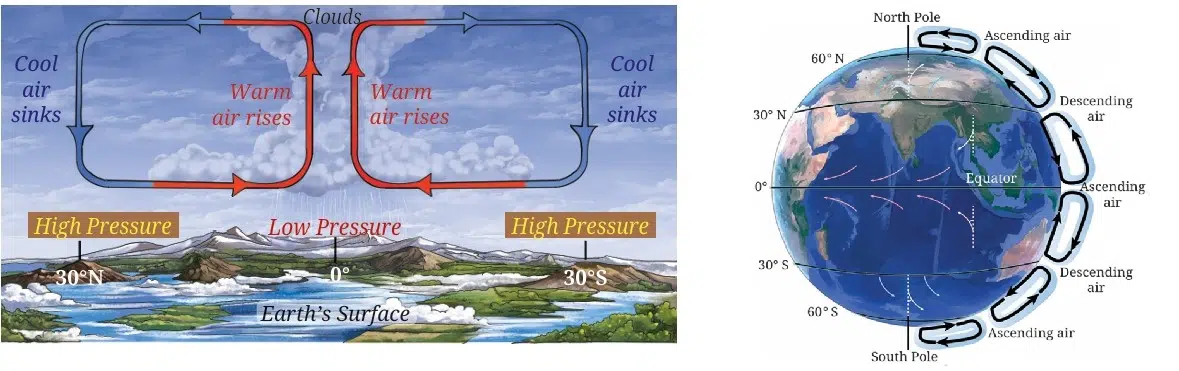
How are planetary winds formed?
Step 1: The Sun Heats the Equator
The equator receives the maximum heat from the Sun and makes the air hot. Hot air is lighter and rises upward because of this low-pressure area.
Step 2: Cool Air Sinks at 30° Latitude
The hot air rises high into the sky and moves away from the equator to become cool. The cool air is heavier than the hot air, so it comes down near 30° north and 30° south.
Step 3: Air Moves Back
Air always moves from high pressure to low pressure. So, the cool air moves back towards the equator. This movement of air is called a planetary wind.
Why Don’t Winds Blow Straight?
The earth is rotating; because of rotation, winds do not move in a straight line. The wind bends while moving. In the Northern Hemisphere, winds bend to the right. In the Southern Hemisphere, winds bend to the left.
Ocean currents
What are ocean currents?
The ocean currents are the continuous movement of large amounts of ocean water from one place to another, just like rivers flowing inside the oceans.
What causes ocean currents?
The ocean currents are mainly caused by
- Winds: Strong winds push the surface water.
- Temperature: The warm water near the equator moves toward the poles; cold water from the poles sinks and moves back.
- Salinity (saltiness): More salty water is heavy and sinks; less salty water is light and stays on top.
- Earth’s rotation: Earth rotation makes water move in circles called gyres. The direction of gyres—
- In the Northern Hemisphere, the ocean currents move clockwise.
- In the Southern Hemisphere the ocean currents move counterclockwise.
- Continents: The land blocks and changes the path of currents.
Why Are Ocean Currents Important?
Ocean currents are very important because they help control the Earth’s climate and support marine life.
- They Control Climate: The ocean currents carry warm water from the equator to the poles. For example, the North Atlantic Drift carries warm water towards northwestern Europe.
- They Support Marine Life: Currents carry nutrients for fish and plants.
- Help humans: Useful for trade, fishing, and weather.
Biogeochemical Cycles
Living things and non-living things are always connected, like plants, animals, and humans need water, oxygen, carbon, and nitrogen to live. These substances are not used only one time. They move from the environment to living organisms and then return to the environment. This process keeps repeating, and this process is called a biogeochemical cycle.
Why are biogeochemical cycles important?
- They recycle essential nutrients so they do not run out.
- They help the plants, animals, and humans to survive.
- They help to make a natural balance.
- They help ecosystems to recover from natural disasters or damage.
- Main Biogeochemical Cycles
1. Water Cycle
The water cycle is the movement of water between Earth’s surface and the atmosphere. Water keeps changing its state, like liquid, water vapor, and ice, but the total amount of water remains the same on the earth.
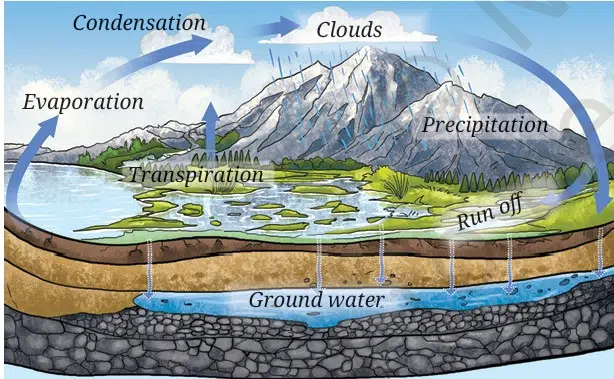
Steps of the Water Cycle
- Evaporation: In this stage, the sun heats water, changing it to water vapor, which rises into the atmosphere.
- Transpiration: The plants also release water vapor through tiny pores in their leaves; the process is called transpiration.
- Condensation: When the water vapor cools in the atmosphere, then it changes into tiny water droplets and joins together to make clouds.
- Precipitation: When the clouds become heavy, then the water falls back to the earth. This process is called precipitation.
- Runoff: When the water flows from land to rivers, lakes, and finally the oceans, it is called runoff.
- Infiltration: Some of the rainwater enters the soil. This process is called infiltration.
- Groundwater: The water below the earth surface is called groundwater.
Effect of Climate Change on the Water Cycle
- Global warming is changing the water cycle.
- Higher temperatures increase evaporation.
- Some of the places on earth receive heavy rainfall and floods, and other places experience droughts.
- Glaciers melt faster because of this; sea level rises.
- Less water enters the ground, reducing groundwater.
- Farming becomes difficult because of irregular rainfall.
2. Carbon Cycle
The carbon cycle is the process where the carbon moves between the atmosphere, living organisms, oceans, and the earth. Carbon is the most important element because all living things contain carbon.
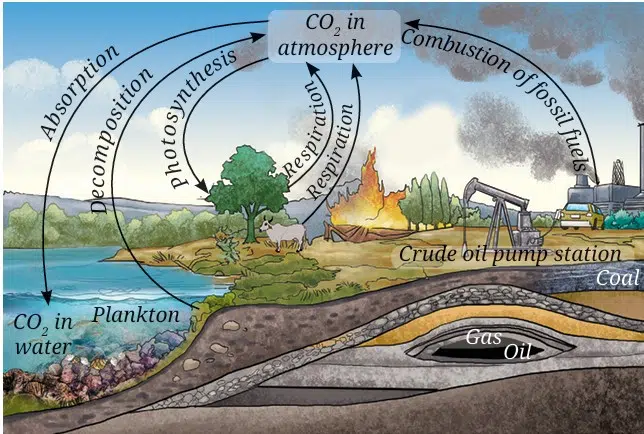
Steps of the Carbon Cycle
- Photosynthesis: In photosynthesis plants take carbon dioxide from the atmosphere using sunlight and prepare food.
- Feeding: Animals eat plants, and carbon moves from plants to animals.
- Respiration: The plants and animals release carbon dioxide into the atmosphere while breathing.
- Decomposition: The dead plants and animals are broken down with the help of microorganisms and return the carbon to the atmosphere and soil.
- Fossil Fuels: Some of the dead organisms remain buried for millions of years; they cannot change into coal, petroleum, and natural gas.
- Combustion: The burning of fossil fuels releases carbon dioxide back into the atmosphere.
- Ocean Storage: The oceans absorb carbon dioxide. The marine organisms use this carbon to build shells, and some carbon gets stored on the ocean floor.
3. Nitrogen Cycle
Nitrogen is a very important element; 78% of the atmosphere contains nitrogen gas (N₂). The plants and animals cannot use it directly because nitrogen gas is very stable. The nitrogen used to be converted into usable nitrogen compounds. The continuous movement of the nitrogen between atmosphere, soil, water, and living organisms is called the nitrogen cycle.
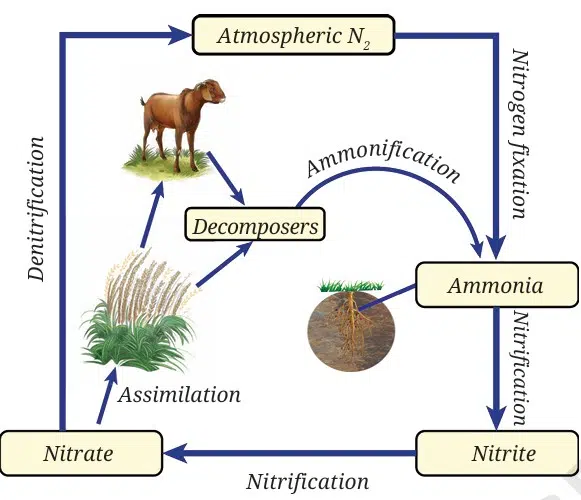
Steps of the Nitrogen Cycle
- Nitrogen Fixation: The nitrogen gas (N₂) cannot be used directly from the atmosphere; nitrogen-fixing bacteria convert nitrogen gas into ammonia (NH₃), like Rhizobium and Azotabacter.
- Nitrification: Ammonia is converted into nitrate in two different steps. Nitrosomonas converts ammonia (NH₃) into nitrite (NO₂⁻). Nitrobacter converts nitrite (NO₂⁻) into nitrate (NO₃⁻). Plants can easily absorb nitrates from the soil.
- Assimilation: Plants absorb nitrates from the soil through their roots, and the animals obtain nitrogen by eating plants or other animals.
- Ammonification: The plants and animals die or produce waste, then decomposers like bacteria and fungi break down the organic matter. This process helps the nitrogen to convert back into ammonia (NH₃) and return to the soil.
- Denitrification: Denitrifying bacteria like Pseudomonas help to convert nitrates (NO₃⁻) back into nitrogen gas (N₂), and this nitrogen gas returns to the atmosphere.
3. Oxygen Cycle
Oxygen is a very important element on earth. About 21% of the atmosphere is made up of oxygen gas (O₂). The continuous movement of oxygen between the atmosphere, living organisms, land, and oceans is called the oxygen cycle.
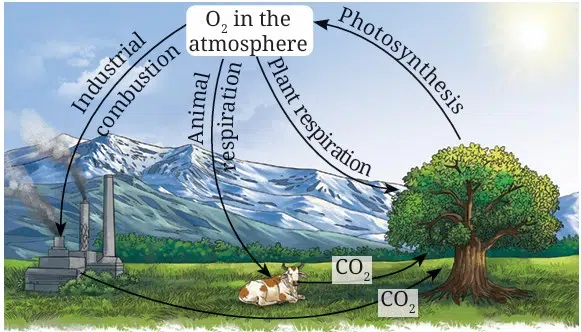
Steps of the Oxygen Cycle
- Photosynthesis: The plants take carbon dioxide, water, and sunlight to make food. During this process the oxygen is released into the atmosphere.
- Respiration: The plants, animals, and humans breathe oxygen and release carbon dioxide into the atmosphere.
- Combustion: The burning fuels such as petrol, coal, diesel, and wood use oxygen and release carbon dioxide into the atmosphere.
- Oxygen Balance: Photosynthesis continuously replaces the oxygen during respiration and combustion. They keep the amount of oxygen in the atmosphere balanced.
Human Impact on Earth’s Processes
Humans affect the earth’s natural systems and disturb the biogeochemical cycles, like the water, carbon, nitrogen, and oxygen cycles. This leads to climate change, pollution, and loss of biodiversity.
Major Human Activities Affecting the Environment
- Burning of Fossil Fuels
- Coal, petroleum, and natural gas are called fossil fuels. When these fuels are burned, then they
- Releases a large amount of carbon dioxide
- increase the greenhouse effect.
Causes global warming and climate change.
- Disturbs the carbon cycle.
- Deforestation
- The deforestation means cutting down forests.
Effects of Deforestation
- Reduces photosynthesis.
- Decreases oxygen production.
- Causes soil erosion.
- Reduces biodiversity.
- Increases carbon dioxide in the atmosphere.
- Reduces transpiration, leading to less rainfall.
- Destroys the habitats of plants and animals.
Excessive Use of Fertilizers
The fertilizer is used to increase the crop production, but excessive use of fertilizers is harmful.
Effects of excessive use of fertilizers
- Extra nitrates enter rivers and lakes.
- Algae use up the oxygen dissolved in water.
- Algae grow rapidly, forming algal blooms.
- Fish and other aquatic animals die due to lack of oxygen.
Ocean Acidification
Oceans absorb some of the carbon dioxide present in the atmosphere. When too much CO₂ is absorbed, then—
- Seawater becomes more acidic.
- Coral reefs are damaged.
- Marine organisms are affected.
- Marine ecosystems become unbalanced.
Air Pollution
Due to vehicles and industries, air pollution happens. These pollutants react with sunlight and form—
- Smog (a mixture of smoke and fog)
- Ground-level ozone, which is harmful to human health.
Disclaimer: The content that is present on our website is based on the NCERT Class 9 Science textbook and is provided for educational purposes only. All the content and images have been taken from Science Class 9 NCERT Textbook and CBSE Support material. Images and content shown above are the property of individual organizations and are used here for reference purposes only. To make it easy to understand, some of the content and images are generated by AI and cross-checked by the teachers.