
← Back to Class 10 Study Material
Practice Heredity Class 10 MCQs based on the NCERT Science textbook. These multiple-choice questions cover important concepts such as heredity, variation, genes, chromosomes, Mendel’s experiments, dominant and recessive traits, sex determination, and inheritance of characteristics.

Heredity Class 10 MCQ
Conceptual Recall
Q. Inheritance from the previous generation provides the next generation with:
a) Only variations
b) Only body design
c) A common body design along with subtle changes
d) Completely new characters only
Answer: c) A common body design along with subtle changes
Q. In asexual reproduction, variations among offspring are mainly due to:
a) Environmental changes only
b) Small inaccuracies in DNA copying
c) Crossing over of chromosomes
d) Fusion of gametes
Answer: b) Small inaccuracies in DNA copying
Q. Which mode of reproduction generally produces greater diversity among individuals?
a) Vegetative propagation
b) Binary fission
c) Asexual reproduction
d) Sexual reproduction
Answer: d) Sexual reproduction
Q. In sexually reproducing organisms, each trait in a child can be influenced by:
a) Only maternal DNA
b) Only paternal DNA
c) Both paternal and maternal DNA
d) Environmental factors only
Answer: c) Both paternal and maternal DNA
Q. The scientist who proposed the basic rules of inheritance through experiments on pea plants was:
a) Charles Darwin
b) Gregor Mendel
c) Louis Pasteur
d) Robert Hooke
Answer: b) Gregor Mendel
Q. In Mendel’s cross between a tall pea plant and a short pea plant, all F₁ plants were:
a) Short
b) Medium height
c) Half tall and half short
d) Tall
Answer: d) Tall
Q. A section of DNA that provides information for one protein is called a:
a) Chromosome
b) Gene
c) Trait
d) Gamete
Answer: b) Gene
Q. Genes control characteristics of an organism mainly by controlling the production of:
a) Minerals
b) Water
c) Proteins
d) Vitamins
Answer: c) Proteins
Q. In the example of plant height, tallness depends directly on the amount of:
a) Chlorophyll
b) Plant hormone
c) Starch
d) Cell sap
Answer: b) Plant hormone
Q. In human beings, the sex of a child is mainly determined by:
a) Environmental conditions
b) Nutrition of the mother
c) Genes inherited from parents
d) Blood group of parents
Answer: c) Genes inherited from parents
Q. How many pairs of chromosomes are present in human beings that are not sex chromosomes?
a) 21 pairs
b) 22 pairs
c) 23 pairs
d) 24 pairs
Answer: b) 22 pairs
Q. The sex chromosomes in human females are:
a) XY
b) YY
c) XX
d) XO
Answer: c) XX
Application-Based
Q. A bacterium divides twice, producing four bacteria. The four offspring are very similar but not exactly identical. What is the most appropriate reason?
a) Different food sources
b) Mutations caused by sunlight
c) Minor inaccuracies during DNA copying
d) Fusion of gametes
Answer: c) Minor inaccuracies during DNA copying
Q. During a heat wave, some bacteria survive while others die. The surviving bacteria most likely possess:
a) Harmful variations
b) Variations that help them tolerate heat
c) More DNA than others
d) Fewer chromosomes
Answer: b) Variations that help them tolerate heat
Q. In a sexually reproducing population, offspring differ significantly from one another because:
a) They inherit DNA from two individuals
b) They do not inherit traits from parents
c) DNA copying never occurs
d) All variations are environmental
Answer: a) They inherit DNA from two individuals
Q. A tall pea plant (TT) is crossed with a short pea plant (tt). All F₁ offspring are tall. This shows that the trait for tallness is:
a) Recessive
b) Dominant
c) Absent in offspring
d) Lost during reproduction
Answer: b) Dominant
Q. In the F₂ generation of Mendel’s monohybrid cross, some short plants reappeared even though all F₁ plants were tall. This indicates that:
a) The shortness trait was lost in F₁ generation
b) Shortness was not inherited
c) The shortness trait was present but not expressed in F₁ plants
d) New genes were formed in F₂ generation
Answer: c) The shortness trait was present but not expressed in F₁ plants
Q. A gardener crosses a tall pea plant with round seeds and a short pea plant with wrinkled seeds. In the F₂ generation, some plants are short with round seeds. This observation supports:
a) Blending of traits
b) Independent inheritance of traits
c) Loss of parental traits
d) Asexual reproduction
Answer: b) Independent inheritance of traits
Q. A gene undergoes a change that makes an enzyme less efficient in producing a growth hormone. The plant is most likely to become:
a) Taller than normal
b) Shorter than normal
c) Yellow in colour
d) Seedless
Answer: b) Shorter than normal
Q. If an efficient enzyme produces a larger amount of growth hormone in a plant, the plant will most likely be:
a) Short
b) Dwarf
c) Tall
d) Seedless
Answer: c) Tall
Q. A child receives one copy of a gene from the mother and one from the father. This explains why:
a) Only maternal traits are inherited
b) Only paternal traits are inherited
c) Both parents influence the traits of the child
d) Environment has no effect on traits
Answer: c) Both parents influence the traits of the child
Q. A child inherits an X chromosome from the mother and a Y chromosome from the father. The child will be:
a) A girl
b) Either a boy or a girl
c) A boy
d) Unable to survive
Answer: c) A boy
Q. In a family with three daughters, a fourth child is expected. What is the probability that the fourth child will be a boy?
a) 100%
b) 75%
c) 25%
d) 50%
Answer: d) 50%
Q. In some reptiles, the sex of offspring depends on the temperature at which eggs are kept. This shows that:
a) Sex is always genetically determined
b) Environmental factors can determine sex in some organisms
c) Only females are produced
d) Chromosomes play no role in heredity
Answer: b) Environmental factors can determine sex in some organisms
Assertion–Reason
Q. Assertion (A): Offspring produced through sexual reproduction show greater variation than those produced through asexual reproduction.
Reason (R): Sexual reproduction combines characteristics from two different individuals.
a) Both A and R are true, and R is the correct explanation of A
b) Both A and R are true, but R is not the correct explanation of A
c) A is true, but R is false
d) A is false, but R is true
Answer: a) Both A and R are true, and R is the correct explanation of A
Q. Assertion (A): All variations in a species have equal chances of survival.
Reason (R): The environment selects individuals with favourable variations.
a) Both A and R are true, and R is the correct explanation of A
b) A is true, but R is false
c) A is false, but R is true
d) Both A and R are false
Answer: c) A is false, but R is true
Q. Assertion (A): A single copy of the tallness factor is enough to make a pea plant tall.
Reason (R): Tallness is a dominant trait over shortness.
a) Both A and R are true, and R is the correct explanation of A
b) Both A and R are true, but R is not the correct explanation of A
c) A is true, but R is false
d) A is false, but R is true
Answer: a) Both A and R are true, and R is the correct explanation of A
Q. Assertion (A): Recessive traits can disappear forever after one generation.
Reason (R): Recessive traits may remain present but not be expressed in some generations.
a) Both A and R are true, and R is the correct explanation of A
b) Both A and R are true, but R is not the correct explanation of A
c) A is true, but R is false
d) A is false, but R is true
Answer: d) A is false, but R is true
Q. Assertion (A): Genes control traits in an organism.
Reason (R): Genes contain information for making proteins.
a) Both A and R are true, and R is the correct explanation of A
b) Both A and R are true, but R is not the correct explanation of A
c) A is true, but R is false
d) A is false, but R is true
Answer: a) Both A and R are true, and R is the correct explanation of A
Q. Assertion (A): Each body cell generally contains two copies of each chromosome.
Reason (R): One chromosome of each pair is inherited from each parent.
a) Both A and R are true, and R is the correct explanation of A
b) Both A and R are true, but R is not the correct explanation of A
c) A is true, but R is false
d) A is false, but R is true
Answer: a) Both A and R are true, and R is the correct explanation of A
Q. Assertion (A): Human females produce only one type of gamete with respect to sex chromosomes.
Reason (R): All eggs produced by females contain an X chromosome.
a) Both A and R are true, and R is the correct explanation of A
b) Both A and R are true, but R is not the correct explanation of A
c) A is true, but R is false
d) A is false, but R is true
Answer: a) Both A and R are true, and R is the correct explanation of A
Q. Assertion (A): The father determines the sex of the child in humans.
Reason (R): Sperms may carry either an X chromosome or a Y chromosome.
a) Both A and R are true, and R is the correct explanation of A
b) Both A and R are true, but R is not the correct explanation of A
c) A is true, but R is false
d) A is false, but R is true
Answer: a) Both A and R are true, and R is the correct explanation of A
Case Study-Based
Case Study: A population of bacteria reproduces continuously. During reproduction, small variations arise among the offspring. When environmental conditions change and the temperature rises sharply, some bacteria survive while others do not. Over time, the surviving bacteria form a larger population.
Q. The variations seen in the bacterial population arise mainly due to:
a) Changes in food availability
b) Inaccuracies during DNA copying
c) Loss of genetic material
d) Reduction in reproduction rate
Answer: b) Inaccuracies during DNA copying
Q. The survival of certain bacteria during the temperature rise demonstrates that:
a) All variations are equally useful
b) Variation has no role in survival
c) Environmental factors can select useful variations
d) Asexual reproduction prevents variation
Answer: c) Environmental factors can select useful variations
Case Study: Mendel crossed pure tall pea plants with pure short pea plants. All plants in the F₁ generation were tall. When the F₁ plants were self-pollinated, both tall and short plants appeared in the F₂ generation. Mendel concluded that traits are controlled by factors (genes), and some traits may be dominant over others.
Q. The reappearance of short plants in the F₂ generation indicates that:
a) Only tallness was inherited in F₁ plants
b) Shortness was not inherited by F₁ plants
c) Both tallness and shortness were inherited in F₁ plants
d) New traits were created in F₂ plants
Answer: c) Both tallness and shortness were inherited in F₁ plants
Q. In the cross represented in the case study, the trait for shortness is:
a) Dominant
b) Recessive
c) Codominant
d) Neither dominant nor recessive
Answer: b) Recessive
Case Study: A pea plant has a gene that controls the production of an enzyme needed for making a growth hormone. In one plant, the enzyme works efficiently and a large amount of hormone is produced. In another plant, a change in the gene makes the enzyme less efficient, resulting in less hormone production.
Q. The difference in height between the two plants occurs because genes influence the production of:
a) Water
b) Soil nutrients
c) Proteins and enzymes
d) Oxygen
Answer: c) Proteins and enzymes
Q. The plant with the less efficient enzyme is likely to be:
a) Taller
b) Shorter
c) Wider
d) Older
Answer: b) Shorter
Case Study: In humans, females have two X chromosomes (XX), while males have one X and one Y chromosome (XY). During reproduction, all eggs carry an X chromosome. Half of the sperms carry an X chromosome and the other half carry a Y chromosome. The combination of these chromosomes determines the sex of the child.
Q. Which chromosome contributed by the father results in the birth of a girl child?
a) Y chromosome
b) Both X and Y chromosome
c) X chromosome
d) No sex chromosome
Answer: c) X chromosome
Q. According to the information given, the expected ratio of boys to girls is:
a) 3 : 1
b) 1 : 3
c) 1 : 1
d) 2 : 1
Answer: c) 1 : 1
Diagram/Visual-Based
Q. Refer to Figure. The figure mainly illustrates that:
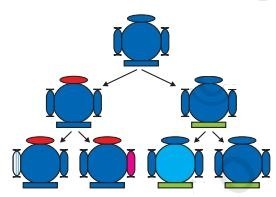
a) Variations can accumulate generation after generation
b) All offspring are identical to parents
c) DNA copying is always accurate
d) Sexual reproduction does not create variation
Answer: a) Variations can accumulate generation after generation
Q. Refer to Figure. Which new combinations of traits appear in the F₂ generation that were not present together in the parent plants?
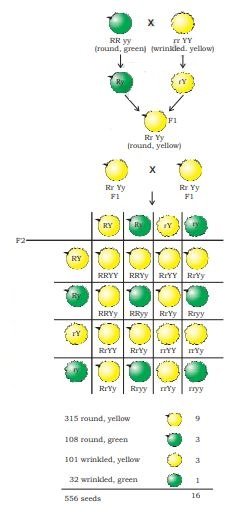
a) Tall-round and short-wrinkled
b) Round-yellow and wrinkled-green only
c) Tall-wrinkled and short-round type combinations
d) Only parental combinations are formed
Answer: c) Tall-wrinkled and short-round type combinations
Q. Refer to Figure. The appearance of new combinations such as round-green and wrinkled-yellow seeds in the F₂ generation shows that genes located on different chromosomes can be:
a) Destroyed during reproduction
b) Independently inherited
c) Permanently linked together
d) Lost in gamete formation
Answer: b) Independently inherited
Q. Refer to Figure, Which statement is best supported by the diagram?
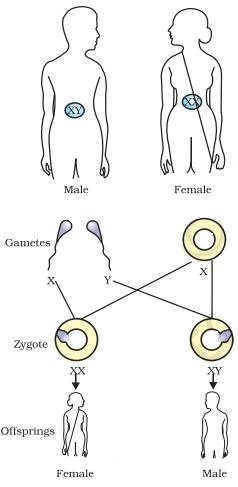
a) Mothers determine the sex of the child
b) Only boys inherit the X chromosome from the mother
c) The sex of a child depends on whether the father’s sperm carries X or Y chromosome
d) Girls inherit chromosomes only from the mother
Answer: c) The sex of a child depends on whether the father’s sperm carries X or Y chromosome
Disclaimer: The content that is present on our website is based on the NCERT Class 10 Science textbook and is provided for educational purposes only. All the content and images have been taken from Science Class 10 NCERT Textbook. Images and content shown above are the property of individual organizations and are used here for reference purposes only. To make it easy to understand, some of the content and images are generated by AI and cross-checked by the teachers.