
How Forces Affect Motion Class 9 MCQs designed according to the latest NCERT syllabus and CBSE guidelines. This collection features comprehensive, competency-based, case-based, assertion-reason, and application-oriented multiple-choice questions that help students understand balanced and unbalanced forces, inertia, Newton’s laws of motion, momentum, and everyday applications of force.
How Forces Affect Motion Class 9 MCQ
Conceptual Recall MCQs
Q1. A force can change the __ of an object.
(a) mass
(b) shape
(c) temperature
(d) colour
Answer: (b) shape
Q2. The SI unit of force is the newton.
(a) Joule
(b) Newton
(c) Watt
(d) Kilogram
Answer: (b) Newton
Q3. Which of the following is a contact force?
(a) Gravitational force
(b) Electrostatic force
(c) Frictional force
(d) Magnetic force
Answer: (c) Frictional force
Q4. When two equal and opposite forces act on an object, the forces are called ‘balanced forces’.
(a) Unbalanced forces
(b) Balanced forces
(c) Net forces
(d) Rotational forces
Answer: (b) Balanced forces
Q5. If forces acting on an object are unbalanced, the net force is
(a) Zero
(b) Non-zero
(c) Infinite
(d) Undefined
Answer: (b) Non-zero
Q6. Friction always acts.
(a) In the direction of motion
(b) Opposite to the direction of motion
(c) At right angles to motion
(d) Along gravitational force
Answer: (b) Opposite to the direction of motion
Q7. Which pair of forces are balanced when a box rests on the floor?
(a) Applied force and friction
(b) Gravitational force and normal force
(c) Friction and air resistance
(d) Applied force and weight
Answer: (b) Gravitational force and normal force
Q8. Newton’s first law of motion is also called:
(a) Law of acceleration
(b) Law of inertia
(c) Law of Gravitation
(d) Law of friction
Answer: (b) Law of inertia
Q9. If the net force on an object is zero, its acceleration is
(a) Zero
(b) Constant
(c) Increasing
(d) Decreasing
Answer: (a) Zero
Q10. Newton’s second law of motion mathematically is expressed as the following:
(a) F = ma
(b) F = mg
(c) F = mv
(d) F = (1/2)mv²
Answer: (a) F = ma
Q11. One newton is defined as the force that produces an acceleration of
(a) 1 m/s² on a mass of 1 g
(b) 1 m/s² on a mass of 1 kg
(c) 10 m/s² on a mass of 1 kg
(d) 9.8 m/s² on a mass of 1 g
Answer: (b) 1 m/s² on a mass of 1 kg
Q12. Newton’s third law of motion states:
(a) Force = mass × acceleration
(b) Every action has an equal and opposite reaction.
(c) Force is directly proportional to velocity.
(d) Force is inversely proportional to mass.
Answer: (b) Every action has an equal and opposite reaction.
Q13. The two forces in Newton’s third law act on the two bodies involved.
(a) The same object
(b) Two different objects
(c) Only moving objects
(d) Only stationary objects
Answer: (b) Two different objects
Q14. In a system of two boxes connected by a string, the force transmitted through the string is called:
(a) Normal force
(b) Frictional force
(c) Tension
(d) Gravitational force
Answer: (c) Tension
Q15. Internal forces in a system:
(a) Change the motion of the system
(b) Cancel each other out
(c) Are always greater than external forces.
(d) Do not exist in connected objects
Answer: (b) Cancel each other out
Application-Based MCQs
Q16. A cricket bat changes the direction of a moving ball. This shows that force can
(a) Change mass
(b) Change direction of motion
(c) Change temperature
(d) Change colour
Answer: (b) Change direction of motion
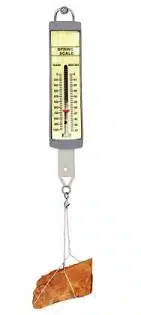
Q17. A spring balance is used to measure the following:
(a) Temperature of an object
(b) Magnitude of force
(c) Speed of motion
(d) Shape of an object
Answer: (b) Magnitude of force
Q18. In a tug of war, if both teams pull with equal force, the rope:
(a) Moves towards team A
(b) Moves towards Team B
(c) Does not move
(d) Breaks
Answer: (c) Does not move
Q19. Two people push a stalled car in the same direction with forces of 50 N and 70 N. The net force is:
(a) 20 N
(b) 120 N
(c) 70 N
(d) 50 N
Answer: (b) 120 N
Q20. Two boxes of masses m₁ and m₂ are connected and pulled with force F. The acceleration of the system is:
(a) F/m1
(b) F/m2
(c) F/(m1 + m2)
(d) F x (m1 + m2)
Answer: (c) F/(m1 + m2)
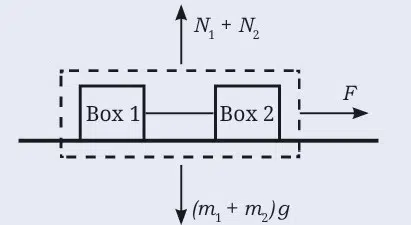
Q21. If two boxes are treated as a single system, which forces are considered?
(a) Only internal forces
(b) Only external forces
(c) Both internal and external forces
(d) No forces at all
Answer: (b) Only external forces
Q22. A rocket moves upward because of the following:
(a) Gravity pulls it up.
(b) Exhaust gases push downward, producing an upward reaction force.
(c) Air friction lifts it.
(d) The rocket engine reduces its mass.
Answer: (b) Exhaust gases push downward, producing an upward reaction force.
Q23. While walking, friction helps us move forward because
(a) Friction acts backward.
(b) Friction acts forward when we push the ground backward.
(c) Friction disappears on smooth floors.
(d) Friction reduces our speed.
Answer: (b) Friction acts forward when we push the ground backward.
Q24. A block of mass 25 kg is pushed with a net force of 5 N. The acceleration produced is:
(a) 0.2 m/s²
(b) 2.5 m/s²
(c) 5 m/s²
(d) 25 m/s²
Answer: (a) 0.2 m/s²
Q25. A sports car of mass 1500 kg accelerates at 2 m/s². The force acting on it is:
(a) 750 N
(b) 3000 N
(c) 1500 N
(d) 2000 N
Answer: (b) 3000 N
Q26. A moving box experiences a forward applied force equal to the backward frictional force. What will happen?
(a) The box will stop immediately.
(b) The box will move with constant velocity.
(c) Box will accelerate forward
(d) The box will move backward.
Answer: (b) The box will move with constant velocity.
Q27. A ball kept at rest on the floor will not move until the following:
(a) A net force acts on it.
(b) Friction disappears
(c) Gravity stops acting
(d) Normal force increases
Answer: (a) A net force acts on it.
Q28. A bicycle slows down after you stop pedalling. This is due to:
(a) Gravitational force
(b) Normal force
(c) Frictional force
(d) Magnetic force
Answer: (c) Frictional force
Q29. On which surface will coins travel the longest distance after being released by a stretched rubber band?
(a) Wooden table top
(b) Cemented floor
(c) Laminated tabletop
(d) Polished marble floor
Answer: (d) Polished marble floor
Assertion–Reason MCQs
Q30. Assertion (A): Force is a vector quantity.
Reason (R): Force has both magnitude and direction.
(a) Both A and R are true, and R is the correct explanation of A.
(b) Both A and R are true, but R is not the correct explanation of A.
(c) A is true, R is false.
(d) A is false, R is true.
Answer: (a) Both A and R are true, and R is the correct explanation of A.
Q31. Assertion (A): Treating connected objects as a single system simplifies analysis.
Reason (R): Internal forces cancel out, and only external forces determine motion.
(a) Both A and R are true, and R is the correct explanation of A.
(b) Both A and R are true, but R is not the correct explanation of A.
(c) A is true, R is false.
(d) A is false, R is true.
Answer: (a) Both A and R are true, and R is the correct explanation of A.
Q32. Assertion (A): When a bullet is fired, the gun recoils backward.
Reason (R): The force exerted on the bullet is equal and opposite to the force exerted on the gun.
(a) Both A and R are true, and R is the correct explanation of A.
(b) Both A and R are true, but R is not the correct explanation of A.
(c) A is true, R is false.
(d) A is false, R is true.
Answer: (a) Both A and R are true, and R is the correct explanation of A.
Q33. Assertion (A): For the same force, lighter objects accelerate more than heavier ones.
Reason (R): Acceleration is inversely proportional to mass.
(a) Both A and R are true, and R is the correct explanation of A.
(b) Both A and R are true, but R is not the correct explanation of A.
(c) A is true, R is false.
(d) A is false, R is true.
Answer: (a) Both A and R are true, and R is the correct explanation of A.
Q34. Assertion (A): An object moving with constant velocity has no net force acting on it.
Reason (R): A net force is required only to change velocity, not to maintain constant velocity.
(a) Both A and R are true, and R is the correct explanation of A.
(b) Both A and R are true, but R is not the correct explanation of A.
(c) A is true, R is false.
(d) A is false, R is true.
Answer: (a) Both A and R are true, and R is the correct explanation of A.
Q35. Assertion (A): Friction depends on the nature of surfaces in contact.
Reason (R): Smooth surfaces produce less friction than rough surfaces.
(a) Both A and R are true, and R is the correct explanation of A.
(b) Both A and R are true, but R is not the correct explanation of A.
(c) A is true, R is false.
(d) A is false, R is true.
Answer: (a) Both A and R are true, and R is the correct explanation of A.
Q36. Assertion (A): Balanced forces do not change the state of motion of an object.
Reason (R): The net force acting on the object is zero.
(a) Both A and R are true, and R is the correct explanation of A.
(b) Both A and R are true, but R is not the correct explanation of A.
(c) A is true, R is false.
(d) A is false, R is true.
Answer: (a) Both A and R are true, and R is the correct explanation of A.
Case-Based MCQ
Q37. Case Study : A student pushes a box on the floor. The box moves a short distance and then stops.
Which forces are acting on the box?
(a) Only applied force
(b) Applied force and frictional force
(c) Only gravitational force
(d) Only normal force
Answer: (b) Applied force and frictional force
Q38. Two boxes of masses 2 kg and 3 kg are connected by a string on a frictionless surface. A force of 10 N pulls the system.
Case Study Question: What is the acceleration of the system?
(a) 10/2 = 5 m/s²
(b) 10/3 = 3.3 m/s²
(c) 10/5 = 2 m/s²
(d) 10 x 5 = 50 m/s²
Answer: (c) 10/5 = 2 m/s²
Q39. Two spring balances are connected and pulled in opposite directions. Both show the same reading. Case Study Question: What does this indicate?
(a) Forces are unequal.
(b) Forces cancel each other.
(c) Forces are equal and opposite, acting on different objects.
(d) No force is acting
Answer: (c) Forces are equal and opposite, acting on different objects.
Q40. In cricket, a fielder pulls back his hands while catching a fast ball.
Case Study Question: Why does this reduce injury?
(a) It increases acceleration of the ball.
(b) It decreases time of contact.
(c) It increases time of contact, reducing force.
(d) It increases the velocity of the ball.
Answer: (c) It increases time of contact, reducing force.
Q41. A person pushes a cart and then suddenly stops applying force. The cart continues moving for some distance before stopping.
Case Study Question: Which law explains this observation?
(a) Newton’s second law
(b) Newton’s first law
(c) Newton’s third law
(d) Law of gravitation
Answer: (b) Newton’s first law
Q42. In Activity 6.2, a wooden block is pulled by a spring balance until it just starts moving.
Case Study Question: What does the reading of the spring balance indicate?

(a) The weight of the block
(b) The normal force acting on the block
(c) The magnitude of frictional force
(d) The applied force only
Answer: (c) The magnitude of frictional force
Q43. A weightlifter lifts a barbell and holds it steady above his head.
Case Study Question: Which forces act on the barbell, and are they balanced?
(a) Only gravitational force, not balanced
(b) Gravitational force and upward force by the lifter’s hands, balanced
(c) Only upward force, balanced
(d) Gravitational force and friction, unbalanced
Answer: (b) Gravitational force and upward force by the lifter’s hands, balanced
Diagram-Based MCQs
Q44. Observe the figure given below, a spring balance is shown. What does it measure?
(a) Speed of an object
(b) Weight of an object
(c) Temperature of an object
(d) Volume of an object
Answer: (b) Weight of an object
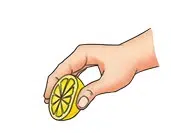
Q45. Observe the figure given below, squeezing a lemon shows that force can:
(a) Change the colour of an object
(b) Change the shape of an object
(c) Change the mass of an object
(d) Change the temperature of an object
Answer: (b) Change the shape of an object
Q46. Observe the figure given below, Box 1 experiences two forces:
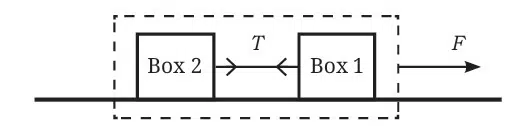
(a) Force 𝐹 to the right and tension 𝑇 to the left
(b) Force 𝐹 to the left and tension 𝑇 to the right
(c) Only gravitational force
(d) Only normal force
Answer: (a) Force 𝐹 to the right and tension 𝑇 to the left
Q47. Observe the figure given below, the downward gravitational force on the system is balanced by the following:
(a) Frictional force
(b) Normal force
(c) Tension force
(d) Applied force
Answer: (b) Normal force
Q48. Observe the figure given below, a person pushes the ground backward with their feet. The ground pushes forward due to the following:
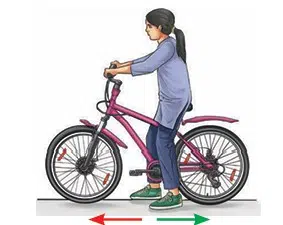
(a) Gravity
(b) Friction
(c) Air resistance
(d) Normal force
Answer: (b) Friction
Q49. Observe the figure given below the rocket launches upward because
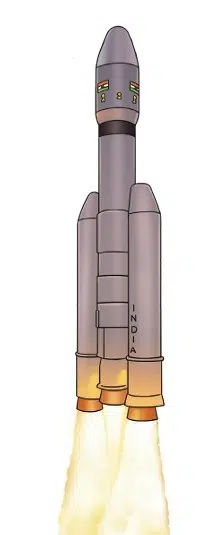
(a) The Earth pulls it upward.
(b) Exhaust gases exert downward force, producing an upward reaction.
(c) Gravity disappears
(d) The rocket loses mass.
Answer: (b) Exhaust gases exert downward force, producing upward reaction.
Q50. Observe the figure given below, the velocity-time graph between 5 s and 10 s is parallel to the time axis. This indicates:
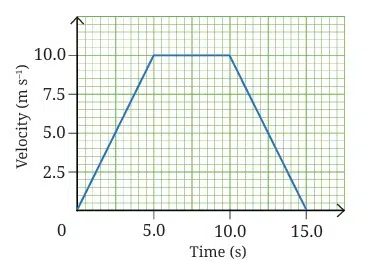
(a) Constant acceleration
(b) Constant velocity
(c) Increasing velocity
(d) Decreasing velocity
Answer: (b) Constant velocity
Q51. Observe the figure given below, a coconut cracks when dropped with high velocity on a hard surface because
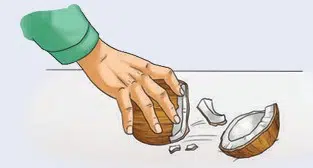
(a) The ground applies a very large force in a short time.
(b) The coconut has no inertia.
(c) Gravity disappears suddenly.
(d) The shell is weak.
Answer: (a) The ground applies a very large force in a short time.
Q52. Observe the figure given below, the position-time graph is a horizontal line. This represents:
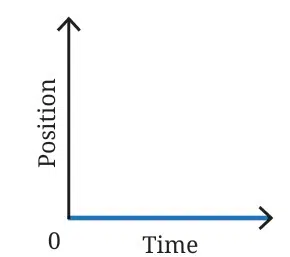
(a) Object moving with constant velocity
(b) Object at rest
(c) Object accelerating
(d) Object slowing down
Answer: (b) Object at rest
Q53. Observe the figure given below, the velocity-time graph is a straight line parallel to the time axis. This represents:
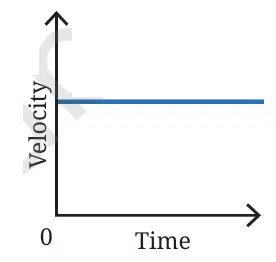
(a) Constant acceleration
(b) Constant velocity
(c) Object at rest
(d) Decreasing velocity
Answer: (b) Constant velocity
Q54. Observe the figure given below, the box does not move until a larger force is applied. Why?
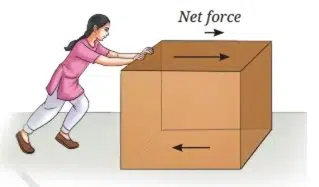
(a) Normal force is greater than applied force.
(b) Frictional force resists motion.
(c) Gravitational force pulls the box down.
(d) Air resistance is too strong.
Answer: (b) Frictional force resists motion.
Q55. Observe the figure given below, after the coins lose contact with the rubber band, which force acts on them?
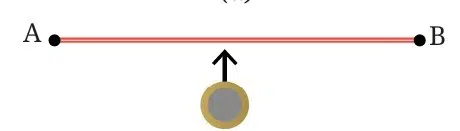
(a) Applied force
(b) Gravitational force only
(c) Frictional force only
(d) Normal force only
Answer: (c) Frictional force only
Q56. Observe the figure given below, two equal forces act in opposite directions. The rope:
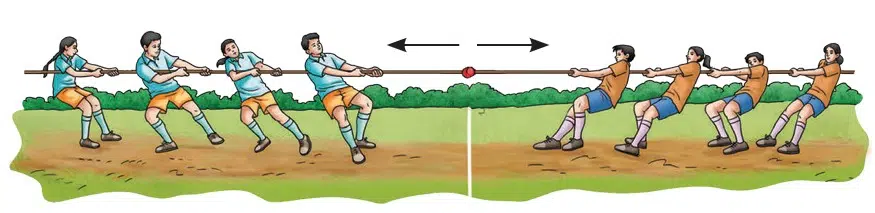
(a) Moves left
(b) Moves right
(c) Remains at rest
(d) Rotates
Answer: (c) Remains at rest
Q57. Observe the figure given below, two forces of 10 N and 6 N act in opposite directions. The net force is:
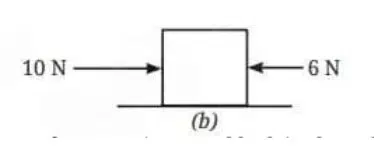
(a) 16 N right
(b) 4 N right
(c) 6 N left
(d) 10 N left
Answer: (b) 4 N right
Disclaimer: The content that is present on our website is based on the NCERT Class 9 Science textbook and is provided for educational purposes only. All the content and images have been taken from Science Class 9 NCERT Textbook and CBSE Support material. Images and content shown above are the property of individual organizations and are used here for reference purposes only. To make it easy to understand, some of the content and images are generated by AI and cross-checked by the teachers.
It is a very delightful and educational resource which I use to prepare for my exams. Thank you very much, kind ma’am or sir.
Its a too help ful for class 9 student for physics rxam preparation and revision thanjs for this…