
← Back to Class 9 Science NCERT Solutions
Patterns in Life Diversity and Classification Class 9 NCERT Solutions provide simple, accurate, and step-by-step answers to all the textbook questions based on the latest NCERT Class 9 Science syllabus. These solutions explain biodiversity, classification of living organisms, the five-kingdom system, plant and animal classification, and the importance of scientific classification in easy-to-understand language.
Patterns in Life Diversity and Classification Class 9 NCERT Solutions
Q1. What do you understand by biodiversity?
Answer: Biodiversity means the variety of living things found on Earth. It includes tiny organisms like bacteria and algae, as well as big plants, animals, and humans. This diversity is very important because each living thing plays a role in keeping nature balanced. For example, algae in oceans make most of the oxygen we breathe, fungi and bacteria clean waste and make soil fertile, and bees, bats, and birds help plants by pollination.
Q2. How does the grouping of organisms help us understand diversity?
Answer: There are millions of living things on Earth. If we study them one by one, it becomes very hard. By putting similar organisms together, scientists can study them easily. Grouping shows how organisms are alike or different, how they are related, and how they live in nature. It also helps in naming new species and protecting endangered ones.
Q3. On what basis, are plants and animals classified?
Answer: Plants and animals are classified on the basis of their features and functions. Scientists look at:
- External features – shape, size, body structure.
- Mode of nutrition – plants are autotrophic (make their own food), animals are heterotrophic (depend on others).
- Cell type – prokaryotic or eukaryotic.
- Cell structure – unicellular or multicellular, with or without cell wall.
- Internal structures – tissues, organs, skeleton.
- Reproduction – sexual or asexual.
- Genetic similarity – DNA and inherited traits.
- Ecological role – producer, consumer, or decomposer.
Q4. How does classification help address problems in farming?
Answer: Classification helps farming by making it easy to choose useful crops and control pests. Farmers can identify plants that resist drought or diseases and select them for better yield. They can also separate harmful insects from helpful ones like bees. This reduces crop loss and improves food security.
Q5. If many organisms share common features, could they also share a common ancestry?
Answer: Yes, if many organisms share common features, they could also share a common ancestry. This means they may have evolved from the same ancestors long ago. Similar features show that these organisms are connected and belong to the same evolutionary family. For example, birds and bats both have wings, but their internal structures are different.
Q6. How can a single-celled organism carry out all its life processes when billions of cells are required to perform similar functions in multicellular organisms like us?
Answer: A single‑celled organism can carry out all life processes because everything happens inside one cell. That cell has special parts (organelles) which do different jobs. For example, the cell membrane controls what goes in and out, the nucleus controls activities, mitochondria make energy, and cytoplasm helps chemical reactions. In multicellular organisms like us, billions of cells share the work, but in unicellular organisms, one cell does all the work alone.
Q7. An earthworm (annelida) and a beetle (arthropoda), both have segmented bodies but the beetle has a hard external skeleton. How does the beetle’s external skeleton help it survive?
Answer: The beetle’s hard external skeleton, called an exoskeleton, helps it survive in many ways. It acts like a strong shield that protects the beetle’s soft body inside. This skeleton prevents injury, saves the beetle from drying out by reducing water loss, and keeps harmful germs or chemicals away. It also gives support to the body and helps the beetle move with the help of its jointed legs. Because of this tough covering, beetles can live in different environments and stay safe from predators.
Q8. Does the term ‘biodiversity’ relate only to the variety of organisms, or does it encompass other elements?
Answer: Biodiversity means not only the variety of organisms but also their habitats and interactions. It includes plants, animals, fungi, and microbes, along with forests, oceans, deserts, and rivers where they live. It also covers how they depend on each other, like pollination, food chains, and decomposition.
Q9. If you find a new organism in a pond, what features will you observe to classify it and why?
Answer: If you find a new organism in a pond, you will observe some basic features to classify it:
- Cell type – Is it prokaryotic (no true nucleus) or eukaryotic (with nucleus)?
- Cell structure – Is it single‑celled or multicellular, with or without a cell wall?
- Mode of nutrition – Does it make its own food (autotrophic) or depend on others (heterotrophic)?
- Movement – Can it move on its own or not?
- Reproduction – Does it reproduce sexually or asexually?
Q10. Why do genetic studies provide deep information about living beings?
Answer: Genetic studies give deep information because DNA carries all life instructions. By studying genes, scientists can know how organisms are related, how they evolved, and why they have certain traits. Genes show hidden similarities and differences that we cannot see from outside.
Q11. How can changes in climate affect the biodiversity?
Answer: Changes in climate can affect biodiversity in many ways:
- Loss of species – Some plants and animals cannot survive rising temperatures or changing rainfall.
- Habitat destruction – Forests, wetlands, and coral reefs may shrink or disappear.
- Migration – Animals move to new areas, which changes food chains and balance in ecosystems.
- Extinction risk – Species that cannot adapt or move may die out.
- Reduced diversity – Fewer species means weaker ecosystems and less stability.
Q12. Meena and Hari observed an animal in their garden. Hari called it an insect while Meena said it was an earthworm. Choose the correct option which confirms that it is an insect.
(i) Bilateral symmetrical body
(ii) Body with jointed legs
(iii) Cylindrical body
(iv) Body with little segmentation
Answer: (ii) Body with jointed legs
Explanation:
Insects are identified by their jointed legs and hard external skeleton (exoskeleton). Earthworms do not have legs; they only have a cylindrical, segmented body.
Q13. Sponges represent one of the simplest animal body plans. Their bodies lack true tissues and organs. Which feature of sponge cells supports its classification under the animal kingdom?
(i) Absence of mitochondria
(ii) Ability to photosynthesise
(iii) Presence of a cell membrane
(iv) Presence of a cell wall
Answer: (iii) Presence of a cell membrane
Explanation:
Sponges are animals because their cells have a cell membrane but no cell wall. They cannot photosynthesise and they do have mitochondria. This feature confirms their place in the animal kingdom.
Q14. Observe two different animals in your immediate environment. What features help you distinguish between them? How do these features help place them into different groups?
Answer: To distinguish two animals in your environment, we can visible features like.
- Body covering – e.g., a bird has feathers, while a dog has hair.
- Body structure – e.g., an insect has jointed legs, while an earthworm has a cylindrical segmented body.
- Mode of movement – e.g., fish swim with fins, while cats walk on four legs.
- Feeding method – e.g., cow eats plants (herbivore), while tiger eats other animals (carnivore).
Q15. How would a scientist justify choosing cellular organisation as a more fundamental characteristic for the basis of classification rather than the presence of xylem and phloem?
Answer: scientist would justify choosing cellular organisation as a more fundamental characteristic because it is the basic unit of life. All living beings are made of cells, and whether they are prokaryotic or eukaryotic, unicellular or multicellular decides their broad classification.
On the other hand, the presence of xylem and phloem is only a feature of higher plants. It cannot be used to classify all organisms, since animals, fungi, and lower plants do not have them.
Q16. You find an unlabelled slide of a single-celled organism that has a well-defined nucleus and multiple cilia. Which group would it most likely belong to? Give reasons.
Answer: The organism most likely belongs to Protista.
Reasons:
- It is single‑celled but has a well‑defined nucleus, so it is a eukaryote.
- The presence of cilia (tiny hair‑like structures) shows it can move and capture food.
- These features match protists like Paramecium, which are unicellular, eukaryotic, and use cilia for movement and feeding.
Q17. How does the diversity of organisms contribute to the balance and stability of an ecosystem?
Answer: The diversity of organisms is very important for the balance and stability of an ecosystem:
- Food chains – Different organisms form links in food chains, keeping energy flow continuous.
- Pollination – Insects, birds, and bats help plants reproduce, ensuring plant survival.
- Decomposition – Fungi and bacteria recycle nutrients back into the soil.
- Adaptation – Variety of species makes ecosystems stronger against changes like drought or disease.
- Balance – Each species plays a role, preventing overgrowth of one and extinction of another.
Q18. If all unicellular organisms were grouped into a single kingdom, what problems would arise?
Answer: If all unicellular organisms were grouped into a single kingdom, several problems would arise:
- Too much diversity – Unicellular organisms include both prokaryotes (like bacteria) and eukaryotes (like protists). Putting them together ignores big differences in cell structure.
- Different cell organisation – Some have a true nucleus, others don’t. This is a fundamental difference.
- Different nutrition modes – Some make their own food (autotrophs), others depend on others (heterotrophs).
- Different habitats – They live in varied environments, from extreme conditions to normal ponds.
- Classification confusion – It would make study and understanding harder because important distinctions would be lost.
Q19. Viruses were studied in earlier classes. Why are they not placed in any of the five kingdoms? Give reasons.
Answer: Viruses are not placed in any of the five kingdoms because they do not show all the features of living organisms.
- No cellular structure – Viruses are not made of cells, unlike organisms in the five kingdoms.
- Depend on host – They cannot reproduce or carry out life processes on their own; they need a host cell.
- Non‑living outside host – Outside a host, they behave like non‑living particles.
- Do not fit criteria – The five kingdoms are based on cell type, body organisation, and nutrition, which viruses lack.
Q20. If you were asked to revise the five kingdom classification, would you create a separate category for viruses or keep them outside the system? Justify your answer and explain what this indicates about the evolving nature of scientific classification.
Answer: If I were asked to revise the five‑kingdom classification, I would keep viruses outside the system rather than create a separate kingdom.
Reasons:
- Acellular nature – Viruses are not made of cells, so they don’t fit the basic unit of life.
- Dual behaviour – They act like non‑living particles outside a host but show life‑like activity inside a host.
- Mismatch with criteria – The five kingdoms are based on cell type, body organisation, and nutrition, which viruses lack.
Q21. Viruses contain genetic material like living organisms but lack cellular organisation. Which features prevent them from fitting into the five kingdom system? What does this tell us about the limitations of classification systems?
Answer: Viruses cannot fit into the five‑kingdom system because:
- No cellular organisation – They are acellular, unlike all organisms in the kingdoms.
- Host dependence – They cannot reproduce or perform life processes without a host cell.
- Non‑living outside host – They behave like particles, not living beings, when outside.
- Mismatch with criteria – The five kingdoms are based on cell type, body organisation, and nutrition, which viruses lack.
Q22. Both pteridophytes and bryophytes lack flowers and seeds, yet they are placed in different groups. Explain this classification using their key features.
Answer: Pteridophytes and bryophytes are both non‑flowering, seedless plants, but they are placed in different groups because of their key features:
Bryophytes
- Small, simple plants (like mosses and liverworts).
- Lack true roots, stems, and leaves.
- Do not have vascular tissues (xylem and phloem).
- Depend on water for reproduction.
Pteridophytes
- Larger plants (like ferns).
- Have true roots, stems, and leaves.
- Possess vascular tissues (xylem and phloem) for transport.
- Can live in drier places compared to bryophytes.
Q23. In the classification hierarchy, which group — class or genus — has fewer members but more features in common? Explain your answer.
Answer: In the classification hierarchy, the genus has fewer members but more features in common compared to a class.
Explanation:
- Class – A broader group. It contains many organisms with only general similarities (e.g., Mammalia includes humans, dogs, whales).
- Genus – A narrower group. It contains fewer organisms that share very specific features (e.g., Panthera includes lion, tiger, leopard).
Q24. A scientist discovers a new organism with the characteristic features of locomotion and autotrophic nutrition. Which character(s) would help the scientist identify the organism belonging to Protista according to the five kingdom classification?
Answer: The new organism would belong to Protista if it shows these characters:
- Single‑celled eukaryote – It has a well‑defined nucleus, so it is not a prokaryote.
- Locomotion structures – Protists often move using cilia, flagella, or pseudopodia.
- Autotrophic nutrition – Some protists (like Euglena) can make their own food through photosynthesis.
Q25. A researcher identified a unicellular eukaryotic organism as fungi. What identification key would you suggest according to the five kingdom classification to keep a unicellular organism in the Kingdom Fungi?
Answer: To keep a unicellular organism in the Kingdom Fungi according to the five‑kingdom classification, a scientist would use these identification keys:
- Eukaryotic cell – It must have a true nucleus and membrane‑bound organelles.
- Heterotrophic nutrition – Fungi do not photosynthesise; they absorb food from surroundings.
- Cell wall composition – Fungal cell walls are made of chitin, not cellulose (plants) or absent (animals).
- Reproduction – They reproduce by spores, often through budding (e.g., yeast).
- No locomotion – Unlike protists, fungi do not have cilia or flagella for movement.
Q26. During a long-term ecological study, students examined organisms collected from three different environments — a freshwater pond, damp soil near decaying logs and the digestive tract of animals. Instead of naming organisms directly, scientists recorded only structural, cellular and nutritional features as given in the table below.
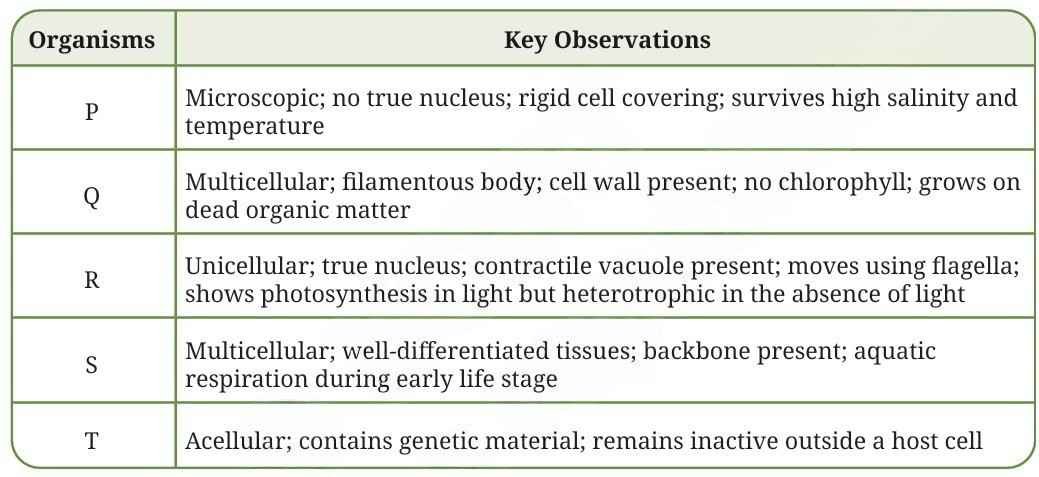
Answer:
| Organism | Key Features | Likely Group | Reason |
|---|---|---|---|
| P | Microscopic, no true nucleus, rigid covering, survives extreme conditions | Monera (Archaebacteria) | Prokaryotic, extremophile, no true nucleus. |
| Q | Multicellular, filamentous, cell wall, no chlorophyll, grows on dead matter | Fungi | Heterotrophic, saprophytic, cell wall present but no chlorophyll. |
| R | Unicellular, true nucleus, contractile vacuole, flagella, photosynthesis in light, heterotrophic in dark | Protista (Euglena‑like) | Unicellular eukaryote, dual nutrition, locomotion with flagella. |
| S | Multicellular, differentiated tissues, backbone, aquatic respiration in early stage | Chordata (Amphibia) | Vertebrate with backbone, amphibian traits (gills in early stage). |
| T | Acellular, genetic material, inactive outside host | Virus | Not cellular, parasitic, excluded from five kingdoms. |
Q27. The students realised that some organisms fit neatly into Whittaker’s five kingdom classification, while others challenged the very basis of this classification.
Based on the case study, answer the following questions —
- (i) Identify one organism that clearly belongs to the Kingdom Fungi. State one observation that supports your answer.
- (ii) Which organism would be placed in the Kingdom Monera? Mention one characteristic that justifies this placement.
- (iii) Organisms R and Q are both eukaryotic, yet they are placed in different kingdoms. Analyse the criteria that separate them.
- (iv) Explain why organism S cannot be classified using the mode of nutrition alone.
- (v) Organism T does not fit into any of the five kingdoms. Which fundamental characteristic used in classification does it lack and what does this reveal about the limitations of classification systems?
- (vi) If classification were based only on habitat, which organisms might be incorrectly grouped together? Explain the scientific consequences of such a classification.
- (vii) Imagine scientists discover a new organism that is multicellular, eukaryotic, lacks chlorophyll and absorbs nutrients from a host externally. Should it be placed under fungi or animalia? Justify your reasoning using classification criteria.
Answer:
(i) Kingdom Fungi
- Organism: Q
- Observation: Multicellular, filamentous body, cell wall present, no chlorophyll, grows on dead organic matter.
- This is typical of fungi (saprophytic nutrition).
(ii) Kingdom Monera
- Organism: P
- Characteristic: Microscopic, no true nucleus, rigid covering, survives extreme conditions.
- Prokaryotic cell structure places it in Monera (Archaebacteria).
(iii) R vs Q (both eukaryotic)
- R → Protista: unicellular, flagella, dual nutrition (photosynthesis + heterotrophy).
- Q → Fungi: multicellular, filamentous, heterotrophic by absorption.
Criteria: Body organisation (unicellular vs multicellular) and mode of nutrition.
(iv) Organism S
- Multicellular, backbone, aquatic respiration in early stage.
- Cannot be classified by nutrition alone because animals are all heterotrophic, but vertebrate features (backbone, tissues, respiration mode) place it in Chordata (Amphibia).
(v) Organism T
- Acellular, genetic material, inactive outside host.
- Lacks the cellular organisation fundamental to classification.
- Reveals: Limitations of classification systems — they cannot fully include entities like viruses.
(vi) Habitat‑based classification problem
- Example: R (Protista in pond water) and S (Amphibia in pond water) might be grouped together if only habitat is considered.
- Consequence: Misleading grouping, ignores structural and cellular differences, reduces scientific accuracy.
(vii) New organism (multicellular, eukaryotic, lacks chlorophyll, absorbs nutrients externally from host)
- Fits Fungi, not Animalia.
- Reason: Animals ingest food internally, while fungi absorb nutrients externally.
- Classification criteria: Mode of nutrition (absorptive heterotrophy) + cell wall presence (chitin).
Disclaimer: The content that is present on our website is based on the NCERT Class 9 Science textbook and is provided for educational purposes only. All the content and images have been taken from Science Class 9 NCERT Textbook and CBSE Support material. Images and content shown above are the property of individual organizations and are used here for reference purposes only. To make it easy to understand, some of the content and images are generated by AI and cross-checked by the teachers.