
← Back to Class 9 Science NCERT Solutions
Understanding Sound Waves Characteristics and Applications Class 9 NCERT Solutions helps students master important concepts covered in the latest NCERT Class 9 Science syllabus. These step-by-step solutions explain every question in simple language, making it easier to understand sound waves, their properties, reflection, applications, and numerical problems.
Sound Waves Characteristics and Applications Class 9 NCERT Solutions
Q1. Two astronauts are repairing the arm of a space station together during a spacewalk. Can they talk to each other and hear the sounds of metal clanking as they do on the Earth?
Answer: Sound needs air or another medium to travel. In space there is almost a vacuum (no air, no particles). Without a medium, sound waves cannot move from one person to another. That is why astronauts use special radios inside their suits to talk.
Q2. How do most bats use sound to locate their prey in the dark at night?
Answer: Bats use a special method called echolocation to find their prey at night.
- A bat makes a high‑pitched sound (like a squeak).
- This sound travels through the air and hits objects, like an insect.
- The sound then bounces back to the bat as an echo.
- By listening to the echo, the bat understands where the insect is, how far it is, and even how big it might be.
Q3. Explore various ways of producing sound.
Answer: Sound is produced when objects vibrate. Strings, membranes, air columns, vocal cords, and even animal body parts can vibrate to make sound.
- Vibrating strings: When you pluck a stretched rubber band or guitar string, it vibrates and produces sound.
- Vibrating membranes: In drums or tabla, the stretched skin (membrane) vibrates when struck, creating sound.
- Vibrating air columns: In flute or bansuri, blowing air makes the air inside the hollow pipe vibrate, producing sound.
- Vibrating objects: Metals like bells or tuning forks vibrate when struck, producing sound.
- Vocal cords: In humans and animals, tightly stretched vocal cords vibrate to produce sound when we talk or sing.
- Body parts in animals: Some animals like crickets and grasshoppers rub their wings or legs to make sound.
Q4. Make a list of different types of musical instruments and identify their vibrating parts which produce sound.
Answer: List of musical instruments and their vibrating parts that produce sound are:
- Guitar: The strings vibrate when plucked.
- Tabla/Drum: The stretched membrane (skin) vibrates when struck.
- Flute/Bansuri: The air column inside the pipe vibrates when blown.
- Tuning fork: The metal prongs vibrate when struck.
Q5. Assertion (A): We cannot hear the sound of a bell ringing in a closed jar after most of the air is pumped out.
Reason (R): Sound requires a medium to travel.
Choose the correct statement:
(i) Both A and R are true, but R is not the correct explanation of A.
(ii) Both A and R are true, and R is the correct explanation of A.
(iii) A is true, but R is false.
(iv) A is false, but R is true.
Answer: (ii) Both A and R are true, and R is the correct explanation of A.
Q6. Assertion (A): Compressions and rarefactions move through the medium.
Reason (R): Individual particles of the medium continuously move forward with the wave.
Choose the correct statement:
(i) Both A and R are true, but R is not the correct explanation of A.
(ii) Both A and R are true, and R is the correct explanation of A.
(iii) A is true, but R is false.
(iv) A is false, but R is true.
Answer: (iii) A is true, but R is false.
Q7. When sound travels from a tuning fork to your ear, which of the following actually reaches your ear?
(i) Air particles near the tuning fork
(ii) Energy carried by sound waves
(iii) The tuning fork material
(iv) A continuous stream of compressed air
Answer: (ii) Energy carried by sound waves
Explanation:
When a tuning fork vibrates, it makes the air around it vibrate too. These vibrations create compressions and rarefactions (sound waves). The energy of these sound waves travels through the air to your ear. The air particles themselves do not move all the way to your ear; they only vibrate back and forth in their own place. The tuning fork material also stays where it is.
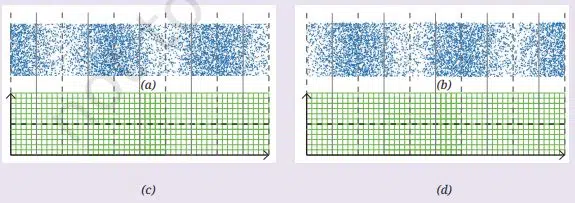
Q8. The variation of density of the medium for two sound waves is shown in Fig. (a) and (b). Label compression and rarefaction by C and R on it. In the graph given in Fig. (c) and (d), label the axes and draw the curves corresponding to Fig. (a) and (b).
Answer:
- In Fig. (a) and (b), the high‑density regions are called Compressions (C) and the low‑density regions are called Rarefactions (R). So you should mark the peaks as C and the valleys as R.
- In Fig. (c) and (d), the x‑axis should be labeled as Distance (or Time, depending on what is shown), and the y‑axis should be labeled as Density of the medium.
- The curves you draw in (c) and (d) should look similar to the wave patterns in (a) and (b), showing alternate compressions (C) and rarefactions (R).
Q9. Conduct Activity 10.1 once again with a thick rubber band and then with a thin rubber band. Does the thin rubber band vibrate faster than the thick rubber band? If yes, how do the frequency and time period of the sound produced by the thin rubber band differ from that of the thick rubber band?
Answer: Yes, the thin rubber band vibrates faster than the thick rubber band.
- A thin rubber band is lighter and can move quickly, so it vibrates faster.
- Faster vibration means it has a higher frequency (more oscillations per second).
- Since frequency and time period are opposites, a higher frequency means a shorter time period.
- A thick rubber band vibrates slower, so it has a lower frequency and a longer time period.
Q10. If the frequency of a sound wave produced by an oscillating piston of a long tube filled with air is 20 Hz, then how many oscillations does the piston complete per minute?
Answer: The piston completes 1200 oscillations per minute.
- Frequency means the number of oscillations per second.
- So, 20 Hz = 20 oscillations in 1 second.
- In 1 minute, there are 60 seconds.
- Therefore, oscillations in 1 minute = 20 × 60 = 1200
Q11. For the sound wave represented by the graph shown in Figure, what is half of its wavelength?
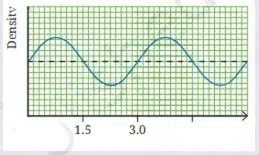
Answer: Half of the wavelength is 1.5 cm.
- The wavelength (λ) is the distance between two consecutive compressions (C) or two consecutive rarefactions (R).
- In the graph, one full wavelength is about 3.0 cm (from one crest to the next crest).
- Therefore, half of the wavelength = 3.0 ÷ 2 = 1.5 cm.
.
Q12. Table 10.1 shows the speed of sound in a few media at atmospheric pressure.
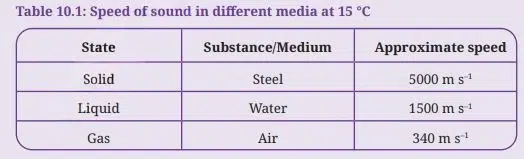
Answer: Speed of sound is highest in solids, lower in liquids, and lowest in gases.
- Sound travels fastest in solids because particles are packed closely and can pass vibrations quickly.
- It is slower in liquids like water.
- It is slowest in gases like air, because particles are far apart.
Q13. Compare the speeds in different media by finding the ratio of
(i) the speed of sound in water with respect to the speed in the air.
(ii) the speed of sound in steel with respect to the speed in the water.
Answer:
- Speed of sound in air = 340 m/s
- Speed of sound in water = 1500 m/s
- Speed of sound in steel = 5000 m/s
(i) Ratio of speed in water to air
\[ \text{Ratio} \;=\; \frac{\text{Speed in water}}{\text{Speed in air}} \;=\; \frac{1500}{340} \;\approx\; 4.4 \]So, sound travels about 4.4 times faster in water than in air.
(ii) Ratio of speed in steel to water
\[ \text{Ratio} \;=\; \frac{\text{Speed in steel}}{\text{Speed in water}} \;=\; \frac{5000}{1500} \;\approx\; 3.3 \]So, sound travels about 3.3 times faster in steel than in water.
Q14. Two friends are standing along a steel fence at a distance of 340 m from each other (Fig. 10.23). Gunjan places her ear over the fence and her friend knocks the fence with a metal object. Using the values of the speed of sound in steel and air given in Table 10.1, calculate the time difference between the sound that reached Gunjan through the air and the steel. Would it have been possible for her to distinguish between the two sounds? (The time interval between two sounds must be at least 0.1 s to be heard separately.)
Answer:
- Distance between friends = 340 m
- Speed of sound in air = 340 m/s
- Speed of sound in steel = 5000 m/s
Time taken through air
\[ t_{\text{air}} \;=\; \frac{\text{distance}}{\text{speed in air}} \;=\; \frac{340}{340} \;=\; 1 \;\text{second} \]Time taken through steel
\[ t_{\text{steel}} \;=\; \frac{\text{distance}}{\text{speed in steel}} \;=\; \frac{340}{5000} \;=\; 0.068 \;\text{seconds} \]Time difference
\[ \Delta t \;=\; t_{\text{air}} – t_{\text{steel}} \;=\; 1 – 0.068 \;=\; 0.932 \;\text{seconds} \]The time difference (0.932 s) is greater than 0.1 s, Gunjan will clearly hear two separate sounds — one through the steel first, and then through the air.
Q15. An experiment is being set up that requires echoes to arrive at least 0.2 s after the emission of sound. What minimum distance should a reflecting surface be placed at? Assume the speed of sound to be 343 m s–1.
Answer:
- Speed of sound in air = 343 m/s
- Minimum time delay required = 0.2 s
- For an echo, sound travels to the wall and back (so distance covered = 2 × distance to wall).
Formula
\[ t \;=\; \frac{2d}{v} \]where 𝑡 = time, 𝑑 = distance to wall, 𝑣 = speed of sound.
Calculation
\[ 0.2 \;=\; \frac{2d}{343} \]\[ d \;=\; \frac{343 \times 0.2}{2} \;=\; \frac{68.6}{2} \;=\; 34.3 \;\text{m} \]The reflecting surface must be placed at least 34.3 m away.
Q16. humans could detect ultrasonic waves like dogs can? What would be the advantages and disadvantages?
Answer: If humans could detect ultrasonic waves (like dogs do), here are the clear advantages and disadvantages:
Advantages
- Better communication: We could hear high‑frequency signals used by animals (like bats, dolphins, or dogs).
- Early detection: Ultrasonic alarms or devices could be heard directly, helping in safety and medical alerts.
- Improved sensing: We could detect tiny movements or vibrations that normal hearing misses.
Disadvantages
- Noise overload: Many machines (like TVs, computers, or insect repellents) emit ultrasonic sounds. Humans would constantly hear irritating high‑pitched noises.
- Health effects: Continuous exposure to ultrasonic waves might cause stress, headaches, or discomfort.
- Difficulty focusing: Everyday environments would feel “too noisy” because of hidden ultrasonic signals.
Q17. Sound travels much farther in water than light, and thus, is used for various underwater applications. A sonar signal sent to find the depth of ocean takes 4 s to return. What is the depth of the ocean at that location if the speed of sound in seawater is 1500 m s–1?
Answer:
- Speed of sound in seawater = 1500 m/s
- Total time for the sonar signal to go down and come back = 4 s
- In echo problems, the sound travels twice the depth (down + up).
Formula
\[ t \;=\; \frac{2d}{v} \]where 𝑡 = time, 𝑑 = depth, 𝑣 = speed of sound.
Calculation
\[ 4 \;=\; \frac{2d}{1500} \]\[ d \;=\; \frac{1500 \times 4}{2} \;=\; 3000 \;\text{m} \]The depth of the ocean at that location is 3000 m.
Q18. Which observation best supports the idea that sound is a mechanical wave?
(i) Sound shows reflection
(ii) Sound needs a medium to propagate
(iii) Sound has frequency
(iv) Sound carries energy
Answer: (ii) Sound needs a medium to propagate
Q19. For a sound wave propagating in a medium, increasing its frequency will increase its
(i) wavelength
(ii) speed
(iii) number of compressions per second
(iv) time period
Answer: (iii) number of compressions per second
Q30. If 20 compressions pass a point in 4 seconds, the frequency is
(i) 80 Hz
(ii) 5 Hz
(iii) 10 Hz
(iv) 0.2 Hz
Answer:
Given:
- 20 compressions pass a point in 4 seconds.
Step‑by‑step:
- Frequency = Number of oscillations (compressions) per second.
The frequency is 5 Hz → Option (ii).
Q31. In a room, the reflected sound reaches the ear 0.05 s after its production. Will it produce an echo or reverberation? Justify your answer.
Answer: For echoes, the key condition is that the reflected sound must reach the ear at least 0.1 s later than the original sound to be heard separately.
- In this case, the reflected sound reaches after 0.05 s.
- Since 0.05 s < 0.1 s, the reflected sound will not be heard as a separate echo.
- Instead, it will mix with the original sound, producing reverberation.
The sound will produce reverberation, not an echo, because the time interval (0.05 s) is too short to distinguish the two sounds separately.
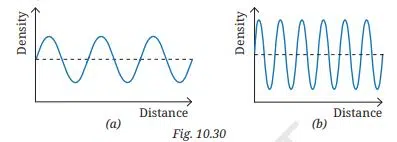
Q32. Graphs representing two sound waves are given in Fig. 10.30. If the scales on the X and Y axes of the two graphs are the same, which of the two sound waves has (i) greater wavelength, and (ii) smaller amplitude?
Answer:
Wavelength is the distance between two consecutive compressions (or rarefactions).
- In graph (a), the wave has fewer oscillations spread over the same distance → longer wavelength.
- In graph (b), the wave has more oscillations packed in → shorter wavelength.
Amplitude is the maximum displacement from the mean density line.
- In graph (a), the peaks are taller → greater amplitude.
- In graph (b), the peaks are smaller → smaller amplitude.
Final Answer:
- (i) Graph (a) has greater wavelength.
- (ii) Graph (b) has smaller amplitude.
Q33. The sound waves emitted by three sources A, B and C are represented in Fig. 10.31. If the frequency of A is maximum and C is minimum, identify the corresponding curves, and mark A, B and C on them.
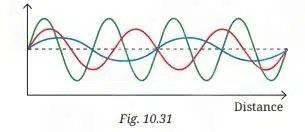
Answer:
- Red curve: A (maximum frequency)
- Green curve: B (medium frequency)
- Blue curve: C (minimum frequency)
Frequency means the number of oscillations per second. On the graph, higher frequency = more waves packed in the same distance.
- A (maximum frequency): The curve with the most oscillations (shortest wavelength).
- C (minimum frequency): The curve with the fewest oscillations (longest wavelength).
- B (medium frequency): The curve in between.
Q34. Draw a graph to represent a sound wave for which the density amplitude is 3 units and wavelength is 4 cm.
Answer:
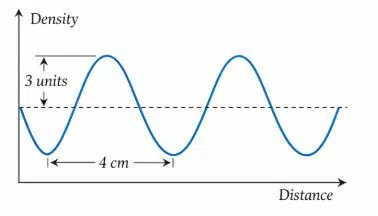
Q35. In a movie, while showing the explosion of a spacecraft in space, a flash of light is shown along with sound at the same time. What are the errors in this depiction?
Answer: In space, you would only see the flash of light, not hear any sound — because sound needs air to travel.
Sound cannot travel in space:
- Sound is a mechanical wave.
- It needs particles (like air or water) to vibrate and carry energy.
- Space is a vacuum, meaning there are no particles — so sound cannot travel there.
- You could see the explosion, but you would not hear it.
Light and sound do not arrive together:
- Light travels much faster than sound.
- Even on Earth, you see lightning before you hear thunder.
- So showing both flash and sound at the same time is incorrect.
Q36. A source produces a sound wave of wavelength 3.44 m. If the wave travels with a speed of 344 m s–1 find its time period.
Answer:
Given:
- Wavelength 𝜆 = 3.44m
- Speed of sound 𝑣 = 344m/s
Step 1: Use the formula
𝑣 = 𝜆 × 𝑓
where 𝑓 = frequency.
\[ f = \frac{v}{\lambda} = \frac{344}{3.44} = 100 \ \text{Hz} \]Step 2: Find the time period
\[ T \;=\; \frac{1}{f} \;=\; \frac{1}{100} \;=\; 0.01 \;\text{s} \]- Frequency = 100 Hz
- Time period = 0.01 s
Q37. A ship searching for a sunken ship sent a sonar signal and detected an echo after 5 s. If ultrasonic wave travels at 1525 m s–1 in seawater, approximately how far down in the ocean is the wreckage of the sunken ship located?
Answer:
- Speed of ultrasonic wave in seawater = 1525 m/s
- Total time for echo (down + back) = 5 s
Formula
\[ t \;=\; \frac{2d}{v} \]where 𝑡 = time, 𝑑 = depth, 𝑣 = speed.
Calculation
\[ 5 \;=\; \frac{2d}{1525} \]\[ d \;=\; \frac{1525 \times 5}{2} \;=\; \frac{7625}{2} \;=\; 3812.5 \;\text{m} \]The wreckage is located at a depth of about 3812.5 m (≈ 3.8 km).
Q38. A vehicle is fitted with an ultrasonic distance sensor as part of parking assistance system which provides echolocation, while the driver is reversing the vehicle. It emits ultrasonic wave (about 40 kHz) which is reflected by the obstacle. When the warning beep starts sounding at a distance of 1.2 m from the obstacle, how much time is taken by ultrasonic wave to travel to the obstacle and come back? Assume the speed of ultrasonic wave in air to be 345 m s–1.
Answer:
- Distance to obstacle = 1.2 m
- The ultrasonic wave travels to the obstacle and back → total distance = 2 × 1.2 = 2.4m
- Speed of ultrasonic wave in air = 345 m/s
Formula
\[ t \;=\; \frac{\text{distance}}{\text{speed}} \]Calculation
\[ t \;=\; \frac{2.4}{345} \;\approx\; 0.00696 \;\text{s} \]That is about 0.007 seconds (7 milliseconds).
The ultrasonic wave takes about 0.007 s to travel to the obstacle and return.
Q39. The speed of sound in air is about 331 m s–1 at 0 ºC and nearly 344 m s–1 at 22 ºC. Roughly how much extra time will the sound of thunder take to travel a distance of 1720 m, if the air temperature changes from 22 ºC to 0 ºC? Assume that all other conditions remain unchanged.
Answer:
- Distance = 1720 m
- Speed of sound at 22 ºC = 344 m/s
- Speed of sound at 0 ºC = 331 m/s
Step 1: Time at 22 ºC
\[ t_{22} \;=\; \frac{1720}{344} \;\approx\; 5 \;\text{s} \]Step 2: Time at 0 ºC
\[ t_{0} \;=\; \frac{1720}{331} \;\approx\; 5.2 \;\text{s} \]Step 3: Extra time
\[ \Delta t \;=\; t_{0} – t_{22} \;=\; 5.2 – 5.0 \;=\; 0.2 \;\text{s} \]The sound of thunder will take about 0.2 seconds extra to reach when the air temperature drops from 22 ºC to 0 ºC.
Q40. The variation of density of medium for a sound wave propagating with a speed of 340 m s–1 is shown in Fig. 10.32. Calculate the wavelength and frequency of the sound wave.
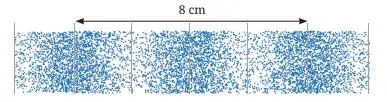
Answer:
- Speed of sound wave 𝑣 = 340 m/s
- From Fig. 10.32, the distance between two consecutive compressions (or rarefactions) is given as 8 cm = 0.08 m.
- That distance is the wavelength 𝜆.
Step 1: Wavelength
- 𝜆 = 0.08m
Step 2: Frequency
Formula:
\[ f \;=\; \frac{v}{\lambda} \;=\; \frac{340}{0.08} \;=\; 4250 \;\text{Hz} \]- Wavelength = 0.08 m (8 cm)
- Frequency = 4250 Hz
Q41. The graphical representation of two sound waves A and B propagating at the same speed of 345 m s–1 is shown in Fig. 10.33. What is the wavelength of each of them? Also, calculate their frequencies.
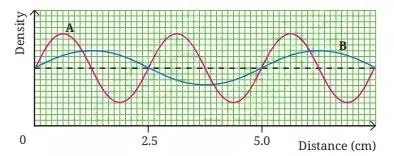
Answer:
- Speed of sound waves 𝑣 = 345 m/s.
- Two waves, A (red) and B (blue), are shown with different wavelengths but same speed.
Step 1: Identify wavelength from graph
From the figure, the distance between two consecutive compressions/crests gives the wavelength.
Suppose:
- For wave A (red), the wavelength is about 3 cm = 0.03 m.
- For wave B (blue), the wavelength is about 6 cm = 0.06 m.
Step 2: Use formula
\[ f \;=\; \frac{v}{\lambda} \]For wave A:
\[ f_{A} \;=\; \frac{345}{0.03} \;\approx\; 11500 \;\text{Hz} \]For wave B:
\[ f_{B} \;=\; \frac{345}{0.06} \;\approx\; 5750 \;\text{Hz} \]- Wavelength of A = 0.03 m (3 cm), Frequency = 11,500 Hz
- Wavelength of B = 0.06 m (6 cm), Frequency = 5750 Hz
Q42. Two identical sound sources are placed at A and B — one in air and one submerged in water (Fig. 10.34). Both produce sounds at the same time, which travel horizontally to the vertical side of the cliff and come back. If the time taken by the sound to return to A is 4.5 times than that of B, what is the ratio between the speeds of sound in air and water?
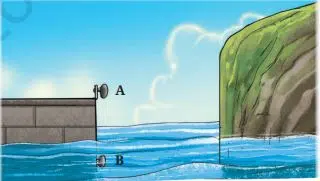
Answer:
- Two identical sound sources at A (air) and B (water).
- Both send sound to the cliff and back.
- Time taken by sound in air = 4.5 times the time taken in water.
- Speed of sound in air = Vair speed in water = Vwater
Step 1: Relation between time and speed
For the same distance 𝑑:
\[ t \;=\; \frac{2d}{v} \]So,
\[ t_{\text{air}} \cdot t_{\text{water}} \;=\; \frac{v_{\text{water}}}{v_{\text{air}}} \]Step 2: Use given ratio
\[ t_{\text{air}} \cdot t_{\text{water}} \;=\; \frac{v_{\text{water}}}{v_{\text{air}}} \;=\; 4.5 \]Step 3: Final ratio
\[ v_{\text{air}} : v_{\text{water}} \;=\; 1 : 4.5 \]The ratio of speeds of sound in air to water is 1 : 4.5.
Disclaimer: The content that is present on our website is based on the NCERT Class 9 Science textbook and is provided for educational purposes only. All the content and images have been taken from Science Class 9 NCERT Textbook and CBSE Support material. Images and content shown above are the property of individual organizations and are used here for reference purposes only. To make it easy to understand, some of the content and images are generated by AI and cross-checked by the teachers.