
Get The Invisible Living World Class 8 Notes with easy explanations, short summaries, key points, important definitions, and exam questions. These notes are perfect for quick revision and better exam preparation.
The Invisible Living World Class 8 Notes
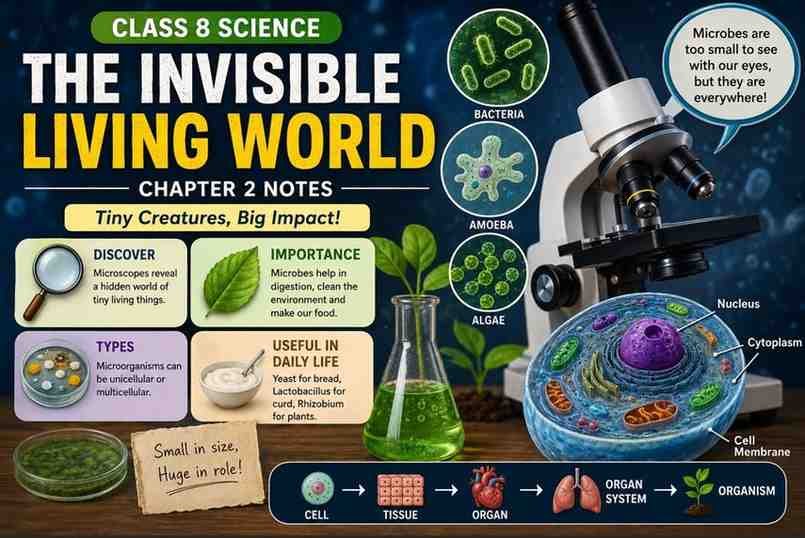
Our eyes can only see objects that are big enough. People discovered curved glass, which is called a lens. This lens helps to see small things as big. Later the microscopes were discovered, and they showed a hidden world of tiny living creatures.
All the living things, big or small, are called organisms. Some organisms can be seen with the naked eye, and some need lenses or microscopes. The reading glasses and magnifying glasses are examples of how lenses help us to see better.
Ever heard of …
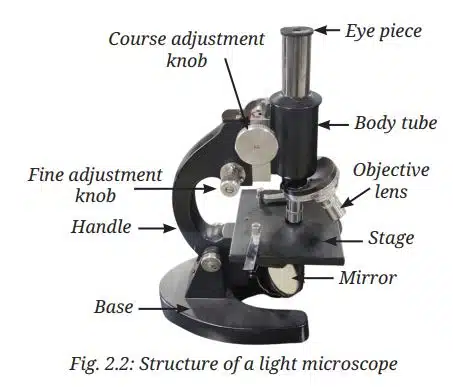
In 1665, Robert Hooke published a book called Micrographia. He used a microscope, which helps to see the tiny things 200 – 300 times bigger. When he looked at cork, he saw tiny empty spaces like a honeycomb. He called them cells. This was the first time the “cell” was used in science.

Around the same time, Antonie van Leeuwenhoek, a Dutch scientist, made better lenses and microscopes. The first time he saw clearly tiny living things like bacteria and blood cells. That’s why he is called a Father of Microbiology.
What Is a Cell?
The cell is a basic unit of life. All living beings are made of cells. To see them, we use a microscope. The cell has three main parts. The outer layer is called the cell membrane. The round structure in the middle is the nucleus, which is also covered by a thin membrane.
The space between the cell membrane and nucleus is filled with cytoplasm. These three—cell membrane, cytoplasm, and nucleus—are the basic parts of a cell. Some cells, like onion peel cells, have an extra outer layer called the cell wall.

The plant and animal cells differ in shape and structure.
The plant cells have tiny rod-shaped structures called plastids. Some plastids, like chloroplasts, contain chlorophyll, which makes the plants green and helps in photosynthesis. Other plastids store food and substances in non-green parts of plants.
Plant cells also have a large space called a vacuole. This vacuole helps to store important materials, remove waste and keep the cell firm. It also gives strength and support to the plant.
In animal cells, vacuoles are absent or very small. These small vacuoles only store substances dissolved in water.
Variation in shape and structure of cells
Cells have different shapes because they do different jobs.
- Muscle cells are spindle-shaped. Their shape helps them to move food in the food pipe and churn food in the stomach.
- Nerve cells are long with branches. Their shape helps them to carry messages quickly to all the parts of the body.

Other cells, like cheek cells, are thin and flat. They make a protective lining inside the mouth. Plant cells can be rectangular, oval or tube-like. Tube-like cells help to carry water through the plant.
What Are the Levels of Organisation in the Body of a Living Organism?
The body of a living organism is organised in a complex way.
- Cell: The smallest unit of life. Like a brick in a wall.
- Tissue: Many similar cells join together to make tissue.
- Organ: Different tissues combine to make one organ (like heart, lungs, and leaf).
- Organ system: Many organs work together for a big job (like digestion or breathing).
- Organism: All organ systems together make a complete living being (like a plant or an animal).
Cell → Tissue → Organ → Organ system → Organism

Ever heard of …
The yolk (the yellow part of an egg) of an ostrich egg is a single cell. It is the largest cell in the living world. The size is about 130 mm to 170 mm wide.

What Are Microorganisms?
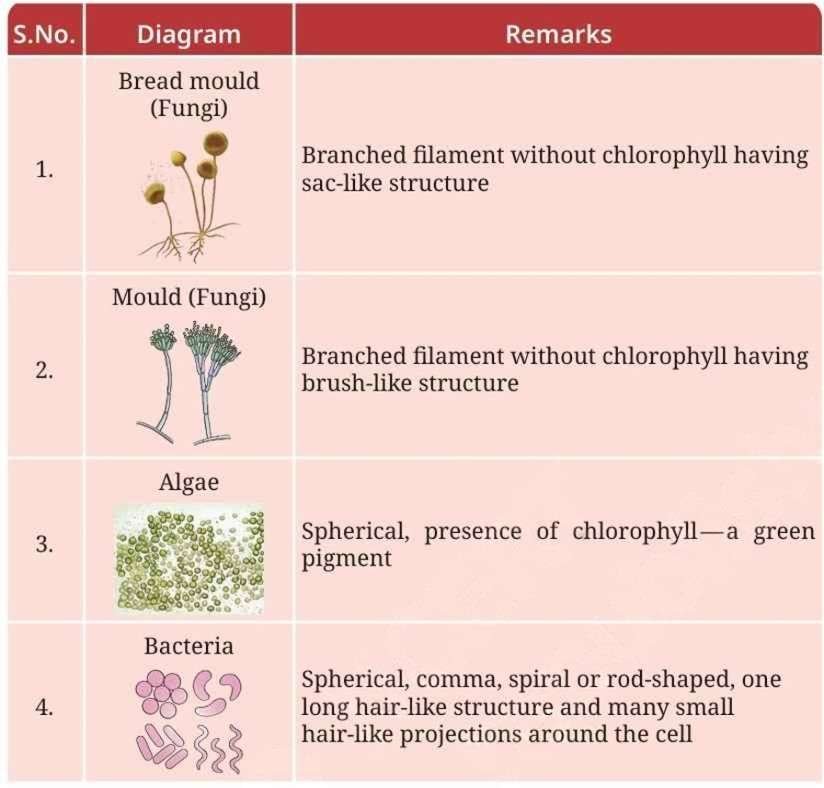
Some of the living things are made of just one cell or very few cells. They are so small that they can not be seen with the naked eye. These are called microorganisms. Some microorganisms, like bacteria and amoeba, are made of just one cell (unicellular). Others, like some fungi and algae, have many cells (multicellular).
Types of Microorganisms
- Unicellular: Unicellular organisms have only one cell, like bacteria and amoeba.
- Multicellular: Multicellular organisms have multiple cells, like fungi and algae.
Organisms present in pond water

Organisms present in soil suspension
How Are We Connected to Microbes?
Microbes live everywhere: in the water, soil, air, food and even inside our bodies. When food like lemon, tomato or orange is left outside, microbes grow on it. That’s why you see powder or cotton-like growth on rotten fruits.

Why Pickles Don’t Rot
Pickles and murabbas have salt and sugar, because high salt or sugar helps to prevent growing microbes. These acts are known as preservatives.
Diversity of Microbes
These microbes are found in extreme places like hot springs and snow and normal conditions. They live inside our gut and help in digestion. The microbes come in different shapes, like spherical, rod-shaped, irregular, etc.
How do microbes help us?
Microbes break down the waste material. They help the plants to grow, animals to digest food and humans to stay healthy.
Key players in cleaning the environment
If you will put fruit and vegetable peels in the soil, then they will change into dark manure. This happens because microbes break down the waste. This manure is rich in nutrients and makes soil fertile. This process is called decomposition. Microbes also decompose the dead animals.
Microbes and Biogas
Some microbes live without oxygen. They help to decompose plant and animal waste. During the process of decomposition, they release biogas, mainly methane and carbon dioxide. This biogas can be used for cooking, heating, electricity and even vehicles.
Scientist Example: Ananda Mohan Chakrabarty made a special bacterium in 1971. This bacteria can break down oil spills and clean pollution. He got a patent in 1980 for his discovery.
Microbes in the Kitchen
There are some microbes which are used in kitchens, like yeast. Yeast is a fungus and is used in bread and cakes. The yeast releases carbon dioxide bubbles; because of this, the dough becomes soft and fluffy. Yeast can also make a little alcohol and gives off a smell.
Some of the other microbes, like Lactobacillus, help ferment batter for idli, dosa and bhatura. Lactobacillus is also used when we want to make curd. The lactobacillus eats the sugar in milk (lactose) and changes it into lactic acid. Lactic acid makes the milk sour and thick. This bacteria grows well in warm conditions.
Helpful Bacteria in Plants
Some bacteria, like Rhizohium, live in root nodules of legumes like beans, peas and lentils. They help to trap nitrogen from the air and make it useful for plants. They help the plant to grow better without chemical fertilisers. That’s why farmers grow legumes in rotation with other crops; soil gets more nitrogen naturally.

Amazing microalgae: tiny helpers in water
What Are Microalgae?
Microalgae are tiny plant-like organisms. They live in water, soil and even on trees. They make their own food using sunlight, like plants. Microalgae release oxygen in the time of the food-making process; half of the earth’s oxygen comes from them.
Why Are They Important?
- They are rich in nutrients.
- They are food for many aquatic animals.
- Some microalgae, like spirulina, chlorella and diatoms, are used by humans as health supplements and in medicines.
- They help to clean water.
- They are used to make a biofuel.
Why Is a Cell Considered to Be a Basic Unit of Life?
All the living things are made of cells. A cell is the smallest building block of life. Every cell has important jobs like breathing, eating, waste removal, etc.
Multicellular Organisms
Plants and animals that have many cells are called multicellular organisms. Different cells do special jobs, like muscle cells help in movement, nerve cells carry messages, etc. Cells work together to keep the organism alive.
Unicellular Organisms
Some microbes, like bacteria and protozoa, have only one cell, which are called unicellular organisms. This cell can do all the jobs needed for survival.
To see cell parts clearly, we used a microscope. An electron microscope can magnify a cell up to 1,000,000 times.
Disclaimer: The content that is present on our website is based on the NCERT Class 8 Science textbook and is provided for educational purposes only. All the content and images have been taken from Science Class 8 NCERT Textbook. Images and content shown above are the property of individual organizations and are used here for reference purposes only. To make it easy to understand, some of the content and images are generated by AI and cross-checked by the teachers.