
← Back to Class 9 Science NCERT Solutions
Tissues in Action Class 9 NCERT Solutions provides accurate and easy-to-understand answers to all textbook questions. These solutions help students understand the structure and functions of plant and animal tissues, improve conceptual knowledge, and prepare effectively for exams.
Tissues in Action Class 9 NCERT Solutions
1. Meristematic tissues divide repeatedly. What property of their cells allows them to do this?
- (i) They have thick walls for protection.
- (ii) They contain large vacuoles that store nutrients.
- (iii) They have thin walls, dense cytoplasm, and a large, prominent nucleus.
- (iv) They are functionally differentiated cells.
Answer: (iii) They have thin walls, dense cytoplasm, and a large, prominent nucleus.
Explanation: Meristematic cells have thin walls, dense cytoplasm and big nucleus which make cells active and divide repeatedly.
2. If a plant is unable to transport food from leaves to roots, which tissue is malfunctioning?
- (i) Xylem
- (ii) Phloem
- (iii) Epidermis
- (iv) Sclerenchyma
Answer: (ii) Phloem
Explanation: Phloem carries food and transports this food to leaves and other parts of the plant. If phloem fails, roots and stems cannot get food. Xylem transports water, not food.
3. Why are the epithelial tissues that line an animal’s internal organs usually only one or a few cells thick?
- (i) To store food efficiently.
- (ii) To provide maximum strength.
- (iii) To allow quick exchange of materials across them.
- (iv) To reduce friction.
Answer: (iii) To allow quick exchange of materials across them.
Explanation: The thin layers make diffusion easy; for example, the lining of lungs allows gases to exchange quickly. If thick, then the exchange would be slow.
4. You can perform these two jumps:
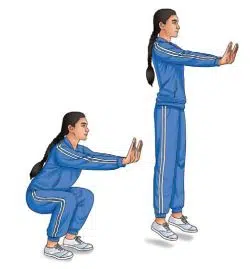
- Straight-leg jump — keep knees and ankles stiff.
- Normal jump—bend knees and ankles naturally.
- How did your ankle, knee, and hip positions differ between the two jumps?
Answer:
In a straight-leg jump—
- The ankles remained stiff, with no bending.
- The knees were locked, straight, and without movement.
- The hips are also stiff and less flexible.
- As a result, the jump feels hard, less springy, and can strain joints.
Normal jump
- The ankles bend naturally and absorb shock.
- The knees bend and straighten, giving bounce.
- The hips bend slightly and add flexibility.
- As a result, the jump is smoother, higher, and safer because joints act like shock absorbers.
5. Which type of joint is involved when you bend your knees and ankles?
- (i) Ball and socket
- (ii) Hinge
- (iii) Pivot
Answer: (ii) Hinge
Explanation: The hinge joints allow movement in one direction only, just like opening and closing a door. Your knees and ankles bend and straighten in this way.
6. In each of the following cases (A, B, C, and D), choose the correct option as given below:
A. Assertion: Epithelium is well-suited for gas exchange in the lungs.
Reason: It consists of multiple layers of tall cells that slow down diffusion.
(i) Both (A) and (R) are true, and (R) is the correct explanation of (A).
(ii) Both (A) and (R) are true, but (R) is not the correct explanation of (A).
(iii) (A) is true, but (R) is false.
(iv) (A) is false, but (R) is true.
Answer: (iii) (A) is true, but (R) is false.
Explanation: Epithelium in lungs → thin, single layer → fast gas exchange.
B. Assertion: Cardiac muscle can contract continuously without fatigue.
Reason: Cardiac muscle cells have a high number of mitochondria and an abundant blood supply.
(i) Both (A) and (R) are true, and (R) is the correct explanation of (A).
(ii) Both (A) and (R) are true, but (R) is not the correct explanation of (A).
(iii) (A) is true, but (R) is false.
(iv) (A) is false, but (R) is true.
Answer: (i) Both (A) and (R) are true, and (R) is the correct explanation of (A).
Explanation: Cardiac muscle → many mitochondria + blood supply → contracts non‑stop.
C. Assertion: Tendons connect bone to bone and allow joint movement.
Reason: Tendons are made of tough connective tissue that transmits force from muscle to bone.
(i) Both (A) and (R) are true, and (R) is the correct explanation of (A).
(ii) Both (A) and (R) are true, but (R) is not the correct explanation of (A).
(iii) (A) is true, but (R) is false.
(iv) (A) is false, but (R) is true.
Answer: (iv) (A) is false, but (R) is true.
Explanation: Tendons → Connect muscle to bone, not bone to bone.
D. Assertion: In a hinge joint, movement occurs primarily in one plane.
Reason: The bone ends are shaped to allow sliding in all directions.
(i) Both (A) and (R) are true, and (R) is the correct explanation of (A).
(ii) Both (A) and (R) are true, but (R) is not the correct explanation of (A).
(iii) (A) is true, but (R) is false.
(iv) (A) is false, but (R) is true.
Answer: (iii) (A) is true, but (R) is false.
Explanation: Hinge joint → Moves in one plane only, like a door.
7. Plot a graph between the age of a tree (in years) on the x-axis and the diameter of the tree (in cm) along with the number of annual rings formed over time on the y-axis, using the data given in Table.
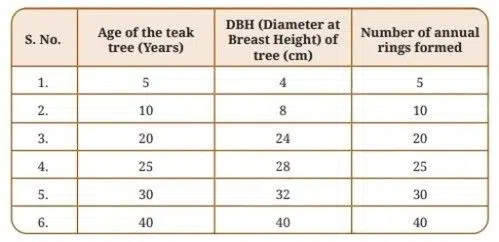
Table: Data related to the age of a teak tree and the corresponding increase in the diameter of the stem and number of annual rings
- (i) Analyse the graph in terms of the diameter of the stem over time and share the interpretation.
- (ii) What is the relation between the diameter of the teak tree and the annual rings formed?
- (iii) Which specialised tissue is responsible for the girth of the stem, and where is it located?
Answer:
(i) Graph Analysis—Diameter vs. Age
When the age increases, then the diameter of the stem also increases. At first, the growth is slow. Later, growth becomes faster. After 25 years, growth is steady but slower.
Interpretation: The tree grows quickly in middle age, then stabilizes as it gets older.
(ii) Relation between Diameter and Annual Rings
Each annual ring is equal to 1 year of growth. The number of rings always equals the age of the tree. When the rings increase, the diameter also increases. So, diameter is directly related to the number of annual rings.
(iii) Specialized Tissue Responsible for
The tissue lateral meristem is also known as the cambium. It is located along the circumference of the stem. These cells divide and add new layers inside and outside the stem girth increase. That way we see annual rings in tree trunks.
8. In a forest, it was observed that one of the trees was severely debarked by an elephant to meet its food requirements, as the bark is a rich source of nutrients (Fig.). Based on your learning, answer the following:
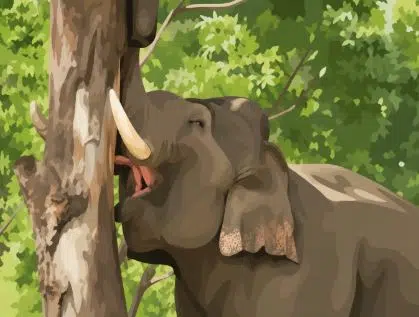
- (i) Which function(s) of the tree is/are hampered by debarking?
- (ii) Which plant tissue would be affected by further damage to the tree trunk even after debarking?
- (iii) Which function of the tree would be hampered if the tissues beneath the bark were severely damaged?
- (iv) What assumptions are you making to answer the questions above? How would the answer change if your assumptions were also changed?
Answer:
(i) Functions hampered by debarking
Bark contains phloem, which transports food from leaves to roots. If bark is removed, then the food transport will be stopped. Because of the tree, it will not be able to send sugars to roots, and roots become weakened, and the tree may die.
(ii) Tissue affected by further trunk damage
Beneath bark lies the lateral meristem (cambium). If it is damaged, then the tree cannot increase girth or repair itself, and xylem (water transport) may be harmed, and the water supply will stop.
(iii) Function hampered if tissues beneath bark are damaged
If there is phloem damage, then food transport will be blocked. If there is xylem damage, then water transport will be blocked. Both will stop the nutritional and water supply, which leads to tree death.
(iv) Assumptions made
Suppose the bark includes food transport tissue (phloem) and a protective layer (cork). If bark is removed, then the food transport will stop, and the root will not transport the sugars (food) to the leaves, and then the tree will become weakened.
Suppose we assume “bark” means only the protective layer (cork). If we remove bark, the protection is lost, and the tree is exposed to injury, infection, and water loss. But his food transport continues.
But in reality, debarking usually removes phloem and cambium, so both transport and growth are affected.
9. Aamrapali observed that a young mango sapling’s stem bends flexibly during monsoon winds and does not break. Which tissue is responsible for this flexibility? Predict and provide your explanation of the impact if the existing tissue were replaced by sclerenchyma.
Answer:
Why does the sapling bend without breaking?
The stem bends because of collenchyma tissue. Collenchyma cells have walls thick only at the corners. They are living cells with pectin, which means a flexible material. This gives the stem strength and flexibility; it helps to bend in the wind but does not snap.
What if collenchyma is replaced by sclerenchyma?
Sclerenchyma cells are dead, hard, and fully lignified, which means “woody.” They provide rigidity, not flexibility. If collenchyma were replaced by sclerenchyma,
- The stem would become stiff and brittle.
- In strong winds, instead of bending, the stem would break easily.
10. Sohan designed an experiment for the regeneration of sugarcane, where he used cuttings to grow sugarcane. He used two types of cuttings, type ‘A’ and type ‘B’ (Fig). After a few weeks, type ‘B’ cuttings sprouted and developed into sugarcane plants, whereas the type ‘A’ cuttings did not sprout.
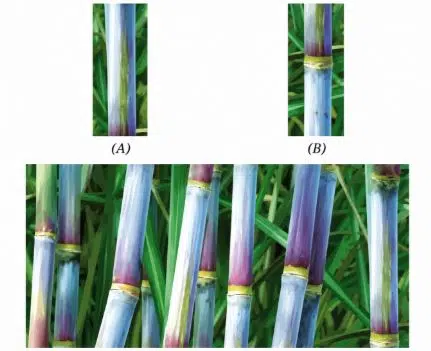
- (i) Why were the type ‘B’ cuttings able to grow as sugarcane, but type ‘A’ could not?
- (ii) What difference was present in type ‘B’ compared to type ‘A’?
- (iii) What observation or measurement was made to determine whether this change had an effect?
- (iv) What parameters should be kept the same for both types of cuttings to ensure a fair comparison?
Answer:
(i) Why type ‘B’ cuttings grew but type ‘A’ did not
Type B cuttings had a node, which means the part of the stem where buds and leaves arise. This node contains an intercalary meristem, whose actively dividing cells help to regenerate it. Type A cutting lacked a node, so no new shoots could form and no growth would occur.
(ii) Difference between type ‘B’ and type ‘A’
- Type B = cutting with a node.
- Type A = cutting without a node.
The presence of a node made the difference.
(iii) Observation/measurement made
After a few weeks, type B sprouted new shoots and roots, but type A showed no sprouting. The observation was whether new plants developed from the cuttings.
(iv) Parameters to keep the same for fair comparison
To ensure fairness, both the cuttings should have the following:
- Same length of stem piece
- Same soil type and nutrients.
- Same water supply
- Same light and temperature conditions.
- Only the presence and absence of a node should be different.
11. During the discussion in class, Rohan gives a statement that “a tissue is a group of similar cells performing similar functions.” But Rajiv counters that “this is true in the case of simple tissues but a little different in the case of complex tissues.” Provide your explanation in view of the discussion in class.
Answer: Rohan said, “A tissue is a group of similar cells performing similar functions.” This is true for simple tissues. For example,
- Parenchyma: all cells look alike and store food.
- Collenchyma: all cells look alike and give flexibility.
- Sclerenchyma: all cells look alike and give hardness.
In simple tissues cells are of the same type and have the same work.
Rajiv said, “This is true in the case of simple tissues but a little different in the case of complex tissues.” It is correct because complex tissues are made of different types of cells. For example,
- Xylem: has tracheids, vessels, fibers, and parenchyma. Together they carry water.
- Phloem: has sieve tubes, companion cells, fibers, and parenchyma. Together they carry food.
In complex tissues cells are different types but work together for one function.
12. Coconut husk fibers are used for mats, which are tough and fibrous. Which tissue has structural features suitable for providing this strength? Explain why living parenchyma couldn’t serve the same purpose.
Answer:
Which tissue provides strength?
The fibers in coconut husk are made of sclerenchyma, which have very thick walls with lignin, meaning a hard substance. These cells are dead but extremely strong and rigid. Because of this, the mats made from husk fibers are tough and durable.
Parenchyma cells are living with thin walls. They are soft and mainly used for storage of food and water. They cannot provide the hardness and toughness needed for mats. If husk fibers were parenchyma, mats would be soft and weak.
13. Vibha claims to her friend Neha that “meristematic cells are located only at the root and shoot apices.” What do you think about this statement? What question can Neha ask Vibha to help her understand further if the statement is incorrect?
Answer: Vibha said, “Meristematic cells are located only at the root and shoot apices.” This is partly correct because at the tips of roots and shoots there are apical meristems, which help the plant to grow longer, but meristematic cells are of three types:
- Apical meristem: at tips of roots and shoots, helps in length growth.
- Lateral meristem: along the sides of the stem, helps in girth growth.
- Intercalary meristem: at nodes or base of leaves, helps in regrowth (e.g., sugarcane).
So, meristematic cells are not only at apices but also at stem sides and nodes.
What question can Neha ask Vibha?
Neha can ask: “If meristematic cells are only at apices, then how does a tree stem increase in thickness or how does sugarcane regrow from its nodes?”
This question will help Vibha realize that lateral meristems and intercalary meristems also exist.
14. A plant cell and an animal cell are of the same size.
- (i) Which cell will have a larger vacuole? Give reasons.
- (ii) What assumptions are you making to answer the question above?
Answer:
(i) Which cell will have a larger vacuole?
The plant cell has a larger vacuole because the plant cell has a single large central vacuole. It stores water and minerals and maintains turgor pressure, which keeps the cell firm. Animal cells have many small vacuoles, not one big one. So, even if both cells are the same size and the plant cell vacuole is much larger.
(ii) Assumptions made
- Assumption: Both cells are healthy and mature.
- Assumption: Plant cell has its typical structure (cell wall + large vacuole).
- Assumption: An animal cell has small vacuoles only, not a central vacuole.
If assumptions change, then the answer could differ.
15. A textbook states, “Each plant tissue performs only one specific function.” What questions would you ask to critically examine the correctness of this statement? What examples of tissues would you take to find out the answers to these questions?
Answer:
Statement to examine
“Each plant tissue performs only one specific function.”
This statement is not fully correct. Some of the tissues mainly do one job, but many also have additional roles.
Questions to ask critically
Does every tissue really have only one role, or can some do more than one?
Examples to test the statement
- Parenchyma: The main job is to store food and water but also helps in photosynthesis (chlorenchyma) and buoyancy (aerenchyma).
- Collenchyma: The main job is to support young stems but also allows flexibility.
- Sclerenchyma: The main job is rigidity and hardness but also protection (seed coats, husks).
- Xylem: The main job is to carry water from roots to leaves but also provides mechanical strength.
- Phloem: The main job is to carry food from leaves to other parts, but it also stores substances and supports tissue.
Disclaimer: The content that is present on our website is based on the NCERT Class 9 Science textbook and is provided for educational purposes only. All the content and images have been taken from Science Class 9 NCERT Textbook and CBSE Support material. Images and content shown above are the property of individual organizations and are used here for reference purposes only. To make it easy to understand, some of the content and images are generated by AI and cross-checked by the teachers.