
← Back to Class 8 English Poorvi
Read the Verghese Kurien – I Too Had a Dream Class 8 Summary in simple and easy-to-understand language. This summary explains the life, work, achievements, and vision of Dr. Verghese Kurien, known as the Father of the White Revolution in India. It helps students understand the chapter easily and is useful for quick revision and exam preparation.
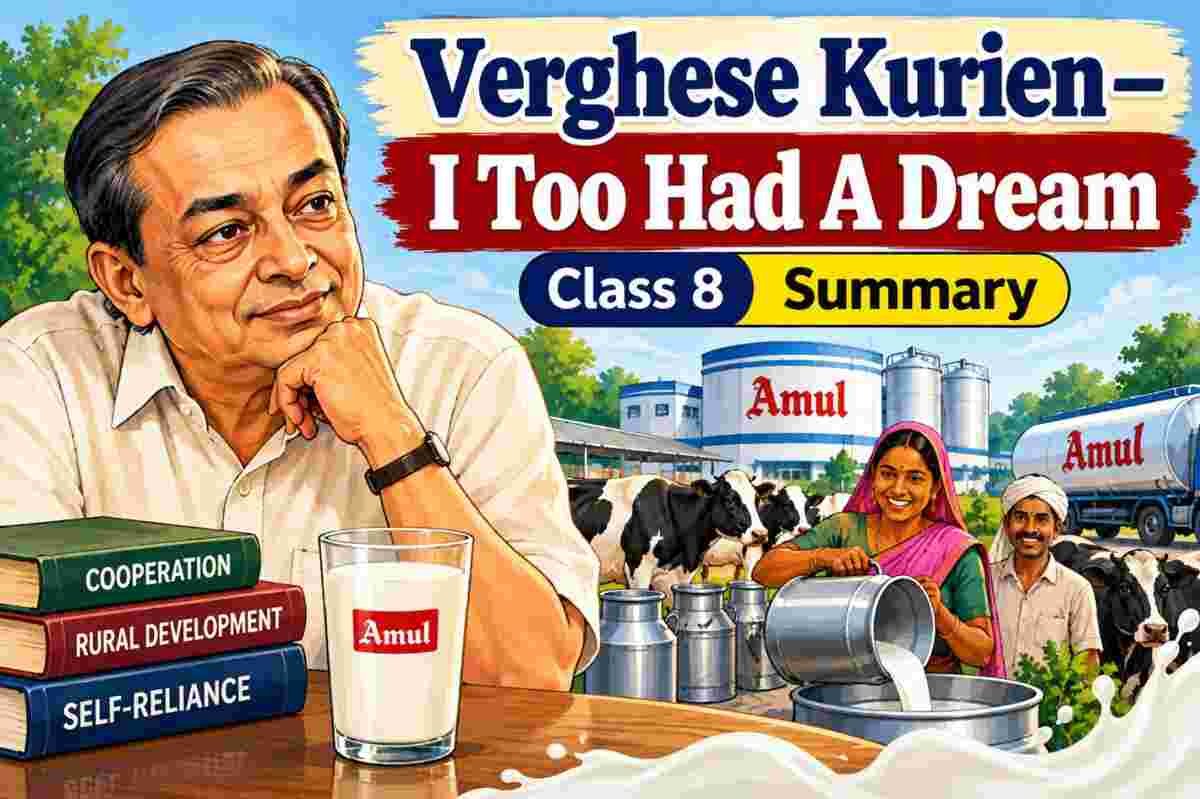
Verghese Kurien I Too Had A Dream Class 8 Summary
Summary of the Story
This is a letter written by a grandfather to his grandson Siddharth. The grandfather explains why writing letters is more valuable than phone calls—it can be read again and again. He shares his life story: after independence, he chose to serve farmers in Anand, Gujarat, instead of taking other careers. His wife supported him in this choice.
He talks about the importance of values like honesty and integrity, responsibility, and working for the common good. He reminds Siddharth that true success is not just about rewards but about effort and contribution.
He also recalls the day Siddharth joined him at the Padma Vibhushan award ceremony. Finally, he advises his grandson to live bravely, love others, and work for humanity.
Summary in Hindi
यह पत्र एक दादा ने अपने पोते सिद्धार्थ को लिखा है। दादा बताते हैं कि पत्र लिखना फोन पर बात करने से अधिक मूल्यवान है क्योंकि पत्र बार-बार पढ़े जा सकते हैं। वे अपने जीवन की कहानी बताते हैं—आजादी के बाद उन्होंने किसानों की सेवा करने का रास्ता चुना। उनकी पत्नी ने भी इस निर्णय में उनका साथ दिया।
वे ईमानदारी, जिम्मेदारी और समाज की भलाई जैसे मूल्यों पर जोर देते हैं। वे सिद्धार्थ को याद दिलाते हैं कि असली सफलता मेहनत और योगदान में है। अंत में वे उसे सलाह देते हैं कि साहस से जियो, दूसरों से प्रेम करो और मानवता की सेवा करो।
Theme of the Story
The theme is values, service, and responsibility. It shows that life is meaningful when we live honestly, help others, and work for the common good.
About the Author
This letter is written by Dr. Verghese Kurien, known as the “Father of the White Revolution” in India. He worked in Anand, Gujarat, and transformed India’s dairy industry.
Characters in the Story
- Grandfather (Dr. Verghese Kurien) – Writer of the letter.
- Siddharth – His grandson.
- Grandmother – Supportive partner in his journey.
Moral of the Story
The moral is that life is a privilege. We must use it with honesty, responsibility, and service to others. True rewards come from hard work and contribution, not from wealth or fame.
Difficult Words with Meanings and Sentences
| Difficult Words | Meaning | Sentences |
|---|---|---|
| Fleeting | Short-lived. | The joy was fleeting. |
| Abiding | Long-lasting. | The memory gave abiding happiness. |
| Humility | Modesty. | He accepted the award with humility. |
| Ardently | Strongly. | She ardently supported his choice. |
| Integrity | Honesty. | Integrity is the key to trust. |
| Privilege | Special chance. | Education is a privilege. |
| Cherish | Value deeply. | We should cherish our family moments. |
| Innocently | Without knowing. | The child asked innocently. |
| Musings | Thoughts. | His musings inspired many. |
Pronunciation of Difficult Words
- Fleeting → flee-ting
- Abiding → uh-bai-ding
- Humility → hyoo-mil-i-tee
- Ardently → ar-dent-lee
- Integrity → in-teg-ri-tee
- Privilege → priv-uh-lij
- Cherish → che-rish
- Innocently → in-oh-sent-lee
- Musings → myoo-zings
Phrases and Idioms with Sentences
| Phrase/Idiom | Meaning | Sentence |
|---|---|---|
| Common good | Benefit of all | We must work for the common good. |
| Life is a privilege | Life is a gift | Life is a privilege, so use it well. |
| Images of perfection | Things that look perfect | Social media shows only images of perfection. |
Word Power
- Letter – पत्र
- Farmer – किसान
- Service – सेवा
- Values – मूल्य
- Honesty – ईमानदारी
- Responsibility – जिम्मेदारी
- Reward – पुरस्कार
- Humanity – मानवता
Disclaimer: The content that is present on our website is based on the NCERT Class 8 English textbook and is provided for educational purposes only. All the content and images have been taken from English Class 8 NCERT Textbook. Images and content shown above are the property of individual organizations and are used here for reference purposes only. To make it easy to understand, some of the content and images are generated by AI and cross-checked by the teachers.
← Back to Class 8 English Poorvi