
← Back to Class 9 Artificial Intelligence
Artificial Intelligence (AI) is transforming the way we live, learn, and work. To develop AI solutions responsibly, it is important to understand the AI Project Cycle, which provides a structured approach to solving real-world problems using AI. All the important Information are taken from the Artificial Intelligence Class IX Textbook Based on CBSE Board Pattern.

Learning Outcome – To identify and appreciate Artificial Intelligence and describe its applications in daily life.
AI Reflection Project Cycle and Ethics Class 9 Notes
Introduction to AI
AI stands for artificial intelligence. The term artificial intelligence was coined by Stanford researcher John McCarthy in 1956 and combines the two words artificial and intelligence.
- Artificial – Artificial refers to something created or produced by humans rather than existing naturally.
- Intelligence – The ability to acquire and use knowledge and skills is referred to as intelligence.
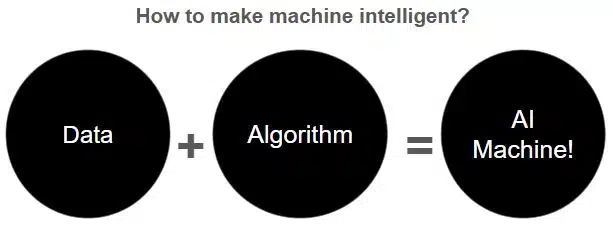
Definition: Artificial intelligence (AI) is the ability of machines to do cognitive tasks such as thinking, perceiving, learning, problem-solving, and decision-making. It is based on how individuals use their brains to observe, learn, figure out, and make decisions.
Activity: Game Time
Game 1:
Rock, Paper, Scissors AI Game Based on Data Statistics
Rock, Paper, Scissors is an easy game to play. Each player chooses one of the three things (typically by creating the appropriate hand shape on three counts!) and the following rules are used to determine who won that round:
- Paper wraps (beats) Rock
- Scissors cut (beat) Paper
- Rock blunts (beats) Scissors
The purpose of the game is to guess your opponent’s choice and select the proper object to defeat them.
Game link – https://next.rockpaperscissors.ai
Game 2:
Games related to Natural language Processing (NLP)
- Semantris is a word association game developed by the Google team that uses machine learning to make associations between words.
Game link – https://research.google.com/semantris
Game 3:
Quick Draw Game based on Computer Vision – CV
Quick Draw is an online game developed by Google. This game can draw a picture of an object or idea based on guesses given by the user.
Game link – https://quickdraw.withgoogle.com/
Three Domains of Artificial Intelligence
There are three types of domain in Artificial Intelligence.
- Computer Vision (CV)
- Data Statistics (Data for AI)
- Natural Language Processing (NLP)
1. Computer Vision (CV)
Computer vision allows computers and systems to extract useful information from digital photos, videos, and other visual inputs. The goal of Computer Vision is to take necessary action after identifying an object or person in a digital image.
2. Data Statistics (Data for AI) –
Data statistics is a collection of facts, observations, or measurements used to analyse the data using mathematical methods to make decisions. Data statistics is a part of data science and helps the system to collect a large amount of data, analyse it, interpret it, maintain sets of data, and extract meaning from them using mathematical formulas.
3. Natural Language Processing (NLP)
Natural language processing (NLP) is a branch of artificial intelligence. Natural language Processing has the ability to understand text and spoken words in the same manner that humans can.
Application of AI
Some of the AI applications are –
- Face Lock in Smartphones – Nowadays, mobiles come with face lock systems. In this mobile, the front camera detects and captures the face and matches it with the features image, and if it is matched, then the phone will be unlocked.
- Smart assistants – smart assistants like Apple’s Siri and Amazon’s Alexa—recognise the speech patterns of the user and provide a useful response.
- Fraud and Risk Detection – Now AI can identify and prevent fraud-related activities by analysing the data. AI also helps the bank to push their banking products based on the customer’s purchasing power.
- Medical Imaging – The AI application is used to read and convert 2D scan images into interactive 3D models that enable medical professionals to gain a detailed understanding of a patient’s health condition.
Introduction to AI Project Cycle
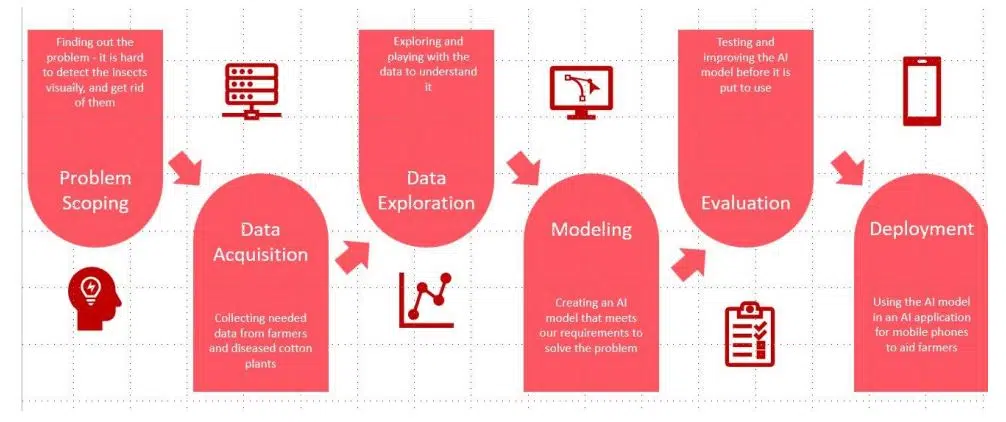
The AI Project Cycle is a step-by-step process that a company must follow in order to derive value from an AI project and to solve the problem.
There are five different stages of AI Project Cycle.
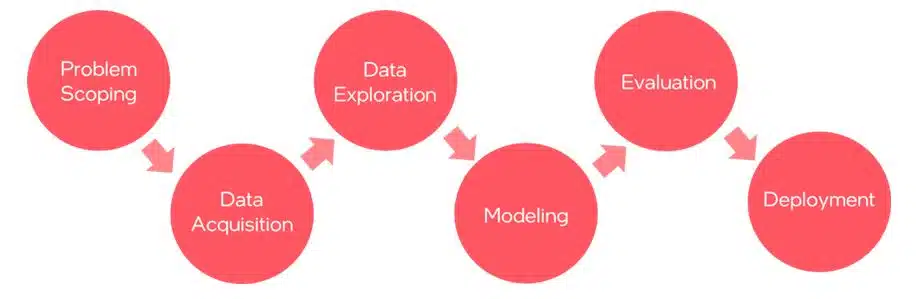
Let us go through the AI project cycle with the help of an example.
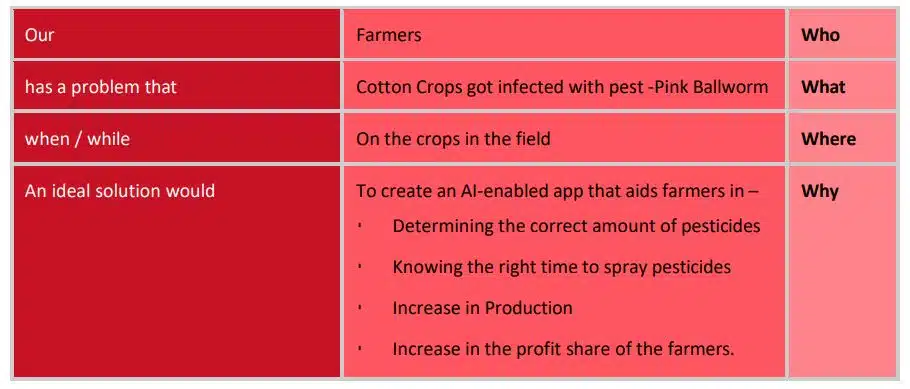
Problem: Pest infestation damages crops
Let’s see one example: suppose one farmer has a cotton field, and he is getting a loss in agriculture due to his inability to manage pests in the field. Here the AI project cycle can help to identify which worm is responsible and how much pesticide farmers have to use.
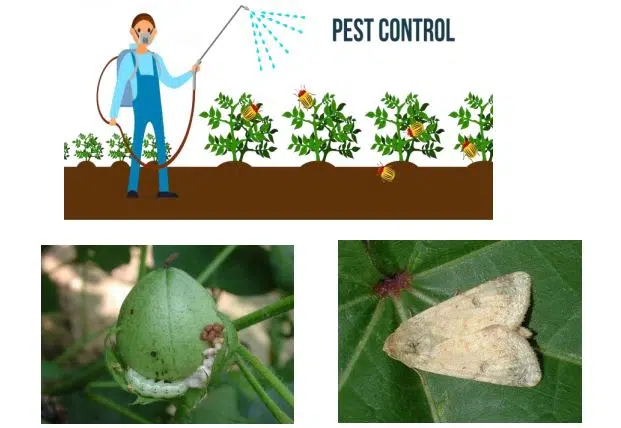
- Step 1: First you have to know which of the worms is responsible for affecting the cotton crop; you will collect the following data. This is problem scoping.
- Images of the pest
- Farmer Name
- Village Name
- Farm size
- Pesticide usage
- Step 2: Whatever the above problems are, first you have to know that the above data is accurate and reliable. To do this, you have to acquire the data from different sources. This is known as data acquisition.
- Step 3: Now you have to explore the data; researchers can identify patterns and trends. You also want to know how much pesticide is used and other relevant factors. This is known as data exploration.
- Step 4: After exploring the data, now you can develop the AI-enabled app, which will take photos of the field using mobile and help to identify the worms and tell the farmer how much pesticide they have to use. This is a data modeling stage.
- Step 5: Now you have to make your model before stating; first, you have to test it in as many ways as possible. The stage of testing the models is known as Evaluation.
- Step 6: The last stage, where you are make the model, is known as Deployment.
Let us look at the main features of CottonAce app-
- CottonAce is a mobile application that can help farmers protect their crops from pests.
- CottonAce uses AI to warn the farmers about a possible pest infestation.
- It aids farmers in –
- Determining the correct amount of pesticides
- Knowing the right time to spray pesticides
- Seeking professional help as needed.
How does it work?
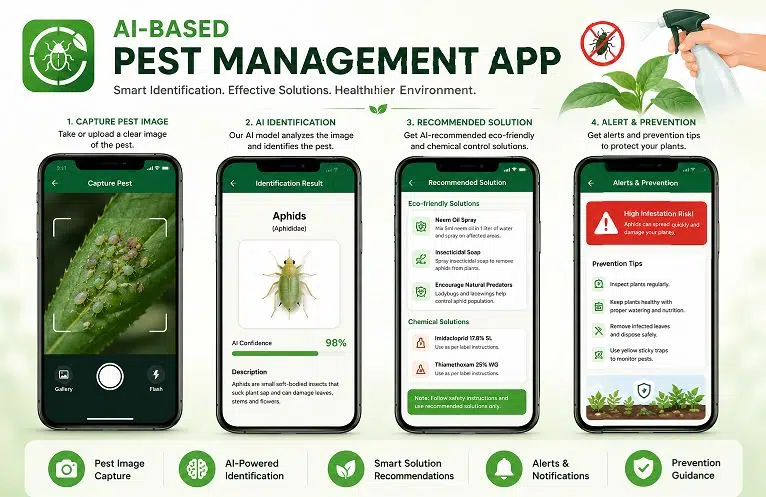
- A farmer sets up a trap to capture pests.
- Take a picture of the captured pests.
- Upload the picture on the app.
- The app detects the insect, level of infestation, and the required measures to cure it.
What is AI project cycle mapping?
AI Project Cycle Mapping is the process of connecting a real-world problem with the different stages of the AI Project Cycle to develop an AI-based solution.
Why do we need an AI Project Cycle?
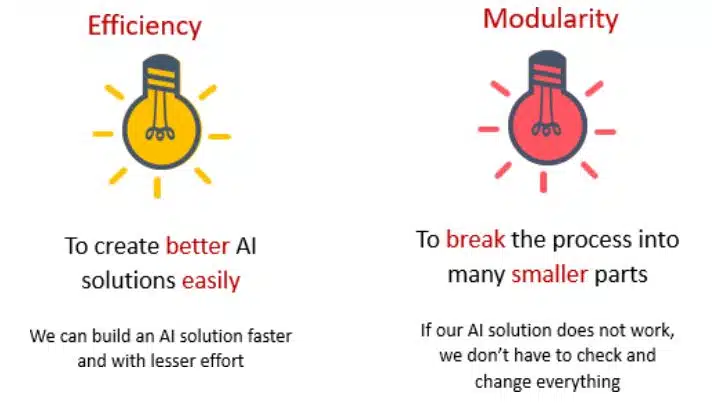
1. Problem Scoping
Whenever we begin a new project, we encounter a number of challenges. In fact, we are surrounded with issues! These issues might be minor or major; sometimes we overlook them, and other times we require immediate attention.
To understand a problem, determine the different aspects that affect the problem, and define the project’s goal are problem scoping.
How to Identify the problem Scoping in AI project
Follow the following steps to identify the problem scoping from the project –
- Understand why the project was started.
- Define the project’s primary objectives.
- Outline the project’s work statement.
- Determine the most important goals.
- Choose important milestones.
- Determine the major constraints.
- Make a list of scope exclusions.
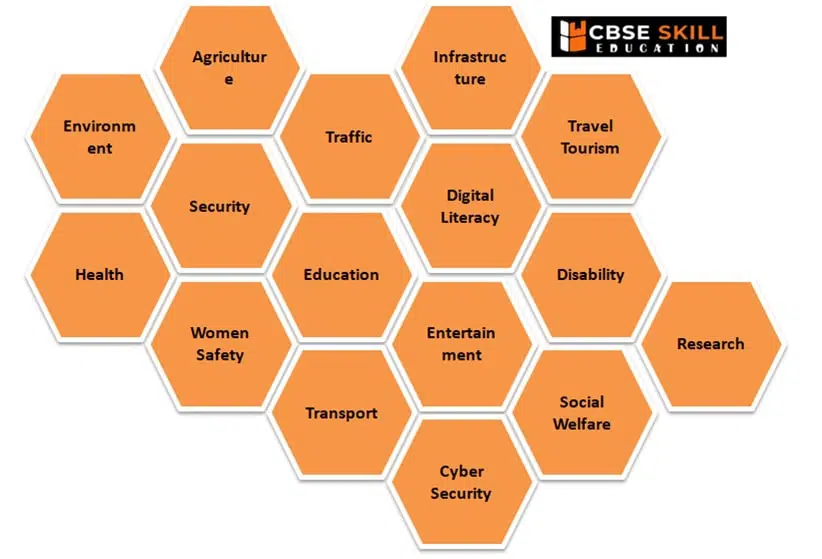
AI can acquire data from the different sources
AI can acquire data from different data sources, see the figure below.
What is 4Ws problem canvas
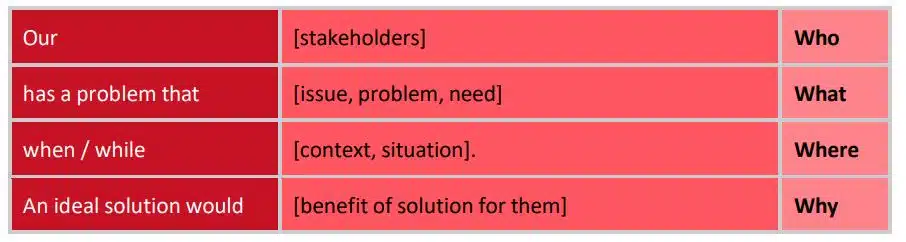
The 4Ws helps to identify and understand the problem in a better manner. The 4Ws of Problem Scoping are Who, What, Where, and Why.
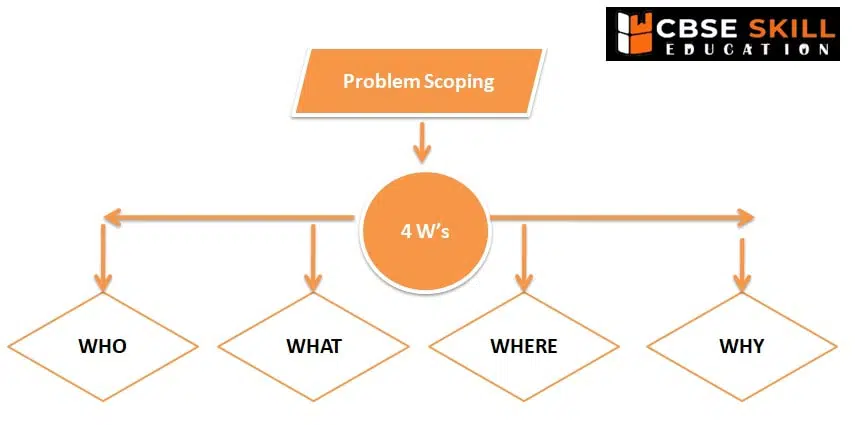
- Who – The “Who” element helps us to understand and categorize who is directly and indirectly affected by the problem, and who are known as Stakeholders.
- What – The “What” section aids us in analyzing and recognizing the nature of the problem, and you may also gather evidence to establish that the problem you’ve chosen exists under this block.
- Where – What is the situation, and where does the problem arise.
- Why – Refers to why we need to address the problem and what the advantages will be for the stakeholders once the problem is solved.
What is problem statement template
After you’ve completed the above 4Ws, make a summary of what you’ve learned. The problem statement template is the name for this summary. This template summarizes all of the important points in one place. So, if the same problem comes again, this statement will make it much easier to fix.
Example of 4W canvas for Pest Management
Let’s see one example How we can identify the problem using Brainstorming, 4Ws Problem canvas and mind map
To identify the problem, follow the following six methods to be used to address the problem:
1. Identify the Topic – First you have to select the topic. For example, Topic: “How to improve quality education in ruler area”
2. Brainstorm related problems – Brainstorming is a method for identifying and solving problems. It helps us come up with new ideas. To solve the problem, first we have to identify the problem related to quality education in rural areas.
- Student financial problem
- Teachers are not using technology
- Resources are not available
- Quality education problem belongs to ruler area only
3. 4Ws Problem Canvas – You can use the 4Ws problem canvas to identify the problem.
- What: What is the specific problem?
- Example: Students are not getting quality education in rural areas.
- Who: Who is affected by this problem?
- Example: Are students of the ruler area affected by this problem?
- Where: Where does this problem occur?
- Example: Ruler area with poor infrastructure?
- Why: Why is it important to solve this problem?
- Example: To improve literacy rate?
4. Create a Mind Map – Now you have to create a mind map of the above brainstorm-related problem.
- Financial problem – School fees, cost of study materials
- Technology – Poor internet access, computers are not available in classes
- Resources – Lack of study materials, limited teachers in school
5. Evaluate the prioritized problem – After the mind map, now you have to identify what the main problem is; for example, students are having problems in education due to limited internet connectivity and due to a lack of digital learning tools.
6. Set the goal for the project – After identifying the problem, now you have a clear goal to address the above problem. Now you can create an offline AI-powered application based on the “Offline Learning Platform” that can provide quality education in rural areas and help the students to overcome the internet connectivity barriers.
2. Data Acquisition
The method of collecting correct and dependable data to work with is known as data acquisition. Data can be in the form of text, video, photos, audio, and so on, and it can be gathered from a variety of places such as websites, journals, and newspapers.
For example, suppose you want AI to predict an employee’s next salary. You have given the AI the previous record; this is training data. Later on, you check if AI predicts correctly; this is known as ‘testing data’. If the training data are wrong, then the prediction will also be wrong.
Key points of Good Data
- Relevant data: The data should match the problem.
- Authentic data: Data must be correct and reliable.
- Sufficient data: Enough data is needed for AI to learn properly.
What is dataset?
Dataset is a collection of data in tabular format. Dataset contains numbers or values that are related to a specific subject. For example, students’ test scores in a class is a dataset.
The dataset is divided into two parts
- Training dataset – Training dataset is a large dataset that teaches a machine learning model. Machine learning algorithms are trained to make judgments or perform a task through training datasets. Maximum part of the dataset comes under training data (Usually 80%)
- Test dataset – Data that has been clearly identified for use in tests, usually of a computer program, is known as test data. 20% of data used in test data.
Acquiring data from reliable sources
Sometimes, we collect data from random websites. Such data may be wrong or fake; if the data is fake, then AI predictions will be incorrect. The solution is to find reliable sources to collect data like government portals. Government portals provide open-source data, which is free to use. Data are authentic and verified. Data is in proper formal like tables, charts, and downloadable files. Some ethical rules also we have to follow when we are collecting data, like never using private data that belongs to someone else.
There are six ways to collect data.
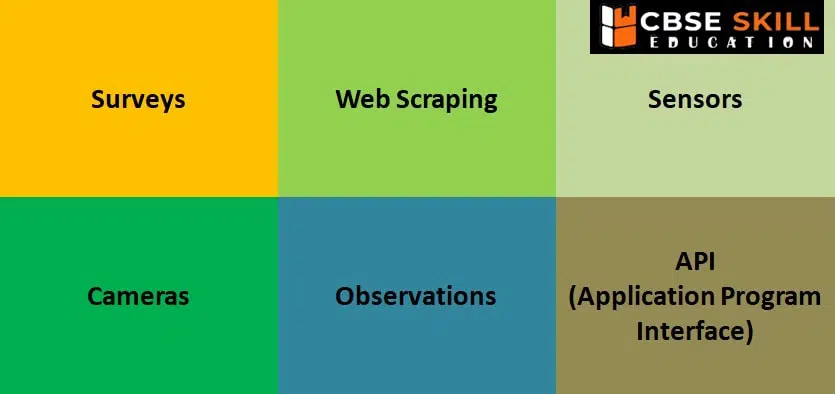
- Surveys – A research method for gathering data from a predetermined sample of respondents in order to get knowledge and insights into a variety of issues.
- Cameras – We can collect visual data with the help of cameras, this data is unstructured data that can be analyzed via Machine learning.
- Web Scraping – Web scraping is also known as data scraping. This method is used in AI to extract data from websites automatically and efficiently.
- Observation – Some of the information we can gather through attentive observation and monitoring.
- Sensors – With the help of sensors also we can collect the data. A device that detects or measures a physical property is called a sensor, such as a biomatrix.
- Application – An API is a software interface that enables two apps to communicate with one another.
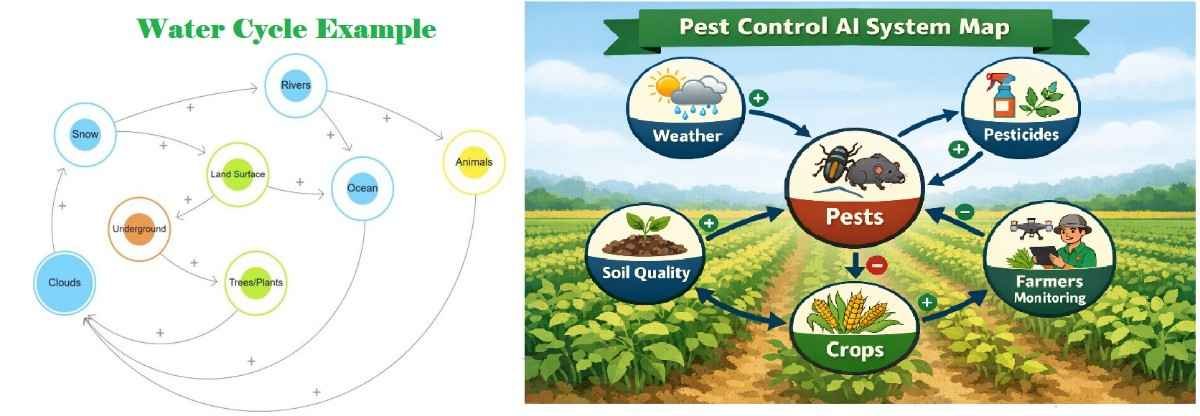
The Water Cycle
In the water cycle, the elements like clouds, rivers, oceans, soil, and animals are connected to each other. In AI, data sources are like elements in the water cycle. Each source contributes to the final dataset. For example, salary records, census data, expenses, etc. If one source is wrong or fake, then the whole prediction becomes wrong.
3. Data Exploration
In order to better understand the nature of the data, data analysts utilize data visualization and statistical tools to convey dataset characterizations, such as size, amount, and accuracy. Data exploration is a technique used to visualize data in the form of statistical methods or using graphs.
Why data exploration?
Exploration helps you gain a better understanding of a dataset, making it easier to explore and use it later. It also helps to quickly understand the data’s trends, and patterns.
What is a data visualization chart?
Data visualization charts are graphical representations of data that use symbols to convey a story and help people understand large volumes of information.
The following are some of the most frequent data visualization chart and graph formats:

a. Column Chart – A column chart is a basic Visualization chart that uses vertical columns to represent data series. Because column lengths are easy to compare, column charts are an effective approach to demonstrate the changes in the data.

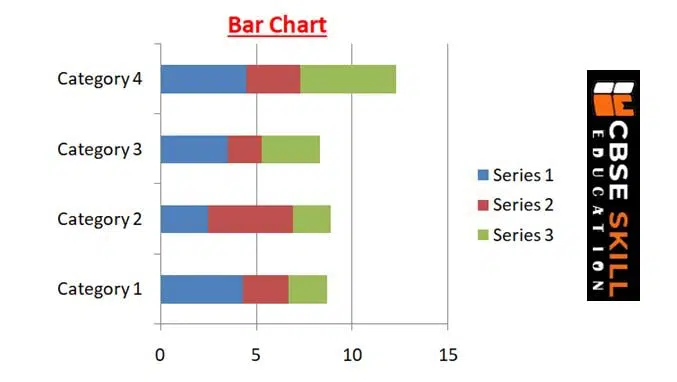
b. Bar Chart – A bar chart is a visual representation of category data. The data is displayed in a bar chart with multiple bars, each representing a different category.
4. Modelling
Before jumping into modelling let us clarify the definitions of Artificial Intelligence (AI), Machine Learning (ML) and Deep Learning (DL).
- Artificial Intelligence – Artificial intelligence (AI) is the simulation of human intelligence in robots that have been trained to think and act like humans. The term can also refer to any machine that demonstrates, like humans, the ability to learn and solve the problem is Artificial Intelligence.
- Machine Learning – Machine learning is a part of an Artificial Intelligence application in which we give data to the machine and allow them to learn for themselves. It’s essentially getting a machine to accomplish something without being specifically programmed to do so.
- Deep Learning – Deep learning is a part of Artificial Intelligence that uses neural networks with multilayer. Deep learning analyzes the data, learns the data and solves the problem the same as a human. Deep learning requires the machine to be educated with a large quantity of data in order to train itself.
Venn Diagram of AI

Data modeling means organizing and structuring data so that a AI can understand and use it. AI, ML and DL uses data models to learn patterns and make decisions. Without proper data modeling, AI cannot understand relationships between inputs and outputs.
What is data modeling?
An AI model is a program that has been trained to recognize patterns using a set of data. AI modeling is the process of creating algorithms, also known as models, that may be educated to produce intelligent results. This is the process of programming code to create a machine artificially. There are two different types of AI model –
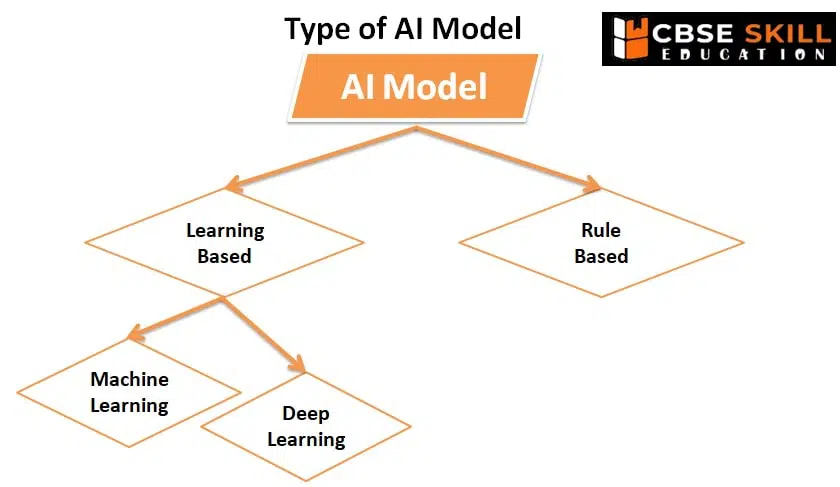
Learning Based – Refers to AI modeling in which the developer hasn’t specified the relationship or patterns in the data. Random data is provided to the computer in this method, and the system is left to figure out patterns and trends from it. When the data is unlabeled and too random for a human to make sense of, this method is usually used.
Rule Based – The rule-based approach to AI modeling is when the developer defines the relationship or patterns in data. The machine follows the developer’s rules or instructions and completes its job properly.
Rule Based AI Model (Decision Tree)
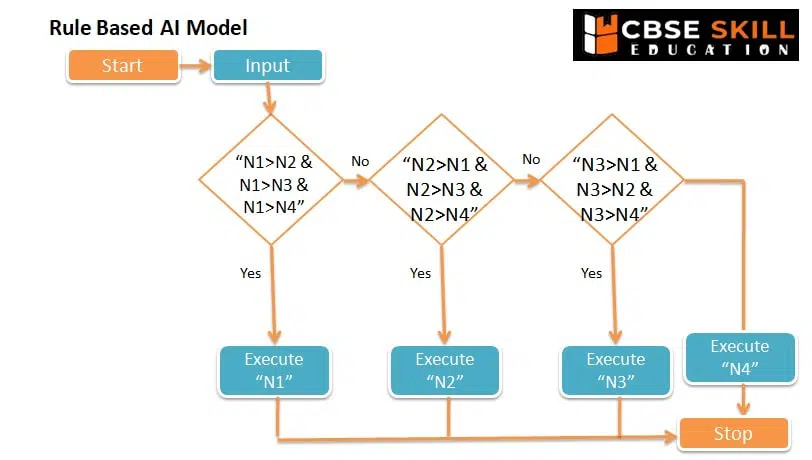
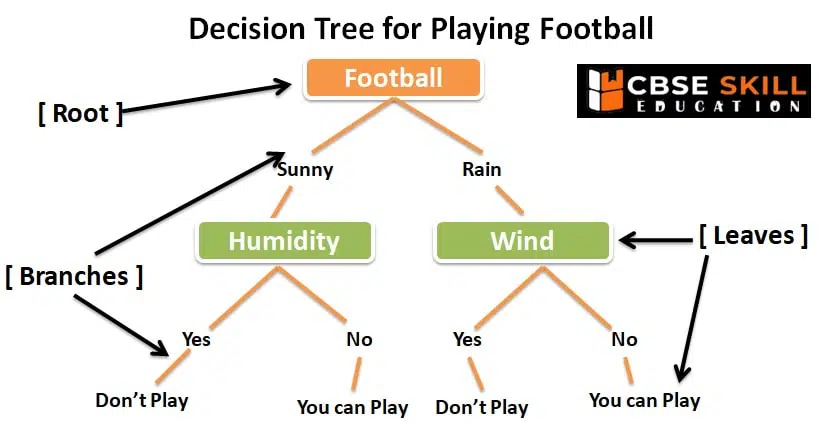
Decision Tree in AI
The concept of Decision Trees is similar to that of Story Speaker. It’s a rule-based AI model that uses numerous judgments (or rules) to assist the machine in determining what an element is. The following is the basic structure of a decision tree:
5. Evaluation
Evaluation means checking how well an AI model works. It tells us if the model’s predictions are reliable and accurate. We test the model using testing data, not the data used for training.
Why Not Use Training Data?
If we test using the same data that is used for training, then the model will just memorize it and always give correct answers for that data. This problem is called “overfitting.” To measure how well the model performs, we have to use unseen data.
Various Evaluation Techniques
There are four different types of evaluation techniques –

Model Evaluation Terminologies
There are various new terminologies which come into the picture when we work on evaluating our model. Let’s explore them with an example of the Forest fire scenario.
The Scenario
Suppose we made an AI model to predict forest fires. To check if it works properly or not, then we have to compare two things.
- Prediction: What the AI says
- Reality: What actually happens in the forest.
By comparing these, we can understand the model is correct or wrong.
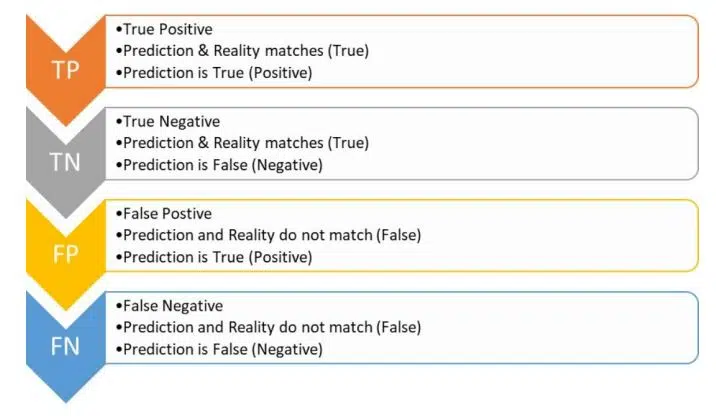
Case 1: Is there a forest fire? Here, we can see in the picture that a forest fire has broken out in the forest.
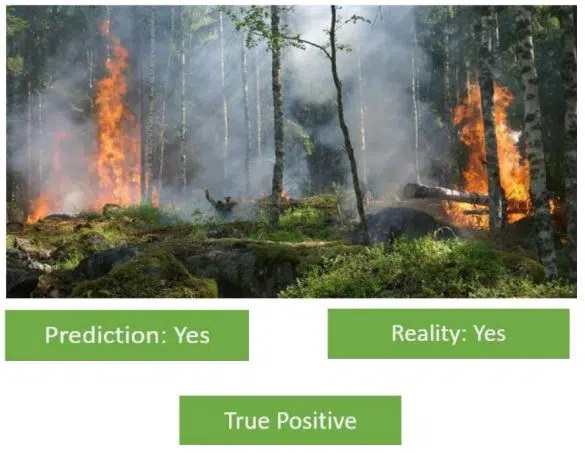
Here, we can see in the picture that a forest fire has broken out in the forest. The model predicts a Yes which meansthere is a forest fire. The Prediction matches with the Reality. Hence, this condition is termed as True Positive.
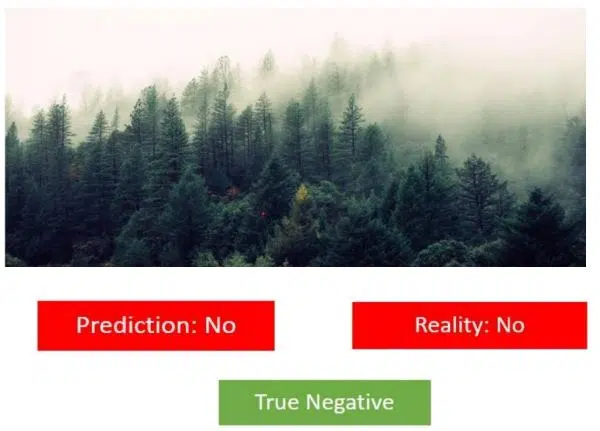
Case 2: Is there a forest fire?
Case 3: Is there a forest fire?
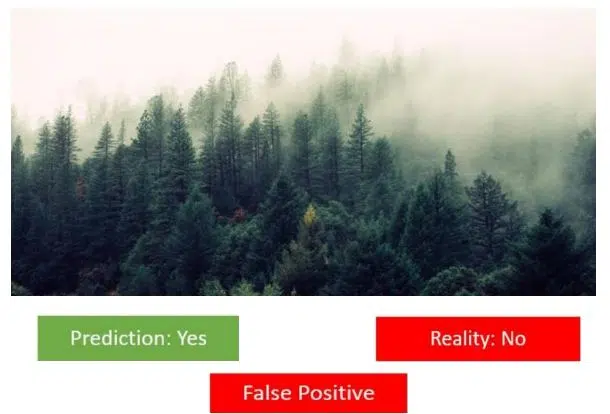
Here the reality is that there is no forest fire. But the machine has incorrectly predicted that there is a forest fire. This case is termed as False Positive.
Case 4: Is there a forest fire?
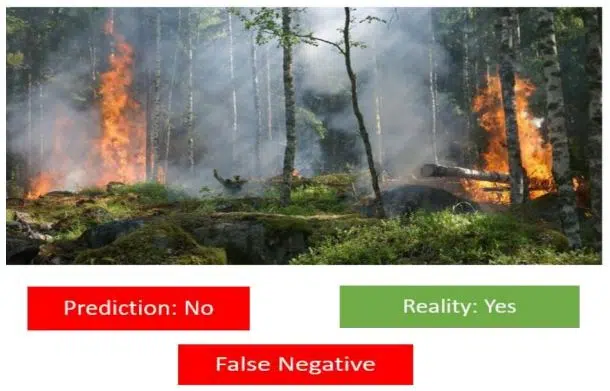
Here, a forest fire has broken out in the forest because of which the Reality is Yes but the machine has incorrectly predicted it as a No which means the machine predicts that there is no Forest Fire. Therefore, this case becomes False Negative
Confusion matrix
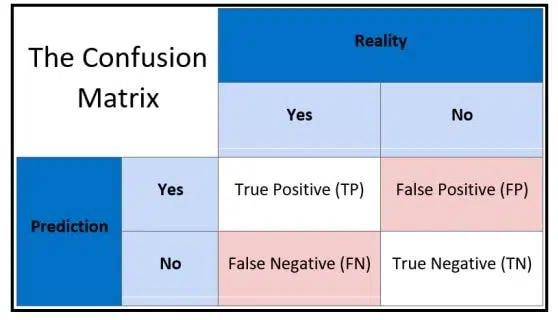
The result of comparison between the prediction and reality can be recorded in what we call the confusion matrix. The confusion matrix allows us to understand the prediction results.
5. Deployment
Deployment is a final stage of the AI project cycle. It means putting the AI model into a real-world scenario where it can be used. The key steps in deployment are
- Testing & Validation: Check if the model works correctly.
- Integration: Connect the model with existing systems (apps, machines, websites).
- Monitoring & Maintenance: Keep track of performance and update when needed.
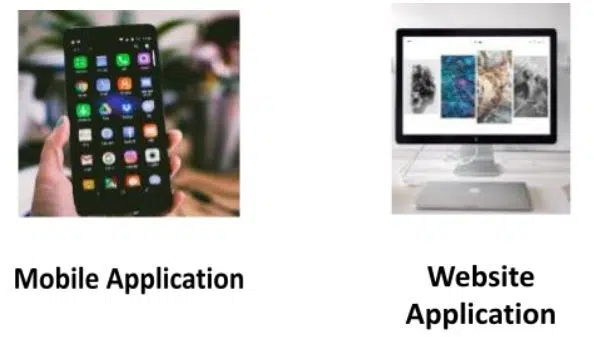
AI can be used on mobile apps, website apps, etc.
Ethics and Morality
Ethics are rules of right and wrong made by the society or profession. They help the people, how to behave in public or in the workplace. For example, serving a dirty burger is unethical because society says it is wrong. Morals are personal beliefs and values about right and wrong. For example, deciding not to lie because you believe honesty is important.
| Morals | Ethics |
|---|---|
| The beliefs dictated by our society. | The guiding principles to decide what is good or bad. |
| Morals are not fixed and can be different for different societies. | These are values that a person themselves chooses for their life. |
| Examples: Always speak the truth Always be loyal Always be generous | Examples: Is it good to speak the truth in all situations? Is it good to be loyal under all circumstances? Is it necessary to always be generous? |
Ethics and Personal Data
Suppose there is one student, Jack. Jack uses the internet for research, social media, games, and shopping. This means that personal information like name, age, and location is stored online.
Ethics are rules of right and wrong in society. When dealing with personal data, ethics says—
- Protecting Jack’s privacy.
- Not misusing his information.
- Collecting data only with consent.
- Using data for the right purpose.
Ethics with Personal Data
- There are around 5.34 billion smartphone users in the world as of July 2022, with their information available on the internet.
- AI can help us find out data related to a particular person, from all the available data.
- Such AI solutions are used by organizations to give us customized recommendations for products, songs, videos, etc.
- In this way, AI can influence our decision-making at times
- This calls for a need for ethical principles that govern AI and people who are creating AI.
Major Issues around AI Ethics
Let’s learn some more about Jack:
Jack’s school uses an AI essay grading system. He feels his essay was good, but the AI gave him a bad grade. This shows that the AI can sometimes evaluate incorrectly because of bias, poor training data, or lack of context.
To make AI fair and safe, we follow these four principles:
- Human Rights: AI must respect freedom and fairness. For example, AI should not discriminate against students.
- Bias: AI should not favor one side or group, and this usually happens when the training data is not balanced.
- Privacy: AI must protect personal data. It should clearly tell what data is collected and how it is used.
- Inclusion: AI must not exclude any group. It should be easy to use for everyone, either rich or poor.
Old Subject Specific skills Notes (For revision)
- Unit 1 – Introduction to Artificial Intelligence (AI)
- Unit 2 – AI Project Cycle
- Unit 3 – Neural Network
- Unit 4 – Introduction to Python
Disclaimer: We have taken an effort to provide you with the accurate handout of “AI Reflection Project Cycle and Ethics Class 9 Notes“. If you feel that there is any error or mistake, please contact me at anuraganand2017@gmail.com. The above CBSE study material present on our websites is for education purpose, not our copyrights. All the above content and Screenshot are taken from Artificial Intelligence Class 9 CBSE Textbook and Support Material which is present in CBSEACADEMIC website, This Textbook and Support Material are legally copyright by Central Board of Secondary Education. We are only providing a medium and helping the students to improve the performances in the examination.
For more information, refer to the official CBSE textbooks available at cbseacademic.nic.in
very usefull notes you will top m
This was very helpful…. THANK YOU!!!, although I am reading this 1 day before exam I understood everything.
This was very helpful…. THANK YOU!!!, although I am reading this 1 day before exam I understood everything.
Notes are very helpful this is good for quick revision before exams
The notes are clear and great for quick revision..! Thanks!
very helpful
very helpful notes it is good for ai and i studied all 9th and 10th class from here
thanks
GOOD FOR REVISION… THANKYOU
Very Helpful!!
Notes are very good
notes are very useful
Very Nice! These Notes Helped My Students A LOT before Exams!
CBSE Skill Education , Thank You For providing Quality Education
~Saint. Laste Na Pe’ Karumt
it is not very useful the having out of syllabus questions the worst
Thank you for your feedback. I recommend cross-checking it with the latest official curriculum. Also, please confirm with your subject teacher whether they are referring to the updated syllabus or not. This will help avoid any confusion regarding what is considered in or out of syllabus.
https://cbseacademic.nic.in/web_material/Curriculum26/sec/417-AI-IX.pdf
It is very useful and easy to understand also it’s very important + fun … Thank you… ???? … I am using this one day before my exams… But understood everything… Including all other chapters and topics…