
← Back to Class 9 Artificial Intelligence
Math for AI Class 9 Questions and Answers are designed to help students understand the mathematical concepts used in Artificial Intelligence. This chapter introduces important topics such as patterns, data handling, probability, logical thinking, and problem-solving skills that form the foundation of AI applications. These questions and answers are based on the latest CBSE Artificial Intelligence (417) syllabus and will help students strengthen their concepts and prepare effectively for examinations.
Math for AI Class 9 Questions and Answers
1. Explain the relationship between mathematics and artificial intelligence, providing justification for their interconnection.
Answer: Mathematics is the foundation of AI; without math, predictions are not possible. AI uses algebra for equations and models. Probability and statistics help the AI to make predictions. Linear algebra is used in machine learning and neural networks. Calculus helps in optimization training models. Without math, AI cannot process data or learn patterns.
2. Aman is confused about how probability theory is utilized in artificial intelligence. Help Aman by providing two examples to illustrate its importance.
Answer: Probability theory is very important in artificial intelligence because it helps the machine to deal with uncertainty and make better decisions. For example, for spam email detection, AI checks the email. If any strange words or links are found, then AI uses probability to decide if the email will go to the spam folder or not. Speech recognition: When you speak, AI listens. It compares your voice with many possible words. Probability calculates the change for each word, and it decides which word should be used.
3. Define certain events and likely events with examples.
Answer: Probability can be expressed in the following ways:
- Certain events: An event will happen without a doubt means there is an event that will always happen, like the sun rising in the east; if you toss a coin, it will land either heads or tails.
- Likely events: There are some events that have a high chance of happening but not 100%, like it may rain during the monsoon season. A student who studies well is likely to score good marks.
4. Write any two examples of impossible and equally probable events.
Answer:
- Impossible Events: There are some events that can never happen. For example, rolling a 7 on a standard die, and a die only has numbers for 1 to 6. Getting both head and tail together in one coin toss.
- Equal probability events: Events where all outcomes have the same change. For example, tossing a fair coin and getting heads or tails has a 50% chance, and rolling a fair die and getting a number from 1 to 6 then each has an equal chance of 1/6.
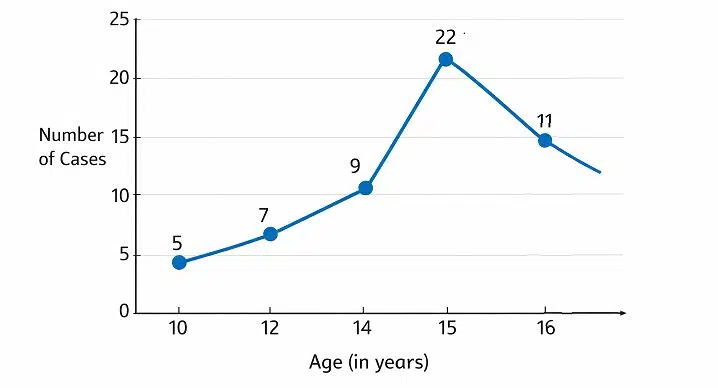
5. Radhika collected the data of the age distribution of cases admitted during a day in a hospital.
| Age (in years) | 10 | 12 | 14 | 15 | 16 |
| Cases admitted (in a day) | 5 | 7 | 9 | 22 | 11 |
Find the average number of cases admitted in hospital. Also, draw a line graph to represent the data graphically.
Answer: The data is given –
- Ages (years): 10, 12, 14, 15, 16
- Cases admitted: 5, 7, 9, 22, 11
Step 1: Find Total Cases
5 + 7 + 9 + 22 + 11 = 54
So, total cases admitted = 54
Step 2: Find Average
Average = Total cases / Number of age groups
Average = 54 / 5 = 10.8
Step 3: Line Graph
- X‑axis → Age (10, 12, 14, 15, 16)
- Y‑axis → Cases admitted (5, 7, 9, 22, 11)
Plot points: (10,5), (12,7), (14,9), (15,22), (16,11)
6. Identify the likely, unlikely, impossible and equal probability events from the following:
- a. Tossing a coin
- b. Rolling an 8 on a standard die
- c. Throwing ten 5’s in a row
- d. Drawing a card of any suite
Answer:
a. Tossing a coin
- Total outcomes = 2 (Head, Tail)
- Favourable outcomes for Head = 1
P(Head) = 1/2, P(Tail) = 1/2
Both are equal. So, equal probability
b. Rolling an 8 on a standard die

- A standard die has numbers: 1, 2, 3, 4, 5, 6
- Total outcomes = 6
- Favourable outcomes for 8 = 0 (because 8 is not on the die)
P(8) = 0 / 6 = 0
Probability = 0, means impossible
c. Throwing ten 5’s in a row
When you roll a die once, the change of getting 5 is:
P(5) = 1 / 6
That one time the chance is ther out of 6
Now, if you roll the die ten times, and you want 5 every time, you multiply the chances together:
P(Ten 5’s) = ( 1 / 6 )10
= 1 / 610
= 0.000000016
The Probability is very small, unlikely
d. Drawing a card of any suite
- Total cards = 52
- Favourable cards for one suit (e.g., Hearts) = 13
P(Hearts) = 13 / 52 = 1 / 4 = 0.25
Probability = 0.25, likely
7. How are math and AI related?
Answer: Maths is a langauge of AI. AI uses math to learn, calculate, and make decisions. Some of the important parts used in AI are
- Algebra: helps AI build formulas.
- Probability and statistics: help AI deal with uncertainty.
- Calculus: helps AI improve and learn faster.
- Geometry: helps AI understand shapes and images.
8. Why is AI used in math?
Answer: AI helps to solve hard math problems quickly. It helps to find patterns in numbers and also helps in data analysis, predictions, and graph drawing. For example, AI can check students’ math answers or create practice questions.
9. What do you mean by statistics in AI?
Answer: Statistics means collecting, organizing, and studying data to find the useful information. For example, counting how many students passed an exam and finding the average marks.
10. What is probability in AI?
Answer: Probability means chance or likelihood of something happening. In AI, it helps machines make smart guesses when not sure. For example, AI checks the chance that an email is spam or not.
11. What are the different probabilities in AI?
Answer: Different probabilities in AI are
- Certain events: An event will happen without a doubt.
- Likely events: The probability of one event is higher than the probability of another event.
- Unlikely events: One event is less likely to happen than another event.
- Impossible events: There’s no chance of an event happening.
- Equal Probability Events: The chances of each event happening are the same.
Disclaimer: We have taken an effort to provide you with the accurate handout of “Math for AI Class 9 Questions and Answers“. If you feel that there is any error or mistake, please contact me at anuraganand2017@gmail.com. The above CBSE study material present on our websites is for education purpose, not our copyrights. All the above content and Screenshot are taken from Artificial Intelligence Class 9 CBSE Textbook and Support Material which is present in CBSEACADEMIC website, This Textbook and Support Material are legally copyright by Central Board of Secondary Education. We are only providing a medium and helping the students to improve the performances in the examination.
For more information, refer to the official CBSE textbooks available at cbseacademic.nic.in