
← Back to Class 9 Science NCERT Solutions
Work Energy and Simple Machines Class 9 NCERT Solutions provides easy, accurate, and step-by-step solutions to all the NCERT textbook questions. The answers are written in simple language so that Class 9 students can understand every concept without difficulty.
Work Energy and Simple Machines Class 9 NCERT Solutions
1. What will be the magnitude of velocity of the child at the bottom of the blue slide?
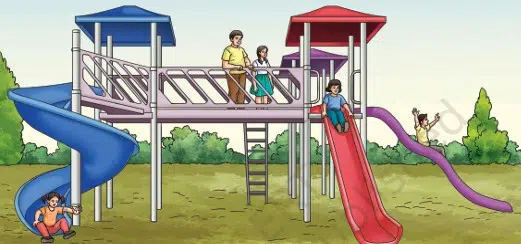
Answer: At the bottom of the slide almost all the energy is kinetic, so the child has maximum velocity. The formula used.
where:
𝑔 = 9.8 m/s2 (gravity)
ℎ = height of slide
Explanation:
When the child at the top of the slide the child has protentional energy due to height, When the child comes down then protentional energy changes to kinetic energy and when the child at the bottom of the slide then almost all energy is kinetic.
2. Will two children of different masses reach the bottom of the same slide with the same velocity?
Answer: Both children will reach the bottom with the same velocity because the velocity depends only on height (h) and gravity (g) not on mass.
3. Which of the slides will result in the largest magnitude of velocity for the child at its bottom?
Answer: The child will have the largest velocity at the bottom of the slide means more height have more speed at bottom and less height have less speed at bottom.
4. In the previous chapter, a weightlifter is shown holding a barbell steady in her hands (Fig. 6.8). Is she doing any work on the barbell while holding it steady?
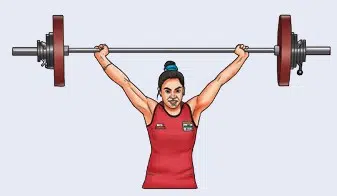
Answer: In physics, work means:
W = F x d
where F = force, d = displacement
The weightlifter appies an upword force to balance the barbell’s weight. But the barbell is not moving so there is no displacement. So, she applying the force but because the barbell does not move, then the work is not done displacement = 0 and the work done = 0.
5. Is the work done by friction on the stack of coins that travels on a rough surface (Fig. 6.13c) — positive, negative or zero?
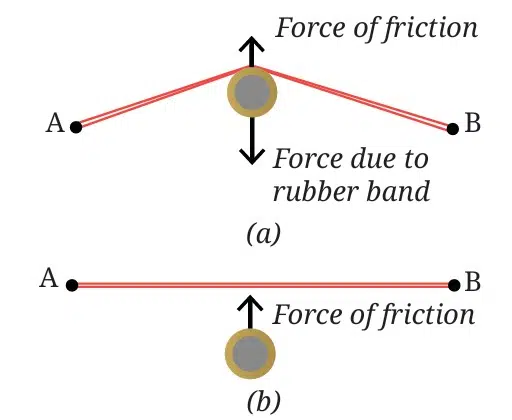
Answer: The work done by friction on the stack of coins is negative.
Explanation,
Coins move forward on a rough surface and friction act backward means opposite to motion. When the force and displacement are in opposite directions then the word done is negative.
6. When you pedal a bicycle on a flat road, your muscles supply energy. In what forms does this muscular energy appear as you ride?
Answer: When you pedal, your muscles supply energy and the muscular energy changes into –
- Kinetic energy of bicycle: The bicycle moves forward.
- Heat energy: The friction in chains, tires and road produces heat.
- Sound energy: The small sounds comes from moving parts.
7. Two objects A and B of mass m and 4 m have the same kinetic energy. What is the ratio of the magnitude of velocities of A and B?
Answer: The ratio of velocities is: 𝑣𝐴:𝑣𝐵 = 2:1
Explanation:
Given
- Mass of object A = 𝑚
- Mass of object B = 4 𝑚
- Both have same kinetic energy.
Formula for kinetic energy:
\[ KE = \tfrac{1}{2} m v^2 \]\[ \text{Step 1: For A} \quad KE = \tfrac{1}{2} m v_A^2 \]\[ \text{Step 2: For B} \quad KE = \tfrac{1}{2} (4m) v_B^2 = 2m v_B^2 \]\[ \text{Step 3: Equating (same KE)} \quad \tfrac{1}{2} m v_A^2 = 2m v_B^2 \]\[ \tfrac{1}{2} v_A^2 = 2 v_B^2 \quad \Rightarrow \quad v_A^2 = 4 v_B^2 \]\[ \text{Step 4: Square root} \quad v_A = 2 v_B \]8. Does the kinetic energy of an object which moves with constant velocity change with its position?
Answer: The kinetic energy do not change with position if the object moves with constant velocity.
Explanation,
Formula of kinetic energy,
\[ KE = \tfrac{1}{2} m v^2 \]If the object moves with constant velocity then the v does not change. If the velocity is constant then the kinetic energy also stays constant. So, the changing position do not change kinetic energy only the change in velocity.
9. Does the potential energy of an object near the surface of the Earth change if it moves with constant velocity in the horizontal direction? What if the object is gradually raised in the vertical direction?
Answer:
- Horizontal motion: The potential energy does not change.
- Vertical upward motion: The potential energy increases.
Explanation,
Case 1: Object moves horizontally with constant velocity
The formula of potential energy,
𝑃𝐸 =𝑚𝑔ℎ
Here, height (h) does not change when the object moves sideways. If the height is the same then the potential energy stays constant.
Case 2: Object moves upward gradually (vertical direction)
If the object is lifted then height (h) will increase. More height means more potential energy means when the height increase then the potential energy also increase.
10. For the situation depicted in Fig. 7.19, calculate the mechanical energy of the ball just before it hits the ground and show that even at this position, it is mgh .
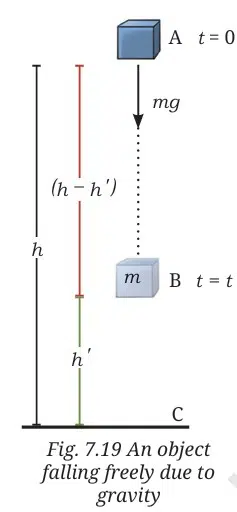
Answer: The mechanical energy of the ball just before hitting the gound is ME = mgh, even at the bottom, the total mechanical energy is still mgh.
Explanation,
Step 1: Mechanical Energy Formula
ME = KE + PE
Step 2: At the Bottom (just before hitting ground)
- Potential Energy (PE) = 0 (because height = 0 at ground).
- Kinetic Energy (KE) formula,
So,
\[ ME = KE + PE = \tfrac{1}{2} m v^2 + 0 \]Step 3: Find Velocity at Bottom
From energy conversion:
[ v = \sqrt{2gh} ]
Step 4: Substitute Velocity
\[ KE = \tfrac{1}{2} m (2gh)^2 \]\[ KE = \tfrac{1}{2} m (2gh) \]\[ KE = mgh \]11. You may have seen an exhibit like that in Fig. 7.22 in a science park, where a ball is released from the highest point. Describe how the kinetic energy and potential energy change at points A, B and C. Why do subsequent points, such as C, D and E, usually have lower heights compared to the previous ones? Could it have anything to do with the energy lost due to friction?
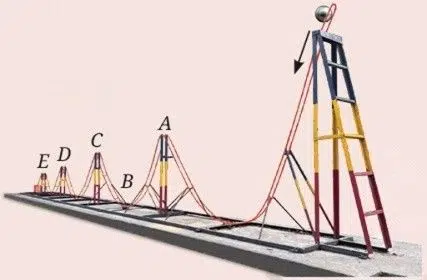
Answer:
- At A -> PE maximum, KE = 0.
- At B -> PE decreases, KE increases.
- At C -> PE = 0, KE maximum.
At later points (C, D, E) -> heights are lower because friction and air resistance cause energy loss (converted into heat and sound).
12. Explain why roads on hills are built to wind around in gentle slopes rather than going straight up (Fig. 4.26)?
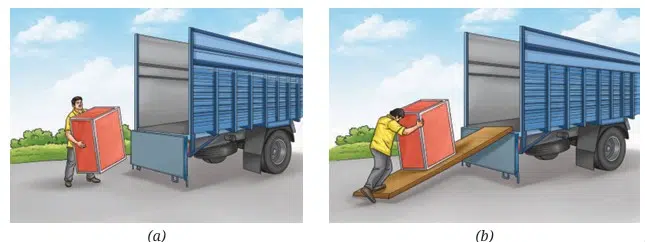
Answer: Roads on hills are built to wind around in gentle slopes because a gentle slope works like an inclined plane. An inclined plane reduces the force needed to move a vehicle uphill. Although the road becomes longer, vehicles need less effort to climb. This makes driving easier, safer, and more comfortable. If the road went straight up, it would be very steep, and vehicles would need much more force to climb, making driving difficult and unsafe.
13. To reach a higher floor, we find climbing an inclined ladder easier in comparison to climbing a vertical ladder (Fig. 7.30). Explain why.
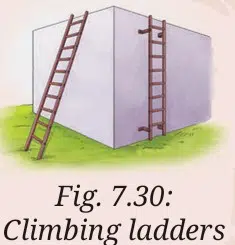
Answer: Climbing using a ladder is easier than a vertical ladder because the effort is spread over a longer distance. This means that less force is needed at each step, and an inclined ladder also provides better balance and stability.
14. Why is it easier to open the lid of a can by using a spoon as shown in Fig. 7.35?
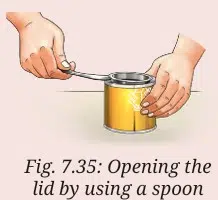
Answer: When you use a spoon to open the lid then the spoon acts like a lever. In the lever, a small force applied at a longer arm produces a large force at the shorter arm. Because of this the force you apply is multiplied.
15. Why do you push an object closer to scissors fulcrum when you want to cut an object which is hard?
Answer: Scissors work as a lever, and near the fulcrum the mechanical advantage is greater. This means the same effort applied by hand produces a stronger cutting force, making it easier to cut hard objects.
16. Throughout history, many designs of perpetual machines (using wheels, weights or magnets) have been proposed but none actually work. Why do all real machines eventually slow down and stop? Explain in terms of work and energy.
Answer: All real machines slow down and finally stop because some energy is always lost due to friction and air resistance. This energy changes into heat and sound, so the machine keeps losing its mechanical energy. Since no machine can create new energy on its own, it cannot keep moving forever. Therefore, a perpetual machine is not possible.
17. State whether True or False.
(i) Work is said to be done when a force is applied, even if the object does not move.
(ii) Lifting a bucket vertically upward results in positive work done on the bucket.
(iii) The SI unit for both work and energy is joule (J).
(iv) A motionless stretched rubber band has kinetic energy.
(v) Energy can change from one form to another.
Answer:
(i) Work is said to be done when a force is applied, even if the object does not move.
Answer: False
(ii) Lifting a bucket vertically upward results in positive work done on the bucket.
Answer: True
(iii) The SI unit for both work and energy is joule (J).
Answer: True
(iv) A motionless stretched rubber band has kinetic energy.
Answer: False
(v) Energy can change from one form to another.
Answer: True
18. Fill in the blanks.
(i) Work done = _ × (in the direction of force).
(ii) 1 joule of work is done when a force of newton displaces an object by 1 metre in the direction of the force. (iii) The expression for kinetic energy of a body of mass m and velocity v is .
(iv) The potential energy of an object of mass m at a small height h from the Earth’s surface is . (v) Power is defined as the _ at which work is done.
Answer:
(i) Work done = Force × displacement (in the direction of force).
(ii) 1 joule of work is done when a force of 1 newton displaces an object by 1 metre in the direction of the force.
(iii) The expression for kinetic energy of a body of mass m and velocity v is ½mv².
(iv) The potential energy of an object of mass m at a small height h from the Earth’s surface is mgh.
(v) Power is defined as the rate at which work is done.
19. When a ball thrown upwards reaches its highest point, tick which of the following statement(s) are correct?
(i) The force acting on the ball is zero.
(ii) The acceleration of the ball is zero.
(iii) Its kinetic energy is zero.
(iv) Its potential energy is maximum.
Answer:
- (iii) Its kinetic energy is zero.
- (iv) Its potential energy is maximum.
20. For each of the following situations, identify the energy transformation that takes place:
(i) a truck moving uphill,
(ii) unwinding of a watch spring,
(iii) photosynthesis in green leaves,
(iv) water flowing from a dam,
(v) burning of a matchstick,
(vi) explosion of a fire cracker,
(vii) speaking into a microphone,
(viii) a glowing electric bulb, and
(ix) a solar panel.
Answer:
- (i) A truck moving uphill: Kinetic energy -> Potential energy
- (ii) Unwinding of a watch spring: Potential energy -> Kinetic energy
- (iii) Photosynthesis in green leaves: Light energy -> Chemical energy
- (iv) Water flowing from a dam: Potential energy -> Kinetic energy
- (v) Burning of a matchstick: Chemical energy -> Heat energy and Light energy
- (vi) Explosion of a firecracker: Chemical energy -> Heat energy, Light energy and Sound energy
- (vii) Speaking into a microphone: Sound energy -> Electrical energy
- (viii) A glowing electric bulb: Electrical energy -> Light energy and Heat energy
- (ix) A solar panel: Light energy -> Electrical energy
21. A student is slowly lifted straight up in an elevator from the ground level to the top floor of a building. Later, the same student climbs the staircase, all the way to the top. Given that the height of the building is h = 72.5 m, acceleration due to gravity is g = 10 m s–2, and student’s mass is m = 50 kg.
(i) Find the gain in the potential energy if the student is lifted straight up to the top.
(ii) Find the gain in the potential energy when the student climbs the stairs to the same top.
(iii) What do you conclude about the dependence of the potential energy on the path taken?
Answer:
Given:
- Mass of student (m) = 50 kg
- Height (h) = 72.5 m
- Acceleration due to gravity (g) = 10 m/s²
(i) Gain in potential energy when lifted in the elevator
Potential Energy = mgh
- = 50 × 10 × 72.5
- = 36,250 J
Answer: 36,250 J
(ii) Gain in potential energy when the student climbs the stairs
The height reached is the same, so the gain in potential energy is also:
- = 50 × 10 × 72.5
- = 36,250 J
Answer: 36,250 J
(iii) Conclusion
The potential energy is the same in both cases because the height is the same. It does not depend on the path taken. It depends only on the vertical height reached.
22. A crane lifts a mass m to the 10th floor of a building in a certain time. It then raises the same mass to the 20th floor of the same building in double the time. How much more energy and power are required? Assume that the height of all floors is equal.
Answer:
(i) Energy required
- Height to the 10th floor = 10h
- Energy required = mg(10h) = 10mgh
- Height to the 20th floor = 20h
- Energy required = mg(20h) = 20mgh
More energy required = 20mgh − 10mgh = 10mgh
Answer: 10mgh more energy is required.
(ii) Power required
Power = Work ÷ Time
- For the 10th floor:
- For the 20th floor:
- Time = 2t
So,
P₁ = P₂
No extra power is required. The power remains the same because both the work and the time are doubled.
23. Which factors determine the energy required to raise a flag from the ground to the top of a tall flagpole using a pulley? Does raising the flag slowly or quickly change the amount of work done? If the speed at which the flag is raised is doubled, how does the power requirement change? Explain your answers.
Answer:
The energy needed to raise a flag depends on the mass of the flag and the height of the flagpole. A heavier flag or a taller flagpole needs more energy.
Raising the flag slowly or quickly does not change the work done because the flag is lifted to the same height.
If the flag is raised twice as fast, twice the power is needed because the same work is done in less time.
24. A man of mass 60 kg rides a scooter of mass 100 kg. He accelerates the scooter to a velocity v. The next day, his son with a mass of 40 kg joins him as a passenger. If the scooter reaches the same speed on both days in the same time interval, what is the ratio of the fuel of the tank used on the two days? Assume that the energy transfer to the scooter happens entirely due to fuel, and no other losses occur due to air resistance and friction.
Answer:
The fuel used depends on the kinetic energy of the scooter.
Kinetic Energy ∝ Total Mass
First day:
- Man = 60 kg
- Scooter = 100 kg
- Total mass = 160 kg
Second day:
- Man = 60 kg
- Son = 40 kg
- Scooter = 100 kg
- Total mass = 200 kg
Since the scooter reaches the same speed on both days, the fuel used is proportional to the total mass.
Fuel ratio = 160 : 200 = 4 : 5
The ratio of fuel used on the two days is 4 : 5.
25. On a seesaw with sliding seats, a child is sitting on one side and an adult on the other side. The adult weighs twice that of the child. The seesaw however is balanced. Draw a figure which depicts this situation showing the distances from the fulcrum where the child and the adult are seated.
Answer: If the adult weighs twice as much as the child, the adult must sit half the distance from the fulcrum to balance the seesaw.
26. A ball of mass 2 kg is thrown up with a velocity of 20 m s–1.
(i) Identify the sign of the work done by gravity on the ball during its upward motion and its downward motion.
(ii) If the ball reaches a height of 19.4 m, how much work was done by air resistance (assume g = 10 m s–2).
Answer:
Given:
- Mass (m) = 2 kg
- Initial velocity (u) = 20 m/s
- Height (h) = 19.4 m
- Gravity (g) = 10 m/s²
(i) Sign of the work done by gravity
- During upward motion: Negative (gravity acts downward while the ball moves upward).
- During downward motion: Positive (gravity and the ball move in the same direction).
(ii) Work done by air resistance
Initial Kinetic Energy
\[ KE = \frac{1}{2} m v^2 = \frac{1}{2} \times 2 \times 20^2 = 400 \, J \]Potential Energy at 19.4 m
- PE = mgh = 2 × 10 × 19.4 = 388 J
Work done by air resistance
- = PE − KE = 388 − 400 = −12 J
- −12 J
The negative sign shows that air resistance opposes the motion of the ball.
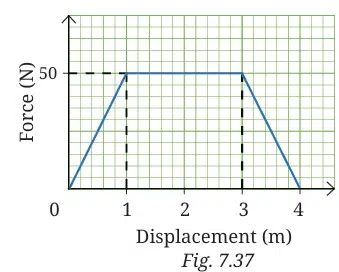
27. A 10.0 kg block is moving on horizontal floor with negligible friction. As shown in the Fig. 7.37, a variable force is applied on the block in its direction of motion from its position at 0 m till 4 m. If the block had a kinetic energy of 180 J when it was at 0 m, find the block’s speed (i) at 0 m, and (ii) at 4 m. Does the block have negative acceleration in any portion of its motion?
Answer:
Given:
- Mass (m) = 10 kg
- Initial Kinetic Energy = 180 J
(i) Speed at 0 m
Using,
\[ KE = \frac{1}{2} m v^2 \]\[ 180 = \frac{1}{2} \times 10 \times v^2 \]\[ 180 = 5v^2 \]\[ v^2 = 36 \]\[ v = 6 \,\text{ m/s} \]6 m/s
(ii) Speed at 4 m
First, find the work done by the force (area under the graph).
Triangle (0–1 m):
\[ KE = \frac{1}{2} \times 1 \times 50 = 25 \, J \]Rectangle (1–3 m):
- 2 × 50 = 100 J
Triangle (3–4 m):
\[ KE = \frac{1}{2} \times 1 \times 50 = 25 \, J \]Total work done = 25 + 100 + 25 = 150 J
Final Kinetic Energy
- = 180 + 150 = 330 J
Now,
\[ KE = \frac{1}{2} m v^2 \]\[ 330 = \frac{1}{2} \times 10 \times v^2 \]\[ 330 = 5v^2 \]\[ v^2 = 66 \]\[ v = \sqrt{66} \approx 8.1 \,\text{ m/s} \]8.1 m/s (approximately)
(iii) Does the block have negative acceleration?
No. The force is always positive (in the direction of motion), so the acceleration is also positive throughout the motion. The force becomes smaller after 3 m, but it never becomes negative. Therefore, the block does not have negative acceleration.
28. The gravitational attraction on the surface of the Moon (lunar surface) is about 1/6 th of that on the surface of the Earth. An astronaut can throw a ball up to a height of 8 m from the surface of the Earth. How far up will the ball thrown with the same upward velocity travel from the surface of the Moon?
Answer:
Given:
\[ h_E = 8 \,\text{ m} \]\[ g_M = \frac{1}{6} g_E \]The height reached depends on velocity and gravity:
\[ h = \frac{u^2}{2g} \]Since the same velocity is used,
\[ \frac{h_M}{h_E} = \frac{g_E}{g_M} = 6 \]So,
\[ h_M = 6 \times h_E = 6 \times 8 = 48 \,\text{ m} \]The ball will rise to a height of 48 m on the Moon.
29. A 1000 kg car is moving along a road at a constant speed. Suddenly, the driver notices some obstruction ahead and applies the brakes to come to a complete stop. The graphical representation of motion of the car starting from the instant the driver spots the traffic ahead is shown in Fig. 7.38.
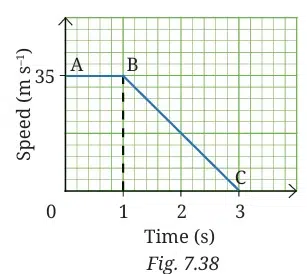
(i) Describe how the car moves between positions A and B.
(ii) Calculate the kinetic energy of the car at A.
(iii) State the work done by the brakes in bringing the car to a halt between B and C.
(iv) What does the kinetic energy of the car transform into?
Answer:
Given:
- Mass of car (m) = 1000 kg
- Speed at A = 35 m/s
- Speed at C = 0 m/s
(i) Describe how the car moves between A and B.
Between A and B, the car moves with constant speed of 35 m/s. It does not accelerate or slow down.
(ii) Calculate the kinetic energy of the car at A.
\[ KE = \frac{1}{2} m v^2 \]\[ = \frac{1}{2} \times 1000 \times 35^2 \]\[ = 500 \times 1225 \]\[ = 612500 \, J \]612,500 J
(iii) State the work done by the brakes in bringing the car to a halt between B and C.
When the car stops, its final kinetic energy becomes 0 J.
Work done by brakes = 0 − 612500 = −612500 J
−612,500 J
(The negative sign shows that the brakes oppose the motion.)
(iv) What does the kinetic energy of the car transform into?
The kinetic energy of the car changes mainly into heat energy due to friction between the brake pads and the wheels. A small amount is also produced as sound energy.
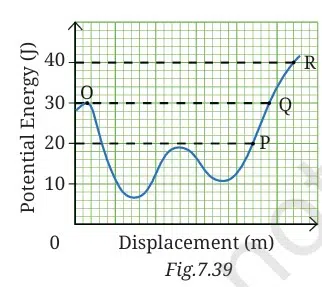
30. The potential energy-displacement graph of a 0.5 kg ball moving along a frictionless track is shown in Fig. 7.39. At O, the velocity of the ball is 0 m s–1 and potential energy is 30 J. Calculate the velocity of the ball at P, Q and R.
Answer:
Given from graph (Fig. 7.39):
- Mass of ball = 0.5 kg
- At point O: Potential Energy = 30 𝐽, Kinetic Energy = 0𝐽 (velocity = 0).
- So, Total Mechanical Energy = 30 J (constant everywhere because track is frictionless).
(i) At point P
- Potential Energy at P = 10 𝐽.
- Kinetic Energy = Total – Potential = 30 – 10 = 20 𝐽.
- Velocity:
(ii) At point Q
- Potential Energy at Q = 25 𝐽.
- Kinetic Energy = 30 – 25 = 5 𝐽.
- Velocity:
(iii) At point R
- Potential Energy at R = 40 𝐽.
- But total energy = 30 𝐽.
- Since potential energy > total energy, the ball cannot reach point R.
So, velocity at R = not possible.
31. A coconut of mass 1.5 kg falls from the top of a coconut tree onto the wet sand on a beach. The height of the tree is 10 m. On impact, the coconut comes to rest by making a depression in the sand.
(i) Calculate the velocity of the coconut just before it hits the sand.
(ii) Assume that the average resistive force of sand is 3000 N and all of the coconut’s energy is used to create the depression in the sand.
Calculate the depth of the depression the coconut makes in the sand. Assume g = 10 m s–2.
Answer:
Given:
- Mass of coconut, 𝑚 = 1.5 kg
- Height of tree, ℎ = 10 m
- Gravity, 𝑔 = 10 m/s2
- Resistive force of sand, 𝐹 = 3000 N
(i) Velocity just before hitting the sand
Using equation of motion:
\[ v = \sqrt{2 g h} \]\[ v = \sqrt{2 \times 10 \times 10} = \sqrt{200} \approx 14.14 \,\text{ m/s} \]Velocity = 14.14 m/s
(ii) Depth of depression in sand
Kinetic energy of coconut just before impact = Potential energy lost =
\[ E = m g h = 1.5 \times 10 \times 10 = 150 \, J \]Work done against resistive force = 𝐹 × 𝑑
\[ 150 = 3000 \times d \]\[ d = \frac{150}{3000} = 0.05 \,\text{ m} \]Depth of depression = 0.05 m (5 cm)
- Velocity before impact = 14.14 m/s
- Depth of depression = 0.05 m (5 cm)
Disclaimer: The content that is present on our website is based on the NCERT Class 9 Science textbook and is provided for educational purposes only. All the content and images have been taken from Science Class 9 NCERT Textbook and CBSE Support material. Images and content shown above are the property of individual organizations and are used here for reference purposes only. To make it easy to understand, some of the content and images are generated by AI and cross-checked by the teachers.