
Get Electricity Magnetic and Heating Effects Class 8 Notes with easy explanations, short summaries, key points, important definitions, diagrams, and exam questions. These notes are perfect for quick revision and exam preparation.
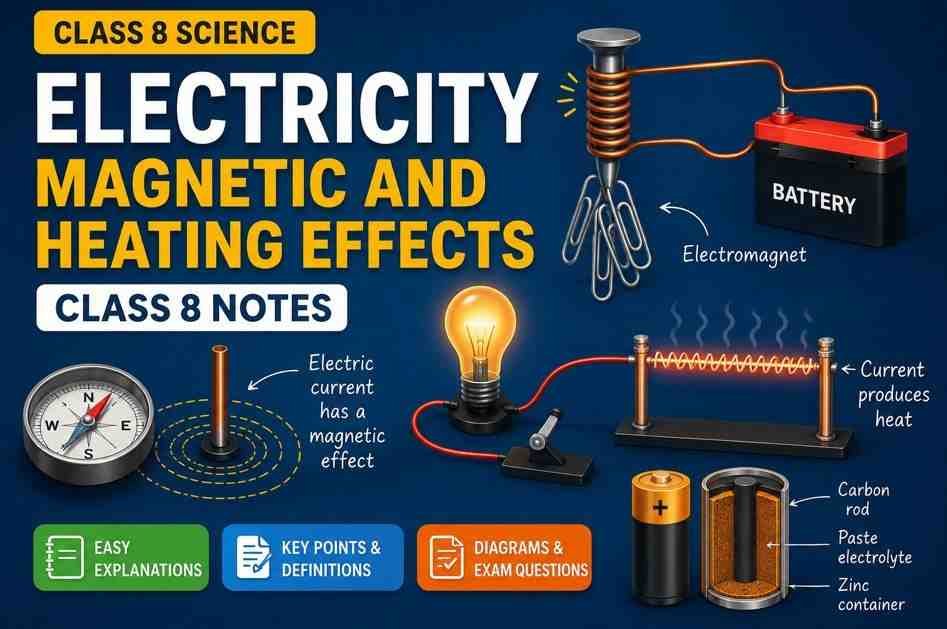
Electricity Magnetic and Heating Effects Class 8 Notes
It was the day of the science exhibition. Mohini and Aakarsh went around looking at different models; there was one simple model that caught their attention. Their senior, Sumana, showed a lifting object using an electromagnet. Instead of a crane hook, she used an iron nail wrapped with wire connected to a battery.
- When she closed the circuit, the nail picked up iron paper clips like a magnet.
- When she opened the circuit, the clips fell down.

Mohini and Aakarsh were surprised. They remembered learning earlier that magnets attract iron, but here there was no magnet; only using electricity, they had created magnetism.
Does an Electric Current Have a Magnetic Effect?
Yes, an electric current has a magnetic effect.
A compass needle has a small magnet. Normally magnets point to the north side. When you bring a magnet near the compass, then the needle moves. This shows that the wire is acting like a magnet. If you will use electric current flow through a wire, then the following will happen:
- The wire itself is acting like a magnet.
- The compass needle moves because it feels this magnetic effect.
When the current is switched off, the wire stops being a magnet, and the compass needle goes back to its previous direction.
Electromagnets
An electromagnet is a magnet made using electricity. It is not a permanent magnet; it only works when current flows. The basic steps of making an electromagnet are –
- Take an iron nail/rod.
- Wrap copper wire around the nail/rod.
- Connect the wire ends to a battery.
- When the circuit is ON, the nail becomes a magnet, and it can pick up things like paper clips.
- When the circuit is OFF, the nail loses magnetism and the clips fall down.
Note: The electromagnet also has two poles, North and South; when you change the current direction, then you can reverse the poles.
Lifting electromagnets
Suppose there is one big electromagnet attached to a crane. The crane operator can switch the current ON and OFF.
- When the current is ON: The electromagnet becomes strong and can lift heavy iron or steel objects.
- When the current is OFF: The magnet loses its power and the object falls down.
Does a Current Carrying Wire Get Hot?
Activity: Let us observe
- Step 1: Set up the wire: Fix the nichrome wire between two nails on cardboard.
- Step 2: Touch the wire before the current; you will feel normal (not warm).
- Step 3: Switch ON the current for 30 seconds and switch OFF.
- Step 4: Touch the wire after current flows; you will feel warmth.

When the electric current flows through the nichrome wire, it faces some resistance. This resistance changes some electrical energy into heat energy and makes the wire warm.
Many household appliances, such as electric room heaters, electric stoves, electric kettles, electric irons, water heating immersion rods, and hair dryers, work on the same principle of the heating effect of electric current.
The heating effect of electric current is useful in many appliances. But sometimes, it can cause energy loss, damage to plugs and sockets or even fires. Household circuits use fuses and circuit breakers to stop overheating and prevent accidents.

How Does a Battery Generate Electricity?
Let us start with one of the earliest types of electric cells ever made.
Voltaic cell
A Voltaic cell is also called a Galvanic cell. A Voltaic cell is a device that converts chemical energy into electrical energy through the chemical reaction.
The Voltaic cell contains two metal rods made of different materials and the liquid called an electrolyte, placed in a glass. An electrolyte is a weak acid or salt solution. A chemical reaction between the rods and the electrolyte produces electricity.
When the circuit is connected, electric current flows from the positive terminal through the circuit to the negative terminal. When the cell stops working, it is called a “dead cell”.

Activity: Let us construct Voltaic cell
Take five or six juicy lemons, copper wires, iron nails and LED with some connecting wires.
- Step 1: Insert the copper wire and the iron nail into one of the lemons.
- Step 2: Repeat the above step for all the remaining lemons.
- Step 3: Join the copper wire and nails.
- Step 4: Connect the LED between the two wires.
- Step 5: If the LED does not glow, then reverse the LED wire.
In the lemon battery, the copper and iron are the electrodes, and lemon juice is the electrolyte. The glowing LED shows that the electricity is being produced. a

Dry cells
A dry cell is a type of electric cell in which the electrolyte is in the form of a paste, not a liquid. It also converts chemical energy to electrical energy and is basically used in portable electronic devices.
It consists of a zinc container which acts as a negative terminal and a carbon rod at the centre covered with a metal cap that acts as the positive terminal. The carbon rod is surrounded by the paste-like electrolyte.

Rechargeable batteries
Rechargeable batteries can be recharged and reused multiple times. This prevents wastage and saves money over time as well.

There are many different kinds of rechargeable batteries that are used for different applications — from small batteries used in watches and phones to batteries used in laptops and tablet to bigger batteries that run inverters or drive electric vehicles.
Disclaimer: The content that is present on our website is based on the NCERT Class 8 Science textbook and is provided for educational purposes only. All the content and images have been taken from Science Class 8 NCERT Textbook. Images and content shown above are the property of individual organizations and are used here for reference purposes only. To make it easy to understand, some of the content and images are generated by AI and cross-checked by the teachers.