
Get Exploring Forces Class 8 Notes with easy explanations, short summaries, key points, important definitions, diagrams, and exam questions. These notes are ideal for quick revision and exam preparation.
Exploring Forces Class 8 Notes
What Is a Force?
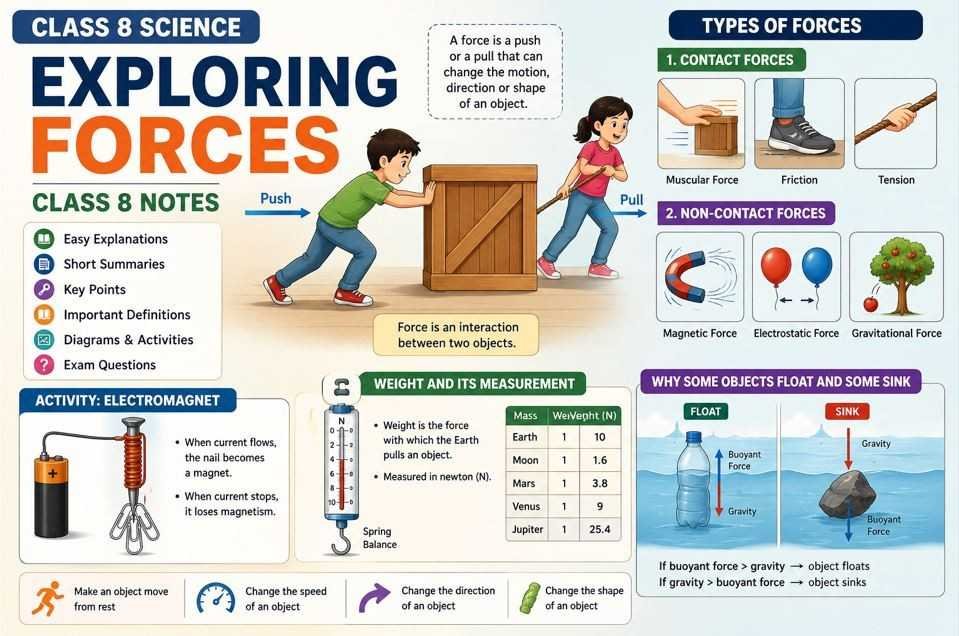
A force is simply a push or a pull applied on an object. Force helps to change the motion, speed, direction, or shape of the object.
Activity: Let us explore force.
- Step 1: Take a large cardboard box.
- Step 2: Try moving the box in different ways.
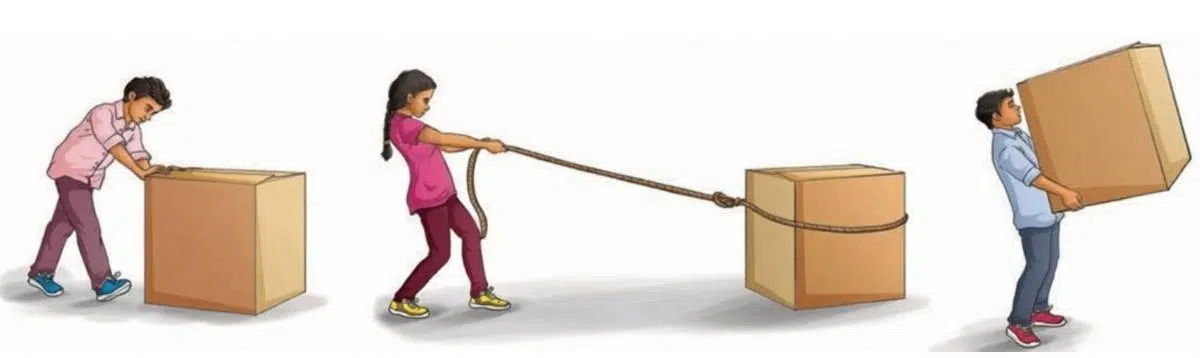
When you moved the box, in any way, you had to either push it or pull it. In physics, this push or pull applied on an object is called a force.
What Can a Force Do to the Objects on Which It Is Applied?
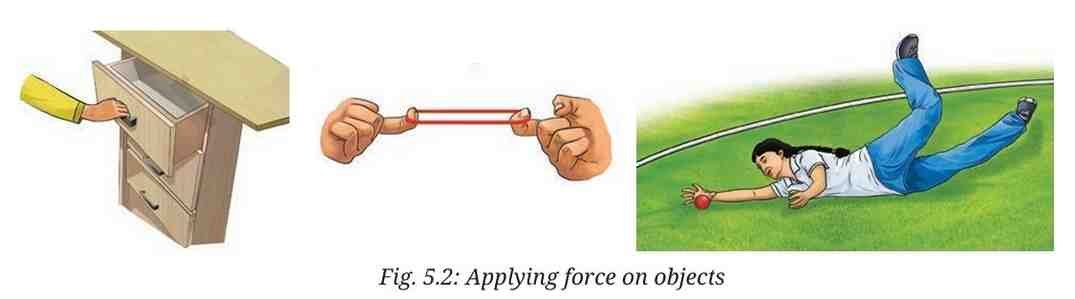
In everyday life there are many situations where a force is applied, like opening a drawer, stretching a rubber band, a fielder stopping a ball, kicking a football, etc. The force applied on an object may
- Make an object move from rest.
- Change the speed of an object if it is moving.
- change the direction of motion of an object.
- bring about a change in the shape of an object.
Are Forces an Interaction Between Two or More Objects?
A force is always the result of interaction between two objects. For example,
- When you push a table, your hand interacts with the table.
- When a fielder stops a ball, the hand interacts with the ball.
- When you kick a football, your foot interacts with the ball.
Push or pull happens only when the two objects come in contact. At least two objects are needed for applying a force. The SI unit of force is the newton (N), written with a small ‘n’.
What Are the Different Types of Forces?
1. Contact forces
The contact forces are the forces that act only when two objects touch each other. This contact can be:
- Direct contact: Using your hand, you can push the table.
- Indirect contact: Using a stick to move a stone or pulling with a rope.
a. Muscular force
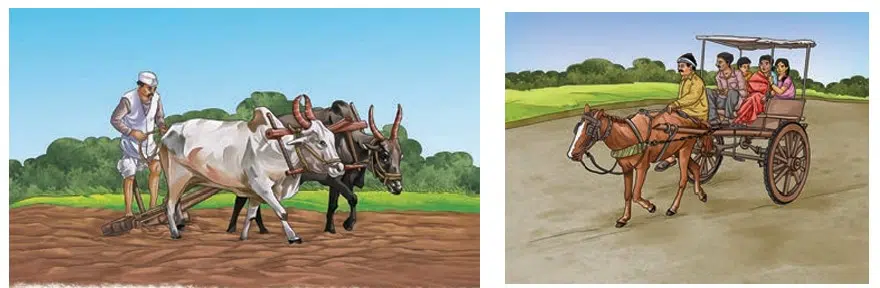
Muscular force is one type of contact force. For example, when we perform any physical activity like walking, running, or lifting, then the muscles apply the force. The muscular force always needs physical contact, for example, your body touching or acting on something.
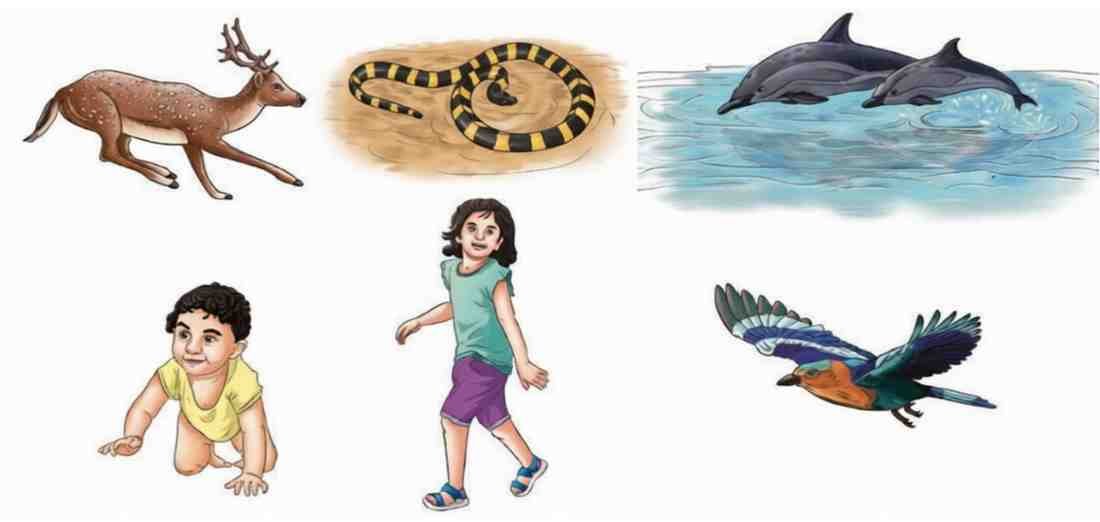
Humans used the muscular force of some animals to carry out many tasks for a long time.
b. Friction
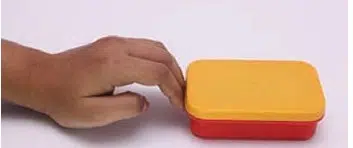
Friction is a contract force. Friction is a force that happens when two surfaces rub against each other. The friction always acts opposite to motion. That’s the way:
- A ball stops after rolling.
- A bicycle slows down when you stop pedaling.
- On a rough road, friction is higher, so a bicycle stops quickly.
- On a smooth road the friction is less, so the bicycle moves longer.
2. Non-contact forces
There are forces whose effect can be experienced even if the objects are not in contact. These forces are called non-contact forces. Let us learn about non-contact forces.
a. Magnetic force
The magnets attract or repel without contact. When the two magnets are brought close to each other, like poles (North–North and South–South) repel each other, while unlike poles (North–South) attract each other.
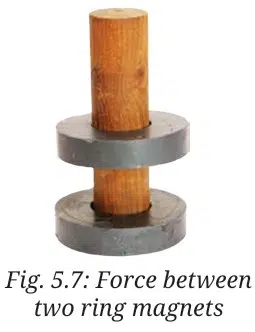
Notes: The force exerted by a magnet on another magnet or a magnetic material is called magnetic force.
b. Electrostatic force
Electrostatic force is a non-contact force. When two objects are rubbed together, they get electric charges on their surfaces. These are called static charges. A charged object can attract a neutral (uncharged) object without touching it. This force is called electrostatic force.
Activity: Let us experiment.
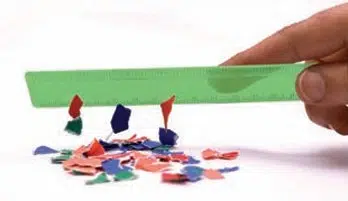
- Step 1: Take a plastic scale.
- Step 2: Rub plastic with polythene.
- Step 3: Do not touch the rubbed part.
- Step 4: Now, bring it close to the small pieces of paper.
The paper pieces get pulled towards the plastic scale and stick to it when it is brought close to the paper pieces, and this is an electrostatic force.
Activity: Let us experiment.
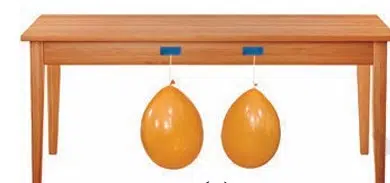
- Step 1: Take two balloons.
- Step 2: Hang the balloons in such a way that they do not touch each other.
- Step 3: Rub both balloons with the woollen cloth.
Observation 1: You will notice that the balloons move away from each other. This happens because both balloons acquire the same type of electric charge, and like charges repel each other.
- Step 4: Now bring the woollen cloth close to one of the rubbed balloons.
Observation 2: The balloon is attracted to the woollen cloth. This happens because the balloon and the woollen cloth acquire opposite charges when rubbed together, and unlike charges attract each other.
c. Gravitational force
The force with which the Earth attracts objects towards itself is called the gravitational force. The gravitational force exerted by the Earth is also called the force of gravity or simply gravity.
Since the gravitational force acts without contact with the object it attracts, it is a non-contact force. Gravitational force is always an attractive force, unlike magnetic force or electrostatic force, which can either be attractive or repulsive.
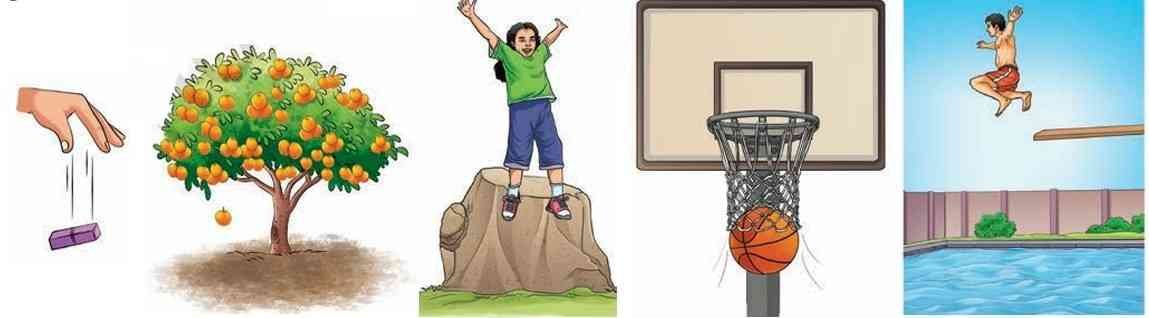
What is vertical motion?
When you drop an object, gravity pulls it straight down. When you throw an object upward, gravity keeps pulling it down. This up-and-down movement is called vertical motion. This happens because of the gravitational force.
Weight and Its Measurement
The earth pulls everything towards itself with the force of gravity. The strength of this pull on an object is called its weight. Weight is a type of force; it is measured in the same unit as that of force. Therefore, the SI unit of weight is also the newton (N).
Activity: Let us explore
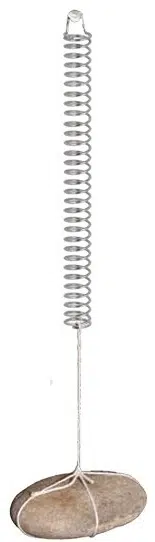
When you hang an object on a spring, the Earth pulls it down, and this pull is its weight. The spring stretches because of that pull.
- Heavier objects like a stone make the spring stretch more.
- Lighter objects like a pencil box make the spring stretch less.
Let us learn to measure the weight using a spring balance.
Reading the Scale
The maximum weight it can measure is 10 N. Thus, this scale has a range of 0 to 10 N. There are 5 small divisions between them. So, each small division = 1 ÷ 5 = 0.2 N. That means the smallest weight you can measure is 0.2 N.
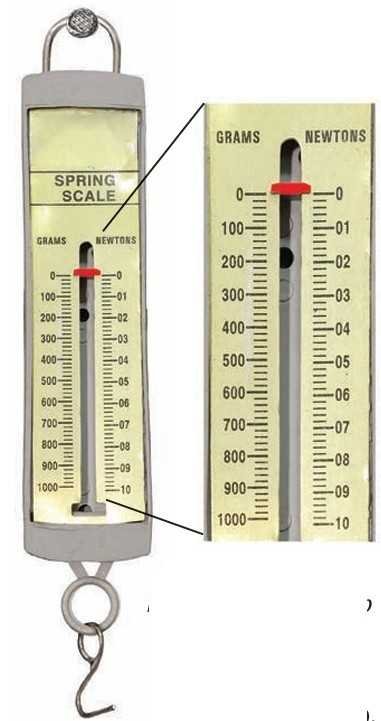
Measuring Weight
- Step 1: Hand an object from the hook.
- Step 2: The spring stretches and the pointer shows the weight.
- Step 3: You can record the reading.
Note: The object should not be heavier than the maximum value of the spring balance.
Weight is the gravitational force with which the Earth (or another planet) pulls an object. Since gravitational force can vary very slightly from place to place on the Earth (and can be very different on different planets), weight can change, but mass does not.
| Earth | Moon | Mars | Venus | Jupiter | |
|---|---|---|---|---|---|
| Mass of the object | 1 kg | 1 kg | 1 kg | 1 kg | 1 kg |
| Weight of the object | 10 N | 1.6 N | 3.8 N | 9 N | 25.4 N |
Why Some Objects Float and Some Sink
The Earth’s gravity pulls everything downward, but water pushes upward with a force called “buoyant force,” which is also known as “upthrust.” There are two forces acting on the object:
- Gravity, which is a downward force, makes it sink.
- Buoyant force is an upward force that makes it float.
What Decides Floating or Sinking?
- If gravity is greater than buoyant force, then the object will sink. (gravity > buoyant force, it will sink)
- If gravity is equal to buoyant force, then the object will float. (gravity = buoyant force, it will float)
That’s why a stone sinks because a stone is heavy for its size; gravity pulls it strongly downward as compared to buoyant force. A sealed empty bottle has air inside. Air is very light, so the bottle’s overall weight is small. Water pushes upward strongly, so the bottle floats.
Disclaimer: The content that is present on our website is based on the NCERT Class 8 Science textbook and is provided for educational purposes only. All the content and images have been taken from Science Class 8 NCERT Textbook. Images and content shown above are the property of individual organizations and are used here for reference purposes only. To make it easy to understand, some of the content and images are generated by AI and cross-checked by the teachers.