
← Back to Class 9 Science NCERT Solutions
Reproduction How Life Continues Class 9 NCERT Solutions provide accurate, step-by-step answers to all the textbook questions based on the latest NCERT Class 9 Science syllabus. These solutions explain the concepts of reproduction in plants and animals in simple language, helping students understand important topics with ease.
Reproduction How Life Continues Class 9 NCERT Solutions
Q1. When does a farmer prefer asexual or sexual methods of reproduction for crops production?
Answer:
Asexual reproduction
Farmers use asexual methods when they want the same type of plant again and again.
- All new plants look and grow like the parent.
- It is fast and simple.
- Good for crops like potato, sugarcane, banana, rose.
- Helps in making many plants quickly with the same good taste or quality.
Sexual reproduction
Farmers use sexual methods when they want new varieties of crops.
- Offspring are different from parents.
- These differences are called variations.
- Variations help plants to fight diseases and survive in changing weather.
- Useful for crops like wheat, maize, sunflower, pea plants.
Q2. Why do you think most complex animals and flowering plants use sexual reproduction, while many simple organisms, like yeast and hydra mainly reproduce asexually?
Answer: Complex animals and flowering plants use sexual reproduction because it creates variations. These variations help them adapt to changes in the environment and survive for many generations.
Simple organisms like yeast and hydra use asexual reproduction because it is quick and easy. Only one parent is needed, and they can make many identical copies fast when conditions are good.
Q3. In a china-rose (hibiscus or gudhal) plant, a pollen tube grows and continues through the style after pollen lands on the stigma. Which process is about to happen next?
Answer: After the pollen tube grows through the style, the next step is fertilisation, where the male gamete joins with the female gamete to form a zygote.
Q4. Look at the pictures (Fig. 11.16) of calotropis (madar) seeds and dandelion seeds given below. Can you guess what kind of seed dispersal these seeds are adapted for?
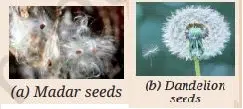
Answer: Madar and dandelion seeds are dispersed by wind because their light, feathery structures help them drift through the air.
- They have fine hair‑like structures or fluffy tufts.
- These act like parachutes, making the seeds light and helping them float in air.
- Wind can easily carry them far away from the parent plant.
Q5. A farmer plants two varieties of maize side by side, but notices that seeds form only when pollen from one variety reaches the stigma of the other. What type of pollination is this?
Answer: This is cross‑pollination, because pollen from one maize variety fertilises the flower of another variety.
Q6. Why do animals with external fertilisation generally produce more eggs than animals with internal fertilisation?
Answer: Animals with external fertilisation produce more eggs because many are lost in water or eaten, while internal fertilisation protects the eggs, so fewer are needed.
Q7. In animals, which fertilisation method the gametes are more protected?
Answer: Gametes are more protected in internal fertilisation, because fertilisation happens inside the female’s body.
Q8. Ravi suddenly notices that he is growing taller rapidly, his shoulders are broadening, and his voice cracks. What stage of life is he entering?
Answer: Ravi is entering puberty, the stage of life when a child’s body changes into an adult body.
- In boys, shoulders become broad, muscles grow, and the voice becomes deep.
- Height increases quickly.
- These changes happen because of hormones.
Q9. Rina’s period occurs every 28 days. Her last period was on the 5th of March. On which day is she most likely to get her next period?
Answer: Rina’s period occurs every 28 days. Her last period was on 5th March.
To find the next date, we simply add 28 days to 5th March.
- 5 March + 28 days = 2 April
Q10. A human zygote has just formed. How many chromosomes does it have?
Answer: A human zygote is formed when the male gamete (sperm) fuses with the female gamete (egg).
- The sperm has 23 chromosomes.
- The egg also has 23 chromosomes.
- When they join during fertilisation, the zygote gets a total of 46 chromosomes (23 pairs).
Q11. A flower’s anthers are removed before it matures. Later, pollen from another plant of the same species is dusted onto its stigma and seeds are produced. Which process has been ensured here?
(i) Self-pollination
(iii) Fertilisation
(ii) Cross-pollination
(iv) Tissue culture
Answer: (ii) Cross-pollination
Explanation: The process is cross‑pollination, because pollen from one plant fertilised the flower of another plant of the same species.
Q12. Arrange the following stages of sexual reproduction in plants in the correct order:
(i) Pollen germination on stigma
(ii) Fertilisation
(iii) Pollination
(iv) Formation of zygote
Answer: Pollination → Pollen germination on stigma → Fertilisation → Formation of zygote
- First comes pollination – pollen grains are transferred from the anther to the stigma.
- Next is pollen germination on stigma – the pollen grain grows a pollen tube down through the style.
- Then comes fertilisation – the male gamete travels through the pollen tube and fuses with the female gamete in the ovule.
- Finally, the zygote is formed – this is the first cell of the new plant.
Q13. Assertion (A): The zygote formed after fertilisation immediately attaches to the uterus wall.
Reason (R): The uterus wall is always prepared to receive the zygote.
(i) Both A and R are true, and R is the correct explanation of A.
(ii) Both A and R are true, but R is not the correct explanation of A.
(iii) A is true, but R is false.
(iv) A is false, but R is true.
Answer: (i) Both A and R are true, and R is the correct explanation of A.
Q14. Why does asexual reproduction produce offsprings that are genetically identical to the parent?
Answer: Asexual reproduction produces offspring that are genetically identical because they come from one parent only, without gamete fusion, so the DNA copy remains the same.
Q15. Explain why the menstrual cycle stops during pregnancy.
Answer: During pregnancy, the menstrual cycle stops because the fertilised egg (zygote) has already attached to the uterus wall.
Explanation:
- Normally, if no baby forms, the uterus lining breaks every month → this is the period.
- But when a baby starts to grow, the fertilised egg sticks to the uterus wall.
- The uterus lining must stay thick and safe to hold the baby.
- Special hormones keep the lining strong.
- So, the uterus lining does not break, and periods stop.
Q16. Why are flowers that bloom at night white or light in colour as compared to flowers that bloom during the day?
Answer: Flowers that bloom at night are white or light in colour so that they can be seen easily in the dark and attract night pollinators.
Explanation:
- At night, it is dark. Bright colours like red or blue cannot be seen clearly.
- White or light colours are easily visible in dim light.
- Night‑blooming flowers need to attract moths or bats for pollination.
- Their pale colour helps these animals find them quickly.
Q17. Why do vegetatively propagated plants tend to be more vulnerable to diseases than sexually reproduced plants?
Answer: Vegetatively propagated plants are more vulnerable to diseases because they are genetically identical to the parent, so the same weakness or disease passes to all offspring.
Explanation:
- In vegetative reproduction, the new plant grows from stem, root, or leaf of the parent.
- There is no mixing of gametes (no fertilisation).
- So, the new plants have the same genetic material as the parent.
- If the parent plant has a weakness or disease, all the new plants will also have it.
- In sexual reproduction, genes mix from two parents, so offspring are different and some may resist diseases.
Q18. If all flowers in a type of plant were only capable of self-pollination, how would it affect the genetic diversity over several generations? Explain.
Answer: If all flowers only did self‑pollination, genetic diversity would decrease over generations because there is no mixing of genes, making plants more alike and less adaptable.
Explanation:
- Self‑pollination means pollen from the same flower or plant fertilises its own ovule.
- There is no mixing of genes from different plants.
- Offspring get almost identical genetic material as the parent.
- Over many generations, this leads to less variation in the population.
- With low diversity, plants may become more vulnerable to diseases and less able to adapt to changes in the environment.
Q19. A farmer wants to produce a large number of genetically identical plants quickly. Suggest suitable reproduction methods and explain why they are effective.
Answer: The farmer should use vegetative propagation or tissue culture, because these methods make plants quickly and all are genetically identical to the parent.
Explanation:
Vegetative propagation
- New plants grow from parts like stem, root, or leaf (e.g., sugarcane from stem cuttings, potato from tubers).
- It is fast and produces plants exactly like the parent.
- Useful for crops where uniformity is important.
Tissue culture
- A small piece of plant tissue is grown in special nutrient medium in the lab.
- Many identical plants can be produced in a short time.
- Effective for producing disease‑free plants and rare species.
Q20. Suresh prepares slides with pollen grains in different sugar concentrations (0%, 2.5%, 5%, 7.5%, 10%) to study the germination of pollen.
(i) What are the different hypotheses which can be tested using this set-up?
(ii) What parameters should be kept the same in this set-up?
Answer:
(i) Hypotheses that can be tested
Using pollen grains in different sugar concentrations, Suresh can test:
- Effect of sugar concentration on pollen germination.
- Optimal sugar concentration needed for maximum germination.
- Too little or too much sugar may stop or reduce germination.
(ii) Parameters to keep the same
To make the experiment fair, Suresh must keep these conditions constant:
- Type of pollen – use pollen from the same plant species.
- Temperature – keep slides at the same temperature.
- Amount of pollen – equal quantity on each slide.
- Volume of solution – same amount of sugar solution on each slide.
- Time allowed – observe germination after the same duration.
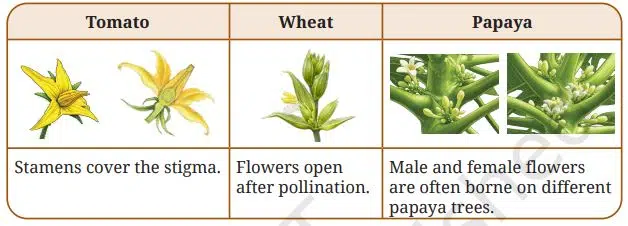
Q21. Look at the picture given below and think in line with the given prompts and find out which type(s) of pollination might have been followed in these flowers —
Answer:
Tomato flower – Type of pollination: Self‑pollination.
- Stamens cover the stigma.
- This means pollen from the same flower easily falls on the stigma.
Wheat flower – Type of pollination: Self‑pollination (autogamy).
- Flowers open only after pollination has already happened.
- This ensures pollen from the same plant fertilizes the ovary.
Papaya flower – Type of pollination: Cross‑pollination.
- Male and female flowers are on different trees.
- So pollen must travel from one plant to another.
Q22. In the lower Himalayan region of northern India, apples are an important cash crop that contribute significantly to farmer’s livelihoods. The fruit yield in apple cultivation is declining continuously, associated with climate change and a significant decline in the population of natural pollinators.
A esearcher-farmer group set up two experimental apple orchards at two distinct locations: Places A and B. In apple orchards at Place A, they allowed natural pollinators to pollinate the flowers of the apple. In apple orchards at Place B, they applied mixed farming techniques of beekeeping. Along with honey, the farmer yielded apples.
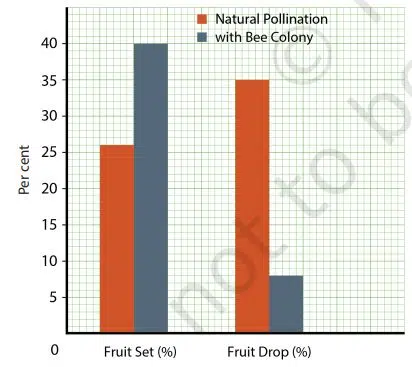
The yield of apples is depicted in Fig. 11.24, in terms of fruit setting (number of fruits/the total number of corresponding fruit-bearing branches) and fruit drop (premature falling of developing fruits) in the two types of experimental places of apple orchards.
(i) What are the hypotheses the researcher farmers group has thought of for this investigation?
(ii) What are the different parameters in the experiment?
(iii) Compare and analyse the data of two experimental orchards Places A and B, in terms of high yields of apple fruits.
(iv) Based on your analysis, what do you infer from the data?
Answer:
(i) Hypotheses: The researcher‑farmer group thought:
- If only natural pollinators are present, fruit yield will be lower.
- If beekeeping (bee colonies) are added, fruit yield will be higher because bees improve pollination.
Hypothesis: Bee colonies increase fruit set and reduce fruit drop compared to natural pollination.
(ii) Parameters in the experiment
- Fruit set (%) → number of fruits formed per fruit‑bearing branch.
- Fruit drop (%) → number of developing fruits that fall prematurely.
- Pollination type → natural pollination vs pollination with bee colony.
(iii) Comparison of data (Place A vs Place B)
- Fruit set:
- Natural pollination (Place A) ≈ 25%
- With bee colony (Place B) ≈ 40%
→ Bee colony gives higher fruit set.
- Fruit drop:
- Natural pollination (Place A) ≈ 35%
- With bee colony (Place B) ≈ 8%
→ Bee colony gives much lower fruit drop.
(iv) Inference from the data
- Orchards with bee colonies have better pollination, leading to higher yield of apples.
- Beekeeping not only provides honey but also improves apple production.
- This shows the importance of pollinators in agriculture, especially when natural pollinators are declining due to climate change.
Q23. A student claims, “In humans, ovulation always happens on day 14 of the menstrual cycle”. Critically examine this claim and state whether the claim is correct or not. Give at least two reasons for your answer.
Answer: The claim is false. Ovulation does not always occur on day 14; it varies depending on the length of the menstrual cycle and other factors.
Explanation:
- Ovulation usually happens around day 14 in a 28‑day cycle, but not always.
- The menstrual cycle length can vary (21–35 days in many women).
- If the cycle is longer or shorter, ovulation will happen earlier or later than day 14.
- Stress, illness, or hormonal changes can also shift the timing.
Disclaimer: The content that is present on our website is based on the NCERT Class 9 Science textbook and is provided for educational purposes only. All the content and images have been taken from Science Class 9 NCERT Textbook and CBSE Support material. Images and content shown above are the property of individual organizations and are used here for reference purposes only. To make it easy to understand, some of the content and images are generated by AI and cross-checked by the teachers.