
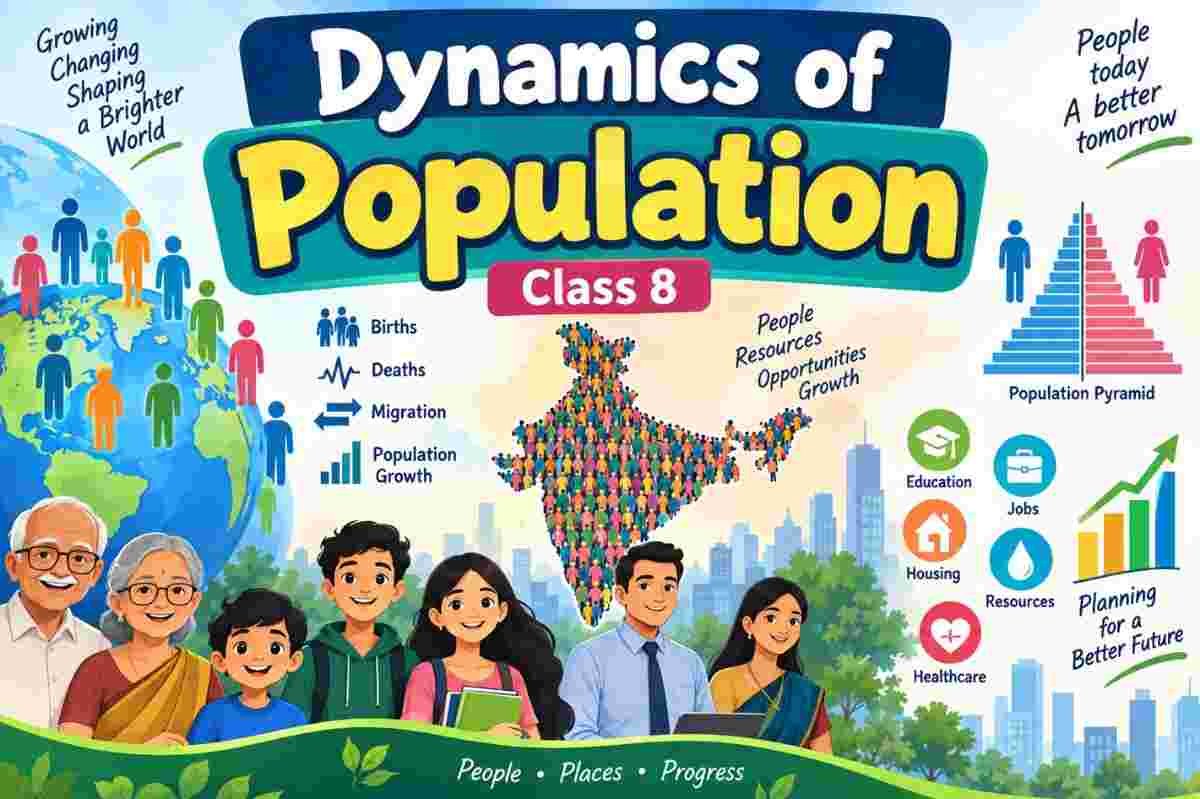
Dynamics of Population Class 8 Notes explain how the population of a country changes over time. This chapter helps students understand important topics such as population growth, birth rate, death rate, migration, population composition, population pyramid, demographic transition, demographic dividend, youth bulge, and ageing population. These notes explain each concept in simple and easy language with examples, making the chapter easier to understand and revise for exams.
Dynamics of Population Class 8 Notes
What Is Demography?
Demography is the study of population. It helps to understand people live in a place, their age, gender, education, and jobs, and how these change over time. In every country, population changes because of births, deaths, and migration. The government wants to know about the population; it helps the government to—
- More schools if the children are more.
- More hospitals and healthcare facilities if elders are more.
- More job opportunities if many young workers are there.
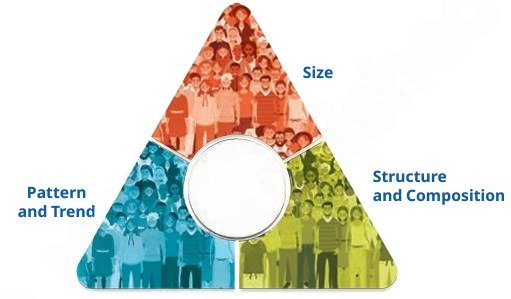
Companies also study age, gender, and income to make products that people want. The population also helps to understand the size and structure, which will help to plan resources like water, energy, housing, and roads.
Population at a Glance
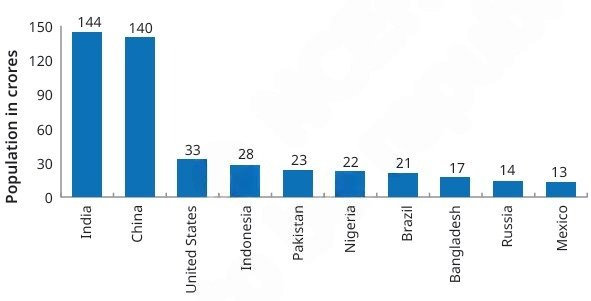
In 2023, India became the most populous country in the world. India has around 17% of the world population. The world population growth is—
- 1950 → 2.5 billion
- 2025 → 8.2 billion
- 2050 → 9.7 billion (expected)
- Mid‑2080s → peak at 10.3 billion, then decline.
Population growth depends on different factors, like better healthcare, which can improve people’s lives for a long time. If the birth rate is falling, then the population growth will be a shower. There are many countries whose growth is increasing, and some of the countries’ growth rates are declining, like
- Shrinking: China, Japan, Italy.
- Growing fast: India, Nigeria, and Ethiopia.
What Determines the Population of a Country?
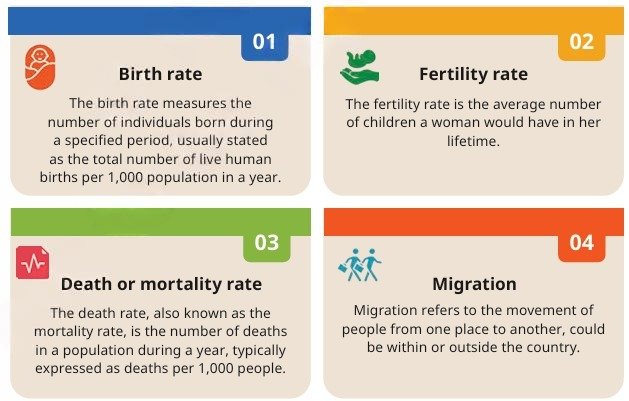
Every time the population changes, the population depends on birth, death, and migration over time. The birth rate is higher; the population grows fast. A lower birth rate population grows slowly.
What is the fertility rate?
Fertility rate means the average number of children a woman is expected to have during her lifetime. A fertility rate of about 2.1 is called the replacement level.
- If fertility is above 2.1, the population is likely to increase.
- If fertility is below 2.1, the population may decrease over time.
There are many countries where the fertility rate is low, like South Korea, Japan, Italy, Spain, and France. The reasons behind the decrease of the fertility rate are
- Better education, especially for girls.
- Women working in jobs → marry later, with fewer children.
- Urbanization → high cost of living → smaller families.
Death or mortality rate
The report shows that many people die in our country. The low mortality rate depends on good healthcare and better nutrition. India reduced child mortality from
- Child mortality in 1950: 271 deaths per 1,000 children
- Child mortality in 2023: 28 deaths per 1,000 children
India has also seen a large increase in life expectancy.
- At the time of independence, life expectancy was 30 years.
- In 2024: life expectancy of 70 years
What does “life expectancy of 70 years” mean?
Suppose 1,000 babies are born in India today. If India’s life expectancy is 70 years, it means that, on average, people born today are expected to live around 70 years under today’s general living conditions. It does NOT mean:
- Every person will die at exactly 70.
- Everyone will live only 70 years.
What is life expectancy?
Life expectancy means the average number of years a newborn is expected to live if living conditions remain similar to those of people today. For example, if life expectancy is 70 years, it means a baby born today is expected, on average, to live around 70 years. It does not mean that every person will live exactly 70 years.
What is migration?
Many times people move for jobs, education, and safety. Sometimes natural disasters or political problems also cause migration. Due to migration, some of the cities, like Delhi, Mumbai, and Bengaluru, grew fast. In one place if many people are living, then there will be a problem of water, housing, and transport.
How Do Countries Experience Population Change?
What is demographic transition?
A country’s population changes over time because birth and death rates change. This change is called demographic transition. The economic development, better healthcare, education, and greater participation of women in decision-making can cause these changes. There are three main stages.
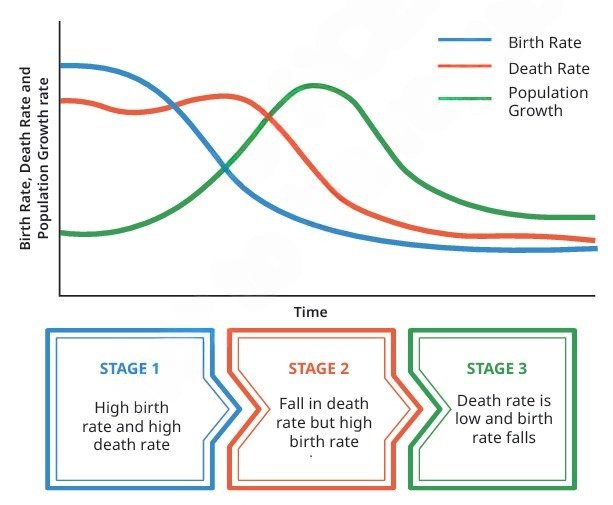
Stage 1 – High death and high birth rates
In this, many babies are born, and many people also die, and because of this, the population growth is very slow. This situation was seen from around 1901 to 1921.
Stage 2 – Death rate falls, but birth rates are still high.
If healthcare improves, fewer people will die, and the birth rate will remain high. As a result, the population grows very quickly. The India population growth became rapid after 1951.
Stage 3 – Death rate is low, and birth rate begins to fall
Death rates remain low because of better healthcare. Birth rates start falling because people have fewer children. Urbanization, higher incomes, and education contribute to this change. Countries such as Italy, Japan, and South Korea have experienced population decline. India’s fertility began falling in the mid-1980s and is now below the replacement level.
India’s Population: Composition and Trends
The population composition means the study of age, gender, education, jobs, etc. This shows how the people are structured in a country. In a population pyramid there are three main parts:
- Bottom = children.
- Middle = working adults.
- Top = elderly.
Shape tells us if the population is young, stable, or aging.
How India’s Population Pyramid Has Changed
In the 1950s, the Indonesian population pyramid looked like a narrow triangle. This shows that—
- Many children and young people
- Fewer elderly people
- High birth rate
- Low life expectancy
- Poorer healthcare and nutrition
That time life expectancy was around 30 to 35 years. In recent years the India population pyramid has become more bell-shaped. This means the
- Base is narrower → families are having fewer children.
- The middle is wider → there are many people of working age.
- The top is becoming wider → people are living longer.
Nowadays, India is moving from a very young population towards a more balanced population.
India’s Demographic Dividend—A Limited Window of Opportunity
India has a large working-age population, which gives India an economic advantage, which is called a demographic dividend. These young and working people can—
- Work in factories and offices
- Work on farms
- Start businesses.
- Earn money.
- Pay taxes.
- Produce goods and services.
Definition: A demographic dividend is the economic benefit a country can get when it has a large and productive working-age population.
What is the youth bulge?
When the country has a very large number of young people, then it is called a youth bulge. In India, a large part of the population consists of children and young adults.
- About 27% of Indians are below 15 years.
- Nearly 65% are in the working-age group of 15–59 years.
This large working-age population gives an advantage to the economic growth.
Why is the Demographic Dividend a Limited Opportunity?
The demographic dividend will not last forever. The number of young people will decrease after 2025. As per the India demographic dividend—
- In 2007, children below 5 years are more.
- In 2011, the population below 15 years reached its highest level.
- After 2050, the older population will be more, and now there will be a decline in population.
Some states, such as Kerala and Tamil Nadu, are already experiencing more population aging than states such as Bihar and Uttar Pradesh.
What is an aging population?
The aging population means the country has more elderly people compared to younger people. When the elderly people will be there then—
- More healthcare is needed.
- Fewer workers will be available.
- Slower economic growth
- Pressure on pensions.
- Fewer taxpayers.
How Can Countries Deal with an Aging Population?
To deal with an aging population, we can use technology and automation, improve healthcare, and develop services for elderly people. For example, in Japan, when the aging population increased the retirement age, they used technology and automation to deal with a shortage of workers.
Countries like India need to use their demographic dividend wisely by investing in:
- Good education
- Skill development
- Healthcare
- Employment opportunities
Women and the “Double Burden”
Many women take formal jobs; some women may have to manage both job responsibility and household responsibilities. This is called a double burden. To help the women, the government has to make
- Better childcare facility.
- Daycare center.
- Families have to support them.
- Flexible working hours.
These facilities can help more women participate in the workforce and allow the country to benefit from its demographic dividend.
Disclaimer: The content that is present on our website is based on the NCERT Class 8 Social Science textbook and is provided for educational purposes only. All the content and images have been taken from Socail Science Class 8 NCERT Textbook. Images and content shown above are the property of individual organizations and are used here for reference purposes only. To make it easy to understand, some of the content and images are generated by AI and cross-checked by the teachers.