
Citizenship Rights and Duties Class 8 Notes explains the rights and responsibilities of citizens in a democracy. These notes cover important citizenship rights, duties of citizens, equality, freedom, and the role of citizens in building a better society. The chapter is explained in simple and easy language to help Class 8 students understand the concepts and prepare for exams.
Citizenship Rights and Duties Class 8 Notes
A citizen is a person who legally belongs to the country. In a democracy, citizens can participate in decision-making like voting. Citizenship gives a right to vote, free speech, freedom or religion, and the right to life, but also there are some duties, like obeying laws, paying taxes, respecting others, and protecting the environment. Citizenship is both—
- A legal identity → connects you formally to your country.
- A social responsibility makes you belong to society and share common values.
Example: Story of Kruti, Sonali, and Harshada
Kruti was a new student. Some students teased her because of her accent. Sonali and Harshada saw this and decided to help her. They told the bullies to stop teasing Kruti. They also invited Kruti to join their badminton team. This made Kruti feel welcome and included.
Kruti happily joined them and felt that she belonged. Sonali and Harshada showed that being a good citizen means helping others, standing up against bullying, and making everyone feel included.
A citizen is a person who legally belongs to a country. Citizens have certain rights, such as
- The right to vote.
- The right to express their views.
- The right to live and work safely.
Citizens also have duties, such as
- Following the law.
- Paying taxes.
- Respecting others.
- Helping to keep society safe.
- Protecting the environment.
Citizenship is not only a legal identity. It also means being responsible towards society and helping others.
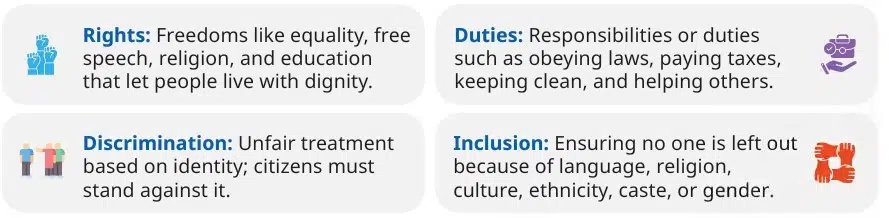
In India, all citizens have equal rights before the Constitution. People may have different languages, religions, or cultures, but they have equal rights. The Citizenship Act, 1955, and the Citizenship (Amendment) Act, 2019, contain rules about Indian citizenship. This chapter mainly focuses on four important ideas:
Rights
What are rights?
The rights are the things we all deserve to live with dignity, safety and respect. For example, education, livelihood, and free speech. Rights are not unlimited; any person’s rights do not harm others. The Constitution gives fundamental rights to all citizens. These protect freedom and dignity. If violated, people can go to court.
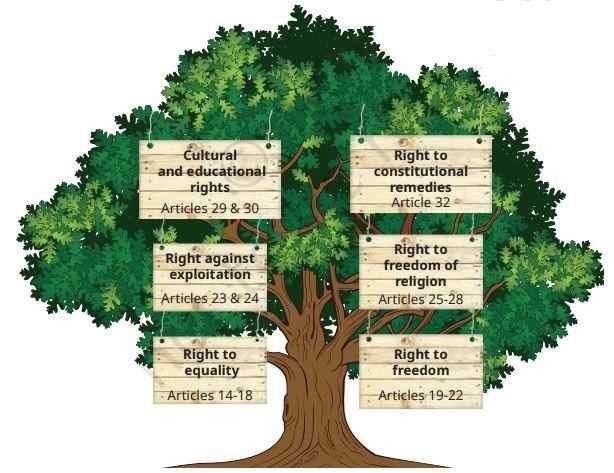
- Right to Equality – Equal before law, no discrimination by caste, religion, gender, race, or birthplace. Ends untouchability.
- Right to Freedom – Freedom of speech, movement, work, and life choices (with reasonable limits).
- Right to Life – Live with dignity, livelihood, education, health, clean environment, fair treatment.
- Right against Exploitation – No forced labour, human trafficking, or child labour (below 14 years in hazardous work).
- Right to Freedom of Religion – Choose and practise any religion freely; government schools cannot promote one religion.
- Cultural and Educational Rights – Protect languages, traditions, and minority schools; equal access to education.
- Right to Constitutional Remedies – Go to Supreme Court if rights are violated.
Duties
Duties are the responsibilities. It is just like how we keep our home clean; we must take care of our society, country, and environment. The Constitution of India gives rights, but it also tells us what we should do. These are called fundamental duties.
Why Are Duties Important?
The duties are important because they help us to make good citizens. They keep our democracy strong. They also protect unity and peace and help to save nature and culture. They help society to grow with dignity.
What the Constitution of India says about duties (Article 51A)
- Respect Constitution, Flag, and Anthem: Stand silently during the National Anthem.
- Follow freedom struggle ideals: Speak against injustice, like bullying.
- Protect unity and sovereignty: Don’t fight over language or religion.
- Defend the nation and help in emergencies: Help people during floods or earthquakes.
- Promote harmony and respect women: Stop teasing and respect dignity.
- Preserve culture and heritage: Don’t write on monuments or forts.
- Protect environment and animals: Plant trees, keep water bowls for stray dogs.
- Develop scientific temper: Learn by experiments, not just memorizing.
- Protect public property: Don’t break benches or school furniture.
- Strive for excellence: Do your best in studies, sports, and work.
- Ensure education for children: Parents must send kids (6–14 years) to school.
Rights and Duties: Two Sides of the Same Coin
Rights are the freedoms and benefits given to every citizen. It allows us to live with dignity; it is protected by law. If someone’s rights are violated, they can go to court for justice. Examples of the rights are
- Freedom of speech.
- Right to equality.
- Right to education.
Duties are the responsibilities that we have to follow as citizens. Duties remind us to use our freedom wisely. They are moral and social responsibilities. The person who is not following them may not always lead to punishment, but it harms society. Examples of Duties—
- Respect the Constitution and National Flag.
- Protect the environment.
- Ensure education for children.
How Rights and Duties Work Together
Rights give us freedom, and duties give us the ability to use that freedom responsibly. Fulfilling duties helps protect everyone’s rights. If any person follows rights and duties, then they keep society fair, peaceful, and democratic.
What is discrimination?
Discrimination means treating someone unfairly because of things like religion, caste, race, disability, gender, looks, or money background. It is unethical and also illegal in India. For example, some students who sailed to Sanya didn’t look like lead actors. But Sanya gave an audition with confidence and was chosen for an important role. The teachers explained that judging someone by looks is discrimination.
Types of Discrimination
There are two types of discrimination.
- Visible discrimination: Direct action like not letting someone sit with you or openly teasing them.
- Invisible discrimination: Subtle actions like excluding someone from a project, making jokes, or ignoring them because of background or appearance.
Why is Discrimination Harmful?
Discrimination hurts people psychologically and physically. It creates social barriers and stops people from enjoying their fundamental rights. It breaks the values of the Indian Constitution, like respect, equality, and unity. A person who discriminates is not acting like a responsible citizen.
What is inclusion?
Inclusion means making sure everyone feels welcome, respected, and valued. It gives equal access to opportunities, no matter their background, language, caste, religion, disability, or economic status. For example, at first only confident English readers joined the club. Then books in regional languages, storytelling, and puppetry were added. Soon, all children participated no matter their language skills. This shows the inclusion means removing barriers so everyone can join.
Why Inclusion Matters
It helps to build unity and equality. It removes social barriers and helps everyone enjoy their rights. It also creates a society where everyone belongs.
Disclaimer: The content that is present on our website is based on the NCERT Class 8 Social Science textbook and is provided for educational purposes only. All the content and images have been taken from Socail Science Class 8 NCERT Textbook. Images and content shown above are the property of individual organizations and are used here for reference purposes only. To make it easy to understand, some of the content and images are generated by AI and cross-checked by the teachers.