
India’s Urban Landscape explores the growth and changing nature of cities in India. It explains how urban areas develop, how people live and work in cities, and how cities are connected through transport, markets, industries, and services. The chapter also helps students understand the opportunities and challenges created by rapid urbanisation, such as housing, traffic, pollution, waste management, and the need for better planning.
India’s Urban Landscape Class 8 Notes
Cities are the place where many people live. In cities there are shops, offices, factories, services, government offices, transport systems, etc. These cities are managed by the local bodies, which are known as municipal corporations. The municipal corporation takes care of roads, water, electricity, and other needs.
In villages there are fewer people living as compared to cities. In village most people are doing farming or agriculture related work. In the village, all the people know each other, which means they are close-knit. The villages are managed by local councils, known as gram panchayats.
There are some rules which is used by the country to define urban area like –
- In India, a place is called urban if it has more than 5,000 people.
- In Japan, the number is 50,000 people.
- In Denmark, even 220 people can make a place urban!
Population Density in Cities
Suppose you have 5 friends in your room and plenty of space available. Now 30 people come to your room, and now you will find it crowded. This is what population density is; the population density tells us how people live in a given area. The formula of population density is –
Population Density = Total Population / Area (sq km)
If the city has 10000 people in 2 sq km, then the density is 5000 people per sq km.
How Do Cities Become Centers of Economic Activities?
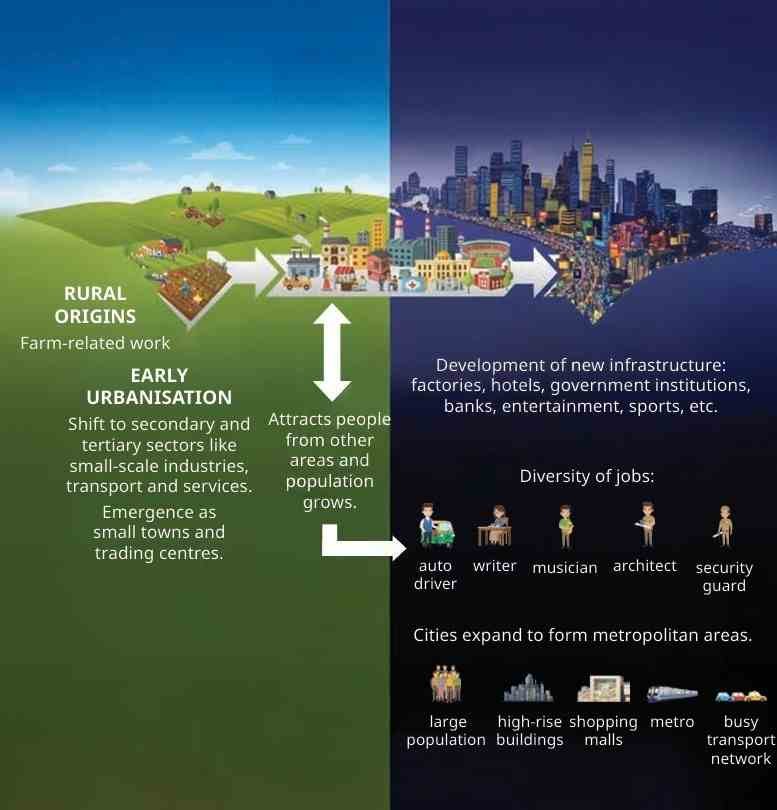
Most of the cities you will find near rivers because of the transport and water supply. In cities, markets grow very fast because of the crossroads of trade routes. Factores needs raw material, and it is available easily in cities. Over a time the cities become centres of jobs, trade, politics and administration.
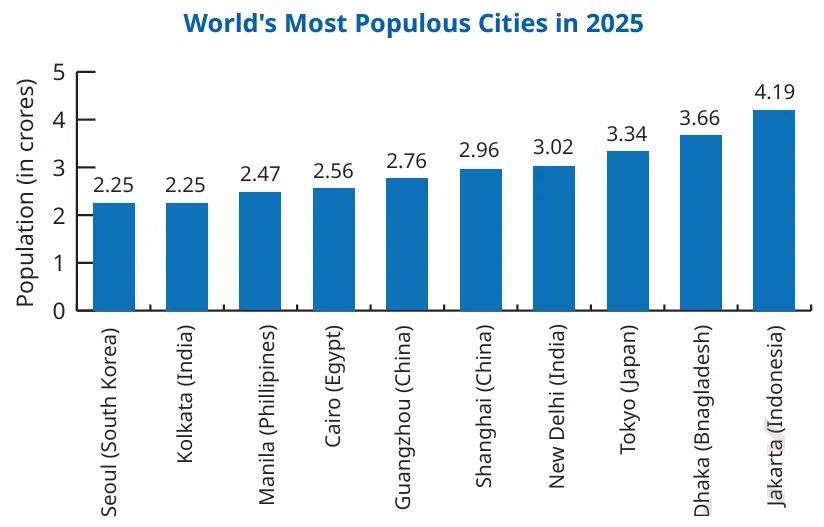
Today approx. 55% of the world’s people live in cities. According to the United Nations’ estimates, by 2050, 68 percent of the world’s population will be living in cities. A similar trend is expected in India, where the urban population has grown from 17 percent in 1951 to around 40 percent in 2025.
What Leads to Urbanization?
When the villages slowly turning into towns and cities are known as urbanisation. This is happens step by step. The main reasons are –
- Location → Cities near rivers, seas, or trade routes grow faster.
- Industries → Factories and businesses attract workers.
- Trade → Ports and markets bring money and jobs.
- Education → Colleges and universities pull students and skilled people.
- Culture → Monuments, temples, and film industries make cities famous.
- Government → Capitals and administrative centers attract people for jobs.
Some examples of Indian cities are
- Mumbai: It grew as a port city and became the financial capital of India. In Mumbai, the Bombay Stock Exchange and the film industry are also available.
- Bengaluru: It is an IT hub and called the Silicon Valley of India.
- Hyderabad: It is the center of technology companies.
- Delhi: It is a center of power, trade, and culture. Delhi expanded into NCR with Noida and Gurugram.
Some of the other factors are also there, like—
- Tourism: Agra because of the Taj Mahal, Varanasi, and Amritsar.
- Cheaper costs: There are some cities like Kochi, Indore, Lucknow, and Nagpur that attract the big companies because of the low costs.
- Moder service: There are some cities where you will find BPO (Business Process Outsourcing) and IT services, which bring jobs to many people.
Cities as Cultural Hubs
Cities help the people to bring together from the different regions. The cities are the mixture of language, food, festivals, and tradition. It is just like a cultural potpourri. For example,
- Mumbai: Mumbai is famous for Vada pav and for textile mills.
- Kolkata: Kolkata is famous for Durga Puja (UNESCO heritage) and museums, including memorials.
Cities also build libraries, museums, stadiums, and cultural centers.
Challenges Faced by Cities
There are some challenges that the people faced in cities are—
- Overcrowding: If too many people live in one place then there will be shortage of houses.
- Infrastructure strain: Because of too many people, there will be a shortage of water, sanitation, energy, waste systems, roads, etc.
- Pollution: The Delhi NCR records AQI (Air Quality Index) above 400, which is unsafe for people.
- Heat islands: Because of the building, concrete, and traffic, the temperature of the cities will increase.
- Crime: If the density is higher, then there will be inequality and it will be difficult to manage law and other issues.
What are slums?
Slums are the crowded areas where the limited services with poor housing are available. It is basically found near railway tracks, industrial areas, and city edges. People here often do informal jobs like vending, domestic help, construction, plumbing, etc. Governement schemes like Pradhan Mantri Awaas Yojana try to provide affordable housing.
Planning Our Cities
Cities are not just buildings and roads. It has a living system that grows and changes. To make them better, we need urban planners.
What is an urban planner?
A person who designs how to use land in cities. They plan homes, offices, parks, schools, hospitals, transport, and safety services. The goal is to improve quality of life for everyone.
What Urban Planners Think About
The urban planners think about the—
- Population: How many people live there?
- Jobs: What kind of work do they do?
- Transport: Roads, buses, metro, and cycling paths.
- Housing: Affordable homes for all.
- Public facilities: schools, hospitals, libraries, and sports centers.
- Safety: Police, fire stations, safe streets.
Examples of Planned Cities
There are many cities that are planned by the government, like
- Ahmedabad (Sabarmati Riverfront): you will have parks, promenades, boating, and the Atal Bridge for walking/cycling.
- Gangtok (MG Road): Clean, pedestrian-only shopping street with restaurants and hotels.
Why Planning Matters
The cities face pollution, traffic, inequality, and loss of green space. A sustainable city balances growth with care for people and nature. It must give opportunities to all, including the vulnerable, without exhausting resources.
Disclaimer: The content that is present on our website is based on the NCERT Class 8 Social Science textbook and is provided for educational purposes only. All the content and images have been taken from Socail Science Class 8 NCERT Textbook. Images and content shown above are the property of individual organizations and are used here for reference purposes only. To make it easy to understand, some of the content and images are generated by AI and cross-checked by the teachers.