
← Back to Class 10 Study Material
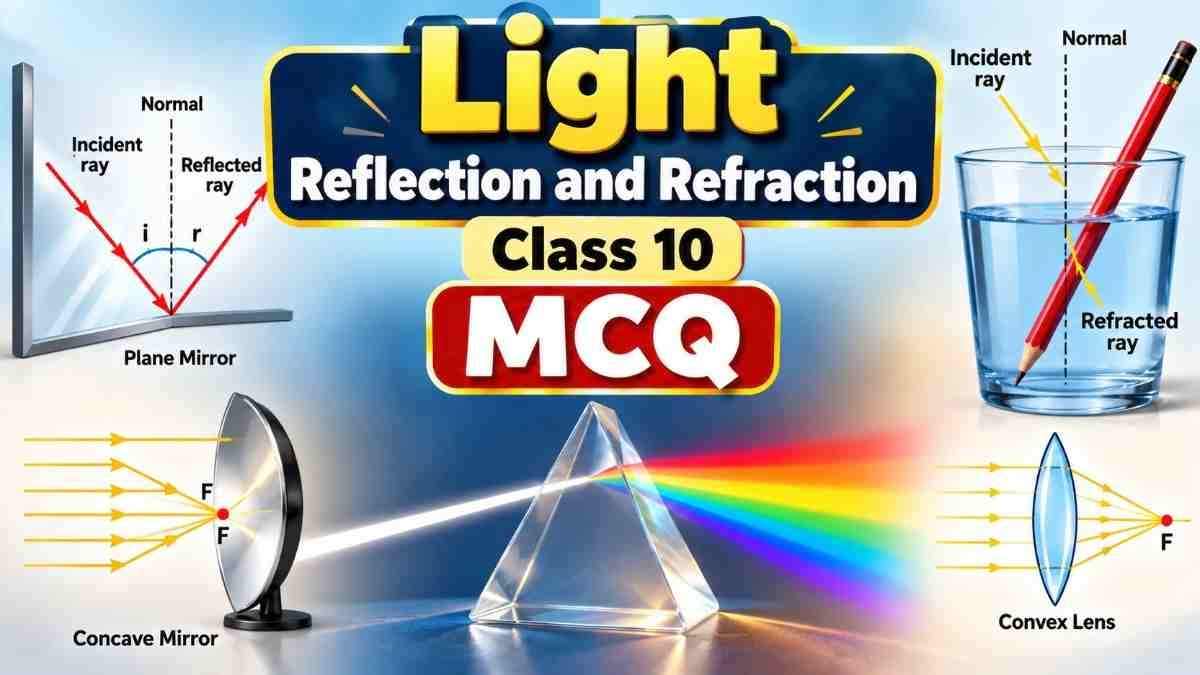
Practice Light Reflection and Refraction Class 10 MCQs based on the NCERT Science textbook. These multiple-choice questions cover important concepts such as reflection of light, spherical mirrors, mirror formula, magnification, refraction, refractive index, lenses, lens formula, and power of a lens.
Light Reflection and Refraction Class 10 MCQ
Conceptual Recall
Q. We are able to see an object because:
a) The object absorbs light
b) The object reflects light into our eyes
c) The object produces sound
d) The object creates air currents
Answer: b) The object reflects light into our eyes
Q. According to the laws of reflection, the angle of incidence is always:
a) Greater than the angle of reflection
b) Less than the angle of reflection
c) Equal to the angle of reflection
d) Twice the angle of reflection
Answer: c) Equal to the angle of reflection
Q. A spherical mirror whose reflecting surface is curved inwards is called a:
a)Convex mirror
b)Plane mirror
c)Cylindrical mirror
d)Concave mirror
Answer: d)Concave mirror
Q. The nature, position and size of the image formed by a concave mirror depend upon:
a) The material of the mirror
b) The position of the object with respect to P, F and C
c) The colour of the object
d) The aperture only
Answer: b) The position of the object with respect to P, F and C
Q. When an object is placed at the centre of curvature (C) of a concave mirror, the image formed is:
a) Virtual and enlarged
b) Real and diminished
c) Real, inverted and of the same size
d) Virtual and diminished
Answer: c) Real, inverted and of the same size
Q. Which mirror is commonly used by dentists to see an enlarged image of a patient’s teeth?
a) Concave mirror
b) Convex mirror
c) Plane mirror
d) Cylindrical mirror
Answer: a) Concave mirror
Q. Convex mirrors are preferred as rear-view mirrors because they always form images that are:
a) Real and enlarged
b) Virtual, erect and diminished
c) Real and inverted
d) Virtual and enlarged
Answer: b) Virtual, erect and diminished
Q. The change in direction of light when it passes from one transparent medium to another is called:
a) Reflection
b) Dispersion
c) Refraction
d) Diffraction
Answer: c) Refraction
Q. When a ray of light travels from a rarer medium to a denser medium, it bends:
a) Away from the normal
b) Towards the normal
c) Parallel to the interface
d) Along the normal only
Answer: b) Towards the normal
Q. A convex lens is also called a:
a) Diverging lens
b) Converging lens
c) Plane lens
d) Reflecting lens
Answer: b) Converging lens
Q. A concave lens always forms an image that is:
a) Real, inverted and enlarged
b) Real, erect and diminished
c) Virtual, erect and diminished
d) Virtual, inverted and enlarged
Answer: c) Virtual, erect and diminished
Q. The power of a lens is defined as:
a) The focal length of the lens
b) The reciprocal of the focal length
c) Twice the focal length
d) The diameter of the lens
Answer: b) The reciprocal of the focal length
Q. The SI unit of power of a lens is:
a) Metre
b) Watt
c) Dioptre
d) Joule
Answer: c) Dioptre
Application-Based
Q. A student sees a sharp, bright spot of sunlight on a paper using a mirror. Which mirror was most likely used?
a)Concave mirror
b)Convex mirror
c)Plane mirror
d)Glass slab
Answer: a)Concave mirror
Q. While observing a spoon, a student finds that one side can produce a magnified image of the face when held close. This side behaves like a:
a)Convex mirror
b)Plane mirror
c)Concave mirror
d)Transparent surface
Answer: c)Concave mirror
Q. A driver prefers a convex mirror as a rear-view mirror because it:
a)Converges light rays
b)Forms a bright spot of light
c)Can burn paper using sunlight
d)Provides a wider field of view
Answer: d)Provides a wider field of view
Q. A candle is placed between the pole (P) and focus (F) of a concave mirror. The image formed will be:
a) Real and inverted
b) Virtual and erect
c) Real and diminished
d) Real and same-sized
Answer: b) Virtual and erect
Q. A student places an object very far from a concave mirror. The image formed will be:
P = Pole of the mirror
F = Principal Focus
C = Centre of Curvature
C ——– F ——– P )
a) At C, enlarged
b) Between F and C, diminished
c) At F, highly diminished
d) Behind the mirror, enlarged
Answer: c) At F, highly diminished
Q. A concave mirror produces a real, inverted and enlarged image of an object. The object is most likely placed:
C ——– F ——– P )
a) Between C and F
b) At C
c) Beyond C
d) At F
Answer: a) Between C and F
Q. A driver wants to see a larger area of traffic behind the vehicle. Which mirror should be used?
a) Concave mirror
b) Plane mirror
c) Convex mirror
d) Any mirror will work equally well
Answer: c) Convex mirror
Q. A solar furnace uses a large concave mirror because it can:
a) Form diminished images
b) Produce virtual images
c) Reflect light in all directions
d) Concentrate sunlight at one point to produce heat
Answer: d) Concentrate sunlight at one point to produce heat
Q. The radius of curvature of a spherical mirror is 20 cm. Its focal length is:
a) 10 cm
b) 20 cm
c) 40 cm
d) 5 cm
Answer: a) 10 cm
Q. A coin placed at the bottom of a bowl becomes visible when water is poured into it. This happens because:
a) Water reflects all the light
b) The coin moves upward
c) Refraction makes the coin appear raised
d) Water produces its own light
Answer: c) Refraction makes the coin appear raised
Q. A ray of light enters obliquely from glass into air. The refracted ray will:
a) Bend towards the normal
b) Bend away from the normal
c) Retrace its path
d) Stop at the boundary
Answer: b) Bend away from the normal
Q. The refractive index of diamond is 2.42. This means that light travels:
a) 2.42 times faster in diamond than in air
b) At the same speed in diamond and air
c) Faster in diamond than in vacuum
d) 2.42 times slower in diamond than in air
Answer: d) 2.42 times slower in diamond than in air
Q. An object is placed at 2F₁ of a convex lens. The image formed will be:
a) At 2F₂, same size
b) At F₂, diminished
c) Beyond 2F₂, enlarged
d) At infinity
Answer: a) At 2F₂, same size
Q. A student places an object between F₁ and 2F₁ of a convex lens. The image obtained is:
a) Real, inverted and diminished
b) Virtual and erect
c) Real, inverted and enlarged
d) Highly diminished
Answer: c) Real, inverted and enlarged
Q. An object is placed between the focus (F₁) and optical centre (O) of a convex lens. The image formed is:
a) Real and inverted
b) Virtual and erect
c) Real and diminished
d) Real and same-sized
Answer: b) Virtual and erect
Q. A lens has a focal length of +0.5 m. Its power is:
a) +2 D
b) -2 D
c) +0.5 D
d) -0.5 D
Answer: a) +2 D
Q. An optician prescribes a lens of power -2.5 D. The lens is:
a) Convex lens
b) Plane lens
c) Concave lens
d) Cylindrical lens
Answer: c) Concave lens
Q. A convex lens of shorter focal length bends light rays more because it has:
a) Lower power
b) Greater power
c) Zero power
d) Constant power
Answer: b) Greater power
Assertion–Reason
Q. Assertion (A): The image formed by a plane mirror is laterally inverted.
Reason (R): The left side of the object appears as the right side in the image.
a)Both A and R are true, and R is the correct explanation of A
b)Both A and R are true, but R is not the correct explanation of A
c)A is true, but R is false
d)A is false, but R is true
Answer: a)Both A and R are true, and R is the correct explanation of A
Q. Assertion (A): The principal focus of a concave mirror is a real point.
Reason (R): Rays parallel to the principal axis actually meet at the focus after reflection.
a)Both A and R are true, and R is the correct explanation of A
b)Both A and R are true, but R is not the correct explanation of A
c)A is true, but R is false
d)A is false, but R is true
Answer: a)Both A and R are true, and R is the correct explanation of A
Q. Assertion (A): A concave mirror can form both real and virtual images.
Reason (R): The type of image formed depends on the position of the object.
a) Both A and R are true, and R is the correct explanation of A
b) Both A and R are true, but R is not the correct explanation of A
c) A is true, but R is false
d) A is false, but R is true
Answer: a) Both A and R are true, and R is the correct explanation of A
Q. Assertion (A): A ray passing through the centre of curvature of a concave mirror retraces its path after reflection.
Reason (R): The ray strikes the mirror normally at the point of incidence.
a)Both A and R are true, and R is the correct explanation of A
b)Both A and R are true, but R is not the correct explanation of A
c)A is true, but R is false
d)A is false, but R is true
Answer: a) Both A and R are true, and R is the correct explanation of A
Q. Assertion (A): A convex mirror always forms a virtual image.
Reason (R): The image formed by a convex mirror is always behind the mirror.
a) Both A and R are true, and R is the correct explanation of A
b) Both A and R are true, but R is not the correct explanation of A
c) A is true, but R is false
d) A is false, but R is true
Answer: a) Both A and R are true, and R is the correct explanation of A
Q. Assertion (A): In the New Cartesian Sign Convention, distances measured to the left of the pole are taken as negative.
Reason (R): The object is always placed to the left of the mirror.
a)Both A and R are true, and R is the correct explanation of A
b)Both A and R are true, but R is not the correct explanation of A
c)A is true, but R is false
d)A is false, but R is true
Answer: a) Both A and R are true, and R is the correct explanation of A
Q. Assertion (A): A ray passing through the optical centre of a lens emerges without deviation.
Reason (R): The optical centre is a point through which light passes undeviated.
a) Both A and R are true, and R is the correct explanation of A
b) Both A and R are true, but R is not the correct explanation of A
c) A is true, but R is false
d) A is false, but R is true
Answer: a) Both A and R are true, and R is the correct explanation of A
Q. Assertion (A): A concave lens cannot form a real image of a real object.
Reason (R): A concave lens always produces a virtual, erect and diminished image.
a)Both A and R are true, and R is the correct explanation of A
b)Both A and R are true, but R is not the correct explanation of A
c)A is true, but R is false
d)A is false, but R is true
Answer: a) Both A and R are true, and R is the correct explanation of A
Q. Assertion (A): The power of a convex lens is positive.
Reason (R): The focal length of a convex lens is taken as positive.
a) Both A and R are true, and R is the correct explanation of A
b) Both A and R are true, but R is not the correct explanation of A
c) A is true, but R is false
d) A is false, but R is true
Answer: a) Both A and R are true, and R is the correct explanation of A
Q. Assertion (A): A lens of greater power has a shorter focal length.
Reason (R): Power is inversely proportional to focal length.
a)Both A and R are true, and R is the correct explanation of A
b)Both A and R are true, but R is not the correct explanation of A
c)A is true, but R is false
d)A is false, but R is true
Answer: a) Both A and R are true, and R is the correct explanation of A
Q. Assertion (A): A ray passing through a rectangular glass slab emerges parallel to the incident ray.
Reason (R): The bending of light at the two parallel faces of the slab is equal and opposite.
a)Both A and R are true, and R is the correct explanation of A
b)Both A and R are true, but R is not the correct explanation of A
c)A is true, but R is false
d)A is false, but R is true
Answer: a) Both A and R are true, and R is the correct explanation of A
Q. Assertion (A): Light travels slower in an optically denser medium.
Reason (R): An optically denser medium has a higher refractive index.
a)Both A and R are true, and R is the correct explanation of A
b)Both A and R are true, but R is not the correct explanation of A
c)A is true, but R is false
d)A is false, but R is true
Answer: a) Both A and R are true, and R is the correct explanation of A
Case Study-Based
Case Study: A student performs an activity using a concave mirror and a sheet of paper. The mirror is directed towards the Sun, and the reflected light is focused onto the paper. After adjusting the distance between the mirror and the paper, a bright and sharp spot is obtained. After some time, the paper begins to burn.
Q. The burning of the paper occurs because:
a)The mirror absorbs heat from the paper
b)The mirror reflects only ultraviolet rays
c)Sunlight is concentrated at a point by the mirror
d)The paper reacts chemically with the mirror
Answer: c)Sunlight is concentrated at a point by the mirror
Q. The bright spot formed on the paper represents the:
a)Pole of the mirror
b)Centre of curvature
c)Aperture of the mirror
d)Principal focus of the mirror
Answer: d)Principal focus of the mirror
Case Study: A student performs an activity by placing a candle at different positions in front of a concave mirror. He notices that when the candle is placed beyond the centre of curvature (C), the image is formed between F and C. When the candle is moved between F and C, the image becomes larger and is formed beyond C.
Q. When the object is beyond C, the image formed is:
a) Virtual and erect
b) Real, inverted and diminished
c) Real, inverted and enlarged
d) Virtual and enlarged
Answer: b) Real, inverted and diminished
Q. When the object is between C and F, the image formed is:
a) Real, inverted and enlarged
b) Real and same-sized
c) Virtual and diminished
d) Virtual and erect
Answer: a) Real, inverted and enlarged
Case Study: A student observes the image formed by a convex mirror. As the object is moved farther away, the image remains erect and diminished. The image is always formed behind the mirror between the pole (P) and focus (F).
Q. The image formed by the convex mirror is:
a) Real and inverted
b) Virtual and erect
c) Real and erect
d) Virtual and inverted
Answer: b) Virtual and erect
Q. As the object moves farther from the convex mirror, the image moves towards:
a) The centre of curvature
b) Infinity
c) The pole
d) The focus
Answer: d) The focus
Case Study: A student performs an experiment with a rectangular glass slab. A ray of light is allowed to fall obliquely on one face of the slab. The ray bends towards the normal on entering the slab and bends away from the normal on emerging into air. The emergent ray is found to be parallel to the incident ray but shifted sideways.
Q. The sideways shift of the light ray occurs due to:
a) Reflection at one surface only
b) Refraction at both surfaces of the slab
c) Absorption of light by glass
d) Dispersion of light
Answer: b) Refraction at both surfaces of the slab
Q. The emergent ray is parallel to the incident ray because:
a) Glass absorbs part of the light
b) The slab has curved surfaces
c) The deviations at the two faces cancel each other
d) The angle of incidence is zero
Answer: c) The deviations at the two faces cancel each other
Case Study: A student performs an experiment with a convex lens. When the object is placed beyond 2F₁, the image is formed between F₂ and 2F₂. As the object is moved closer and placed between F₁ and 2F₁, the image shifts beyond 2F₂ and becomes larger. Finally, when the object is placed between F₁ and O, the image becomes virtual and erect.
Q. When the object is beyond 2F₁, the image formed is:
a) Virtual and enlarged
b) Real, inverted and diminished
c) Real and same-sized
d) Virtual and diminished
Answer: b) Real, inverted and diminished
Q. Which observation indicates that the image is virtual?
a) The image is inverted
b) The image is obtained on a screen
c) The image is formed beyond 2F₂
d) The image is erect and on the same side as the object
Answer: d) The image is erect and on the same side as the object
Case Study: An optician prescribes two lenses to different patients. One lens has a power of +2.0 D and the other has a power of -2.5 D. The first lens has a focal length of +0.50 m, while the second lens has a focal length of -0.40 m.
Q. Which of the following correctly identifies the +2.0 D lens?
a) Concave lens
b) Plane glass slab
c) Convex lens
d) Diverging lens
Answer: c) Convex lens
Q. The focal length of the lens having power -2.5 D is:
a) -0.40 m
b) +0.40 m
c) -0.25 m
d) +0.25 m
Answer: a) -0.40 m
Diagram/Visual-Based
Q. Refer to Figure. Which statement correctly describes the position of the principal focus of a concave mirror?
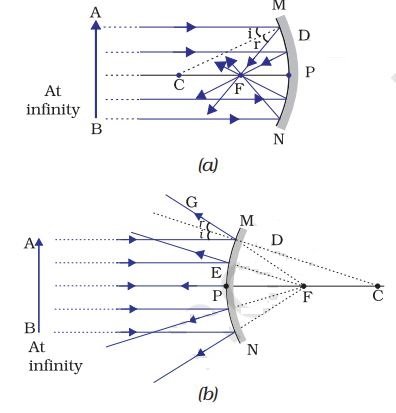
a)It lies behind the mirror
b)It lies on the principal axis in front of the mirror
c)It coincides with the pole
d)It lies beyond the aperture
Answer: b)It lies on the principal axis in front of the mirror
Q. Refer to Figure. For a spherical mirror of small aperture, the relationship between radius of curvature (R) and focal length (f) is:
a)R = f
b)R = 4f
c)R = 2f
d)R = f/2
Answer: c)R = 2f
Q. Refer to Figure. A ray parallel to the principal axis of a concave mirror, after reflection:
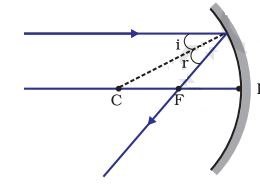
a) Passes through the centre of curvature
b) Retraces its path
c) Passes through the principal focus
d) Becomes parallel to the principal axis
Answer: c) Passes through the principal focus
Q. Refer to Figure. When an object is placed at a finite distance from a convex mirror, the image is formed:
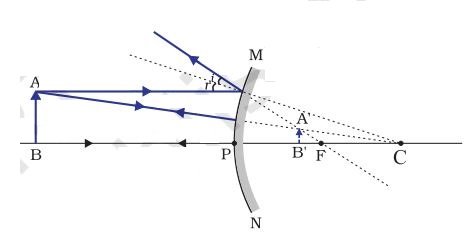
a) At the focus behind the mirror
b) Between P and F behind the mirror
c) Beyond C in front of the mirror
d) At infinity
Answer: b) Between P and F behind the mirror
Q. Refer to Figure. According to the New Cartesian Sign Convention, distances measured above the principal axis are taken as:
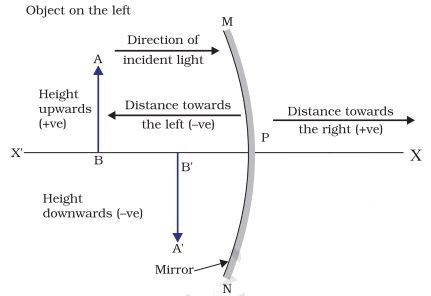
a) Negative
b) Zero
c) Positive
d) Infinite
Answer: c) Positive
Q. Refer to Figure. The ray OO’ shown inside the glass slab is called the:
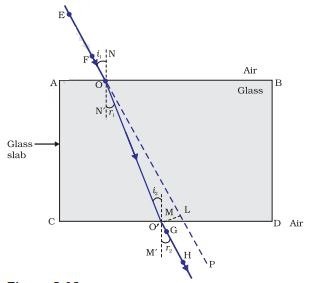
a) Incident ray
b) Emergent ray
c) Reflected ray
d) Refracted ray
Answer: d) Refracted ray
Q. Refer to Figure. Which type of lens is shown converging parallel rays of light to a point?
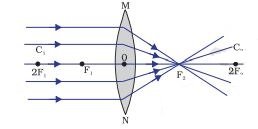
a) Concave lens
b) Convex lens
c) Plane glass slab
d) Plane mirror
Answer: b) Convex lens
Q. Refer to Figure. A ray parallel to the principal axis of a convex lens, after refraction, passes through:
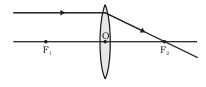
a) The optical centre
b) The centre of curvature
c) The principal focus on the other side of the lens
d) The object
Answer: c) The principal focus on the other side of the lens
Q. Refer to Figure. Which ray passes through a lens without suffering any deviation?
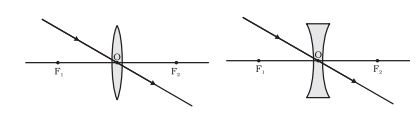
a) A ray passing through the optical centre
b) A ray parallel to the principal axis
c) A ray passing through the focus
d) A ray incident at an angle of 45°
Answer: a) A ray passing through the optical centre
Q. Refer to Figure. The lens shown converges parallel rays of light. Such a lens always has:
a) Negative power
b) Zero power
c) Positive power
d) Infinite power
Answer: c) Positive power
Q. Refer to Figure. The lens shown diverges parallel rays of light. Such a lens has:
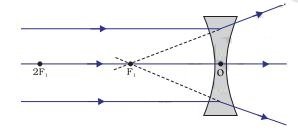
a) Positive power
b) Negative power
c) Zero power
d) Unit power
Answer: b) Negative power
Disclaimer: The content that is present on our website is based on the NCERT Class 10 Science textbook and is provided for educational purposes only. All the content and images have been taken from Science Class 10 NCERT Textbook. Images and content shown above are the property of individual organizations and are used here for reference purposes only. To make it easy to understand, some of the content and images are generated by AI and cross-checked by the teachers.