
← Back to Class 9 Social Science NCERT Solutions
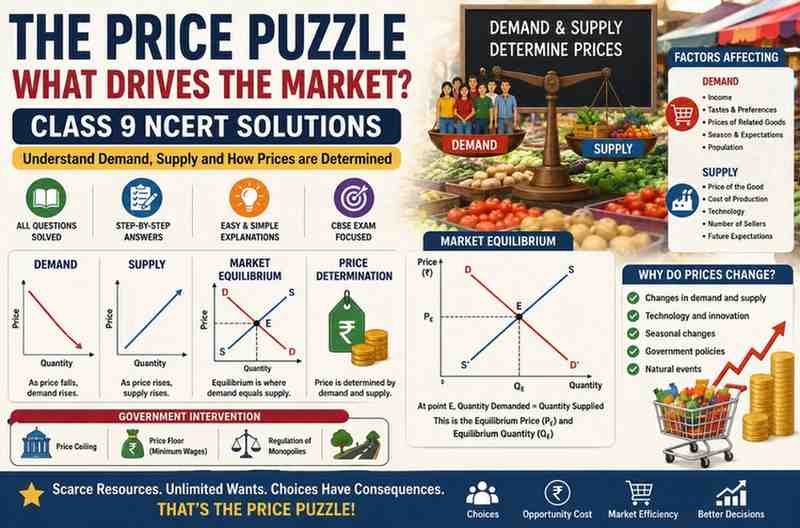
The Price Puzzle: What Drives the Market? Class 9 NCERT Solutions provide accurate, step-by-step answers to all the questions from the NCERT Class 9 Economics chapter “The Price Puzzle: What Drives the Market?” These solutions are prepared according to the latest CBSE syllabus and help students understand important concepts such as demand, supply, market equilibrium, price determination, shifts in demand and supply, government intervention, and market efficiency.
The Price Puzzle What Drives The Market Class 9 NCERT Solutions
Q1. What are the factors that influence the demand for and supply of goods and services in a market?
Answer: Demand is influenced by price, income, tastes, substitutes, complements, seasonality, expectations, and population. Supply is influenced by price, related goods, number of sellers, technology, input costs, and future expectations.
Q2. How are prices of goods and services determined through demand and supply interactions?
Answer: Prices are determined by the interaction of demand and supply. When demand is greater than supply, prices rise. When supply is greater than demand, prices fall.
Q3. What is market equilibrium, and does it exist in the real world?
Answer: Market equilibrium is the point where quantity demanded equals quantity supplied. In reality, equilibrium keeps shifting because markets are dynamic and affected by technology, seasons, and events.
Q4. How and why does the government intervene in the market?
Answer: The government intervenes to ensure fairness and welfare. It sets price ceilings for essentials, price floors like minimum wages, regulates monopolies, and provides public goods such as roads and parks.
Q5. An increase in income always leads to a rise in demand for goods. Defend or refute, giving reasons for the same.
Answer: It is not true that an increase in income always leads to more demand.
- For normal goods (like fruits, clothes, mobiles), when income rises, people buy more.
- But for inferior goods (like low‑quality food or cheap transport), demand may fall when income rises, because people shift to better alternatives.
So, income increase usually raises demand, but not for all goods. It depends on the type of product and people’s preferences.
Q6. If petrol prices double, what happens to:
a. Demand for diesel cars
b. Demand for electric cars
c. Demand for car accessories
d. Demand for public transport
Answer:
- a. Demand for diesel cars: increases (substitute).
- b. Demand for electric cars: increases (alternative).
- c. Demand for car accessories: decreases (less car use).
- d. Demand for public transport: increases (cheaper option).
Q7. A farmer traditionally irrigates fields manually (labour-intensive). He installs drip irrigation (a technology upgrade) that reduces water use by 40 per cent and increases yield by 30 per cent. How does this affect
a. His cost of production
b. His willingness to supply at different prices
c. The overall market supply if many farmers adopt this technology
Answer:
- a. Cost of production: decreases.
- b. Willingness to supply: increases at all prices.
- c. Overall market supply: rises if many farmers adopt it.
Q8. During online festival sales, the prices of many products are very low. Use the concept of demand and supply to explain why the sellers sell at such a low price. What happens to the equilibrium when the price is lowered? Does this benefit only consumers or sellers as well? Explain.
Answer: During online festival sales, sellers lower prices because of demand and supply. When prices fall, more people buy, so demand rises sharply. Sellers want to clear old stock, attract more buyers, and increase total sales.
When price is lowered, the equilibrium changes. Demand becomes higher than supply for a short time, but sellers adjust by offering more goods. This new balance helps the market clear.
It benefits consumers because they get products cheaply. It also benefits sellers, because even at low prices, they sell in large quantities, earn more revenue, and attract new customers for the future.
Q9. Suppose the government sets a maximum sale price for an essential vaccine below the market-driven price. What is likely to happen? Choose from the options below and elucidate your point.
a. Surplus
b. Shortage
c. No effect
d. Fall in demand
Answer: b. Shortage, because demand will rise but suppliers may reduce supply at low prices.
Q10. The government levies higher taxes on products such as tobacco and alcohol to promote healthier choices among citizens. Can you find out other goods where price controls have been set in place? What are the reasons for the same?
Answer: The government in India sets price controls not only on tobacco and alcohol but also on medicines, food items, fuels, and essential commodities to protect consumers and ensure fairness. These controls are meant to stop overpricing, hoarding, and exploitation, especially for goods that are vital for everyday life.
Q11. Can excessive government regulation hurt markets? Explain with examples.
Answer: Yes, excessive government regulation can hurt markets. While rules are needed to protect people, too many controls can reduce efficiency and discourage producers.
- Price distortions: If the government fixes prices too low (like wheat at ₹20 when market price is ₹30), farmers earn less. This reduces production and creates shortages.
- Compliance burden: Small businesses face many licenses and permits (food safety, fire safety, pollution). This increases cost and discourages new entrepreneurs.
- Reduced innovation: Heavy controls mean producers don’t invest in better seeds, technology, or new ideas because profits are limited. This lowers productivity in the long run.
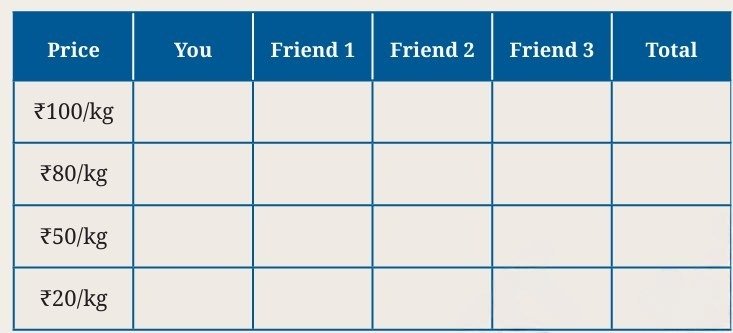
Q12. In the table below, different prices of guava are given.
a. Think and write how much guava you will buy at each price.
b. Ask the same question to three of your friends and fill in the table.
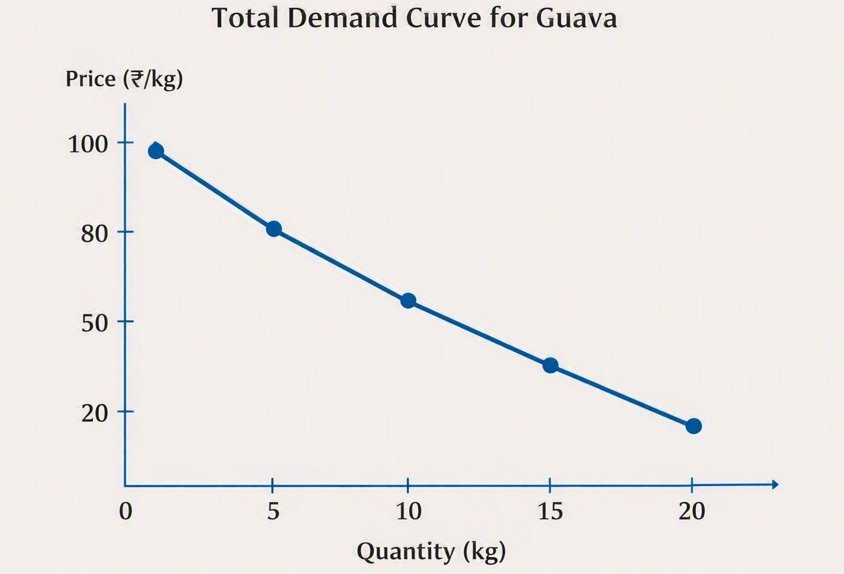
c. Also make a graph for each one of you and one final graph for the total quantity.
Answer:
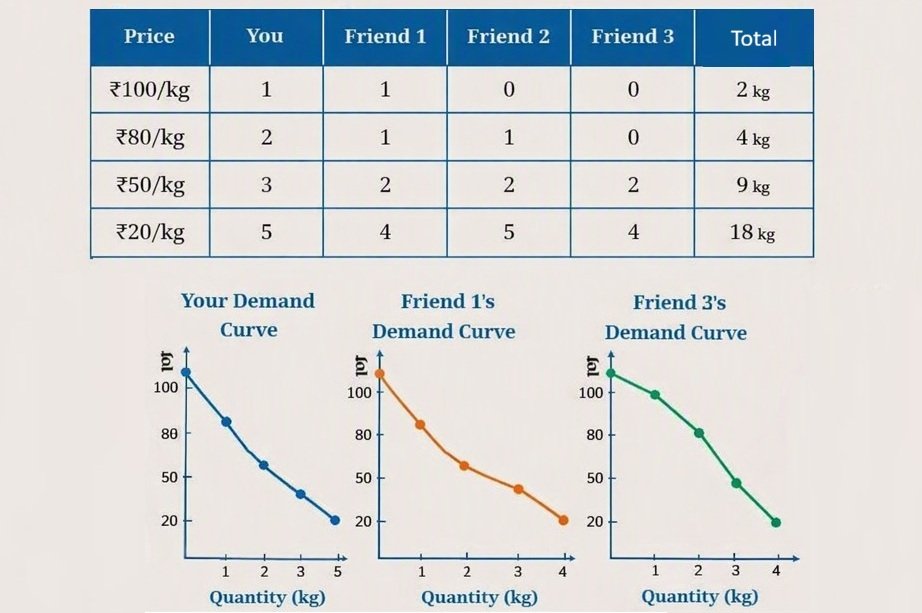
a. My demand for guava
- At ₹100/kg: I buy 1 kg (too costly).
- At ₹80/kg: I buy 2 kg.
- At ₹50/kg: I buy 3 kg.
- At ₹20/kg: I buy 5 kg (very cheap).
b. Friends’ demand (imagined)
Q13. Visit the nearby vegetable market and try to find answers to the following questions.
a. Who decides the prices of different vegetables in the vegetable market?
b. Sometimes the prices of a few vegetables is too high, and sometimes too low. Why is this?
c. The price of tomatoes is high in the morning and eventually gets lower by the evening. Have you ever noticed this? Comment.
Answer:
a. Who decides the prices?
In a vegetable market, prices are decided by sellers based on how much vegetables are available and how many people want to buy them. Sometimes wholesalers fix the rate early in the morning, and retail sellers adjust it depending on demand and freshness.
b. Why are prices sometimes high or low?
Prices change because of demand and supply.
- When supply is less (like after heavy rain or transport problems), prices rise.
- When supply is more (like during harvest season), prices fall.
- So, price depends on how much is available and how much people want to buy.
c. Why tomato price changes during the day?
Yes, tomato prices are often high in the morning and lower in the evening.
In the morning, demand is high because shops and households buy fresh stock. By evening, sellers want to clear leftover tomatoes before they spoil, so they reduce prices.
Q14. Categorise the following combination of goods into substitute goods and complementary goods.
a. Movie ticket in the cinema hall and popcorn
b. Eraser and pencil
c. Laptop and computer
d. Air Conditioner and cooler
e. Notebook and pen
f. Apple and banana
g. Mobile and earphones
Answer:
- Movie ticket & popcorn: Complementary
- Eraser & pencil: Complementary
- Laptop & computer: Substitutes
- Air Conditioner & cooler: Substitutes
- Notebook & pen: Complementary
- Apple & banana: Substitutes
- Mobile & earphones: Complementary
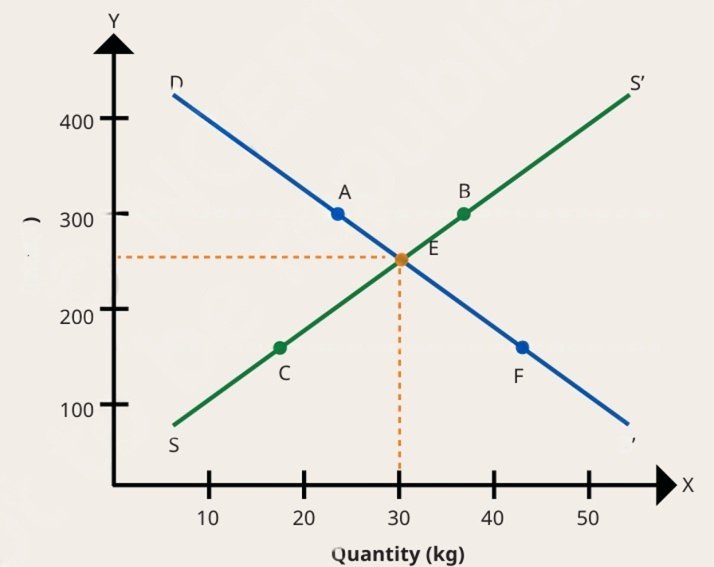
Q15. Fig. 9.8 shows the demand curve DD’ and Supply curve SS’. Based on the figure, answer the following questions:
- a. What does point E represent in this market?
- b. What is the equilibrium price and equilibrium quantity at point E?
- c. Point A lies on DD’. Point B lies on SS’. What do the points A and B indicate about demand and supply? What does the gap between A and B (both on the upper dashed price line) represent?
- d. Point F lies on DD’. Point C lies on SS’. What do the points F and C indicate about demand and supply? What does the gap between C and F (both on the lower dashed price line) represent?
- e. If the price stays at the lower dashed line, what could happen next in a free market?
Answer:
- a. Point E → Market equilibrium.
- b. Equilibrium price = where DD’ and SS’ meet; equilibrium quantity = same point.
- c. Point A (demand) and B (supply) show excess supply; the gap = surplus.
- d. Point F (demand) and C (supply) show excess demand; the gap = shortage.
- e. If price stays low, demand > supply, so shortage occurs and prices rise again.
Q16. Draw a market equilibrium graph using the following demand schedule
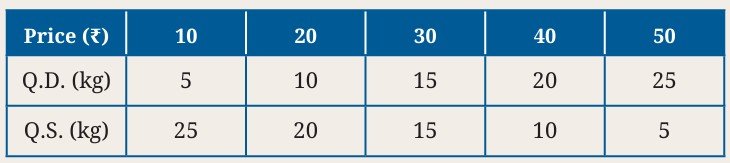
a. Plot the demand and supply curve using the above data.
b. Identify the equilibrium price and quantity.
c. Observe the above data and analyse what happens if the price is set at ₹20 or ₹40.
Answer:
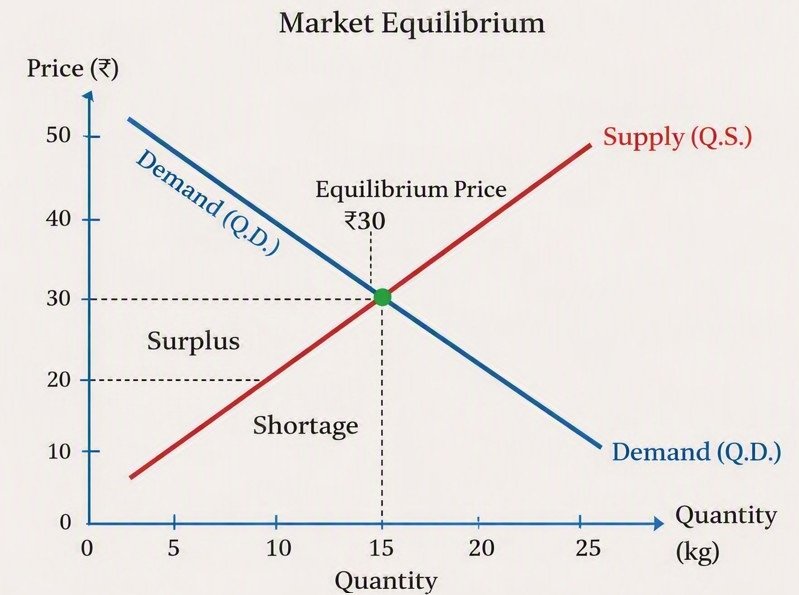
- a. Plot demand and supply curves using given data.
- b. Equilibrium price and quantity = where curves intersect.
- c. At ₹20: excess demand (shortage). At ₹40 -> excess supply (surplus).
Disclaimer: The content that is present on our website is based on the NCERT Class 9 Science textbook and is provided for educational purposes only. All the content and images have been taken from Science Class 9 NCERT Textbook and CBSE Support material. Images and content shown above are the property of individual organizations and are used here for reference purposes only. To make it easy to understand, some of the content and images are generated by AI and cross-checked by the teachers.