
The Role of the Judiciary in Our Society Class 8 Notes explains the importance of the judiciary in India. These notes cover the role of courts, the different levels of courts, the importance of justice, Fundamental Rights, and how the judiciary protects citizens. The chapter is explained in simple and easy language to help Class 8 students understand the concepts quickly and prepare for exams.
The Role of the Judiciary in Our Society Class 8 Notes
Justice means everyone will be treated fairly and equally. The Constitution of India gives promises to all the citizens regarding social justice (fairness in society), economic justice (fairness in money and work), and political justice (fairness in government and rights).
What is the judiciary?
The judiciary is the system of courts in India. Its job is to ensure that the laws are followed and everyone gets justice. It also checks that the government does not misuse its power.
The Connection Between Law and Justice
The law is the set of rules that is made by the government. These rules help the people to understand what is right and what is wrong. Justice means the fair treatment of everyone equally and protecting their dignity.
The government basically makes laws and makes sure that justice is achieved. If someone breaks the laws, then there will be consequences like fines, compensation, or even imprisonment.
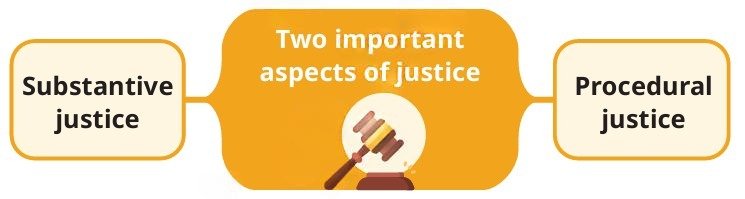
The judicial system helps the people to complain if any injustice happens to them. It gives both sides, the victim and the accused, a chance to present their view and give justice based on the law of the constitution. There are two types of justice—
- Substantive Justice: Substantive justice focuses on the final result or outcome. It asks whether the decision is actually fair, just, and reasonable.
- Procedural Justice: Procedural justice means that every person involved gets a full opportunity to hear before a decision is taken by the court.
As a rule, it is presumed that every person is innocent, till proved guilty.
The Judicial System in India
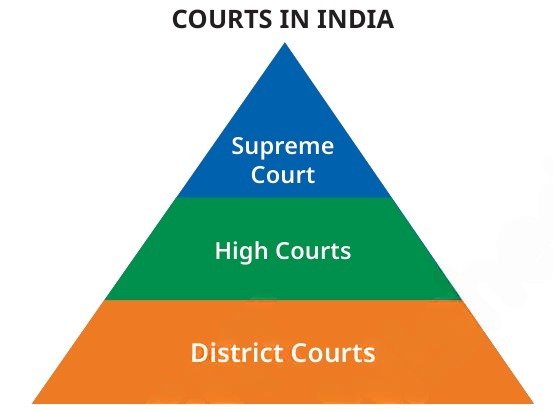
The Indian Judicial system is a unified system, comprising of a hierarchy of courts with the Supreme Court of India at the apex level, the High Courts at the State level and Subordinate Courts at the District level.
The Supreme Court of India
The Supreme Court of India is the highest court in India. The Supreme Court started on 26 January 1950, when the constitution of India came into effect. It is the final interpreter of the Constitution, meaning if there is confusion about what the Constitution says, the Supreme Court gives the final answer.
The location of the Supreme Court is in New Delhi. The head of the court is called the Chief Justice of India. Right now, the total strength is 33 judges + 1 chief justice.
According to Article 124, the judges are appointed by the President of India. The Supreme Court judge should be—
- Citizen of India
- Have been a High Court judge for at least 5 years, OR
- Have been a High Court advocate for at least 10 years, OR
- Be a distinguished jurist (a very respected legal expert), in the opinion of the President.
- A Supreme Court judge retires at the age of 65 years.
1. Writ Jurisdiction of the Supreme Court and High Court
If any fundamental rights are violated, like freedom of speech, freedom of religion, right to life, equality, and liberty. You can directly file the petition to court.
- Directly in the Supreme Court under Article 32.
- Or in the High Court under Article 226.
2. Original Jurisdiction of the Supreme Court
The Supreme Court directly hears disputes between –
- Centre and a State.
- Centre + one State vs another State.
- Between States (like river water disputes).
3. Appellate Jurisdiction of the Supreme Court
The Supreme Court can hear appeals if the cases are already decided by the High Courts. For example,
- If a High Court certifies that the case involves the Constitution or an important question of law.
- Criminal cases involving death sentences.
- Appeals from special tribunals like NGT or NCLAT.
4. Advisory Jurisdiction
If the President of India asks for advice based on the public’s important question of law, then the Supreme Court can give its opinion. Such cases are heard by a Constitution Bench (minimum 5 judges).
5. Special Leave Petitions (Article 136)
The Supreme Court has a special power to allow appeals from any court or tribunal in India. This is used when there is a question of law of public importance or to ensure substantive justice.
According to Article 141, the law declared by the Supreme Court is binding on all courts in India.
High Court
A High Court is the highest court at the State level. Article 214 of the Constitution provides that there shall be a High Court in each State. At present, India has 28 States. There are 25 High Courts, since in some cases, two or more States or Union Territories share a common High Court, as follows:
Each high court has a chief justice and other judges. The number of judges is different in each state. Judges are appointed by the President of India, after consulting—
- The Chief Justice of India,
- The Governor of the State,
- The Chief Justice of that High Court.
To become a High Court judge, a person must:
- Be a citizen of India.
- Have held a judicial office in India, OR
- Have been an advocate of a High Court (or more than one High Court) for at least 10 years.
- A High Court judge retires at the age of 62 years.
Jurisdiction of the High Courts
Each High Court works only within its state or union territory limits. It cannot interfere outside its area. Just like the Supreme Court, High Courts can protect fundamental rights. High courts hear appeals against decisions of:
- Subordinate courts (civil and criminal cases).
- Certain tribunals.
High courts supervise all subordinate courts and tribunals in their state. This ensures lower courts act within their authority and do not misuse power. It is used sparingly—only when necessary. The writ jurisdiction and supervisory jurisdiction of High Courts are considered part of the basic structure of the Constitution. This means they cannot be removed or changed even by Parliament.
Subordinate Courts
Below the High Court there are subordinate courts in each state. This is mentioned in Articles 233 to 237 of the Constitution. This court deals directly with the people. There are different types of subordinate courts—
- District Courts—handle civil and criminal cases at the district level.
- Sessions Courts—deal with serious criminal cases.
- Revenue Courts—handle land and tax-related matters.
- Small Causes Courts—deal with small civil disputes like property rent or minor money claims.
- Tribunals—special bodies set up to settle specific disputes (like company law, environment, etc.).
District judges are appointed by the governor of the state, in consultation with the high court (Article 233). This ensures independence and fairness in the subordinate judiciary. The High Court supervises subordinate courts.
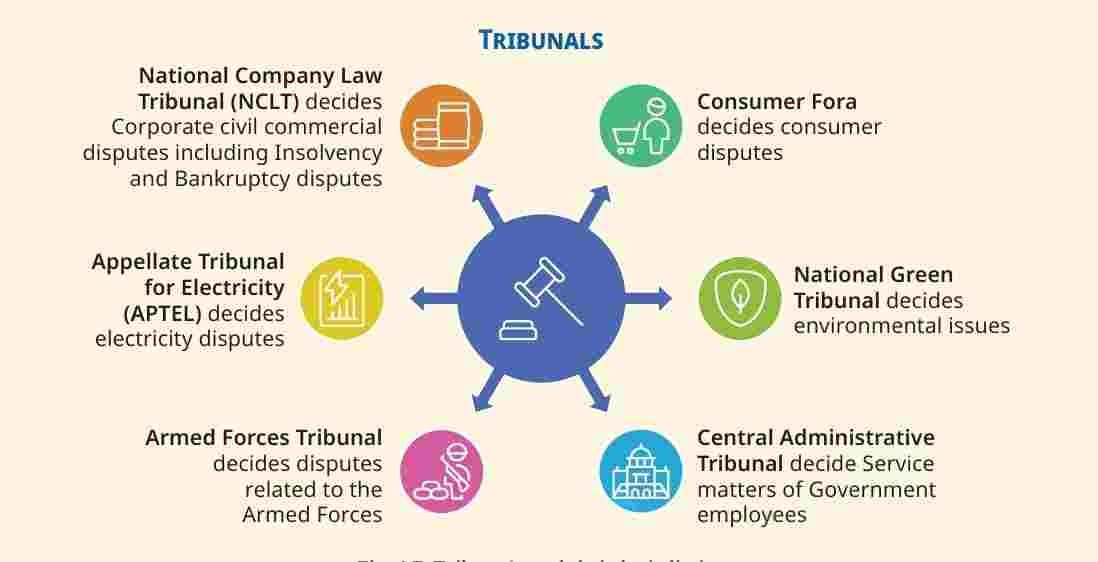
Tribunals
Tribunals are special courts basically created for special disputes. They are quasi-judicial, meaning it is not a full count but similar. For example, company law disputes, environmental cases, and tax matters.
Digital Technology and Judicial System
Technology helps the court be more open and easy to access. People from different backgrounds can now—
- Check case details online.
- Read court orders and judgments in multiple languages.
- This helps everyone understand what is happening in courts.
Alternate Modes of Dispute Resolution
Courts encourage the people to solve disputes outside the regular courts to save time.
Arbitration
- Disputes are given to an arbitrator (retired judge, lawyer, or expert).
- The arbitrator listens to both sides and gives a final decision.
- The decision is binding (must be followed).
- Governed by the Arbitration and Conciliation Act, 1996.
Mediation
- A mediator helps both sides talk and reach a mutual agreement.
- The mediator does not give a decision.
- Governed by the Mediation Act, 2023.
Lok Adalats
- Known as People’s Courts.
- Help settle disputes quickly and peacefully.
- Recognized under the Legal Services Authorities Act, 1987.
- Reduce the backlog of cases in regular courts.
Gram Nyayalayas
- Village-level courts.
- Work in a simple way without technicalities.
- Established under the Gram Nyayalayas Act, 2008.
- Aim: Bring justice closer to rural people.
Disclaimer: The content that is present on our website is based on the NCERT Class 8 Social Science textbook and is provided for educational purposes only. All the content and images have been taken from Socail Science Class 8 NCERT Textbook. Images and content shown above are the property of individual organizations and are used here for reference purposes only. To make it easy to understand, some of the content and images are generated by AI and cross-checked by the teachers.