
Practice Computer Vision Class 10 Extra Questions and Answers to improve your understanding of important concepts related to Computer Vision and Artificial Intelligence. These extra questions cover key topics in a simple and easy-to-understand format, helping Class 10 students revise the chapter and prepare for school and board examinations.
Computer Vision Class 10 Extra Questions and Answers
Q. Analyse how computer vision technology has revolutionised the automotive industry, particularly in autonomous vehicles. What is the primary function it serves?
a. Managing fuel efficiency and engine performance.
b. Controlling audio and entertainment systems.
c. Identifying objects, navigation routes, and environment monitoring for safe autonomous driving.
d. Handling vehicle maintenance scheduling.
Answer: c. Identifying objects, navigation routes, and environment monitoring for safe autonomous driving.
Q. Surveillance systems using computer vision can:
a. Translate spoken languages.
b. Detect suspicious activities and track individuals.
c. Analyse text documents.
d. Process financial transactions.
Answer: b. Detect suspicious activities and track individuals.
Q. In agricultural monitoring using computer vision, drones with cameras are used to:
a. Communicate with farmers.
b. Translate farming manuals.
c. Capture aerial images for crop health assessment.
d. Calculate crop prices.
Answer: c. Capture aerial images for crop health assessment.
Q. In a 1280 x 1024 monitor resolution, what does this specification indicate?
a. The monitor can display 1280 colours with 1024 brightness levels.
b. There are 1280 pixels horizontally and 1024 pixels vertically.
c. The monitor weighs 1280 grams and is 1024 mm wide.
d. The refresh rate is 1280 Hz with 1024 frames per second.
Answer: b. There are 1280 pixels horizontally and 1024 pixels vertically.
Q. Which of the following best describes the relationship between pixels and image resolution?
a. More pixels result in lower image quality.
b. Pixels and resolution are unrelated concepts.
c. Resolution depends only on image file size.
d. The number of pixels in an image is known as resolution.
Answer: d. The number of pixels in an image is known as resolution.
Q. Anita and Surjit are creating an AI application that will classify different types of fruits. The computer vision task that will identify the type of fruit and assign a label to it is called _________ .
a. Segmentation
b. Classification
c. Classification + Localization
d. Object Detection
Answer: b. Classification
Q. Which computer vision task involves both identifying what object is present in an image and determining the precise location of that object within the image?
a. Image Classification
b. Object Detection
c. Instance Segmentation
d. Classification + Localisation
Answer: d. Classification + Localisation
Q. In the context of computer vision vs image processing, which statement correctly differentiates them?
a. Computer vision and image processing are exactly the same.
b. Computer vision enhances the image, while image processing does not.
c. Computer vision is a superset of image processing.
d. Image processing is a superset of computer vision.
Answer: c. Computer vision is a superset of image processing.
Q. The Face Filter feature in Instagram is an application of __________.
a. NLP
b. Computer Vision
c. Data Science
d. Blockchain Technology
Answer: b. Computer Vision
Q. What is the range of possible pixel values in a byte image format?
a. 0 to 100
b. 0 to 255
c. 1 to 256
d. –128 to 127
Answer: b. 0 to 255
Q. Assertion (A) : The less pixels you have, the better the image quality.
Reason (R) : Resolution refers to the number of pixels per unit of area in an image, determining its clarity and detail.
a. Both Assertion (A) and Reason (R) are true and Reason (R) is the correct explanation of Assertion (A).
b. Both Assertion (A) and Reason (R) are true, but Reason (R) is not the correct explanation of Assertion (A).
c. Assertion (A) is true, but Reason (R) is false.
d. Assertion (A) is false, but Reason (R) is true.
Answer: d. Assertion (A) is false, but Reason (R) is true.
Q. State True or False: With respect to computer vision, the classification + localisation task can only be used for single objects.
Answer: True
Q. Assertion (A) : Computer vision enables AI to see, observe and make sense of visual data like images and videos.
Reason (R) : Computer vision works independently without requiring artificial intelligence algorithms.
a. Both (A) and (R) are true, and (R) is the correct explanation of (A).
b. Both (A) and (R) are true, but (R) is not the correct explanation of (A).
c. (A) is true, but (R) is false.
d. (A) is false, but (R) is true
Answer: c. (A) is true, but (R) is false.
Q. How do computers store RGB images?
Answer: RGB images are stored in three channels – Red, Green, and Blue. Each pixel has three values (0–255) for R, G, and B. Together they form the colour of that pixel.
Q. With reference to computer vision, define the following terms:
(a) Pixel
b. Instance Segmentation
Answer:
- (a) Pixel – Smallest unit of an image, arranged in a grid. Each pixel has a value showing brightness or colour.
- (b) Instance Segmentation – Detects objects, gives them a category, and labels each pixel of the object separately.
Q. Name the tasks used in computer vision applications for:
(a) Single objects
(b) Multiple objects
Answer:
- (a) Single objects – Classification + Localisation.
- (b) Multiple objects – Object Detection, Instance Segmentation.
Q. A smart city project wants to implement an integrated AI system. For each of the following requirements, identify the most appropriate AI domain and justify your choice:
- (a) Analysing traffic camera footage to count vehicles and detect traffic violations automatically.
- (b) Processing citizen complaints written in local languages to categorise them as “water supply”, “electricity”, or “waste management” issues.
Answer:
- (a) Traffic camera footage – Computer Vision. It can detect vehicles and violations.
- (b) Citizen complaints in local languages – Natural Language Processing (NLP). It can read and classify text into categories.
Q. Identify the type of deep learning model.
- a) This deep learning model processes input images by learning to assign importance (weights and biases) to various features in the image, allowing it to distinguish one object from another.
- b) This deep learning model is inspired by the structure of the human brain. It can automatically extract features from large datasets without explicit programming. Each node in the network acts like a small machine learning algorithm.
Answer:
- (a) Convolutional Neural Network (CNN) – Works on images, learns features with weights and biases.
- (b) Artificial Neural Network (ANN) – Inspired by the human brain, extracts features from large datasets automatically.
Q. What is a “byte image” format in the context of digital images?
Answer: It stores each pixel as an 8‑bit value (0–255). 0 = black, 255 = white; values in between show brightness/colour.
Q. (A) Expand and define the terms ‘CNN’ and ‘ANN’.
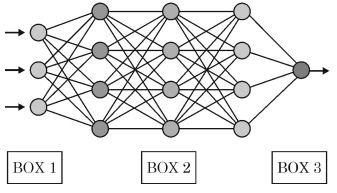
(B) In the diagram of the neural network given below, identify the layer that should be depicted in Box 1 and Box 2:
Answer:
(A) CNN – Convolutional Neural Network. Used for image tasks, extracts features using convolution, pooling, and fully connected layers.
ANN – Artificial Neural Network. General deep learning model inspired by brain neurones.
(B) Box 1 – Convolution Layer (extracts features).
Box 2 – Pooling Layer (reduces size, keeps important features).
Q. Identify the name of the application of Machine Learning (ML) or Deep Learning (DL) being used in the following scenarios.
a) A fitness tracker uses AI to monitor your heart rate and learn what is normal for you. One evening, while you’re relaxing and watching a horror movie, the tracker suddenly flags a spike in your heart rate as an anomaly — thinking something might be wrong.
Answer: Anomaly Detection. It learns normal patterns and flags unusual spikes.
b) A wildlife camera is equipped with AI to monitor animals in a forest. It not only records movement of animals but also identifies and classifies them into categories like “bird”, “mammal”, “insect”, etc.
Answer: Image Classification. It identifies and labels animals into categories.
c) A smart refrigerator is equipped with an internal camera and an AI system. One of its door features a display screen that shows a real-time image of the inside, capturing all the food items on various shelves. For each item, the system not only shows its actual image but also places an AI-generated label on top of it, such as “Milk Carton”, “Apple”, or “Ice Cream”.
Answer: Object Detection. It detects items and places labels like “Milk” or “Apple”.
d) Imagine an app that helps you unlock your bike. Instead of typing a password, you simply scribble a numerical code like “5281” on your phone screen using your finger — even if your handwriting is a bit messy after a tough workout.
Answer: Handwriting Recognition. It reads and interprets messy written digits.
Disclaimer: We have taken an effort to provide you with the accurate handout of “Computer Vision Class 10 Extra Questions and Answers“. If you feel that there is any error or mistake, please contact me at anuraganand2017@gmail.com. The above CBSE study material present on our websites is for education purpose, not our copyrights. All the above content and Screenshot are taken from Artificial Intelligence Class 10 CBSE Textbook, Sample Paper, Old Sample Paper, Board Paper and Support Material which is present in CBSEACADEMIC website, This Textbook and Support Material are legally copyright by Central Board of Secondary Education. We are only providing a medium and helping the students to improve the performances in the examination.
Images and content shown above are the property of individual organizations and are used here for reference purposes only.
For more information, refer to the official CBSE textbooks available at cbseacademic.nic.in