
Practice Evaluating Models Class 10 Extra Questions and Answers to strengthen your understanding of model evaluation in Artificial Intelligence. These extra questions cover important concepts in a simple and easy-to-understand format, helping Class 10 students revise the topic, test their knowledge, and prepare for school and board examinations.
Evaluating Models Class 10 Extra Questions and Answers
Q. Which of the following best describes overfitting in the context of train-test split ?
a. The model performs well on both training and test data.
b. The model performs well on training data but poorly on test data.
c. The model performs poorly on both training and test data.
d. The model performs poorly on training data but well on test data.
Answer: b. The model performs well on training data but poorly on test data.
Q. Statement 1 : Overfitting occurs when a model memorizes the training data rather than learning patterns.
Statement 2 : Using the same data for training and evaluation helps the model give accurate results.
a. Both statements are correct.
b. Both statements are incorrect.
c. Statement 1 is correct but statement 2 is incorrect.
d. Statement 1 is incorrect but statement 2 is correct.
Answer: c. Statement 1 is correct but statement 2 is incorrect.
Q. What is the primary purpose of train-test split in model evaluation ?
a. To increase the size of the dataset.
b. To reduce computational complexity.
c. To estimate the performance of the machine learning model on new data.
d. To improve the accuracy of the training process.
Answer: c. To estimate the performance of the machine learning model on new data.
Q. Recall is a classification metrics that measures :
a. How many False positives are correctly identified by the model.
b. How many actual positive cases were correctly identified by the model.
c. How many negative cases were correctly identified by the model.
d. The overall accuracy of the model.
Answer: b. How many actual positive cases were correctly identified by the model.
Q. A spam e-mail detection system correctly identifies an e-mail as “Not Spam” when it actually is not spam. This represents :
a. True Positive (TP)
b. True Negative (TN)
c. False Positive (FP)
d. False Negative (FN)
Answer: b. True Negative (TN)
Q. This ethical concern refers to an honest explanation how the chosen evaluation metrics work and produce results without keeping any information hidden. Name this ethical concern that should be kept in mind while evaluating an AI model.
a. Bias
b. Transparency
c. Accountability
d. Accuracy
Answer: b. Transparency
Q. In a fire alarm system, if the model predicts “Fire Present” when there is actually no fire, this is classified as :
a. True Positive (TP)
b. True Negative (TN)
c. False Positive (FP)
d. False Neg
Answer: c. False Positive (FP)
Q. In the context of autonomous vehicle safety systems, which type of error would be most critical to minimize ?
a. False Positive (detecting danger when there isn’t any)
b. False Negative (failing to detect actual danger)
c. True Positive (detecting danger correctly)
d. True Negative (correctly identifying that there is no danger)
Answer: b. False Negative (failing to detect actual danger)
Q. Which of the following best describes model evaluation in artificial intelligence ?
a. The process of creating new datasets for training
b. The process of using different evaluation metrics to understand a machine learning model’s performance
c. The process of selecting algorithms for model building
d. The process of data
Answer: b. The process of using different evaluation metrics to understand a machine learning model’s performance
Q. Precision is defined as :
a. The ratio of correctly predicted positive observations to total observations.
b. The ratio of correctly predicted positive observations to total predicted positive observations.
c. The ratio of correctly predicted negative observations to total observations.
d. The harmonic mean of true positives and true negatives.
Answer: b. The ratio of correctly predicted positive observations to total predicted positive observations.
Q. An AI model was tested with 1000 test samples. If True Positive (TP) = 200, True Negative (TN) = 600, False Positive (FP) = 100, False Negative (FN) = 100, how many total predictions were correct ?
a. 300
b. 600
c. 800
d. 900
Answer: c. 800 (TP + TN = 200 + 600 = 800)
Q. _________ is defined as the percentage of correct predictions out of all the observations.
a. Precision
b. Accuracy
c. Recall
d. F1
Answer: b. Accuracy
Q. In a quality control system for manufacturing, which scenario represents a false negative ?
a. When a defective product is correctly identified as defective.
b. When a non-defective product is inaccurately identified as defective.
c. When a non-defective product is correctly identified as non-defective.
d. When a defective product is mistakenly identified as non-defective.
Answer: d. When a defective product is mistakenly identified as non-defective.
Q. Which of the following is not true about Confusion Matrix ?
a. It allows us to understand prediction results.
b. It is a Model Training Matrix.
c. It helps in evaluation of machine learning models.
d. It is used to record comparison between prediction and reality.
Answer: b. It is a Model Training Matrix.
Q. In a medical screening test for a specific disease, which scenario represents a True Negative ?
a. A person without the disease tests positive for the disease.
b. A person with the disease tests positive for the disease.
c. A person with the disease tests negative for the disease.
d. A person without the disease tests negative for the disease.
Answer: d. A person without the disease tests negative for the disease.
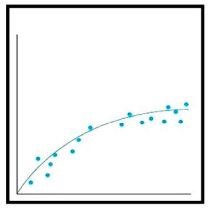
Q. The following diagram indicates :
a. Classification
b. Regression
c. Reinforcement learning
d. Clustering
Answer: b. Regression
Q. In a neural network, what is the function of the input layer ?
a. It performs mathematical operations on the input data.
b. It connects neurons to the output layer for predictions.
c. It receives and passes the raw input data to the hidden layers.
d. It stores weights and biases for neural network training.
Answer: c. It receives and passes the raw input data to the hidden layers.
Q. State True or False : In machine learning, the error is used to see how accurately the model can predict data.
Answer: True
Q. When a model is evaluated on the training data it always predicts correctly. This is known as ___________.
Answer: Overfitting
Q. Define Accuracy. Also give one example to explain why high accuracy does not always mean a model is performing well in real-world situations.
Answer: Accuracy is the percentage of correct predictions out of all predictions made by the model. Example: In medical diagnosis, a model may show 90% accuracy, but if it fails to detect sick patients (false negatives), it is dangerous. So, high accuracy does not always mean good real‑world performance.
Q. Explain Train-test split technique with respect to machine learning algorithm.
Answer: The Train‑test split technique divides data into two parts: training data and testing data. The training data is used to teach the model, and the testing data is used to check how well the model performs on new, unseen data. This helps avoid overfitting.
Q. Give any two characteristics of a Classification Model.
Answer:
- It predicts categorical outputs (like Yes/No, Spam/Not Spam).
- It divides data into predefined classes based on input features.
Q. What is model evaluation in machine learning, and how does it help improve an AI model?
Answer: Model evaluation means checking how well a machine learning model performs using metrics like accuracy, precision, recall, and F1 score. It helps identify strengths and weaknesses of the model and provides feedback to improve accuracy and reliability in real‑world use.
Q. Read the following paragraph and answer the questions that follow:
A school recently tested an AI model designed to predict whether students would pass or fail their final exams. Out of 100 students, the model correctly predicted that
40 students would pass and they actually did. It also correctly identified 30 students who were going to fail. However, the model predicted that 20 students would pass, but they ended up failing. Additionally, it predicted that 10 students would fail, but they actually passed.
a) Draw the confusion matrix based on the above information.
Answer:
Given Data
- Correctly predicted Pass (TP) = 40
- Correctly predicted Fail (TN) = 30
- Predicted Pass but actually Fail (FP) = 20
- Predicted Fail but actually Pass (FN) = 10
Confusion Matrix
| Predicted Pass | Predicted Fail | |
|---|---|---|
| Actual Pass | 40 (TP) | 10 (FN) |
| Actual Fail | 20 (FP) | 30 (TN) |
b) Calculate the accuracy of this classification model. Show your working.
Answer:
Accuracy Calculation
\[ \text{Accuracy} = \frac{TP + TN}{TP + TN + FP + FN} = \frac{40 + 30}{40 + 30 + 20 + 10} = \frac{70}{100} = 0.7 \]Accuracy: 70%
c) Write the total number of wrong predictions made by the model.
Answer: Wrong predictions = FP + FN = 20 + 10 = 30
Q. Read the following paragraph and answer the questions that follow :
PQR Security Solutions has designed an AI Model to detect cyber attacks on E-Commerce websites. For this, various network activities were monitored and analyzed on one of the websites. The model was tested on a dataset of 1500 network activities. Out of these, the model correctly predicted that 1000 were cyber attacks. It also correctly identified that 250 were not cyber attacks. However, the model predicted that 200 were cyber attacks but actually they were not. Additionally, it predicted that 50 were not cyber attacks but they actually were.
a. Draw the confusion matrix based on the given scenario.
Answer:
Confusion Matrix
| Predicted Attack | Predicted Not Attack | |
|---|---|---|
| Actual Attack | 1000 (TP) | 50 (FN) |
| Actual Not Attack | 200 (FP) | 250 (TN) |
b. How many total cases are True Negative in the above scenario ?
Answer: True Negative = 250
c. Calculate Precision.
Answer:
\[ \text{Precision} = \frac{TP}{TP + FP} = \frac{1000}{1000 + 200} = \frac{1000}{1200} = 0.833 \approx 83.3\% \]Precision = 83.3%
Q. Draw the confusion matrix for the following data :
- a. The number of true positive = 200
- b. The number of true negative = 50
- c. The number of false positive = 35
- d. The number of false negative = 55
Answer:
Confusion Matrix
| Predicted Positive | Predicted Negative | |
|---|---|---|
| Actual Positive | 200 (TP) | 55 (FN) |
| Actual Negative | 35 (FP) | 50 (TN) |
Q. An AI model has been developed to predict whether electric vehicle batteries need replacement based on performance data. The model was tested on a dataset of 700 vehicles and the resulting confusion matrix is as follows :
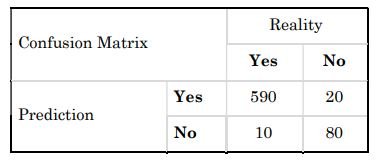
The above Confusion Matrix can also be represented as follows :
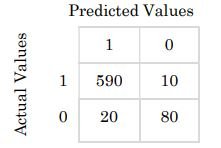
a. How many total cases are False Positives in the above scenario ?
Answer: False Positives = 20
b. Calculate Precision, Recall and Fl
Answer:
\[ \text{Precision} = \frac{TP}{TP + FP} = \frac{590}{590 + 20} = \frac{590}{610} = 0.967 \approx 96.7\% \]\[ \text{Recall} = \frac{TP}{TP + FN} = \frac{590}{590 + 10} = \frac{590}{600} = 0.983 \approx 98.3\% \]\[ F1 = \frac{2 \times \text{Precision} \times \text{Recall}}{\text{Precision} + \text{Recall}} = \frac{2 \times 0.967 \times 0.983}{0.967 + 0.983} = \frac{1.902}{1.950} = 0.975 \approx 97.5\% \]- Precision = 96.7%
- Recall = 98.3%
- F1 Score = 97.5%
Q. A sentiment analysis model was built to classify movie reviews as either ‘Positive’ or ‘Negative’. The model was tested on a dataset of 500 reviews resulting in the following confusion matrix:
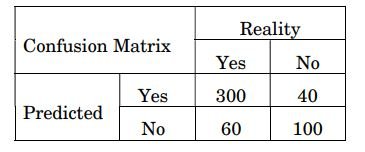
a. How many total cases are True Positive in the above scenario ?
Answer: True Positives = 300
b. Calculate Precision, Recall and F1-Score.
Answer:
\[ \text{Precision} = \frac{TP}{TP + FP} = \frac{300}{300 + 40} = \frac{300}{340} = 0.882 \approx 88.2\% \]\[ \text{Recall} = \frac{TP}{TP + FN} = \frac{300}{300 + 60} = \frac{300}{360} = 0.833 \approx 83.3\% \]\[ F1 = \frac{2 \times \text{Precision} \times \text{Recall}}{\text{Precision} + \text{Recall}} = \frac{2 \times 0.882 \times 0.833}{0.882 + 0.833} = \frac{1.470}{1.715} = 0.857 \approx 85.7\% \]- Precision = 88.2%
- Recall = 83.3%
- F1 Score = 85.7%
Disclaimer: We have taken an effort to provide you with the accurate handout of “Evaluating Models Class 10 Extra Questions and Answers“. If you feel that there is any error or mistake, please contact me at anuraganand2017@gmail.com. The above CBSE study material present on our websites is for education purpose, not our copyrights. All the above content and Screenshot are taken from Artificial Intelligence Class 10 CBSE Textbook, Sample Paper, Old Sample Paper, Board Paper and Support Material which is present in CBSEACADEMIC website, This Textbook and Support Material are legally copyright by Central Board of Secondary Education. We are only providing a medium and helping the students to improve the performances in the examination.
Images and content shown above are the property of individual organizations and are used here for reference purposes only.
For more information, refer to the official CBSE textbooks available at cbseacademic.nic.in