
← Back to Class 9 Social Science MCQs
Preparing for your exam is easier with these Democracy Class 9 MCQs. These multiple-choice questions are based on the latest CBSE Class 9 Social Science syllabus and cover all the important topics from the chapter.
Democracy Class 9 MCQ
Conceptual Recall MCQs
Q1. India’s democracy is the largest in the world because:
a) It has the longest constitution.
b) It has the largest voter base.
c) It was the first democracy in Asia.
d) It has no challenges.
Answer: b) It has the largest voter base.
Q2. The Constitution of India came into force on:
a) 15 August 1947
b) 26 November 1949
c) 26 January 1950
d) 2 October 1947
Answer: c) 26 January 1950
Q3. Popular sovereignty means __________.
a) Power lies with the king.
b) Power lies with the people.
c) Power lies with the judiciary.
d) Power lies with the army.
Answer: b) Power lies with the people.
Q4. The Universal Adult Franchise in India allows ___________.
a) All citizens above 21 years old to vote
b) All citizens above 18 years old to vote
c) Only men to vote
d) Only educated citizens vote
Answer: b) All citizens above 18 years old to vote
Q5. The Right to Information Act was passed in ___________.
a) 1951
b) 2005
c) 1947
d) 2009
Answer: b) 2005
Q6. In a multiparty system, the group that secures more than 50% of seats forms the following:
a) Opposition
b) Judiciary
c) Government
d) Civil society
Answer: c) Government
Q7. Direct democracy is difficult to follow in large countries because:
a) Citizens cannot read laws.
b) Citizens directly participate in decision-making.
c) Elections are not held.
d) Only one party exists.
Answer: b) Citizens directly participate in decision-making
Q8. In representative democracy, people:
a) Directly govern themselves
b) Elect representatives to govern on their behalf.
c) Do not participate in elections.
d) Elect only the judiciary
Answer: b) Elect representatives to govern on their behalf.
Q9. In 2024, India had over how many registered voters?
a) 68 crore
b) 96.8 crore
c) 120 crore
d) 25 lakh
Answer: b) 96.8 crore
Q10. Elections in India are conducted in how many scheduled languages?
a) 10
b) 15
c) 22
d) 28
Answer: c) 22
Q11. One of the major challenges to democracy in recent times is the following:
a) High literacy rates
b) Spread of fake news
c) Strong civic responsibility
d) Equal participation
Answer: b) Spread of fake news
Q12. The Emergency of 1975–77 was imposed on the grounds of the following:
a) External war
b) Internal disturbance
c) Financial crisis
d) Judicial review
Answer: b) Internal disturbance
Application-Based MCQs
Q13. If a citizen feels discriminated against on the basis of caste, which part of the Constitution protects them?
a) Directive Principles
b) Fundamental Rights
c) Preamble
d) Article 368
Answer: b) Fundamental Rights
Q14. A student group in a village decides to elect their leader by voting. This practice reflects the following:
a) Dictatorship
b) Democratic tradition
c) Colonial rule
d) Monarchy
Answer: b) Democratic tradition
Q15. A minister tries to avoid punishment by using personal influence. Which principle of democracy prevents this misuse of power?
a) Separation of Powers
b) Fundamental Rights
c) Rule of Law
d) Popular Sovereignty
Answer: c) Rule of Law
Q16. A child aged 10 is denied free schooling. Which constitutional provision is violated?
a) Article 19
b) Article 21A
c) Article 32
d) Article 25
Answer: b) Article 21A
Q17. A citizen files a request to know how government funds were used for a school project. Which law allows this?
a) Representation of the People Act, 1951
b) Right to Information Act, 2005
c) Article 46
d) Article 21A
Answer: b) Right to Information Act, 2005
Q18. If Scheduled Tribes are given special care for education and economic upliftment, which constitutional article is being followed?
a) Article 21
b) Article 46
c) Article 32
d) Article 19
Answer: b) Article 46
Q19. If students elect class representatives who then choose the School Council President, this system is closest to
a) Direct Democracy
b) Representative Democracy
c) Presidential Democracy
d) Dictatorship
Answer: b) Representative Democracy
Q20. In the United States, the president is elected directly by the people and is independent of the legislature. This reflects:
a) Parliamentary Democracy
b) Presidential Democracy
c) Direct Democracy
d) Constitutional Monarchy
Answer: b) Presidential Democracy
Q21. A polling station is set up in a forest for just one voter. This reflects which feature of Indian democracy?
a) Rule of Law
b) Inclusiveness and accessibility
c) Separation of Powers
d) Fundamental Duties
Answer: b) Inclusiveness and accessibility
Q22. If a Gram Sabha in a tribal area makes decisions for its community, which law empowers it?
a) RTI Act, 2005
b) PESA Act, 1996
c) Representation of the People Act, 1951
d) Article 243(t)
Answer: b) PESA Act, 1996
Q23. If a student damages public property, which democratic value is being weakened?
a) Civic responsibility
b) Fundamental Rights
c) Separation of Powers
d) Popular Sovereignty
Answer: a) Civic responsibility
Q24. A citizen joins the National Service Scheme (NSS) to serve the community. This reflects:
a) Judicial accountability
b) Civic responsibility and participation
c) Rule of Law
d) Fundamental duties only
Answer: b) Civic responsibility and participation
Assertion–Reason MCQs
Q25. Assertion (A): The Constitution of India is called a dynamic document.
Reason (R): Because it can be amended under Article 368 to meet changing needs.
a) Both A and R are true, and R is the correct explanation of A.
b) Both A and R are true, but R is not the correct explanation of A.
c) A is true, R is false.
d) A is false, R is true.
Answer: a) Both A and R are true, and R is the correct explanation of A.
Q26. Assertion (A): Fundamental rights are enforceable in courts of law.
Reason (R): Because they are indivisible and inalienable, subject to reasonable restrictions.
a) Both A and R are true, and R is the correct explanation of A.
b) Both A and R are true, but R is not the correct explanation of A.
c) A is true, R is false.
d) A is false, R is true.
Answer: a) Both A and R are true, and R is the correct explanation of A.
Q27. Assertion (A): The media is called the fourth pillar of democracy.
Reason (R): Because it informs citizens, raises issues, and safeguards democratic values.
a) Both A and R are true, and R is the correct explanation of A.
b) Both A and R are true, but R is not the correct explanation of A.
c) A is true, R is false.
d) A is false, R is true.
Answer: a) Both A and R are true, and R is the correct explanation of A.
Q28. Assertion (A): In parliamentary democracy, the executive is accountable to the legislature.
Reason (R): Because members of the executive are also part of the legislature.
a) Both A and R are true, and R is the correct explanation of A.
b) Both A and R are true, but R is not the correct explanation of A.
c) A is true, R is false.
d) A is false, R is true.
Answer: a) Both A and R are true, and R is the correct explanation of A.
Q29. Assertion (A): Women in India got voting rights in 1950 without prolonged protests.
Reason (R): Because the Constitution of India granted universal adult franchise to all citizens equally.
a) Both A and R are true, and R is the correct explanation of A.
b) Both A and R are true, but R is not the correct explanation of A.
c) A is true, R is false.
d) A is false, R is true.
Answer: a) Both A and R are true, and R is the correct explanation of A.
Q30. Assertion (A): During the Emergency (1975–77), fundamental rights were suspended.
Reason (R): Because the government wanted to restrict citizens’ freedom and control protests.
a) Both A and R are true, and R is the correct explanation of A.
b) Both A and R are true, but R is not the correct explanation of A.
c) A is true, R is false.
d) A is false, R is true.
Answer: a) Both A and R are true, and R is the correct explanation of A.
Case-Based MCQ
Q31. Case Study: A village community gathers in an assembly to discuss water-sharing. Every member gives suggestions, and finally, they reach a common decision through consensus.
Which ancient Indian tradition does this reflect?
a) Colonial councils
b) Sabha and Samiti
c) British Parliament
d) Directive Principles
Answer: b) Sabha and Samiti
Q32. Case Study: A law is passed by Parliament that restricts freedom of speech beyond reasonable limits. Citizens file a petition in the Supreme Court. The Court reviews the law and declares it unconstitutional.
Which principle of democracy is best reflected here?
a) Fundamental Duties
b) Separation of Powers
c) Rule of Law
d) Popular Sovereignty
Answer: b) Separation of Powers
Q33. Case Study: During Question Hour in Parliament, members ask the government about misuse of funds in a welfare scheme. The government must answer and clarify.
Which democratic principle is best reflected here?
a) Fundamental Rights
b) Accountability and Transparency
c) Separation of Powers
d) Rule of Law
Answer: b) Accountability and Transparency
Q34. Case Study: Team A gathers all students to vote directly on decisions like the canteen menu. The president has limited powers.
Which type of democracy does this reflect?
a) Representative Democracy
b) Direct Democracy
c) Presidential Democracy
d) Parliamentary Democracy
Answer: b) Direct Democracy
Q35. Case Study: The Jethipura Gram Panchayat in Gujarat organized special Gram Sabhas and Mahila Sabhas and ensured participation of Scheduled Castes, Scheduled Tribes, and women.
Which democratic principle is best reflected here?
a) Concentration of power
b) Inclusive participation
c) Judicial review
d) Presidential democracy
Answer: b) Inclusive participation
Q36. Case Study: A student shares a false message on social media about a community issue. Many classmates believe it and start arguing.
Which democratic challenge does this situation reflect?
a) Rule of Law
b) Spread of misinformation
c) Separation of Powers
d) Civic responsibility
Answer: b) Spread of misinformation
Diagram-Based MCQ
Q37. Refer to Figure, (Dr. B.R. Ambedkar). Identify his role in the making of the Constitution:
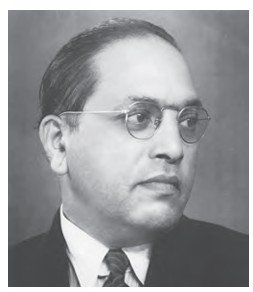
a) First President of India
b) Chairman of the Drafting Committee
c) Leader of the Constituent Assembly
d) Governor-General of India
Answer: b) Chairman of the Drafting Committee
Q38. Refer to the diagram showing three organs of government (legislature, executive, and judiciary).
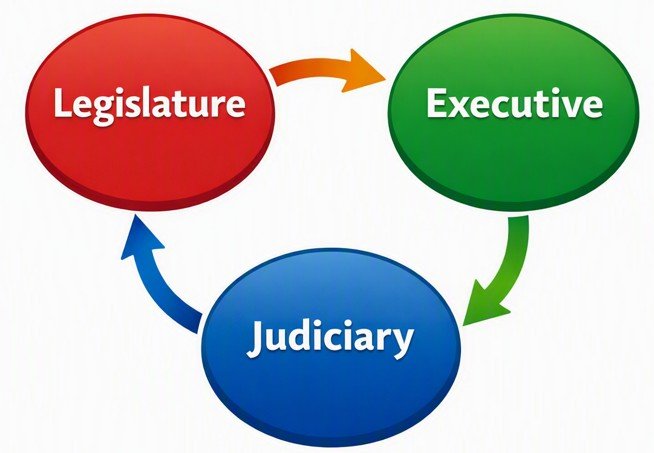
Match each organ with its correct function:
Legislature → (i) Implements laws
Executive → (ii) Makes laws
Judiciary → (iii) Interprets laws.
a) Legislature–(ii), Executive–(i), Judiciary–(iii)
b) Legislature—(i), Executive—(ii), Judiciary—(iii)
c) Legislature–(iii), Executive–(ii), Judiciary–(i)
d) Legislature–(ii), Executive–(iii), Judiciary–(i)
Answer: a) Legislature–(ii), Executive–(i), Judiciary–(iii)
Q39. Refer to the table of democratic processes and institutions.
Match the process with the correct institution:
| Legislative Process | (i) Parliament |
| Electoral Process | (ii) Election Commission |
| Judicial Process | (iii) Courts |
a) Legislative–(i), Electoral–(ii), Judicial–( iii)
b) Legislative–(ii), Electoral–(i), Judicial–( iii)
c) Legislative–(iii), Electoral–(ii), Judicial–( i)
d) Legislative–(i), Electoral–(iii), Judicial–( ii)
Answer: a) Legislative–(i), Electoral–(ii), Judicial–( iii)
Q40. Refer to Figure, (Types of Democracy).
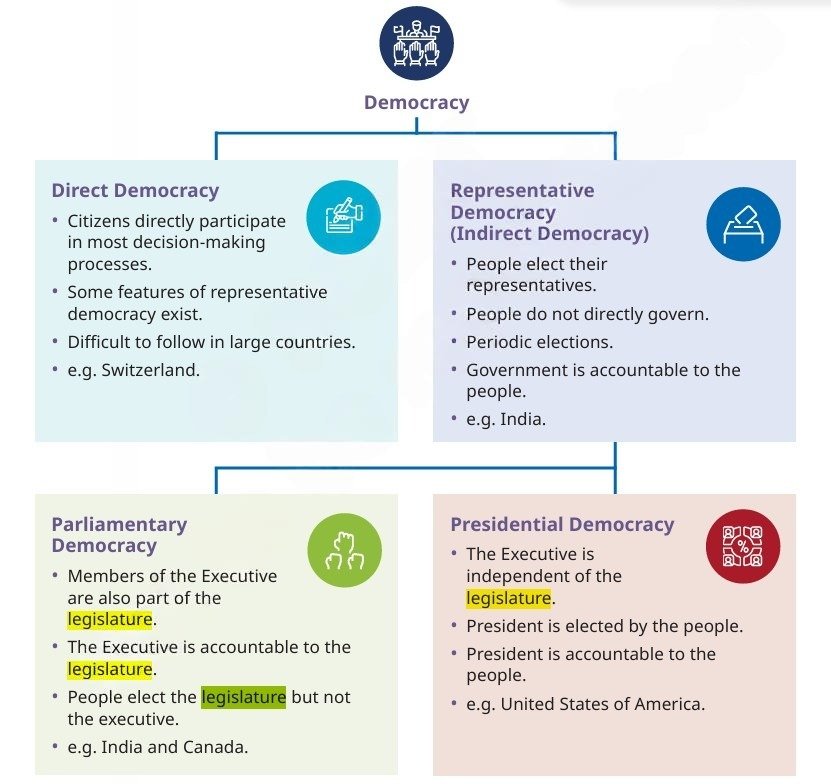
Match the country with its type of democracy:
India → (i) Parliamentary Democracy
Switzerland → (ii) Direct Democracy
USA → (iii) Presidential Democracy
a) India–(i), Switzerland–(ii), USA–(iii)
b) India–(ii), Switzerland–(iii), USA–(i)
c) India–(iii), Switzerland–(i), USA–(ii)
d) India–(i), Switzerland–(iii), USA–(ii)
Answer: a) India–(i), Switzerland–(ii), USA–(iii)
Q41. Refer to Figure, (Gram Panchayat meeting).
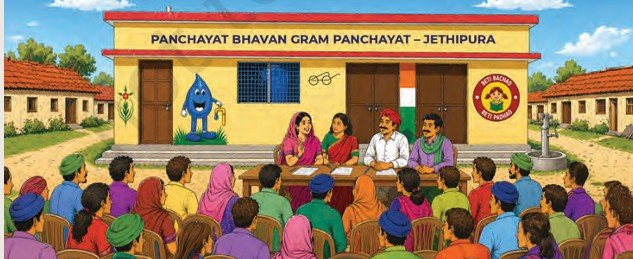
What does the presence of quorum in Gram Sabhas ensure?
a) Decisions are valid and representative.
b) Only leaders can decide.
c) Women cannot participate.
d) Records are not maintained.
Answer: a) Decisions are valid and representative.
Q42. Refer to Figure, (Youth and Democracy).
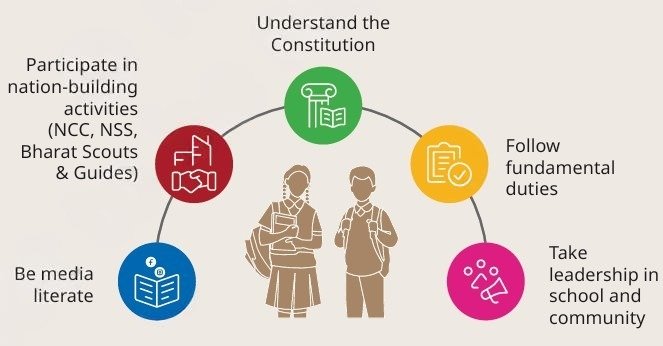
Which of the following activities helps strengthen democracy?
a) Ignoring civic duties
b) Following Fundamental Duties
c) Damaging public property
d) Spreading fake news
Answer: b) Following Fundamental Duties
Disclaimer: The content that is present on our website is based on the NCERT Class 9 Social Science textbook and is provided for educational purposes only. All the content and images have been taken from Social Science Class 9 NCERT Textbook and CBSE Support material. Images and content shown above are the property of individual organizations and are used here for reference purposes only. To make it easy to understand, some of the content and images are generated by AI and cross-checked by the teachers.
Very good question my all doubts are clear thank you for this test
This is the best!!!!!!!!!! 😊