
Get Pressure, Winds, Storms and Cyclones Class 8 Notes with easy explanations, short summaries, key points, important definitions, diagrams, and exam questions. These notes are perfect for quick revision and better exam preparation.
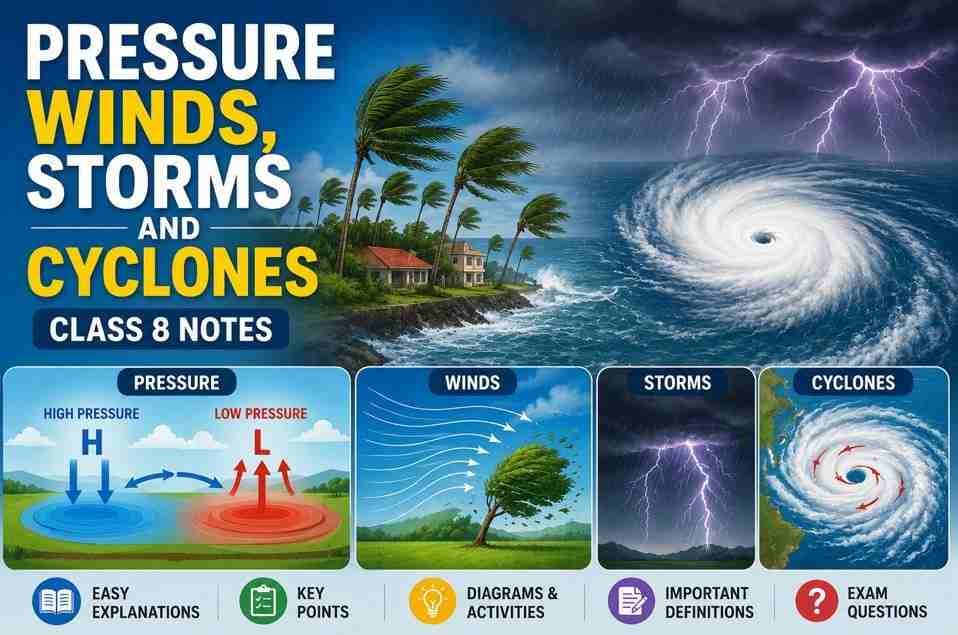
Pressure Winds Storms and Cyclones Class 8 Notes
Pressure
Megha and her brother Pawan went for a picnic. Both carry the bags of the same weight. Pawan’s bag has narrow straps, while Megha’s bag has broad straps.
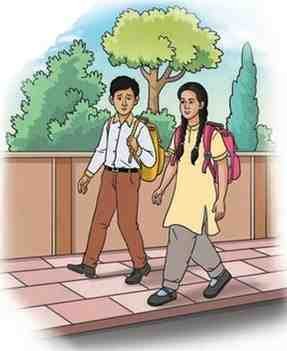
- Megha feels comfortable.
- Pawan feels pain in the shoulders.
Why does Pawan feel pain?
Pawan feels pain because narrow straps press the same weight on a smaller area, giving more pressure on his shoulders. Megha’s broad straps spread the weight, so she feels comfortable.
Rule to remember
- More area -> Less pressure.
- Less area -> More pressure.
- Example 1: A bucket with a broad handle is easy to carry than one with a thin handle.
- Example 2: People basically place a folded cloth on their heads before carrying heavy loads.
What is Pressure?
When a force acts on a surface, it produces pressure.
Definition: Pressure is the force acting on a unit area of a surface.
formula,
- Force is measured in Newton (N).
- Area is measured in square metre (m²).
SI Unit of Pressure
Since,
- Force = Newton (N)
- Area = metre² (m²)
The SI unit of pressure is: Newton per square metre (N/m²) and this unit is called the Pascal (Pa).
1 Pascal (Pa) = 1 N/m²
Question: If a force of 100 N is applied on a cardboard of area 2 m², then the pressure applied on the cardboard will be:
Pressure = 50 𝑁/𝑚²
When the area is small, the pressure is high. The high pressure makes the task easy, like cutting an apple with the sharp edge of a knife. When the area is large, then the pressure is low and tasks become difficult, like using the blunt edge of a knife.
Why Overhead Water Tanks Are Placed High
Water pressure depends on the height of the water tank. If the water tank height is more, then the pressure at the taps will also be more. That’s why tanks are always kept on rooftops or at a height.
Activity: Let us try and find out

- Step 1: Take two transparent pipes of the same length but different diameters.
- Step 2: Tie a rubber balloon tightly to one end of each pipe.
- Step 3: Fix both pipes vertically on a stand.
- Step 4: Fill both pipes with water up to the same height.
- Step 5: Observe what happens to the balloons.
You can notice that both balloons have an equal bulge, even though the diameter of the pipe is different. When you fill it with more water, then the height of the water column increases. Water pushes down because of its height, not because there is more water.
Why is the water tank kept on the roof?
Because the tank is high above the taps and the water falls from a greater height. So the water pushes harder. That is why water comes out of the tap with good force.
Activity: Let us find out.
To show that water pushes not only downward but also on the sides of a container.

- Step 1: Take a plastic bottle and remove its cap.
- Step 2: Make four small holes near the bottom at the same height.
- Step 3: Seal the hole with taps and fill the bottle with water.
- Step 4: Remove all the taps at the same time.
Observation: You will see water comes out from all the holes on the sides of the bottle. Water inside the bottle pushes against the sides of the bottle. This experiment shows that water pushes not only downward but also sideways.
Pressure Exerted by Air
Air is all around the earth. The envelope of air surrounding the Earth is called the atmosphere. It contains gases like nitrogen, oxygen, carbon dioxide, etc. Although we cannot see air, it has weight and exerts (applies) pressure on everything around us. This pressure is called atmospheric pressure.
Activity: Let us explore
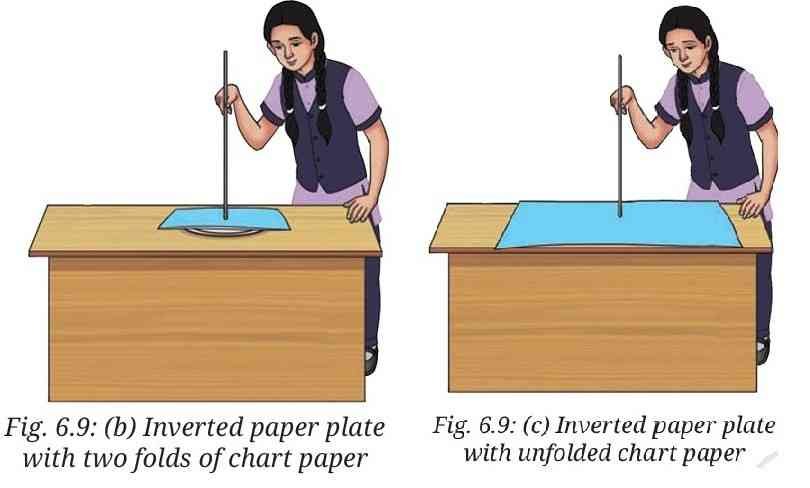
- Step 1: Place an inverted paper plate with a stick attached.
- Step 2: Cover it with folded chart paper in a small area and try to lift it; you will find less effort.
- Step 3: Cover it with unfolded chart paper in a large area and try to lift it; you will find more effort.
The weight of the chart paper is the same in both cases, but when the area is larger, then the air presses on a bigger surface. If the surface is bigger, then the force of air will also be bigger. So that way it is harder to lift the paper. This proves that the air exerts pressure on objects.
Balloon Example

When you blow air into a balloon, it expands in all directions. Because the air inside the balloon pushes on the walls equally, the balloon becomes round.
Activity: Let us perform

When you press the rubber sucker firmly on a smooth surface, then most of the air inside the cup is pushed out. Now the air pressure inside the sucker is very low. The air outside the sucker is still strong. Because of the outside pressure you have to apply a strong force to overcome this pressure.
How Large is Atmospheric Pressure?
The air above us forms a huge column that presses down. For example, the force of air on an area of 15 cm × 15 cm is about the same as the weight of a 225 kg object (2250 N).
Why Our Bodies Don’t Get Crushed
Our body also has fluids and gases inside. The internal pressure balances the external atmospheric pressure. Because of this balance, we don’t feel crushed under the huge weight of air.
Formation of Wind
You must have noticed that on some days, the wind blows strongly, whereas on other days, it is calm. Sometimes, wind becomes so strong that it causes damage to life and property.
You must have seen that when an inflated balloon is kept without closing its mouth, the air from the balloon escapes. Recall that when there is a puncture in the bicycle tube, the air escapes and the tube collapses. In both of these cases, does air move from a high-pressure region to a low-pressure region?
Activity: Let us observe

- Step 1: Take two balloons.
- Step 2: Take one straw.
- Step 3: Put a straw in the first balloon.
- Step 4: Blow air in the second balloon.
- Step 5: Put a straw in the second balloon.
Observe what happens to both the balloons. Air will move from the full balloon (high pressure) to the empty balloon (low pressure). Air keeps moving until both balloons have equal pressure. When pressures are equal, air stops flowing.
- Sea breeze: In nature, the same thing happens. During the day, land gets hot quickly, so pressure is low there. Air from the sea, where pressure is high, moves toward the land. This is called a sea breeze.
- Land breeze: At night, the land cools faster, so pressure is low over the sea. Air from the land, where pressure is high, moves toward the sea. This is called a land breeze.
High-Speed Winds Result in Lowering of Air Pressure
Activity: Let us observe

- Step 1: Take two balloons of the same size.
- Step 2: Inflate both balloons and tie strings to them.
- Step 3: Hang the two balloons from a stick, leaving a gap of 6–10 cm.
- Step 4: Now, blow air into the narrow space between the balloons.
Observation: When you blow air between the balloons, a low-pressure area is created between them. The higher air pressure surrounding the balloon pushes them towards each other.
The same thing happens with houses in storms. Strong winds make low pressure above the roof. The higher pressure inside the house can push the roof up and blow it away if it is weak.
Keeping doors and windows open lets the wind move through the house. This reduces the pressure difference and helps keep the roof safe.
Storms, Thunderstorms, and Lightning
During the day, when the land becomes hot, then the air also becomes hot. The hot air is lighter and goes upward. When the hot air rises, then it leaves an empty space near the ground. This creates a low-pressure area. This empty space is filled by the cool air quickly. This cycle keeps going and the wind keeps moving.
When the rising air goes higher, it cools down. The moisture in the air turns into small drops of water. These drops join together to make clouds. When the clouds become heavy, they fall as rain or snow. Strong winds with rain are called a storm.
Sometimes, the air rises very high and water drops turn into ice. Strong winds move up and down; due to that, the water and ice rub together. This rubbing creates electric charges inside the cloud. The light ice particles go up and become positive. Heavy water drops stay low and become negative, and when the bottom of the cloud is close to the ground, then we see a bright flash called lightning.
Lightning heats the air quickly, and the air expands. This expansion makes a loud sound called thunder. A storm with lightning and thunder is called a thunderstorm.
Lightning can be dangerous! It can ignite fires, damage buildings, and cause severe burns or death in humans and animals. We must take necessary precautions and protect ourselves from lightning. During lightning,
- Stay away from tall objects.
- Find a low-lying open area and crouch down.
- Minimise contact with the ground.
- Do not lie down flat.
- Avoid using an umbrella with a metallic rod.
- If you are in water, get out of it.
If you are inside a bus or a car, you are comparatively safer.
Cyclone

A cyclone is a big spinning storm that forms over warm ocean water. Hot air rises, moist air rushes in, and the whole system starts to spin because of Earth’s rotation.
The center is called the eye. It is calm, but around it there are very strong winds and heavy rain.
When a cyclone reaches land, it becomes weaker, but before that it can cause floods, damage houses, block roads, and cut electricity.
To stay safe, listen to alerts from the India Meteorological Department, keep an emergency kit ready, and move to a safe shelter.
Disclaimer: The content that is present on our website is based on the NCERT Class 8 Science textbook and is provided for educational purposes only. All the content and images have been taken from Science Class 8 NCERT Textbook. Images and content shown above are the property of individual organizations and are used here for reference purposes only. To make it easy to understand, some of the content and images are generated by AI and cross-checked by the teachers.